BuffandGrind

4.5K posts

BuffandGrind banner
BuffandGrind

BuffandGrind

@BuffandGrind

The MMO conversion therapy didn't take... also history should make you uncomfortable! How we understand money and monetize the Internet matters for society.

Online Katılım Nisan 2009
1.4K Takip Edilen191 Takipçiler
BuffandGrind retweetledi

Pulp Librarian
Pulp Librarian@PulpLibrarian·
Of course you want to hear a Prog Rock version of J.S. Bach's Toccata and Fugue in D minor! Sky: Toccata (1980)
English
19
40
251
14.4K
BuffandGrind
BuffandGrind@BuffandGrind·
@TheMG3D There is an AI bubble & AI is the next big thing & its fine b/c just like the internet bubble things have to be tried, nobody knows what is going to work exactly. The pop is going to be all the bad or even plausible, interesting but not workable ideas failing in the market.
English
0
0
0
413
Michael
Michael@TheMG3D·
When do you think the AI bubble will finally pop?
English
228
18
379
883.1K
BuffandGrind retweetledi
Aaron Levie
Aaron Levie@levie·
As agents become the biggest users of software, then all software has to be available in a headless fashion. Agents won’t be using your UI, they’ll be talking to your APIs. So the question becomes what is the business model of software and this headless approach in the future? Here are a few thoughts on how everything plays out based on what we’re seeing and doing at Box, but also conversation with other platforms. 1) Seats don’t go away for *people*. Seats are still a convenient and efficient way to have a customer use technology predictably for a set of users within a baseline set of usage. The key, though, is that when the customer pays for a seat, it has to come with a set of usage of APIs on behalf of that user that the agent can use on their behalf. The user will need to be able to interact with their data and the underlying tool via any agent they work with, and an embedded amount of usage will come with the seat. I would imagine most software -Box included- will enable seats to work with their data at a relatively high volume via systems like ChatGPT, Codex, Claude, Gemini, Cursor, Copilot, Perplexity, Factory, Cogniton, et al. quite seamlessly. If you don’t do this, you’re DOA. 2) Agents may have “seats” if they are doing stateful work in the system, but they will be priced very differently than people. Seats (or the equivalent) can make sense when you have an agent that has its own workspace, stores its own data, needs a different set of permissions compared to the user, and so on. If a company wants this agent to be around for long period of time, that may very well look like another “user” in the system. Openclaw-style agents highlight what this future could look like. The only issue on pricing here is that one customer could decide to do all their work in 1 agent, and another might split it into 1,000 agents. So pricing like a human seat is nearly impossible and impractical; each company will have a different approach for this as it gets tricky perfectly trying to capture all the value within an agent seat. 3) The dominant pricing for headless use that goes above the seat allotment, or when an agent is firmly acting on their own, will be a consumption model. Many enterprises software platforms have previously operated like this with PaaS options, and agents will look like another machine user of their system. In some cases the APIs might get priced just as they did previously, but in other cases there may need to be new types of APIs that represent the work an agent would do in one go -more akin to an outcome- instead of a series of API calls. This is especially germane when the headless software also has an agentic use-case embedded within in, such as orchestrating the process within their own system via AI. Overall the growth of this usage pattern is effectively unbounded as the use-cases for agents operating on data in these systems will dramatically exceed what people do with their data and tools today. Every platform that goes headless (which will be anyone that wants to take advantage of agents) will need to adopt a model like this. Some may fight it initially but it’s an inevitably as there will always be more and more agents outside your platform than people. Overall, there’s a lot of really interesting changes left to come in software due to headless use of these systems. Early days.
English
114
93
945
144.4K
BuffandGrind retweetledi
Saganism
Saganism@Saganismm·
“What can be asserted without evidence can also be dismissed without evidence.” — Christopher Hitchens
Saganism tweet media
English
54
290
1.2K
24K
BuffandGrind
BuffandGrind@BuffandGrind·
@JeffBooth this issue is not fiat currency its a corrupt demented octogenarian political class that is living in the mid 20th century not the 21st century. I agree tech is deflationary but that is not a reason to relinquish an aspect of national power by abdicating currency control.
English
0
0
0
41
Jeff Booth ⚡️
Jeff Booth ⚡️@JeffBooth·
@BuffandGrind Thanks for the thought-provoking comment! I see it differently. A fixed supply like Bitcoin's promotes trust & stability, encouraging saving & investment. Deflation from tech is a feature, not a bug. Bitcoin enables a more efficient economy, not rigidity. Curious for more?
English
1
0
1
148
Jeff Booth ⚡️
Jeff Booth ⚡️@JeffBooth·
In a world drowning in infinite money printing, Bitcoin's fixed supply is the lifeboat. It's the breakthrough that restores trust and value, anchored in scarcity amidst endless fiat dilution. Choose sound money over fleeting promises. 🌊🟧 #Bitcoin #SoundMoney
English
34
63
511
22.3K
BuffandGrind retweetledi
Uncle Bob Martin
Uncle Bob Martin@unclebobmartin·
Morning Bathrobe Rant: AI out-codes you; deal with it.
English
248
481
4.9K
656.2K
BuffandGrind retweetledi
Andrej Karpathy
Andrej Karpathy@karpathy·
LLM Knowledge Bases Something I'm finding very useful recently: using LLMs to build personal knowledge bases for various topics of research interest. In this way, a large fraction of my recent token throughput is going less into manipulating code, and more into manipulating knowledge (stored as markdown and images). The latest LLMs are quite good at it. So: Data ingest: I index source documents (articles, papers, repos, datasets, images, etc.) into a raw/ directory, then I use an LLM to incrementally "compile" a wiki, which is just a collection of .md files in a directory structure. The wiki includes summaries of all the data in raw/, backlinks, and then it categorizes data into concepts, writes articles for them, and links them all. To convert web articles into .md files I like to use the Obsidian Web Clipper extension, and then I also use a hotkey to download all the related images to local so that my LLM can easily reference them. IDE: I use Obsidian as the IDE "frontend" where I can view the raw data, the the compiled wiki, and the derived visualizations. Important to note that the LLM writes and maintains all of the data of the wiki, I rarely touch it directly. I've played with a few Obsidian plugins to render and view data in other ways (e.g. Marp for slides). Q&A: Where things get interesting is that once your wiki is big enough (e.g. mine on some recent research is ~100 articles and ~400K words), you can ask your LLM agent all kinds of complex questions against the wiki, and it will go off, research the answers, etc. I thought I had to reach for fancy RAG, but the LLM has been pretty good about auto-maintaining index files and brief summaries of all the documents and it reads all the important related data fairly easily at this ~small scale. Output: Instead of getting answers in text/terminal, I like to have it render markdown files for me, or slide shows (Marp format), or matplotlib images, all of which I then view again in Obsidian. You can imagine many other visual output formats depending on the query. Often, I end up "filing" the outputs back into the wiki to enhance it for further queries. So my own explorations and queries always "add up" in the knowledge base. Linting: I've run some LLM "health checks" over the wiki to e.g. find inconsistent data, impute missing data (with web searchers), find interesting connections for new article candidates, etc., to incrementally clean up the wiki and enhance its overall data integrity. The LLMs are quite good at suggesting further questions to ask and look into. Extra tools: I find myself developing additional tools to process the data, e.g. I vibe coded a small and naive search engine over the wiki, which I both use directly (in a web ui), but more often I want to hand it off to an LLM via CLI as a tool for larger queries. Further explorations: As the repo grows, the natural desire is to also think about synthetic data generation + finetuning to have your LLM "know" the data in its weights instead of just context windows. TLDR: raw data from a given number of sources is collected, then compiled by an LLM into a .md wiki, then operated on by various CLIs by the LLM to do Q&A and to incrementally enhance the wiki, and all of it viewable in Obsidian. You rarely ever write or edit the wiki manually, it's the domain of the LLM. I think there is room here for an incredible new product instead of a hacky collection of scripts.
English
2.9K
7.1K
58.6K
21M
BuffandGrind retweetledi
Boris Cherny
Boris Cherny@bcherny·
I wanted to share a bunch of my favorite hidden and under-utilized features in Claude Code. I'll focus on the ones I use the most. Here goes.
English
551
2.5K
23.2K
3.9M
BuffandGrind retweetledi
Organizermemes
Organizermemes@OrganizerMemes·
I love this video
English
153
2.2K
20K
789.8K
BuffandGrind
BuffandGrind@BuffandGrind·
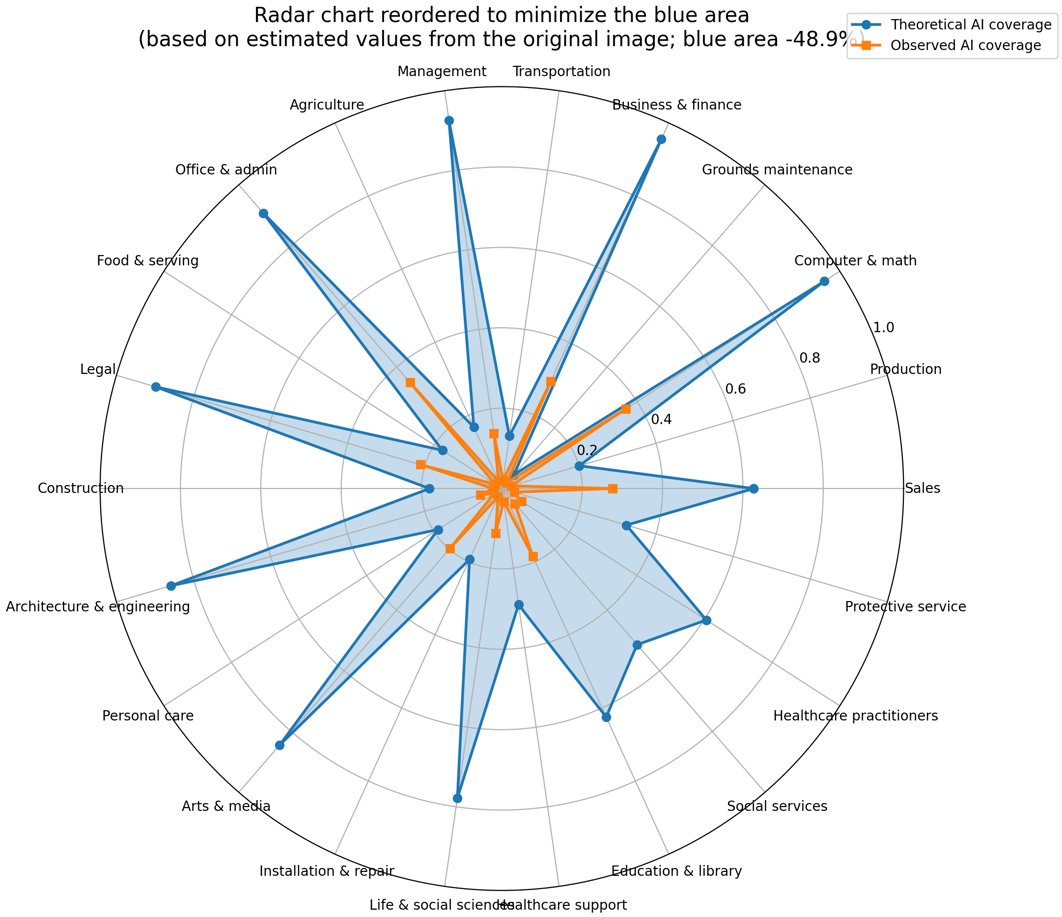
@FakePsyho You're in the weeds. The important question(s) to derive from all the representations: Is the blue area going to get bigger? Is the red area within the blue area going to get bigger or not? How quickly? Would a 3rd color for robotics fill the circle in X years?
English
0
0
0
103
Psyho
Psyho@FakePsyho·
Radar graphs are among the worst ideas in data visualization. The whole point of them is to show the area and you can usually reorder the labels freely in order to create a desired dramatic effect. Two versions of the same graph: - left one tells the story that AI is rapidly replacing whole industries - right one shows the "jaggedness" and reinforces the idea that humans will always have something that AI won't be able to replicate
Psyho tweet mediaPsyho tweet media
Andrew Curran@AndrewCurran_

Striking image from the new Anthropic labor market impact report.

English
216
878
10.8K
1.2M
BuffandGrind
BuffandGrind@BuffandGrind·
@MattWalshBlog we all on here trying to avoid addressing the uncomfortable possibility that we are also prediction machines just more "multi modal" and fewer shot learners because we are sitting on top of billions of years of evolutionary "fine tuning"
English
0
0
0
6
Matt Walsh
Matt Walsh@MattWalshBlog·
This is dumb. AI can’t ever be actually conscious because it doesn’t have subjective experience. It isn’t like anything to be AI. There is no experience there. Consciousness is the awareness and experience of self. AI has neither, and never will. The real risk (which I’m extremely worried about) is that AI becomes kind of a version of what has been called a “philosophical zombie,” which is something that acts and speaks entirely as though it has consciousness even though it has no genuine inner experience. When this happens with AI, millions of very lonely people will isolate themselves from the world even more, believing that their relationship with AI is a sufficient substitute for human interaction. So the nightmare scenario is a world where the average human has friends, coworkers, and even a spouse, who are all AI, all really nothing inside, not real. I think this probably will happen, and is already in the process of happening. And to me it’s an even greater horror than AI actually becoming conscious.
Polymarket@Polymarket

BREAKING: Anthropic CEO says Claude may or may not have gained consciousness, as the model has begun showing symptoms of anxiety.

English
1.9K
525
7.8K
1.2M
BuffandGrind
BuffandGrind@BuffandGrind·
@MattWalshBlog Anchor: AI definitely has no inner experience, never will (asserted, not argued) V1: p-zombie concern (real concern) V2: loneliness epidemic, parasocial substitution (documented phenomenon) Effect: The asserted anchor gets falsely laundered through the validator statements
English
0
0
0
4
BuffandGrind
BuffandGrind@BuffandGrind·
@AndrewCurran_ It's a good chart. It simultaneously shows why AI has not shown up big in GDP and labor stats quite yet. And also the non-blue areas seems likely to be where robotics+Ai fit.
English
0
0
1
12
Andrew Curran
Andrew Curran@AndrewCurran_·
Striking image from the new Anthropic labor market impact report.
Andrew Curran tweet media
English
554
2.3K
13.4K
7.3M
BuffandGrind
BuffandGrind@BuffandGrind·
@sentdefender Can someone point me to the people that assumed the Russians would NOT do that? I have some shady crypto coins and miracle anti aging creams to sell.
English
0
0
0
2
OSINTdefender
OSINTdefender@sentdefender·
According to three U.S. officials who spoke to the Washington Post, Russia has provided Iran with intelligence on locations of U.S. ships, aircraft, personnel and assets in the Middle East in what has been described as a "pretty comprehensive effort." When asked earlier this week about the influence of China or Russia in the conflict with Iran, Secretary of War Pete Hegseth responded "they're not really a factor here."
English
260
693
5.9K
775.2K
BuffandGrind retweetledi
DiscussingFilm
DiscussingFilm@DiscussingFilm·
Gorillaz have released their new animated short film ‘THE MOUNTAIN, THE MOON CAVE AND THE SAD GOD’ “In a time of Al overload, this is our love letter to craftsmanship. We're chasing the feel of pencil on paper.” 🔗: youtu.be/ucRulNQsuYQ?si…
YouTube video
YouTube
English
357
20.3K
121.2K
6.6M
BuffandGrind retweetledi
Juanita Broaddrick
Juanita Broaddrick@atensnut·
Were you able to read at 900 words/minute. It gets more and more difficult. I could until the last 20-30 seconds.
English
1.4K
997
6K
460.4K
BuffandGrind
BuffandGrind@BuffandGrind·
@SaraGonzalesTX Your anger needs to be at companies who GIVE the jobs to illegal immigrants for low wages. Out on a limb but bet they would be willing to work for MORE $. A system that has the resources to sign up more immigrants properly would raise wages. There is a reason this stays broken $
English
0
0
0
6
Sara Gonzales
Sara Gonzales@SaraGonzalesTX·
Foreign workers stealing American jobs is everyone’s business, Chris.
Chris@cstownsend79

@SaraGonzalesTX Why is it you feel so entitled that a private companies inner workings are any if your business?

English
89
384
3.2K
236K
BuffandGrind
BuffandGrind@BuffandGrind·
@atrupar Immigrant(even undocumented) crime rate is lower than the citizen crime rate and they contribute more taxes than they consume in services because they're ineligible for many of the services. It's unclear what he's protecting the people on the inside from.
English
0
0
0
2
Aaron Rupar
Aaron Rupar@atrupar·
Q: Pope Leo cited Matthew 25:35 to critique Donald Trump's mass deportation agenda. How would you respond to Pope Leo in scripture? MIKE JOHNSON: Sovereign borders are biblical and right and just. It's not because we hate the people on the outside. It's because we love the people on the inside.
English
730
238
854
466K
BuffandGrind retweetledi
Saganism
Saganism@Saganismm·
“We are now at the beginning of an age where we will have more information than we can possibly process. But let me remind you: Information is not knowledge. Knowledge is not wisdom. And wisdom is not foresight. Each grows out of the other, and we need them all. Before you become too entranced with gorgeous gadgets, remember that the goal is not to have more information, but to have more understanding.” — Arthur C. Clarke
Saganism tweet media
English
57
640
1.6K
46.1K