Civic108

2.5K posts

Civic108

Civic108

@Civic108

Katılım Mart 2022
148 Takip Edilen310 Takipçiler
Civic108
Civic108@Civic108·
@SteelWoolSponge @litigious_dulce Will I could understand, but Charlie is a powerhouse of knowledge and always real and humble in every interview I've seen of him.
English
1
0
0
115
M🅰️xwell
M🅰️xwell@SteelWoolSponge·
@litigious_dulce I have several thousand shares, but I wish I trusted management more. There's something about Will Gray and Charlie Nelson
English
1
0
3
567
Dulce
Dulce@litigious_dulce·
$NUAI: The Last Asymmetric Bet in the Data Center Trade Look across the small-cap data center cohort right now. NUAI is the only remaining sub-$500M name with a real, exclusive, late-stage hyperscaler negotiation in motion. And after parsing the Q1 2026 call, conviction goes up, not down. The Lease Math Now Works Backwards From 2027 Charlie Nelson laid out the schedule cleanly: "Our schedule is largely driven by power availability. The power that we have available in phases 1 and 2 is in second half of 2027. Everything that we're doing is kind of back-solving from those dates... We still feel good about second half of 2027 in-service date for the first phases of this." Working backwards from ~August 2027 with Stream's compressed 12-14 month build cycle, the lease has to be signed by July or August 2026 to preserve schedule. The construction calendar is a hard forcing function — every party at the table knows it, including the hyperscaler. The Documents Are Closer Than Anyone Realizes When asked about sequencing, Charlie was specific: "The JV docs are well underway, multiple turns already with the lawyers, and the lease as well, as well as the PPA. All of these are progressing concurrently... And this is how it goes with most of these types of industrial developments — concurrent execution, especially when they're all kind of lining up around the same time, just makes sense. And you just kind of have a signing day, if you will. A very fun day, by the way, for any industrial development." "Multiple turns" means the documents are mature. What's left should be legal documentation — a slower, more deterministic process than commercial negotiation. The phrase "signing day" is not casual. It's deal-maker code for a coordinated execution event where multiple interdependent documents close together. The Hyperscaler Engineered This Deal This is the part nobody is talking about enough. The hyperscaler wasn't recruited. They initially came to NUAI wanting to buy the land. Ted Warner walked through the sequence: "We were also getting offers to buy this from actual hyperscalers... One of those we did, we signed an exclusivity agreement because we kept turning them down on selling, and we wanted to work with them on how can we partner with you to own something here. Essentially, it was, 'You've got to work with a really reputable developer.' We went and tried to find one, that exact same party sort of led us to a different party. Now here we are with that party, Stream." The hyperscaler directed NUAI to Stream. They didn't just suggest a developer — they pre-approved their own counterparty. Stream walked in with existing commercial agreements and pre-approved designs with this specific hyperscaler. Charlie confirmed it: "Having pre-approved designs with this particular hyperscaler, which is why we were guided into the relationship with them, frankly — to the fact that they house long lead time equipment that goes towards these projects, and it's a rinse and repeat design." A hyperscaler that takes the time to direct partner selection, share technical specs, sign exclusivity, and cooperate through a developer restart is not a hyperscaler that walks away at the finish line. That's a counterparty that has been quietly engineering the conditions for this deal to close on terms they already endorsed. And It's the Same Hyperscaler Ted's clarification on the Sharon AI confusion was the most underrated moment of the call: "The same party, that hyperscaler is still the person that we hope will be our tenant, that our designs are specifically for... [Stream has] been incredible to work with, just every day checking boxes. It's been awesome to watch them work." No one walked. The hyperscaler that wanted this site in 2025 still wants the site in 2026. The designs are still tailored to their specs. The exclusivity is still in place. The Balance Sheet Is Built For This Ted's segment removed the financing overhang that haunted this name for months. $80M+ cash on hand. $290M Macquarie credit facility. The Sharon AI note is gone. Liens lifted. They illustrated the math: "Our cash needs for phase one would be roughly $180 million before the credit that we'd get for the land contribution... That theoretical $180 million investment is more than covered for phase 1." NUAI's expected equity check for Phase 1 is fully funded. No more "how do they pay for this" question hanging over the stock. The Setup The market just sold the stock 11% on a quarter that confirmed every workstream is on track The lawsuit resolution should come soon PPA likely ready first JV DA close behind — Stream is the most motivated party in the deal Hyperscaler lease execution window: late June through Early August 2026 One signing day, three documents, complete rerate This is the playbook setup for an asymmetric trade. The downside is bounded by the cleaner balance sheet, the Stream-driven execution model, and the standing hyperscaler engagement. The upside is a name with a sub-$500M market cap signing a lease comparable to deals that already moved peers multiples higher. "As a shareholder, I sit here with you, and I wish I could announce who the prospective tenant is, and I can't wait to announce it one day. We've been working very, very hard to get there." — Will Gray, closing remarks NUAI is the last shoe left to drop. investing.com/news/transcrip…
Dulce tweet media
English
19
26
156
19.1K
Civic108
Civic108@Civic108·
@_Sgr_A_Star @Sumeet2692 Maybe you work at Costco as a full stack engineer during the day ;) Or maybe the stack is half full (haters will say it's half empty)
English
0
0
0
38
The God Particle
The God Particle@_Sgr_A_Star·
@Sumeet2692 I work at Costco during the day, but I'm a full stack engineer by night thanks to Claude. (thank you Claude - I'm naming my first born after you)
English
3
0
8
651
The God Particle
The God Particle@_Sgr_A_Star·
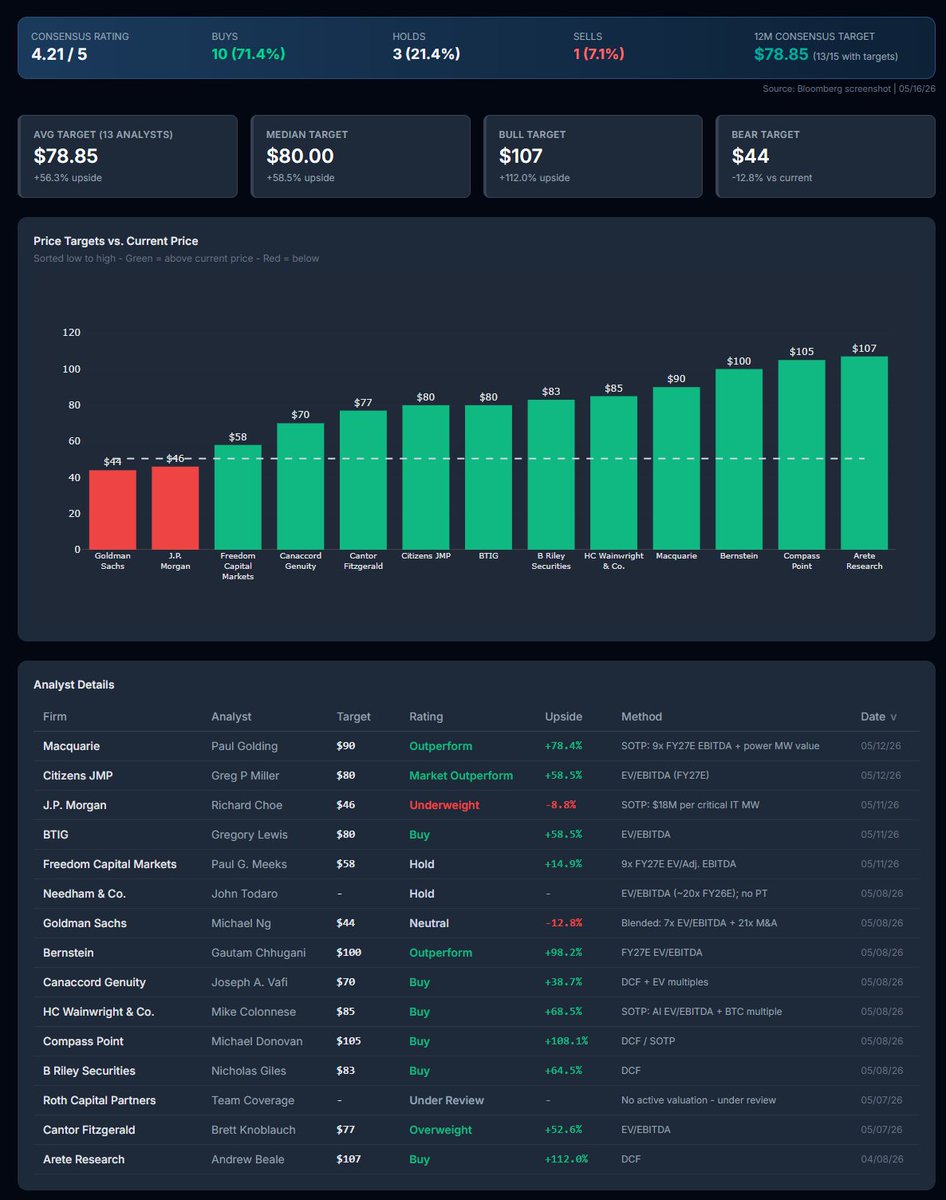
$IREN Now that the earnings call has been digested by the analysts, this is what the Analyst Scoreboard look like. IREN is just getting started.
The God Particle tweet media
English
7
17
204
14.2K
Civic108
Civic108@Civic108·
@onlywens @matthew_sigel everyone needs advertisement and marketing, it's not rocket science that you need to drive sales.
English
1
0
1
179
onlywens
onlywens@onlywens·
@matthew_sigel Yeah, not sure I understand how the acquisition of a marketing firm aligns with their core business model.🤔
English
2
0
7
1.5K
Civic108
Civic108@Civic108·
@MarkosAAIG Overly negative bear takes seem to perform very well too, as we know from the media and news, fear and doom sells. It looks smart to see the dangers coming. (Bear sound smart, bulls make money)
English
1
0
1
48
Markos
Markos@MarkosAAIG·
And to add on that: every creator knows that bull takes perform way better in terms of engagement than critical posts pointing out the real risks because everybody loves the positive.
English
1
0
4
1.4K
Markos
Markos@MarkosAAIG·
Yeah. Let’s talk about something that I have seen getting much worse in 2026, and that’s trading a narrative. It used to be: you find a thesis, you do the work about it, you build conviction, you size up, you post a very detailed breakdown of it. And the narrative followed the work. In the current AI era, it has flipped. Sometimes it’s okay, don’t get me wrong. If you really find a gem of a company where the thesis is very clear and their unique positioning is very clear, and you can do it in very few words, like @serenity did for $AXTI, then it’s fine. But currently, these days, everybody is talking about bottleneck here, bottleneck there, constraint here, constraint there. And people on X spam tickers and even create false narratives around it, like @serenity pointed out now, calling out $PENG, calling out people that write about $PENG in terms of “photonic memory”. And this is just one example of one thousand different stocks I’ve seen this year. And this post is directed right to creators on X, because we have to take some responsibility for this. When you have reach, every post is a push. You can push people toward genuinely doing the work, or you can push them into a narrative you created yourself to make you look smarter than you actually are. You have to understand, when you have a bigger account, that people actually listen to your words. It’s your own choice to spam an LLM summary, write it even more bullish than the very superficial LLM summary already shows, and even extra, create a “narrative” on top of that. I think this year, I’ve seen over one hundred companies that are going to be the next Nvidia. And the worse part is it’s based on potential (most times fake) upside in %. Not on the fundamental strenght that made Nvidia the beast of a company it is today. While your readers take that part in account to. So keep in mind when you’re reading anything, and include mine for the fairness, ask yourselves: did the thesis come first, or did the position come first? Is the evidence true and heavily stress-tested, or is it just a form of decoration? Are risks named, or is it only a bull case that has been posted? A narrative without underlying work is just a marketing pitch for somebody’s X account to get the fast clicks and maybe get a few dollars of X monetisation.
Serenity@aleabitoreddit

Very nuanced. People buying $PENG for $MRVL "photonic memory" are likely to be disappointed. They're on the $SMCI integrator level with potential software add. The high margin, foundational IP belongs to companies like Celestial or others like Lightmatter. What they do is build a 2U box, inside the rack, around Celestial/Marvell's the photonic memory IP. It's also in the development collaboration stage. Retail just misunderstand the different layers and conflate them all as this company building core photonic memory IP. Not commenting on the potential price, but it's a legitimate idea for its base business. And upside would be material if they go past sampling. Just annoying when I get comments about "PHOTONIC MEMORY". Then they're building the chassis that the actual photonic memory IP sits inside and not even in qualification stage.

English
18
3
64
17.9K
HSFU
HSFU@PetersPansen23·
@BitcoinPowerLaw @Civic108 ok so they rather take the $1.3B now then wait another 3 year's for a potential $120m more.
English
1
0
2
32
mNAV.com
mNAV.com@BitcoinPowerLaw·
Strategy retires $1.5B of its 2029 converts at 92¢ on the dollar The company exchanged $1.38 billion in cash for $1.50 billion principal of its zero-coupon 2029 Convertible Senior Notes, a $120M discount to par. The remaining $1.5B of the tranche stays outstanding, alongside five other convertible issues. $MSTR
Michael Saylor@saylor

Strategy to repurchase $1.5 billion principal amount of 2029 convertible notes. $MSTR $STRC strategy.com/press/strategy…
English
2
10
73
18K
Civic108
Civic108@Civic108·
On sales: didn't Dan tweet something like "you don't need a sales team when you have hyperscaler support" or something? If so, he deleted the tweet. I'm 99% sure he tweeted that recently. "IREN may no longer need to build a traditional sales force or aggressively market its software capabilities. NVIDIA itself would likely help facilitate customer adoption"
English
3
0
3
2.1K
franklee6924x
franklee6924x@franklee6924T·
From DGX to DSX — NVIDIA’s Secret Weapon Is $IREN DGX was the pivotal turning point that transformed NVIDIA from a chip company into a systems company. From the original ambition of creating a “unified data center standard,” DGX encountered resistance from the hyperscalers. They refused to adopt NVIDIA’s unified standard and instead developed their own chips, frustrating NVIDIA’s vision of becoming the dominant systems platform of the AI era. Google is perhaps the most notable example: after initially falling out of the core AI race, it rapidly recovered and mounted a full-scale counterattack, at one point nearly matching NVIDIA’s market capitalization and challenging NVIDIA’s status as the “godfather” of AI. DGX failed to conquer the cloud giants’ strongholds. NVIDIA’s massive sales still primarily came from individual GPU chips, while its plan to establish DGX as a new systems standard combining GPUs and software did not succeed. However, strategically, DGX laid an extremely important foundation for NVIDIA. Customers could reject the complete DGX system, but they still had to remain compatible with NVIDIA’s software management stack, otherwise GPU performance could not be fully utilized. As a result, technologies such as NVLink, NVSwitch, and Base Command matured alongside the market, enabling NVIDIA to evolve from simply selling GPUs into a company with full-stack platform control capabilities, while solidifying its dominance in scientific computing and private cloud markets. Entering the Blackwell era, the physical limits of power consumption, interconnect complexity, and liquid cooling made it impossible for the industry to continue operating independently. NVIDIA formally introduced the standardized AI factory architecture known as DSX, positioning it as the optimal path for building large-scale AI data centers. From this point onward, DGX evolved into DSX. In other words, it evolved from a “single-machine AI supercomputer” into a “data-center-scale AI factory standard,” completing the transition from standardizing one machine to standardizing an entire factory. During the Blackwell generation, AI training systems pushed power consumption, interconnect complexity, and thermal management close to physical limits: single rack power draw surpassed hundreds of kilowatts, NVLink/NVSwitch topologies became dramatically more complex, and liquid cooling shifted from optional to mandatory. In theory, this generation already required a standardized architecture like DSX. However, the supply chain ecosystem was not yet mature, and no partner possessed the full engineering capability necessary to build a true “system-level AI factory.” As a result, DSX remained only a concept and reference design. By the Vera Rubin era, NVLink 6, NVSwitch 6, and NVL72 rack systems formed a scalable, reproducible interconnect foundation, finally giving DSX the conditions necessary for practical deployment using NVIDIA’s full-stack technology. But that alone was still insufficient. To fully realize DSX, the industry also required: High-density interconnected rack architecture capabilities Large-scale liquid cooling expertise and construction experience GW-scale single-site campuses with stable long-term power supply These became the necessary conditions for constructing a flagship DSX factory. And only one company in the world possesses all three simultaneously. At this point, IREN enters the stage. Beyond those three core requirements, IREN possesses several additional strategic characteristics: Grid-based power supply. First, grid power solves the stability problem. To become a flagship DSX standard site, power interruptions and voltage fluctuations are unacceptable. Large-scale grid infrastructure provides industrial-grade voltage stability guarantees. Second, relying on the grid offers superior cost economics. Third, it provides regulatory compliance as public infrastructure, removing the unpredictable risks often associated with behind-the-meter (BTM) power systems, which frequently carry “gray-area” or temporary characteristics and therefore lack sufficient long-term reliability. GW-scale infrastructure. This enables the creation of multiple DSX modular standards. Small and medium-sized data centers become trivial by comparison — deployments from 10MW to over 1GW can all be standardized. This makes IREN the ideal flagship demonstration platform. We already know there will likely be SW2 and potentially additional nearby expansion sites. The total power capacity is enormous. DSX only truly begins with Rubin, and the upgrade path beyond that will continue for many years. Therefore, possessing ultra-large campus-scale sites within a single region is critically important. This advantage makes IREN the one unavoidable choice for NVIDIA. No other company possesses such massive strategic power infrastructure concentrated within a single region. The long-term significance and moat of such infrastructure can hardly be overstated. Small scattered sites stitched together — even if they collectively total several GW — are simply incomparable to IREN’s grid-connected GW-scale campuses concentrated in single regions. Green energy. As global concern over AI energy consumption rises, future “carbon footprint” metrics will become core evaluation standards for sovereign AI procurement. IREN’s long-term commitment to renewable energy allows NVIDIA’s DSX standard to become not only “the most powerful,” but also “the greenest.” This is critically important for attracting national-level infrastructure customers. Owned land and expansion capability. DSX requires data centers to be constructed from the ground up, including specialized transformers, ultra-heavy rack support systems, and complex liquid cooling pipelines. Only companies with full ownership of their land can customize AI factories entirely according to NVIDIA’s blueprint without facing endless approval bottlenecks or third-party building restrictions. Vertical integration and data center engineering expertise. IREN is not merely a data center operator. It is one of the only vertically integrated companies in the industry that owns everything from greenfield development, site development, power procurement, to operations and maintenance. For a DSX flagship factory, NVIDIA needs a partner capable of rapidly executing its “reference designs.” IREN’s model of “designing, building, and operating everything itself” dramatically shortens the timeline from blueprint to first deployed GPU. Liquid cooling capability. DSX is fundamentally a liquid-cooled era architecture. Liquid cooling becomes a central requirement. IREN already possesses high-density rack deployment experience through the Horizon project. Its Chief Innovation Officer is one of the most influential and experienced engineering experts in the United States in data center liquid cooling, high-density thermal architecture, and ASHRAE standards systems. He joined IREN specifically to help establish standards. Long-term operational data accumulation. IREN has years of operational experience managing large-scale, high-heat-density facilities running at full load. The physical environment of Bitcoin mining is remarkably similar to AI inference: both involve 24/7 full-load operations with extreme thermal output. This long-term expertise in managing massive electrical and thermal loads is, in reality, an extremely competitive advantage within the industry. From the analysis above, one can understand why IREN possesses such uniqueness and strategic importance in NVIDIA’s DSX ecosystem, while also inferring the likely development path of DSX itself: DSX will likely follow a “top-down” design philosophy. Using IREN’s massively scalable GW-scale sites and specialized engineering capabilities, NVIDIA can define a flagship standard that is “multi-scale, most advanced, most efficient, and greenest,” then deconstruct that blueprint into modular, reproducible AI factory units. In the future, whether it is a GW-scale campus or merely a company operating a single row of racks, as long as they purchase NVIDIA’s “DSX-certified package,” they could theoretically produce tokens with the same efficiency as IREN. This strategy of “defining the upper limit, then distributing the standard downward” reflects NVIDIA’s true ambition to control the global AI infrastructure ecosystem. IREN’s Sweetwater site — along with future surrounding expansion campuses — could become the incubation base for future AI intelligence factories. The scale of this project may become one of the largest engineering undertakings in human industrial history: “Intelligent factories produce intelligence, and DSX defines how those factories are built and run.” This concept has already moved beyond theoretical logic into actual execution. The reason I am able to describe this vision is because I have been observing this direction consistently for a long time. In reality, developments do appear to be moving this way. The broader historical backdrop behind the emergence of the DSX system comes primarily from three major forces: First, the rapid development of the AI industry has positioned DSX at the center of a major inflection point in compute infrastructure. DSX is a natural product of the industry reaching a new stage of maturity. AI is no longer confined to internal model training inside a few hyperscalers. The entire world now requires AI compute — including sovereign AI, enterprise private AI, neo-clouds, AI inference platforms, agent networks, token factories, vertical-specific models, and national AI infrastructure. Many countries — particularly in the Middle East, Europe, and Southeast Asia — are unwilling to place core AI workloads inside the public clouds of U.S. tech giants due to data sovereignty concerns. Through DSX templates, NVIDIA can help these nations rapidly build their own “national AI factories.” Hyperscalers can no longer monopolize AI infrastructure. This has become one of the most important changes of the past two years, and it forms the foundational soil for DSX to grow. Second, hyperscalers themselves are now constrained by power, land, permitting, transformers, and cooling systems. They are no longer in a state of unlimited expansion. AI inference also requires broader distributed deployment. In the future, there will be large numbers of regional AI factories, national AI nodes, and enterprise private clusters whose operators do not want to rely entirely on hyperscalers. Meanwhile, Google TPU, Amazon Trainium, and Microsoft Maia are all rapidly advancing. Over time, they may reduce GPU purchases, form closed ecosystems, and sell their own AI services externally — creating a strategic threat to NVIDIA. Therefore, NVIDIA must cultivate a “non-hyperscaler AI ecosystem.” Third, by the Blackwell and Vera Rubin eras, single-rack power consumption has already reached the 100kW–200kW range. Traditional air cooling, cabling, and power topology can no longer support these systems. This means that if data centers are not built according to NVIDIA’s DSX standards — system-level liquid cooling, GB200 NVL72 architecture, and related infrastructure — they simply will not be able to run the highest-efficiency compute systems. In other words, physical laws themselves are forcing the market to adopt NVIDIA’s standards. DSX effectively becomes the “entry ticket” to the AI era. Under this backdrop, DSX attempting to define the entire AI factory standard becomes a completely natural progression. It encompasses GPU architecture, network topology, liquid cooling standards, power design, rack standards, software orchestration, inference optimization, and token factory production pipelines — reflecting an ambition to turn AI compute into something like an “industrial iPhone operating system.” After understanding the broader context, one can then better appreciate the deeper strategic meaning behind IREN’s acquisition of Mirantis. To build a standardized flagship DSX factory, IREN already possesses massive GW-scale physical infrastructure, liquid cooling capability, and engineering expertise, but it still lacked the software layer needed to bridge “hardware” and “cloud services.” Mirantis perfectly fills this gap. Its deep experience in OpenStack, Kubernetes, and bare-metal management enables IREN to transform DSX into a directly usable cloud platform, allowing customers to immediately deploy AI workloads out of the box. For NVIDIA, this acquisition enables its key partner IREN to free DSX from dependence on AWS, Google, and other cloud giant software ecosystems, establishing an independent vertically integrated stack. For IREN, the acquisition elevates it from a power and infrastructure supplier into a true “neo-cloud” platform capable of delivering sovereign AI and national-scale AI infrastructure. Mirantis will also integrate NVLink topologies and DSX-specific features directly into software orchestration, enabling AI factories to achieve automated scheduling and token-level operational stability. Although CRWV and NBIS also possess software with somewhat similar functionality, their stacks are largely designed for internal use and are difficult to standardize for export. Mirantis, by contrast, is inherently a cloud-native software company serving global customers. This allows IREN to transform DSX into an exportable “software-defined AI factory” template. Its core product, k0rdent, can unify bare metal, virtual machines, and Kubernetes management while deeply optimizing for NVIDIA GPUs — a capability IREN could not realistically develop internally. One could speculate that NVIDIA itself encouraged this acquisition (especially given how inexpensive the deal appeared, with IREN seemingly receiving extraordinary value). The ultimate objective may be to give DSX an independent software control layer outside AWS and Google while creating a sovereign AI solution deliverable globally. Mirantis upgrades IREN from a hardware host into the software brain of DSX, while giving NVIDIA a strategic ally in global AI infrastructure that is open-source-oriented, conflict-free, economically aligned, and technologically synchronized. NVIDIA choosing not to acquire Mirantis directly — instead allowing IREN to do so — likely centers on avoiding antitrust concerns, maintaining delicate relationships with hyperscalers, and ensuring the software layer remains closely aligned with practical AI factory operations. An IREN acquisition appears as ecosystem collaboration rather than market domination. At the same time, Mirantis software must deeply integrate with IREN’s GW-scale power, liquid cooling, and operations systems, making IREN the more efficient owner. Financially, NVIDIA benefits through warrants tied to IREN’s growth without needing to bear integration costs itself. Through this strategy, NVIDIA effectively supports the emergence of a fully aligned DSX flagship manufacturing partner while preserving its own asset-light structure and strategic control position. A full-scale DSX rollout would potentially: Form the foundation for NVIDIA reaching a $10–15 trillion valuation Become the inevitable path for NVIDIA’s vision of AI intelligence factories and operational control Represent the most economical and efficient path for AI industry development Solve the post–Vera Rubin scaling direction for compute growth Become NVIDIA’s only viable method for breaking out of hyperscaler encirclement IREN becoming the sole top-level collaborator in such a massive project could not have happened spontaneously. Planning something of this scale would likely require at least a year or more of preparation. Ever since interactions between NVIDIA and IREN began to appear unusually secretive, I have noticed multiple examples suggesting unusual behavior between the two companies — almost like two people who already know each other pretending not to in public. Overall, they likely did not want the industry to speculate too early about their true intentions, while also minimizing regulatory attention. Even IREN, once an unusually transparent Bitcoin mining company, has become more guarded. In that sense, the limited interaction between IREN’s investor relations team and the market may actually make sense. At this point, IREN has already completed the most difficult parts of its AI industrial expansion: High-quality, massive-scale, long-term stable power supply, still growing further Secured supply access to the latest GPUs Developed engineering teams and supply chain maintenance capabilities Obtained status as a flagship manufacturing partner for next-generation AI intelligence factories The next inevitable step is filling IREN’s enormous power capacity with high-quality customer contracts. Unlike before, however, IREN may no longer need to build a traditional sales force or aggressively market its software capabilities. NVIDIA itself would likely help facilitate customer adoption while emphasizing the superior token-generation efficiency of the DSX system, because the economic interests of both companies are now deeply aligned. Under the DSX standard, NVIDIA could gradually evolve from a “supplier” into a “global orchestrator.” Securing partnerships with companies like Anthropic would no longer be solely IREN’s concern. NVIDIA itself has strong incentives to push major AI companies already experimenting with TPU systems toward using more NVIDIA-based infrastructure. Second, NVIDIA holds massive warrants in IREN. Every major contract signed by IREN potentially increases its stock price, allowing NVIDIA not only to profit from GPU sales but also from appreciation in IREN’s equity value. Jokingly speaking, one could say IREN “used warrants to buy itself a world-class salesman.” Third, the emergence of sovereign AI has opened an entirely new market. Since IREN acquired Mirantis, the term “sovereign AI” has appeared increasingly frequently. In fact, when evaluating IREN’s sites originally, many observers already noted their suitability for sovereign AI deployments. The strategic quality of IREN’s sites is fundamentally incomparable to the fragmented infrastructure assembled by many competitors. For NVIDIA, it needs a GW-scale “pure-blood” flagship to demonstrate to sovereign AI customers globally that NVIDIA’s DSX architecture can achieve superior token efficiency. Sovereign AI customers may not want to hand their compute, data, models, or orchestration layers to the three major U.S. hyperscalers, but they may still accept supplier sovereignty. The distinction is subtle but important. IREN’s careful positioning and boundary management become critical here. Even the Mirantis acquisition did not overextend into hyperscaler territory; in fact, sovereign AI is already one of Mirantis’ core areas. From this perspective, NBIS may actually be poorly positioned for sovereign AI because its full-stack platform structure is precisely what sovereign AI customers are attempting to avoid. Overall, IREN appears to be positioning itself at a point that maximizes strategic optionality and economic upside. If it attempted to define itself as a fully integrated hyperscaler-like platform, cooperation with a company at NVIDIA’s level would likely become far more difficult. This partnership with NVIDIA may sacrifice some of IREN’s historical emphasis on flexibility and optionality, but technological evolution tends to follow efficiency. The emergence of the “Magnificent Seven” itself demonstrates that antitrust frameworks increasingly must adapt to technological realities. For IREN, the most important objective during this enormous capital expenditure cycle is rapidly establishing scale advantages. These data center assets ultimately become long-term hard assets fully owned by the company. The more infrastructure accumulated now, the greater IREN’s strategic flexibility becomes in the future. From that perspective, this is an extremely rational strategy. As IREN gradually becomes one of the standard-setters for the next-generation compute ecosystem, it could eventually open additional monetization paths such as standardized AI factory design fees, consulting and licensing revenue, and software licensing income. Compared to its core business, these may remain relatively small, but the strategic value of occupying the top layer of the ecosystem could become nearly limitless. Many people — especially institutions — already seem to recognize these dynamics. IREN’s stock price may not have risen dramatically yet, but its trading volume appears to reveal something unusual. The volume itself has become almost phenomenon-level behavior. Meanwhile, IREN’s $6 billion ATM facility has remained active, and immediately after earnings the company issued a $2 billion convertible bond deal, later increased to $3 billion due to overwhelming demand. The intensity of demand, favorable interest rates, and high conversion prices were genuinely surprising. If the narrative described above is even partially correct, such investor enthusiasm becomes entirely understandable. Furthermore, the remaining $5 billion of ATM financing demand will likely be sold at significantly higher prices. At this point, CRWV, NBIS, NSCALE, and LAMBADA increasingly appear to function as alliance members within NVIDIA’s broader ecosystem. Capital markets have seen constant fighting among supporters of the three neo-cloud stocks, especially between NBIS and IREN supporters — almost to the point of ideological warfare. But IREN may ultimately represent NVIDIA’s final and most important strategic move: the piece that controls the overall board. Importantly, IREN achieved this position through its own decisions and execution. It was not merely “chosen” or artificially supported. Yet at the same time, NVIDIA likely must publicly deny any direct support relationship — readers can think carefully about the reasons themselves. NVIDIA’s earlier strategic investments were designed primarily to secure the GPU deployment ecosystem. As the DSX system matures, companies like CRWV, NBIS, NSCALE, and LAMBADA may increasingly become deployment and implementation partners. Interestingly, during the earlier NBIS-versus-IREN debates, some NBIS supporters argued that the two companies did not need to be adversaries and might eventually cooperate — for example, IREN leasing power capacity to NBIS. Looking at things now, cooperation indeed seems possible, but perhaps in the opposite direction: IREN may ultimately become the holder of the standard itself, licensing intellectual property outward. Finally, this article is ultimately just speculative corporate-strategy fiction — written mainly for entertainment purposes, not investment advice.
English
59
79
555
226.4K
Civic108
Civic108@Civic108·
@FinRiff @FL0WG0D This doesn't explain the May 6th $20m Iren call buys though, I don't think there was a convert there. Also, you're saying this is Iren's dealer hedging by buying these calls, not Iren itself? Because Iren would buy capped calls with capped upside, not straight call options.
English
1
0
0
86
FinRiff
FinRiff@FinRiff·
@FL0WG0D 50m into 110s is almost certainly the capped call dealer hedge from iren's fresh $2.6b convert. october tranche capped at 120, this one likely set a tick lower so the flow tracks
English
3
0
14
1.8K
Furkan Yildirim
Furkan Yildirim@FurkanCCTV·
UBS hat ein Maß dafür, wie viele Aktien einen Index wirklich tragen. In den letzten Jahrzehnten lag dieser Wert im Schnitt bei rund 100. Letzte Woche fiel er auf 42. Niedriger als jemals zuvor seit Beginn der Aufzeichnungen. Vergleichbare Marktenge sah die Wall Street zuletzt im Frühjahr 2000. Die fünf Namen, die diese Rallye tatsächlich tragen, lassen sich an einer Hand abzählen. Alphabet, Nvidia, Amazon, Broadcom und Apple. Zusammen verantwortlich für mehr als die Hälfte aller S&P 500 Gewinne seit Anfang April. Der Index ist seit dem Tief Ende März um etwa 12 Prozent gestiegen. Das wirkt nach Stärke. Wer unter die Oberfläche schaut, sieht ein anderes Bild. Es gibt eine Vergleichsversion des S&P 500, in der jede Aktie gleich gewichtet wird. Die sogenannte Equal Weight Variante. Vor dem Iran-Krieg hatte sie den marktkapitalisierten Index überholt. Die Verbreiterung der Rallye war im Gange. Investoren begannen, aus den Mega-Tech-Werten in vernachlässigte Branchen zu rotieren. Supermärkte, Bauunternehmen, Bergbau. Die These für 2026 lautete: Jahr der Aufholjäger. Der 28. Februar hat diese Rotation abgewürgt. Seit Kriegsbeginn ist die gleichgewichtete Variante des Index um rund ein Prozent gefallen. Im selben Zeitraum hat der Philadelphia Semiconductor Index 40 Prozent zugelegt. Intel allein 130 Prozent. Sandisk 100 Prozent. Die Rallye, die nach Stärke aussieht, ist eine Rallye in einer einzigen Handvoll Halbleiter-Namen. Das Gefälle in den Quartalszahlen erklärt den Mechanismus. Der Tech-Sektor des S&P 500 hat im ersten Quartal Gewinne von über 40 Prozent gemeldet. Finanzwerte schafften gerade ein Prozent. Im Gesundheitssektor schrumpfen die Gewinne. Der Energieschock hat die Margen außerhalb von Tech zerdrückt, und solange die Straße von Hormus geschlossen bleibt, dürfte breit gestreutes Gewinnwachstum laut Citi-Strategin Beata Manthey schwer vorstellbar sein. Goldman Sachs schätzt, dass KI-bezogene Investitionen rund 40 Prozent des gesamten S&P 500 Gewinnwachstums in diesem Jahr ausmachen. Die größten Cloud-Konzerne planen 2026 zusammen 670 Milliarden US-Dollar an Ausgaben für KI-Infrastruktur. Diese Summe übersteigt die jährliche Wirtschaftsleistung der meisten Länder dieser Erde. Eine einzige Investitionswette trägt fast die Hälfte des Gewinnmotors einer Volkswirtschaft, die für 25 Prozent der globalen Wirtschaftsleistung steht. Wer die Nachhaltigkeit dieser Bewegung beurteilen will, sollte sich anschauen, was die Profis gerade tun. Goldman Sachs Prime Brokerage hat in den letzten zwei Wochen das größte Tech-De-Grossing der Hedgefonds seit zehn Jahren registriert. Größer als alles seit der Meme-Stock-Episode Anfang 2021. Die Magnificent 7 wurden in vier von fünf Handelstagen netto verkauft. Long-Verkäufe übertrafen Short-Eindeckungen, was bedeutet: Die schnellsten Akteure am Markt schließen aktiv ihre bullischen Positionen, nicht nur ihre Absicherungen. Ben Snider, Chefstratege für US-Aktien bei Goldman Sachs, hat seinen Kunden in dieser Woche eine direkte Warnung geschickt. Die enge Marktbreite signalisiere ein erhöhtes Drawdown-Risiko in den kommenden 6 bis 12 Monaten. Sein bevorzugter Maßstab vergleicht den Abstand des Index zu seinem 52-Wochen-Hoch mit dem Abstand der Median-Aktie zu ihrem eigenen. Dieser Wert liegt aktuell auf einem Niveau, das es seit der Dotcom-Blase nicht mehr gab. Die einzige Zwischen-Episode war Mitte 2023, eine kurze Phase, die schnell wieder verschwand. Außerhalb dieser beiden Fenster muss man rund 25 Jahre zurückgehen, um eine ähnlich kopflastige Marktstruktur zu finden. Valérie Noël, Handelschefin der Schweizer Syz Bank, beschreibt das Resultat als Fragilitätsrisiko. Wenn die Stimmung gegenüber KI-Aktien drehe, könne der Abwärtsweg erheblich sein. Madeleine Ronner von der DWS sagt, der Krieg habe der These einer breiten Markterholung einen Dämpfer verpasst, und je länger er andauere, desto schlechter würden die Chancen auf eine Verbreiterung. Goldman selbst beziffert das Bear-Case-Szenario für den S&P 500 mit 5.400 Punkten. Das wäre vom aktuellen Niveau aus ein Rückgang von rund 30 Prozent. Die mechanische Parallele zum Frühjahr 2000 stammt aus den Goldman-eigenen Analysen. Das Dotcom-Niveau ist der einzige aussagekräftige Vergleichspunkt der letzten Jahrzehnte. Was damals folgte, lässt sich in einer Zahl ausdrücken: Der Nasdaq verlor zwischen März 2000 und Oktober 2002 etwa 78 Prozent seines Wertes. Auch hochwertige Tech-Namen mit echten Gewinnen fielen tief. Die Konzentration, die den Aufstieg getragen hatte, beschleunigte den Absturz, weil dieselben Akteure dieselben Positionen gleichzeitig auflösen mussten. Eng konzentrierte Märkte sind fragile Märkte. Diese Lehre stammt nicht aus einer Modeerscheinung der Marktanalyse, sondern aus dem Lehrbuch der Marktgeschichte. Die schmalste Marktbreite der Aufzeichnungen trifft auf die zweitlängste laufende Hedgefonds-Entgrossierung der letzten zehn Jahre, eine Investitionswette in der Größe einer Volkswirtschaft und einen Krieg, der den Energiepreis bei mindestens 100 US-Dollar zementiert. Der Index macht neue Hochs, während die Median-Aktie 13 Prozent unter ihrem eigenen Hoch steht. Das ist die Definition einer Hohlkörper-Rallye. Wenn dich solche Makro Insights interessieren und dir helfen, interagiere gerne mit dem Post. 🧡
Furkan Yildirim tweet media
Deutsch
11
13
193
12.9K
Civic108
Civic108@Civic108·
@RealmProtector2 @jiahanjimliu @GlobalCollapse Appreciate the conciliatory response. Yes, there are things to critique and execution needs to step up, though apparently the Horizon 1 delay is due to delayed GPU deliveries, so basically out of Iren's control and should be improved with Nvidia partnership.
English
0
0
1
42
Protector of the Realm
Protector of the Realm@RealmProtector2·
@Civic108 @jiahanjimliu @GlobalCollapse All good, just saying from a critical lense. The deals apparently were indeed not good enough even according management’s own guided revenue. I own a small chunk of Iren myself but its important to stay critical. Iren needs to execute this quarter otherwise they lose credibility
English
1
0
2
28
Jim Liu
Jim Liu@jiahanjimliu·
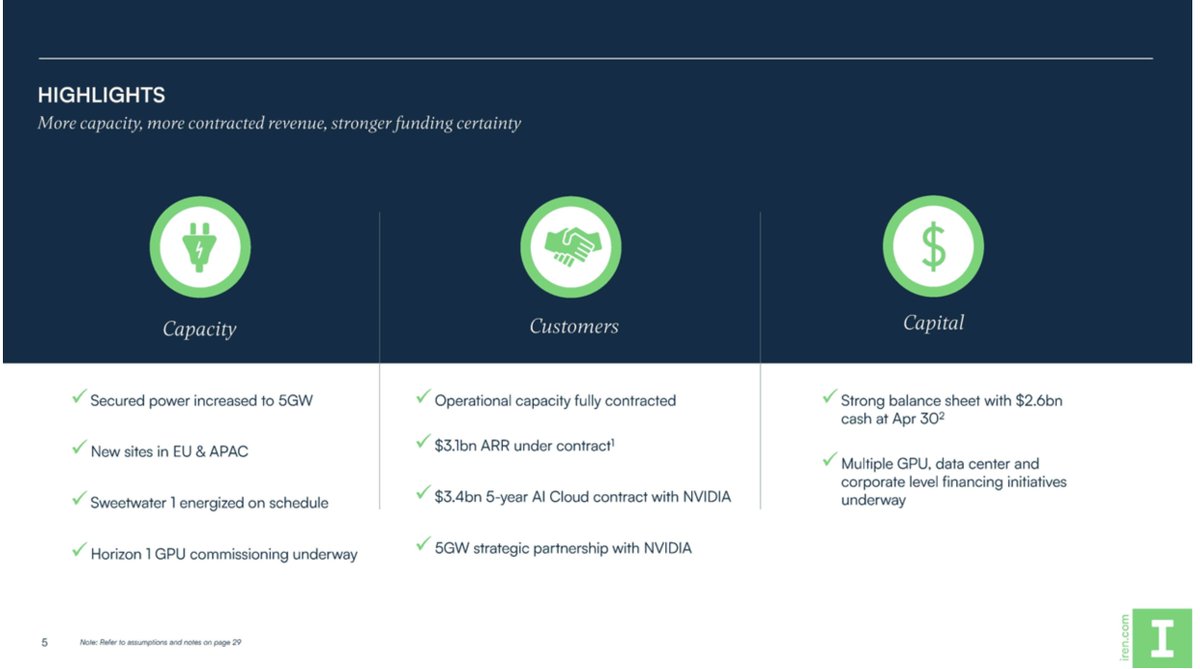
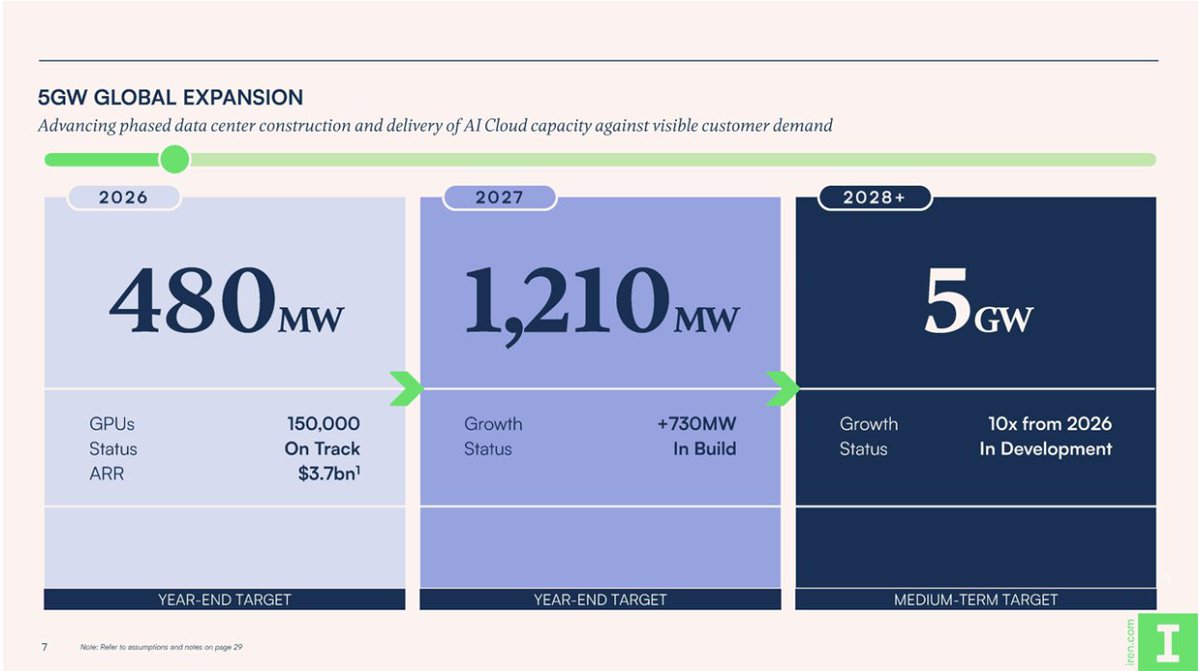
$IREN: First look at Q3 FY 2026 Earnings Quick note - why is IREN giving back all it's gains from $72 -> $60? 1. CRWV had bad cost numbers and whole Neocloud sector is following it's 10% dump. 2. Reason I explain in takeaway 3. Takeaway 1 - Nvidia Contract Economics Nvidia 3.4B/5-year 60MW GPU compute contract with IREN for internal research usage. - This is at 11.3m/MW which is 16% increase from 9.7m/MW MSFT contract. This is very meaningful top line increase given this is for air-cooled which means B300s. Much more profitable than MSFT contract and the topline IREN needs. Takeaway 2 - Why is IREN Expanding Slower than Expected Each GPU generation has greatly improve performance and economics. IREN has a "good" bias from the bitcoin mining days where it was a late move in order to have a fleet that was heavily skewed towards newer ASICs. Technology moves very very fast in the beginning and AI GPUs are still considered early, IREN is trying to time where most of it's fleet is mid-stage GPU aka Vera Rubin or newer. Hence it's SW1 buildout is pushed out to 2027 so that it will be all Vera Rubins. Yes, IREN is still scaling out it's DC buildout teams as this is all external and not contracted out like CRWV/NBIS. CRWV/NBIS for 2026/2027 capacity relies on 3rd parties and NBIS greenfield sites starts 2028. This is why IREN is full funded already for 2026 based on operational cashflow, existing cash on hand and has the Nvidia investment coming in later while NBIS still has 2026 funding needs even after the large convertible and Nvidia investment. Less aggressive but also less capital intensive. CRWV/NBIS is your investment if you want to expand as fast as possible. IREN cares about unit economics and having a VR200 and newer generation fleet. IREN selects customer based on ability to get financing at best interest rate and has better rate on their convertibles than both NBIS's convertible and CRWV's corporate. Given corporate debt is apple or oranges but 9% on CRWV is meaningful enough to compare to IREN's 0% and 1.5% converibles and 6% GPU debt financing. Takeaway 3 - Nvidia Option to Invest Instead of Immediate Investment Market sees this the reason to sell $IREN back down from $72 -> $60. Whereas $CRWV and $NBIS got the money immeidately for shares at market price because they have 2026 unfunded needs, $IREN is fully funded for 2026 and would rather sell at above the market price. The way to negotiate this is to have the shares sold in the future at a premium at which the negotiations happen. Nvidia negotiations were happening today, they were happening when IREN was in the 40s so 70 is a significant premium. YtD relatively IREN at 70 is equivalent to $NBIS issuing shares to NVDA at 140. IREN does not need the 2.1B in 2026, why dilute at $40? IREN will need cash in 2027 where it's buildout is going to accelerate so IREN is it then. The important part is getting priority on Nvidia's delivery schedule. Nvidia does benefit by having the right to buy IREN stock through 2031 at $70 but everyone, everyone is paying alot to secure HBM which is on-chip with the GPU. This $70 call option for Nvidia is good for 600k GPUs. Full Points - 3.7B 2026 ARR runrate and 3.1B ARR already contracted. This means the Mackenzie GPUs are contracted! All the Prince George GPUs are contracted. - New site in not only EU but APAC! Australia confirmed. - 2.6B cash on hand. People can stop talking about the ATM for current liabilities out now. ATM is for future growth/deals/acquisitions. - Will provide 3.4B of AI Cloud compute to Nvidia. Not counted in the 3.7B ARR so likely 2027. IREN is selling GPU compute to Nvidia internal teams! - IREN secures 600k GPUs of Nvidia GPUs as part of partnership. Nvidia has right to buy $IREN at $70 as it delivers the GPUs to IREN, full $2.1B investment option upon delivery of 600k GPUs. - 480MW by 2026, 1.21GW by 2027, 5GW by 2030. Nvidia GPU secured, power long secured, deals will come. - H1 handoff in Q3 CY 2026 is kind of disappointing. Handoff will likely be early Q3 as burn-in already happening now. H2-4 will be handed off by this year is the important part. There must have been some snag in H1. - Rest of Childress will be split among 100MW IT of liquid cooled H5-6 (likely extension for MSFT) and 250MW retrofit of air-cooled capacity. - @FransBakker9812 spot on - First SW1 200MW IT will be in 2027 and be for VR. - AI Revenue 33.6m is lower than expected as commissioning GPUs slower than expected. Will expect this to speed up as IREN ramps up their in-house team.
Jim Liu tweet mediaJim Liu tweet mediaJim Liu tweet media
English
54
89
683
91K
Protector of the Realm
Protector of the Realm@RealmProtector2·
@Civic108 @jiahanjimliu @GlobalCollapse We both know these are not the deals Jim has been talking about for all those months. For the acquisition: software was not a moat and according to him all customers would bring themselves? For Nvidia they choose not to get funding to remain independent? No deal for the new DC?
English
1
0
0
23
Civic108
Civic108@Civic108·
@makemoneymoney6 @_Sgr_A_Star No, they didn't. Nvidia needs to deliver 600k GPUs to EARN the right to buy their stock at $70. And yeah, Iren is a growth company, maybe you've heard that growth companies take some time to grow ARR. Current revenue was definitely a disappointment, noone is arguing otherwise.
English
0
0
1
49
Ewan McGrath
Ewan McGrath@makemoneymoney6·
Huh… doesn’t happen often they analysts jack up targets after a company misses numbers massively, saw leverage up higher than expected, w no chance of hitting their own ARR exit guide…but hey, they did give their biggest provider the right to buy their stock at $70 over 5 years or whatever. Kewl
English
2
0
0
197
The God Particle
The God Particle@_Sgr_A_Star·
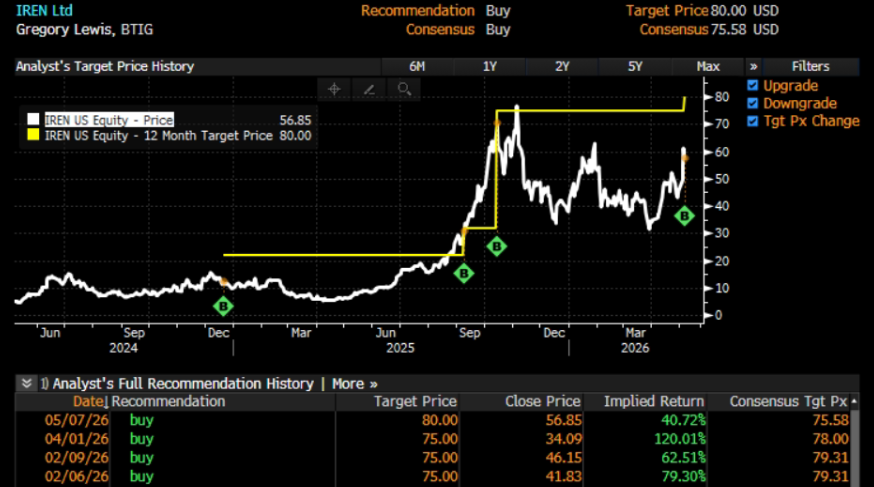
$IREN First PT increase is in: Gregory Lewis at BTIG reiterated it's Buy Recommendation and upped its price target from $75 -> $80
The God Particle tweet media
English
4
15
169
8.2K
Civic108
Civic108@Civic108·
@RealmProtector2 @jiahanjimliu @GlobalCollapse They DID make a deal with Nvidia, besides acquisitions which are also deals. Besides the 5GW over the next years, they have a concrete $0.7 bln ARR deal for air-cooled GPUs with Nvidia, I believe it's 60MW at least for the first phase iirc.
English
1
0
2
30
Protector of the Realm
Protector of the Realm@RealmProtector2·
@jiahanjimliu @GlobalCollapse You said deal would come in March, then it had to be April, and then it was for sure going to be before earnings. Not only did Iren miss AI revenue by a longshot they also still have not signed a deal. Your theory about them picking the best customers is pure bias at this point.
English
1
0
0
110
Civic108
Civic108@Civic108·
@jiahanjimliu How do you know that the $70 call option was negotiated "today" (yesterday before earnings)? It might have been negotiated long ago, and signed up to 4 days ago (deadline for disclosure of MNPI). Great first summary of the earnings btw.
English
0
0
1
110
Civic108
Civic108@Civic108·
@moninvestor Might be a short term play and sell soon, of course, but that's an odd target for that
English
0
0
1
144
Civic108
Civic108@Civic108·
@moninvestor Into a $110 call too. Could have chosen e.g. $85 or $70 too, these would still do multiples with Iren at $110. If Iren is not at $110 in 6 months, that's a lot of money down the drain. Talk conviction.
English
3
0
6
1.1K
Civic108
Civic108@Civic108·
@litigious_dulce Good reflection. And it's still only beginning. Meanwhile I hope Iren gives some consolation if you're still in, up 10.5% for the day :) NUAI will hopefully have such a day soon too, just a bit later.
English
1
0
1
376
Dulce
Dulce@litigious_dulce·
I learned a lot the past 6 months. Despite an objectively successful "career" investing, the market humbled me in a thousand ways. It is no secret that I have a large position in $NUAI, and my thesis for buying it was actually very accurate, notwithstanding the timeline (I was too optimistic in that respect). See substack.com/home/post/p-19… for a good overview by @ThePrudentWhale. Per Tyler Page, the CEO of $CIFR, “behind the meter gas powered sites may be the highest upside convexity in our portfolio," and NUAI specializes in behind the meter gas. Interestingly, CIFR's Odessa site is approximately 30 miles from TCDC, and CIFR confirms that “We do have a lot of interest in Odessa. We have a hyperscaler interest in that site. I think I’ve mentioned before, we would be interested in potentially evolving that site much like we did Black Pearl from a Bitcoin mining site to an HPC campus.” NUAI's Macquarie credit facility (which can be used at least in part to finance TCDC buildout, thereby reducing dilution) validates the legitimacy of the hyperscaler interested in TCDC, and Stream as execution partner significantly derisks construction. Further, the preexisting relationship between the hyperscaler and Stream truncates the normal leasing timeline, e.g., by 50% or more. Now, obviously nothing is definitive yet, but the upside is clearly there: from every angle, the NUAI thesis checks out. However, despite being right about so much, I was also wrong about so much--not NUAI specifically, but the market generally. I obviously had not anticipated Trump causing just a global shitstorm, even if such shitstorm was necessary (likely debatable). I further failed to recognize how risk-averse institutions have become regarding AI plays, strongly preferring companies that have deals in hand to the point of neglecting companies with deals in the making, no matter how good these potential deals are. At the end of the day, institutional investors just place mature business and pre-revenue startups in different categories, regardless of how promising the latter might be. My delayed recognition of the above resulted in me missing many things. For the longest time, I did not appreciate CIFR, $WULF, $HUT, and $APLD, instead only really praising and investing in $IREN for its more ambitious (and risky) strategic vision. Now, in hindsight, it's clear that a diversified bet on the entire data center sector (only including the serious contenders) would have done exceptionally well. This is a lesson I will remember going forward. I know NUAI's time will come. It may not be obvious on the surface, but behind the scenes every tailwind is converging to support NUAI's approach. Besides the growing popularity of behind-the-meter power, NUAI's partnership model is extremely powerful. See the following white paper and article by Stream's CEO are quite informative on this topic: streamdatacenters.com/wp-content/upl… and streamdatacenters.com/articles/what-…. A careful reading will reveal that NUAI's perspective is significantly aligned with Stream's, although I don't know if that's coincidence or design. That said, I know my timing for NUAI was too early, something I could have hedged by diversifying more meaningfully in the data center sector. Many peers are announcing deals literally this week, whereas NUAI's timeline is more like 1-3 months (of course, no one knows for certain). Given that I already made my bed and have no desire to chase, there's not much I can do except wait for capital to rotate from the higher valuation players to NUAI. At the end of the day, maxims like "don't put all your eggs in one basket" and "patience is a virtue" are maxims for a reason. They stand the test of time, particularly in volatile times like today. But, when NUAI signs a deal for TCDC with a hyperscaler and it rerates accordingly (fair value of about $11 based on phase 1 alone), I don't think I will regret my decisions very much. I'm still young, and it's good to learn lessons sooner rather than later. The tuition I paid in opportunity cost was required for me to grow.
English
52
21
381
39.8K
mon
mon@moninvestor·
Incredible pre-market moves today: $HUT +29.69% $AMD +18.62% $SMCI +12.86% $OSCR +10.37% $PENG +9.77% $UBER +8.75% $DRAM +7.82% $COPX +6.76% Incredible recovery by $OUST -12% TO -4% $NRGV down 10.54% $BZAI down 23.38% I will not be surprised to see OUST end in green today.
English
14
3
145
15.1K
Civic108
Civic108@Civic108·
@ryQuant missing some pure BTC for independence from brokerage accounts and so on, just in case.
English
0
0
0
16
Ryan 🏧🟧
Ryan 🏧🟧@ryQuant·
If I was 70 years old, and 100% in equities, and just worked my whole life (actual work, not existing in 5 corporate meetings or podcasting and calling that “work”) I would switch to near 0% equities. 50% $STRC 20% Bonds 20% $GLD 10% Donation/Charity/Taxes etc And retire.
English
7
0
42
13.4K