We should be spending much more money on making multiple, reliable, redundant copies of our libraries and archives. Some of the most important stuff still hasn’t even been digitized.
anyone using the new algo to sort X does not have a "follows" list anymore. who you follow becomes irrelevant and you just get spammed whatever an algo that is deliberately manipulating you to maximize engagement seconds thinks will make you into the best click monkey.
you will rapidly lose all perspective on frequency and how common a view is. click anything and you get more of it. "oh wow, look, everyone else is obsessed with medieval marmosets as well and they agree with me that this is the greatest threat to democracy the world has ever seen!"
it will turn you into a loon.
the "for you" algo is quite literally organized to make it impossible to see reality in any predictable form and will bury you in false signal frequency bias shift and rage and smugbait fractionation through content presentation structure.
this is not because that algo hates you, it doesn't. it's just trying to maximize your user seconds and to get you to view and click on ads but that optimization is not compatible with generating accurate worldviews about what is going on.
the beauty and genius of the original twitter was the reputation economy that underpinned it. you chose to follow those who you found insightful and credible. you curated your feed so that you got input from those you determined were worth listening to.
and critically, that choice was yours, not outsourced to the system.
the "for you" algo trashes this. it just spams you with "stuff i think you'll click on" not "the content of the people who earned your trust."
you're not "following" anyone. you're being fed content that you did not curate.
you're not seeking info, info is being used to seek your attention.
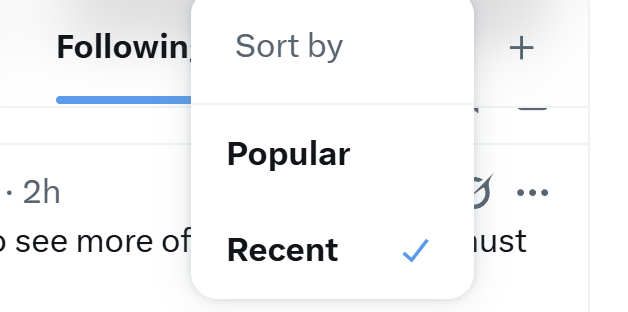
you can get off that hot mess and back to your own list by selecting "following" and then (critical) selecting "recent" so that you see the tweets in order and not (again) sorted by the algo.
that's the structure that made old twitter useful and that keeps you out of the content spirals of force fed clickbait.
really cannot recommend strenuously enough that folks flip back to it.
).
My goal was to answer why so many people have seemingly seen such a dramatic drop in their posts' reach.
The first answer, which is actually somewhat unrelated to the ranking algorithm on Github, is the auto-translate feature, rolled out worldwide on April 7, 2026 (x.com/nikitabier/sta…).
Before that date, if you wrote in English about, say, the Trump-Xi Beijing summit, you were competing for attention with maybe 5,000 other English-language accounts writing on geopolitics.
After that date, your post is competing for attention with other posts on the same topic IN EVERY LANGUAGE ON EARTH. For some topics that do command global attention like geopolitics, that's a very brutal multiplier: you used to be one of 5,000, you're suddenly one of 50,000 (something of that order): MUCH more difficult to stand out.
Secondly, the number of followers you have matters far less than it used to: each post now has to earn its audience reader by reader, on the predicted engagement of the post, and how its topic matches what each reader has recently been engaging with.
Here is how the algorithm works, in simple terms: when you, as a reader, open your feed, the algorithm doesn't load "posts from accounts you follow." Instead it runs a 2-stage prediction of what posts you're likely to engage with in that very moment.
The first stage is the retrieval stage. The system narrows billions of posts on X/Twitter that day down to roughly 1,500 candidates by matching the semantic content of each post - what it's about - against what you as a reader have recently engaged with. Some candidate posts come from accounts you follow; others are pulled from across the platform by pure topic similarity to your recent interests.
You can test this retrieval stage easily: start disproportionally engaging with - say - Brad Pitt videos and you'll bit by bit see your timeline flooded with Brad Pitt content, most of it from accounts you've never followed and never heard of.
Then there's the ranking stage. Each of these candidate posts for your feed is fed through a Grok-based model that tries to understand if you'll engage with the post.
It looks at 15 engagement metrics:
1) P(favorite) — the reader likes the post
2) P(reply) — the reader replies to it
3) P(repost) — the reader reposts it
4) P(quote) — the reader quote-tweets it
5) P(click) — the reader clicks a link in it
6) P(profile_click) — the reader taps through to your profile
7) P(video_view) — the reader watches the video
8) P(photo_expand) — the reader expands an image
9) P(share) — the reader shares it (DM, off-platform, etc.)
10) P(dwell) — the reader stops scrolling and lingers on the post
11) P(follow_author) — the reader follows you after seeing it
12) P(not_interested) — the reader marks "not interested"
13) P(block_author) — the reader blocks you
14) P(mute_author) — the reader mutes you
15) P(report) — the reader reports the post
Fifteen predicted actions, each multiplied by a weight, summed: that sum is the score that determines in which priority a post will be seen among other candidates.
Please note that posting something with a video or an image can give your post an advantage as 2 actions are specifically for these: video_view and photo_expand. No video or photo and you don't get a score for these. Also, naturally, having a video maximizes the chance that a user will "dwell" on your post to watch it.
Also note that 4 of these actions carry negative weights (not_interested, block_author, mute_author and report): meaning that if the model expects a post to generate a lot of negativity, it'll get de-boosted quite dramatically.
But note, first and foremost, what's NOT in there: none of the things that, naively, one might think a serious information platform would weigh. There is no P(this post is true and well-sourced). No P(the author actually knows what they're talking about). No P(this person has spent a decade building a body of work that has held up). No P(this account has earned the right to be taken seriously on this topic). No P(the author has a large following from credible people). The model does not seem to care - at all - about any of that.
Every post starts from zero. You could have ten years of rigorous, well-sourced analysis behind you - or you could be just an uneducated rando who registered yesterday. To this algorithm, you're both just a bag of engagement probabilities.
Now, sure, to be fair, there is a "brand" effect that's not covered by the algorithm: someone who has in fact built a brand will naturally have better engagement metrics because people recognize their account. But that's an indirect, second-order effect. And crucially, it's legacy: those "brands" were built under earlier versions of the algorithm that gave followers and reputation more weight.
Lastly, several other features of the new algorithm compound the dilution, none of them visible from outside but all consequential.
The May 15 update added an "impression bloom filter," tightening the rule that once a reader has been served a post, the system won't serve it to them again. Before, a strong post could marinate in someone's feed across multiple refreshes and accumulate engagement on the second or third pass. Now it basically gets one shot.
Also, your own posts compete with each other. An "Author Diversity Scorer" inside the ranking stage attenuates the score of every subsequent post of yours that ends up in a reader's candidate pool. In plain terms: if multiple of your posts land in a reader's candidate pool, the system shows one at full strength and dampens the others. So don't post several times consecutively on the same topic.
And, last but not least, another huge impact on reach is that, in the old algorithm, when someone reposted or quote-tweeted you, your post was broadcast to their followers' timelines - a repost from an account with 100,000 followers was a huge boost.
In the new algorithm, that mechanism is vastly demoted: reposts - like every post - need to go through the retrieval and ranking stage mentioned above, so a repost from a big account is a long way from the boost it used to be.
This is especially brutal for low-effort quote tweets, which used to function as cheap amplification: now they often can't even clear the retrieval stage - they simply don't contain enough novel semantic content for the system to match them to anyone's interests.
So, putting it all together, the reach collapse comes from many forces stacking at once:
- Auto-translate makes your posts compete for attention against an order of magnitude more content
- The retrieval stage matches posts by topic, not by who follows you
- The ranking stage scores purely on predicted engagement with no weight for credibility, expertise, or track record
- The bloom filter narrows every post's window to one strong shot
- The diversity scorer penalizes prolific posting
- Reposts no longer carry much distribution power
Each of these alone would dent your reach. Combined, they amount to a complete reset: your audience that you built painstakingly over years basically doesn't matter much anymore, and it's much - much - harder to stand out even if you're a big account.
People structurally rewarded by this algorithm are folks who:
- Post visually (videos/images)
- Post on globally popular topics because they clear the retrieval stage easily
- Provoke strong emotional reactions - likes, replies, reposts
- Don't care about accuracy or seriousness because the algorithm doesn't measure it
- Don't care about their existing audience because every post is judged in isolation anyway
In short this new algorithm, like so many on social media, is all about maximizing whether people will engage with something - not about whether they should.
@KatyTalento@sayerjigmi@RobertKennedyJr@SecKennedy Mine also is very very uncomfortable with my refusal. Another thought, what about possible mechanical damage to the breast tissue from the panini-style press particularly for women with cystic breasts?
My bougie, out-of-network obgyn, who is part of a practice that markets itself as the most enlightened on mid-life women’s health, can barely tolerate me because “she’s never had someone refuse to get a mammogram.” My informed non-consent makes her very “uncomfortable.” I specifically cited the Cochrane results, to no effect. The conditioning runs so deep, y’all.
🧵 Doctors are furious that RFK Jr. touched mammography.
But the Cochrane Collaboration — medicine's gold standard — found that for every woman mammography saves, 10 are unnecessarily treated.
The outrage is real. It's just aimed in exactly the wrong direction. 👇
I do not think this article gave readers a particularly balanced understanding of the underlying FDA review. A few reasons why:
• Most importantly, the article never really grapples with the fact that the FDA report itself classified the fatal myocarditis findings as “new safety information,” specifically because they “represent greater severity of the known risk of myocarditis” and fatal outcomes were “not currently described in labeling.”
• Instead, the paragraph focused specifically on fatal myocarditis findings ends by reassuring readers that myocarditis has “been on the label since 2021,” even though the report itself explicitly distinguished fatal outcomes from the already-labeled risk.
• The article repeatedly centers “no deaths definitively linked” without explaining how extraordinarily strict the WHO-UMC “certain” category is in vaccine pharmacovigilance, especially for death. The framework is probabilistic by design, and “certain” attribution typically requires things like rechallenge or similarly definitive evidence, something obviously impossible in death cases and often ethically impossible in serious adverse events more broadly.
• The piece technically lists the WHO-UMC categories, but the overall structure still leaves readers with the impression that anything short of “certain” is largely insignificant. That is not really how pharmacovigilance or FDA safety review works. Possible and probable assessments can still factor into signal evaluation, labeling discussions, risk communication, and further investigation.
• The article frames the report as “contradicting” Prasad without making clear that his memo itself qualified the claims by referencing likely/probable/possible attribution categories identified by staff, and never claimed a “certain” assessment had been made. One can reasonably debate whether some of his rhetoric overstated what those categories support. But that is a narrower and more nuanced issue than the overall presentation suggests.
• It also seems relevant that the email reflected an internal review process before the report was finalized. Movement from an initial ~10 to the final 7 assessments is not inherently surprising in itself, though it would certainly be interesting to better understand what changed in the downgraded cases.
• Finally, yes, anyone can submit a VAERS report. But the report itself shows how many cases were screened out because they did not contain enough information for meaningful assessment. The final classifications came after narrowing to reports with sufficient clinical detail for deeper review. The case chart itself also contains relevant details readers deserve to see, including dose timing, myocarditis-related findings, and the distinction between possible and probable assessments.
Technically accurate statements can still create a misleading overall public impression depending on emphasis, sequencing, and omitted context. That is what bothered me about this piece.
"A CEO who runs in elite, business-leader circles, recently recounted for me a conversation with two pharma and biotech executives, a couple months ago. They were bragging that 'our cabal is planning to eliminate Makary. We have a plan and we will replace him, Bobby (Secretary Kennedy), and their deputies with our people.'
It’s clear the plan is executing on schedule." - @KatyTalento
I love the direct contracting business. Not because it is clever.
Because patients would call after surgery and say:
“No deductible.”
“No copay.”
“No prior auth.”
“I didn’t know healthcare could work like this.”
When we started, there were four companies.
Today, the model has been absorbed by most brokers.
Yesterday in Dallas, I taught 300+ physicians the next frontier:
Permanent capital.
The money used to belong to health systems and carriers.
Now physicians can keep it.
That is how we make independence the proffered model…
Come on!!!
So, to sum up: Marty Makary, Tracy Hoeg, and Vinay Prasad started to investigate suspicious pediatric deaths after administration of the Covid vaccine.
One year later, all three officials are gone (resigned or forced to resign) and the FDA is still/anew recommending the Covid vaccine to small children.
Science!
#NVIC Measles Disease & Vaccine Quick Facts
More serious side effects following MMR vaccination include seizures, thrombocytopenia, pneumonia, meningitis, encephalitis, full body rash, brain damage, permanent loss of hearing, coma, and death.
🔹Using MedAlerts.org, as of April 24, 2026, there have been 119,517 reports of measles-vaccine reactions, hospitalizations, injuries, and deaths following measles vaccinations made to the federal Vaccine Adverse Events Reporting System (VAERS), including 584 related deaths, 9,319 hospitalizations, and 2,276 related disabilities. Approximately 50 percent of those adverse events occurred in children under three years of age.
🔹As of May 1, 2026, there have been 1,400 claims filed in the federal Vaccine Injury Compensation Program (VICP) for 87 deaths and 1,313 injuries that occurred after measles vaccination.
🔹Medical studies report that vaccinated persons can get measles because they either do not respond to the vaccine or the vaccine’s efficacy wanes over time.
🔹Vaccinated mothers do not transfer long-lasting maternal antibodies to their infants which would protect them for the first few months of life.
Learn more ➡️ ow.ly/KtYA50XXJ19#Measles#MMR#Vaccine#VaccineInjury#VaccineDeath#InformedConsent#NoMandates
Did you know that before the measles vaccine was introduced, annually, only 2% of people in the United States contracted the measles? There were only 4 million annual cases out of a population of 200 million.
Parents, do you have questions about measles and the measles vaccine? Many families do! Go here for answers to commonly asked questions: picdata.org/measles-faq#vaccines
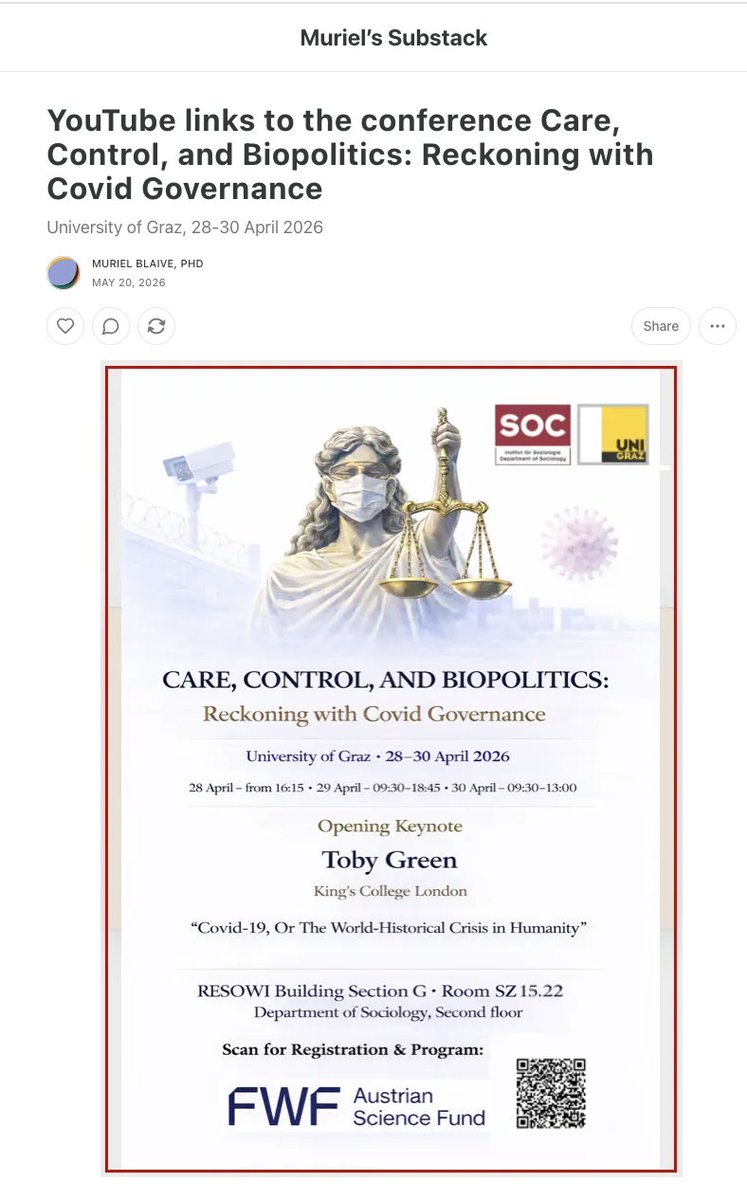
A dramatic funding cut to Austrian universities was announced in the past days. My colleagues are, understandably, in turmoil.
Who could have possibly imagined that spending billions to pay people to stay at home for months on end would result in inflation, an economic crisis, and funding cuts in the following years? As if the situation had been good already before Covid...
Still people, and not only Austrians, will continue blaming anything else but our own idiocy in spending money we didn't have to satisfy an illusory sense of control over an almost certainly man-made virus resulting from the hubris of scientists in search of glory (a "risk worth taking"). The would-be urgency of the situation was dramatized by the pharmaceutical industry with the help of mainstream media it had preemptively corrupted, and of politicians who couldn't believe their luck and seized on this unexpected opportunity to further their control over society.
All this for what? In order to sell us (pardon me: for the national states to heavily invest in, then throw away) an allegedly life-saving vaccine that turned out to be a new sort of "vaccine" - one that needs us to pay for it again and again and again. As to its efficacy and safety profile, who cares?
The pharma industry, the various billionaires who saw their fortune expand in an order of magnitude, and all Zoom-like and AI services who took the chance to seize upon our lives would like to thank us for our services.
And hey, make sure to continue *not* reflecting on how stupid we have been. Why try and learn from our mistakes when we can continue digging the grave of democracy instead?
Legacy media implemented a blackout on CIA officer Jim Erdman's testimony that the CIA’s scientific analysts determined the COVID pandemic started from a lab leak and Tony Fauci interfered in the process.
Erdman was too credible for them to skewer w/ made up news, floating
@MikhailaFuller@DeborahGeesling I really appreciate @GeorgiaEdeMD work . However, many with schizophrenia are truly unable to adhere to a strict diet without 24 hr supervision. Also, many refuse to believe they have a problem (the paranoid thoughts are very real to them). It can be very complicated.
Diet cures isn’t a hot take. It’s backed by research that people aren’t taking seriously for people suffering with schizophrenia and brushing it off is really unhelpful. Read the studies. They’re revolutionary for mental health. I’ve listed a bunch at liondiet.com but metabolicmind.org is great too. Brushing these studies off as “diet” is incredibly uneducated. It’s metabolic therapy.
There's a certain hubris and callousness to the current debate on anti-psychiatry versus psychiatry. It's hard to put into words. Saying it's "all spiritual or heart-related," or that “diet is the cure,” has some truth mixed in. Sure, put safeguards in place for overprescribing.
Yet if you take a moment, I bet you can think of at least two people you know battling serious depression from hormones, bipolar disorder or other factors. Maybe if you're like me, you have friends whose loved ones live with schizophrenia. The suffering these individuals experience is profound.
A woman I met at a disability conference who was blind put it better than I could. She said she almost thinks it's harder for her husband's friend battling bipolar disorder to find help than for herself, who is blind.
We need more compassion and humility, not hot takes on X. Suffering people are the casualties here. There is a full spectrum of maladies, there has been ever since Genesis 3. What people need is hope. Not our hard core opinions on causation and cure. As if we really knew…
@MurielBlaivePhD I listened to the discussion of Toby's lecture. I couldn't really listen to his lecture because he talks really fast 😅 and the audio wasn't quite loud enough, but the discussion was really interesting. I look forward to listening to session 2 today.
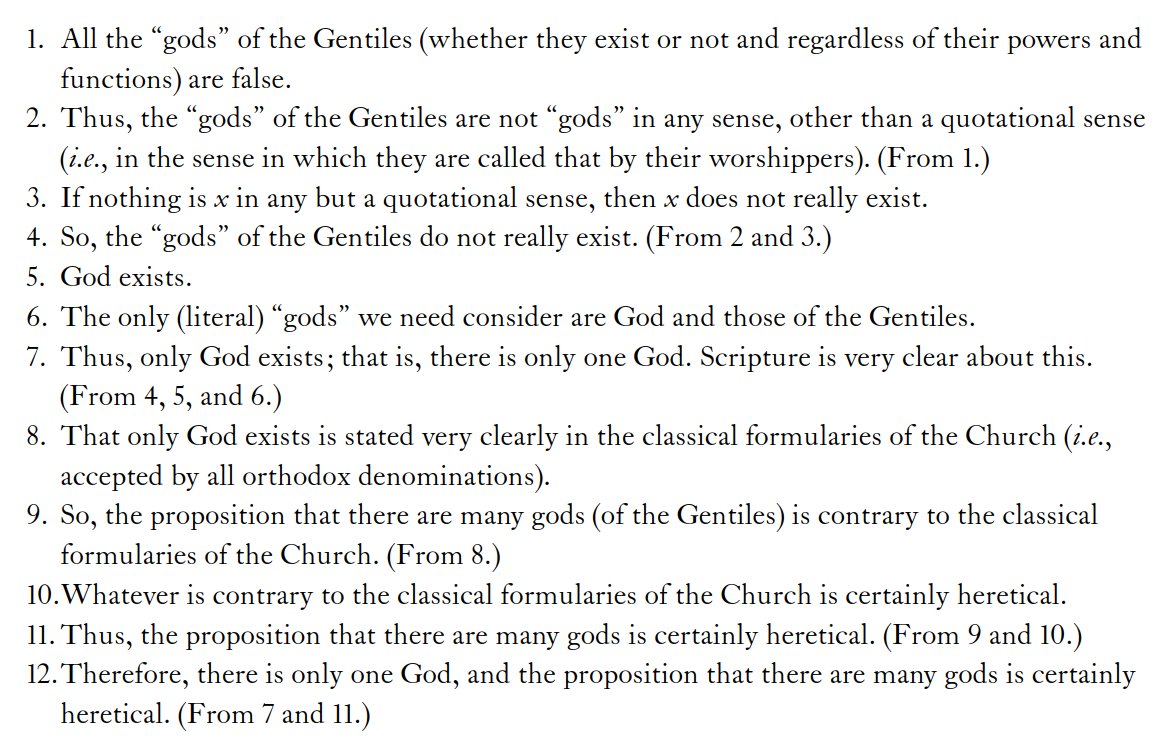
@anonymuzzzzzz@lsanger I am not a student of Heiser's work, but I think your summary is accurate. Yahweh- the one and only God made other spiritual beings with some authority and power assigned by God. Other spiritual beings are referred to as Elhoim just as Yahweh is sometimes referred to as Elhoim
Good grief, Larry, two hours ago you said "I am DONE correcting the many, many mistakes of Heiser's fan club. Wow. Just shoot me if I ever gain followers like that."
Now you're at it again.
Heiser believed their was one supreme Creator, and only one. He also believed there were many spiritual beings, sometimes referred to as gods, both in scripture and elsewhere. He taught that all creation including every being was created by God.
What do you think he taught that you are so obstinate about?
Steel man Heiser and his teaching for us so we know what you're beef is.
“Trust the experts” is not informed consent.
“Because I said so” is not informed consent.
Fear is not informed consent.
Social pressure is not informed consent.
Good intentions matter.
But in medicine, intentions do not replace transparency, discussion of risks and benefits, alternatives, uncertainty, or a patient’s right to say no.
If we truly believe in science and patient autonomy, then questions shouldn’t scare us. Conversations shouldn’t be censored. And parents shouldn’t be shamed for wanting to understand what goes into their child’s body.
The strongest medical decisions are not made through coercion.
They are made through trust, honesty, and informed choice.