david aronstein

421 posts

david aronstein

david aronstein

@DA28030

Katılım Kasım 2023
248 Takip Edilen103 Takipçiler
david aronstein
david aronstein@DA28030·
All they are doing by this is taking the pressure off oil prices which is literally the only card that they can play. It gives much credence to Trump imposing his will on them and a prelude to Iran surrender. Whatever meaningless amounts of money they may have collected is nothing compared to the stress relief on the global crude markets.
English
1
0
4
834
Michelle Wiese Bockmann
Michelle Wiese Bockmann@Michellewb_·
While you were sleeping, the Iran Revolutionary Guard Corps lined up five vessels, including two India-flagged LPG carriers and one Pakistan-flagged crude tanker to transit the Strait of Hormuz via Larak Island. Around 5am they were positioned here (red square) and by lunchtime they had reached Gulf of Oman. This re-routing of traffic via Iran's territorial waters evolved ~2 weeks ago and now between about a dozen ships can be tracked daily (excluding Iranian-flagged ships) via AIS. So far today (I'm posting this around 1620pm London time) I've seen these five ships (all going eastbound) plus another two bulk carriers (one westbound and another eastbound) clearly make the IRGC-controlled transit. There are the usual dark tankers including US-sanctioned Sullana, a VLCC that accidently pinged pretending to be a service vessel sailing westbound plus another Comoros flagged dark fleet tanker with a fake MMSI number that left a telltale blip. In additional to the two COSCO containerships turned back yesterday, I've found another three ships, one of them a bulk carrier signalling "Karachi food for PK", another saying "China owner crew - ex BIK china owner" as well as a livestock carrier. All appear to have been refused transit 24-26/3 and now at anchor, waiting. Why the two containerships were turned away wasn't clear. They were part of the Ocean Alliance which includes France's CMA CGM, perhaps that was why. At 18,000 TEU capacity each, that's a massive marine insurance bill, too. Watching and collating this information daily for @WindwardAI at such a forensic level has shown me how Iran is consolidating control over Hormuz with its selective blockade. Bulk carriers carrying agricultural products to and from Iran have access, as do select Pakistan/India energy commodities cargoes, and of course the dark fleet with oil and gas that is the revenue lifeline for the regime. And there are dark tanker transits by a well-known, baseball cap-wearing Greek shipping billionaire. One of his tankers turned up in India yesterday, another four have gone dark in the Gulf. How he is doing this takes some wily negotiating powers and deep contacts at government and commercial levels to make this happen. Many of the bulk carriers sailing through are also Greece-owned, which brings me to the thorny question of whether or not tolls are being paid for transits. I've seen no primary evidence or direct attribution from people in a position to know, just hearsay and "sources". That's not to say it's happening. A UN Panel of Experts report on Yemen found that the Houthis were also extracting money for safe passage, even when all I ever heard was rumour and innuendo. If there were tolls being paid, that would place those Greece shipowners in a particularly curly position, so perhaps if there are fees, they are being selectively imposed. This is Houthis Red Sea playbook on steroids. Work for an IMO-style safe corridor goes on behind the scenes but in the meantime, the IRGC rules the waves (in the Strait of Hormuz at least).
Michelle Wiese Bockmann tweet media
English
10
50
146
20.3K
david aronstein
david aronstein@DA28030·
I own mostly TEN and some ULCC (frontier airlines, a horribly run poor airline that lost > 50% of its share price top to bottom because of war). It's up 17% since the bottom 7 trading days ago pulling back 10% top to bottom last two days) Given the general market decline and the oil price uptick this to me is pretty telling. When the shitco airline is 17% higher after horrible news, tells me something fundamental has changed. So either oil prices going down or the economy is going to be fine and the uptick in airline fares will compensate for the uptick in fuel prices. I think the break in the gold / silver ratio marked a very important market turning point like 2011. The following 4 years were very relatively poor for natural resources. The consumers of those resources did much better. I would not short the market here, certainly not short term. We have now gone 110 basis points higher in credit default swaps with panic higher on Friday. I think we are time wise very close to a sharp reversal. We could get one more big move down Monday if there is some war reason for it, if not it is likely that the stock lows were set on Friday.
English
1
0
2
26
Joeri
Joeri@joeriwestland·
@DA28030 My portfolio is basically long Oil (both up and down stream) , long mining (PM mostly), long tankers, plus a decent amount of general market shorts.
English
3
0
3
80
Joeri
Joeri@joeriwestland·
I'm increasingly convinced a higher oil price, high crack spread, high LNG price etc environment is structural. Simply the new regime. Even if there is a major Iran de-escalation tomorrow. Say $75+ WTI is here to stay. 1/2
English
5
9
118
15.4K
david aronstein
david aronstein@DA28030·
@joeriwestland Agree, but I would rather play the effect through owning tankers because that would seem to be a less risky play since if the guess on prices is wrong it will be wrong because there is excess crude which will keep crude tanker rates pegged higher for longer.
English
1
0
3
65
Joeri
Joeri@joeriwestland·
@DA28030 the recent situations shows many countries that larger inventories are very valuable. I guess any drop in oil to say low $70's for wti will be met by agressive SPR and storage building initiatives. 2/2
English
2
0
2
89
david aronstein
david aronstein@DA28030·
You are conflating crude + product (20 million ) with crude alone. This is double counting. Prewar was 14.8 million bpd of crude. Iran was 1.5 which is still flowing and now and additional 1.0 mpbd are added to UAE pipeline flows so 14.8 - 2.5 - 12.3. So no this does not include Saudi reroute to Yanbu. All the academic studies show that demand destruction is very fast (like in the month time frame) though supply response is slower as might be expected. While SPR releases are finite 3 billion barrels of global stockpile can source years of supply at 2 mbpd.
English
0
0
0
35
MarketRhythm | Timing & Structure
The 12.2 mbpd figure already assumes partial rerouting and buffers, but pricing doesn’t wait for realized shortages. 20 mbpd still transits Hormuz and 6 mbpd Bab al-Mandeb, while only 5 mbpd can realistically move via Yanbu to global markets. Demand destruction at $100 takes time and SPR releases are finite. Even partial disruption risk reprices crude before balances adjust.
English
1
0
0
38
Javier Blas
Javier Blas@JavierBlas·
Very early on the war I wrote about SaudiArabia’s crucial East-West oil pipeline (see 👇). Now, the conduit has reached its nameplate capacity of 7 million b/d, wit exports from the Saudi Red Sea coast to global markets >5 million b/d.
Javier Blas@JavierBlas

COLUMN: Iran’s strategy is by now clear: Impose an intolerable economic cost on President Trump. One of the last lines of defence is a couple of oil pipelines offerign a partial (**emphasis on partial**) bypass of the Strait of Hormuz. Link: bloomberg.com/opinion/articl… @Opinion

English
27
66
298
93.4K
david aronstein
david aronstein@DA28030·
@joeriwestland I think the biggest risk to this forecast is complete regime change in Iran which will end any Middle East war premium and over time unlock enormous amounts of crude when western tech is applied to their deposits.
English
1
0
2
114
Joeri
Joeri@joeriwestland·
Upstream and downstream equities of course don't price in a sustained new higher price regime at all. If next 5 years Brent moves between $75-120$ range as a new regime, so many energy stocks are screaming buys...
English
2
3
37
2.3K
david aronstein
david aronstein@DA28030·
@joeriwestland The Houthis will do nothing meaningful unless they launch something at a ship. at which point they are going to get carpet bombed out of existence.
English
1
0
2
126
david aronstein
david aronstein@DA28030·
@Mark_Penn Perhaps the most terrifying illumination of the war is the incredible level of innumeracy to be found among X readers.
English
0
0
0
77
Mark Penn
Mark Penn@Mark_Penn·
Iran Math Camp Obviously the Iran war and the disruption of Iran’s global terror network seems to have come down to fear of energy prices. Perhaps FDR’s famous line would now be “we have nothing to fear but fear of oil prices.” So let’s do the math. We use 20 million barrels of oil a day. So if oil prices increased during the war to $110 a barrel that is an extra $1 billion a day in costs. So 60 or 90 days of conflict adds about 60 to 90 billion in costs in a 29 trillion dollar economy. About 70 per cent of that is domestically produced so 70 per cent of it stays in the US economy. It just shifts from one sector to the other. In comparison, Trump took in 260 billion in tariff revenues last year and all of the fears of it were overblown as that amounted to only 1 per cent of the economy. The impact here of even a 4 or 6 month conflict (and there’s no indication it will go on that long) are much less than last year’s tariffs. Oil was over $100 for 3.5 years of Obam’s term without daily headlines. Now once again the fed zigs when it should zag. Higher energy prices from a war are a drag on the economy as a result of blockades and they should cut rates to keep it strong. They instead once again do the opposite. They are a much bigger factor here if they would cut rates to lower costs. Imagine for a second how much the world will save in military and human costs once the greatest sponsor of global terror falls or is contained. This is a regime that gunned down thousands of unarmed protesters while diverting all its resources to missiles and nuclear weapons and their aims remain regional domination and beyond. Net net the math shows that once again the impacts, while absolutely real, are way overblown. The Iranians are playing to our fears and only once we realize that the benefit of removing their stranglehold on the Mideast is worth trillions in the long term can we put our fears in perspective. Once we overcome them, Iran’s principal remaining source of power on the West collapses.
English
58
208
646
25.6K
david aronstein
david aronstein@DA28030·
And unsurprisingly no one posts the actual crude supply deficit at $100. Prewar 14.8 mbpd crude (the 20 number includes products) through the SOH. Now 1.5 Iranian plus about 1 mpbd extra going through bypasses around UAE so total shut in around 12.3 mbpd. Now 5 mbpd exiting via Yanbu so total deficit 7.3 mbpd crude. Demand elasticity is at minimum -.1% for the globe though most academic studies put it at 2x that. Even at a conservative number the move in price from 65 -> 100 is 50% up so 5% decline in demand or about 5.2 mbpd. So total current shortfall at $100 is about 7.3 - 5.2 =2.1 mbpd. This is trivially made up by releases from global stockpiles of nearly 3 billion barrels. So no the price is not going to $150 or $200.
English
0
0
0
52
David Orr
David Orr@orrdavid·
USA is a large net exporter of oil products. This makes the pain to the USA very low through the IRGC's oil blockade on the world. Without fracking this event would have hurt the USA a lot.
David Orr tweet media
English
18
1
32
5.9K
david aronstein
david aronstein@DA28030·
the hormuz deficit is only 12.2 mbpd of crude. you are incorrectly conflating products + crude with crude alone. 5 mpbd of this are made up with Yanbu and at $100 and 5.25 million are removed from demand destruction. this leave 2.1 mbpd deficit at $100 and that can trivially be made up by stockpile release. That is why crude prices are going nowhere but down.
English
2
0
0
65
MarketRhythm | Timing & Structure
Even with the East-West pipeline at 7M b/d capacity, only ~5M b/d can realistically reach global markets from the Red Sea side. If Hormuz flows (20M b/d) get disrupted even partially, that buffer is nowhere near enough. Oil doesn’t need a full closure to spike — just uncertainty is enough. Markets still pricing this too calmly?
English
1
0
3
1.3K
david aronstein
david aronstein@DA28030·
@JavierBlas Why don't you inform your readers about the actual global crude deficit at $100 ? Seems odd for an energy expert.
English
0
0
0
170
david aronstein
david aronstein@DA28030·
The crude math is easy. Prewar 14.8 mbpd crude (the 20 number includes products) through the SOH. Now 1.5 Iranian plus about 1 mpbd extra going through bypasses around UAE so total shut in around 12.3 mbpd. Now 5 mbpd exiting via Yanbu so total deficit 7.3 mbpd crude. Demand elasticity is at minimum -.1% for the globe though most academic studies put it at 2x that. Even at a conservative number the move in price from 65 -> 100 is 50% up so 5% decline in demand or about 5.2 mbpd. So total current shortfall at $100 is about 7.3 - 5.2 =2.1 mbpd. This is trivially made up by releases from global stockpiles of nearly 3 billion barrels. So no the price is not going to $150 or $200.
English
1
0
9
603
van00sa
van00sa@van00sa·
600 petrol stations across Australia ran out of fuel this week according to Bloomberg Just over 20 years ago we had 8 refineries and produced 98% of our own fuel. Today we have only 2 The governments emergency plan in 2020 was to buy 1.7 million barrels and store them in underground salt caverns in Texas. But only 2 years later they sold it all . It was never replaced. Australia currently has zero government owned oil reserves anywhere on earth and no tankers to bring any home anyway. Our government’s message today is to “be a good neighbour, don’t panic buy” Mid April is when the last confirmed tankers arrive.​​​​​​​​​​​​​​​​ after that nothing is booked.
English
80
166
1.2K
75.8K
david aronstein
david aronstein@DA28030·
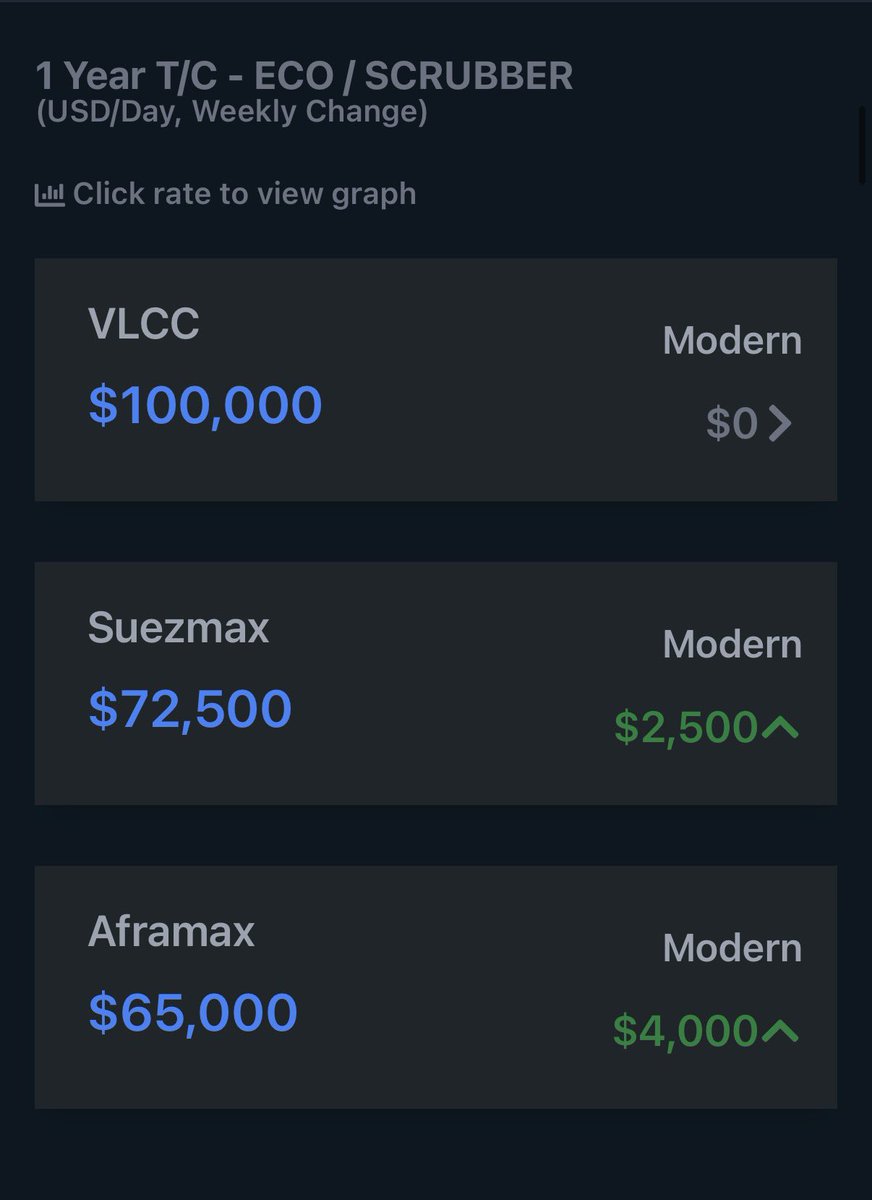
@christankerfund plugging these numbers into TEN data kit gives forward 1 year earnings for TEN of $12.50 without add on from ship sales.
English
0
0
1
88
Chris Shipping 🚢🚢
Chris Shipping 🚢🚢@christankerfund·
Fearnleys marks 1YR charters for Suezmax up by $2500 and Aframax by $4000 this week. $FRO $NAT $TEN $TRMD $BWET $STNG $TNK $DHT $INSW $ASC $ECO $HAFNI
Chris Shipping 🚢🚢 tweet media
English
4
7
56
5.7K
david aronstein
david aronstein@DA28030·
@qthomp maybe the reality is that it is not irrational at all since the alternative is to die.
English
0
0
1
227
Quinn Thompson
Quinn Thompson@qthomp·
Seems highly irrational for Iran to open the Strait during a ceasefire and forego all negotiating leverage. In that case, Trump would just aim for an indefinite ceasefire. And for that to even get off the ground Iran would need to know the US is negotiating in good faith, which was proven to be a false belief weeks ago. The moral of the story is Iran has the leverage here as Trump is crying uncle, not taco, but he will continue to do everything possible to make it seem that is not the case.
The Spectator Index@spectatorindex

BREAKING: Israel's Channel 12 reports that US negotiators are working on a one-month ceasefire with Iran, during which talks will be held over 15 items.

English
41
13
265
35.4K
david aronstein
david aronstein@DA28030·
Excellent! And I agree it will be better once the SOH opens up (and probably will be a madhouse while hundreds of ships of all stripes reshuffle and the longer it takes for it to happen the greater the restocking impulse will be) but the big point of the napkin math and your better more granular take is that Sinokor is still in control and can dictate world wide rates by withholding tonnage or probably just slow steaming. So those folks betting on a long closure and big rate declines are likely going to lose a little until the SOH reopens and then a lot. And at least for the last couple of days the tanker stocks are starting to see the light.
English
0
0
5
214
Wisdom & Boats
Wisdom & Boats@wisdomandboats·
This is great napkin math. I’ve done the granular math here for the whole picture, so mind me as I’m going to be a bit of a smartass and give my two cents on a full breakdown on this: A Yanbu loading for AG/China is about an additional 760 nautical miles. a little over 2 days. Congestion by Yanbu is adding about an additional 4 days to loading (subject to change) Comparing normal AG/China (17 days) routes a Yanbu/China (24 days) route is about 33.33% longer. Pre closure oil flows were 14.2 m bpd. 1.8m is iran and with 4.6m Yanbu flows, 1m UAE pipeline, and .3m Cirkuk pipeline the deficit is about 6.6m bpd. Putting this into a bpd basis (yanbus 4.5m bpd x 33% inefficiency) that still comes out to a ≈600k bpd deficit of demand. This isn’t perfect math since original pre closure flows also had suezmax and aframax cargoes. But overall, even accounting for the inefficiency there’s still a demand deficit. Now account for the 63 VLCCs stuck in the Gulf or about 8% of the fleet, this is still a net positive in demand. But this doesn’t account the impact on other loading zones. Hard to say yet if West Africa loading have changed much. The amount of fixtures doesn’t seem of the range and a normal % still is flowing East. Brazil loadings haven’t increased, but it seems China and Singapore discharges have increased by ≈24% and 65% as volumes route away from SE asia countries and Countries in the Atlantic, this creates a small positive demand The USG has increase volumes with the SPR release. However 172 million barrel release over 120 days is only 1.433m bpd and ≈650k-700k of that will be used to substitute volume from the middle east. The extra 730k-780k bpd will be exported equating to an extra VLCC every 2.8 days roughly. SPR releases could be pushed to ≈4 million bpd but that would cut the release to only happen over a month or so. However VLCC fixture from the USG have changed as cargoes to Singapore have increased 33% where cargoes have to China and korea have decreased 30% and 47%. Singapore voyages are 7-9 days shorter than voyages, which offset about 1/3 of the demand if spr releases stay flat. But demand is till increased hence why USG/East routes are pushing over $20 million again. Putting this all together, yes demand breaks even or even actually increases a bit for VLCCs. But this doesn’t account demand shifting to Suezmaxes and Aframaxes which is starting to be seen in West Africa and the USG. VLCCs are getting a lot more competition, hence why Suezmax and Aframaxes rates are starting to compete and even surpass VLCCs in certain loading zones on a $/day basis This is hard to quantify but having experience in the market, demand tends to even out though vessel segments. Even if the demand increase is almost exclusively long haul. VLCCs never do really well on their own, they drag up rates for the rest of tankers and demand even outs as the only way VLCCs can economically hold at high rates is if rates are high for Suezmaxes and Aframaxes. This competition within tanker segments, Asia using Iranian/russian floating storage, demand destruction, and Oil reserves used in Asia will have a net negative impact on tankers and VLCC which is already starting to show as rates reach pre-closure levels. And when SPR exports stop that’ll add more to this negative impact. Never said this would be a covid like situation where VLCC rates go negative. Tankers will still do well, but in a prolonged situation, tankers will very likely have been better off without this war. So there’s my rant on this and my perspective, but this is all subject to change very easily based on new data, trade flows, and government policies. #oott #tankers #iran
david aronstein@DA28030

apply a little napkin math. pre SOH crude transits at 15 mbpd. Iran still exporting so rest of gulf 13.5. New Yanbu moves 4.5, Fujaira about .8 so actual SOH deficit = 13.5 -4.5 - .8 = 8.2 mbpd. Assuming all SOH barrels went to china (this is most conservative). Yanbu trip is around 30% more days to china than SOH not counting excess Yanbu waiting time. So 4.5 Yanbu is equivalent to and additional 1.35 SOH so the tanker equivalent down to 8.2 - 1.35 = 6.85. If you guessed that USG -> China increase by 2.5 mbpd (SPR release + Canada, US, Ven, Brazil supply response (and you can see it happening with a slew of April and now May fixtures) the US ->China route is around 1.7 x the distance that SOH -> China so equivalent to 2.5 x 1.7 = 4.25 so tanker oversupply down to 6.85 - 4.25 = 2.6 mbpd SOH equivalent to china. Which is ballpark the equivalent of 50 VLCC excess capacity which is pretty close to the number that are trapped in the gulf. So net net we are currently seeing no tanker demand decline which explains why fixtures from the USG -> China laycan April, May are trading TC 140K or so.

English
7
7
54
26K
david aronstein
david aronstein@DA28030·
so how many more hundreds of sorties should the US and Israel undertake before they have zero leverage and Iran has won ? By the same impeccable logic Israel will shortly surrender to Hamas in Gaza because there are no more buildings left to bomb. This has to be the dumbest thing I have read on the internet today and that is saying a lot.
English
1
0
2
781
Rosemary Kelanic
Rosemary Kelanic@RKelanic·
Wars reveal information about countries' relative military capabilities and interests. That's one of the most important insights from the bargaining model of war. Iran believed before the war that fighting the U.S. would strengthen its bargaining position -- and Iran was correct. This war has revealed that Iran wouldn't topple after Khamenei's death, that Iran is highly resolved, and it can inflict damage across the Gulf at low cost, indefinitely. It revealed that Iran can gain massive leverage -- and perhaps even collect "tolls" -- from controlling shipping through the Strait of Hormuz. By contrast, the war has *hurt* U.S. & Israeli bargaining power compared to where it was before the Geneva talks in February. That means we'll get worse terms now than if we'd accepted Iran's proposal then. Why is the U.S./Israel position worse? Decapitation strikes failed to induce Iran to surrender (always an unlikely prospect), nullifying the U.S./Israeli theory of victory by day 3. No new plausible theory of victory has emerged, and it's doubtful one will. That hurts the U.S. position. Trump has proven highly sensitive to oil market swings, and even *removed sanctions* on Iranian oil. As @edwardfishman noted, Iran gained more sanctions relief from closing Hormuz than through any diplomatic means, including the JCPOA. The disruption to oil markets, and Trump's concern about them, also hurts the U.S. position. Now that the war has bogged down into an attrition battle, where Iran can impose costs with cheap means like drones and missiles and Israeli interceptors seem to be running low, the U.S. and Israel are on the losing end of the damage and casualties curve. Costs and casualties will get worse, not better, over time, and that further hurts U.S./Israeli bargaining leverage. Trump is now considering, frankly, foolhardy military gambits, potentially to seize Kharg, islands in Hormuz, or perhaps the highly enriched uranium trapped somewhere under rubble in Iran. These would be significant escalations putting U.S. troops on the ground. None are likely to end the war, and all would likely cause U.S. casualties. In the business lingo, Trump's BATNA (best alternative to a negotiated agreement) is way worse -- not least because of the shadow of Afghanistan. The U.S. forces being surged to the Middle East (2 MEUs plus some airborne units) are comparable to what George W. Bush used to invade Afghanistan in the autumn 2001. What started out as a limited mission to topple the Taliban and capture Osama bin Laden, who instead escaped through the Tora Bora mountains, evolved into a ground campaign that eventually ballooned to over 100k U.S. troops in 2011. The clear imperative here is for Trump to deescalate, credibility costs be damned. This war is existential for Iran but not for the United States, Iran will keep fighting with cheap means like drones, and it will eventually outlast the U.S. just like the Taliban did in Afghanistan. That, or Iran could fracture into chaos, creating refugee flows and breeding terrorism for decades to come. (Terrorism isn't an existential threat to the U.S., but we shouldn't be creating the conditions for it.) Trump doesn't like backing down, but that is what needs to happen here, and stat, before ill-fated escalation leads to more needless deaths. @defpriorities
Idrees Ali@idreesali114

Iran's negotiating posture has hardened sharply since the war began, with the IRGC exerting growing influence over decision-making, and it will demand significant concessions from the U.S. if mediation efforts lead to serious negotiations, three senior sources in Tehran said.

English
57
269
982
299.1K
david aronstein
david aronstein@DA28030·
@ManihiB The only reason that the arb cools down is when the SOH opens up and then you will see eye watering rates.
English
0
0
1
73
Manihi
Manihi@ManihiB·
Wide open arbs = everyone gets paid. Once arb cools down the fight between charterers /traders and owners is back on. Not convinced shipowners will have the upper hand. #tankers
English
1
0
15
1.5K
david aronstein
david aronstein@DA28030·
Anecdotal, but I am trying to get an asset backed mortgage on a piece of property. Whereas the entire thing should be an interaction with some AI based agent it is instead complicated by several humans all adding their own degrees of error which are massive and costly. If I were younger and wanted to create an easy business I'd find some capital that wanted credit exposure through mortgages and have the entire underwriting process be AI interacting with applicants. From one off experience, the current underwriting process for asset backed mortgages is archaic and poor.
English
0
0
0
53
SightBringer
SightBringer@_The_Prophet__·
⚡️This is the moment the model gets hands. That is the real threshold. Once an AI can see the screen, move the cursor, type, navigate software, and execute workflows across arbitrary apps, the whole game changes. The limiting factor stops being language quality. The limiting factor becomes agency. Can the model actually do the work, not just describe it. That is why this matters so much. The modern office is already a robot environment. Buttons, forms, dashboards, tabs, permissions, drop-downs, inboxes, calendars, CRMs, spreadsheets, admin portals. Humans were the temporary glue holding all that fragmented software together. The moment an AI can operate the same interfaces, a huge amount of white collar labor becomes directly attackable without waiting for every company in the world to rebuild its stack. A lot of “knowledge work” was never pure insight. It was operational stitching. Open this. Copy that. Check this field. Schedule that meeting. Move this information between systems. Generate the draft. Update the CRM. Reconcile the report. Upload the file. Follow the workflow. Escalate the exception. Once the model can touch the interface, the human integration layer starts getting erased. The desktop is becoming the first real robot body for AI. People keep imagining humanoids as the big labor shock. The real labor shock arrives sooner through screens. The average office worker already lives inside a digital box. If the model can act inside that box, it has entered the worker’s physical domain. That is enough to trigger a major compression wave. The first wave will be supervised agency. One human overseeing multiple agentic processes. One operator managing ten machine clerks. One analyst managing five machine researchers. One coordinator managing twenty machine admins. That still destroys labor demand because the firm no longer needs one human per workflow. It needs one human per cluster of workflows. That is where the real cull begins. The next layer is organizational. Middle management, operations teams, chiefs of staff, coordinators, assistants, junior analysts, support staff, back-office processors, internal service functions, all the roles built around moving information through software become vulnerable. Once the CEO, VP, or manager can directly deploy agentic systems into the stack, the argument for multiple relay layers gets weaker fast. And deep down, this is how bureaucracy starts dying. Through hundreds of micro-automations that remove the need for human routing, human clicking, human follow-up, human translation, human glue. The deepest part is that capability is no longer the hardest problem. Trust is. Who gets permission. Who watches the model. Who is liable when it clicks the wrong button. Who audits what it did. Who controls the credentials. Who stops the model from becoming a security breach with a smile on its face. That is the next battlefield. The winning AI platform will not just be the one that can act. It will be the one enterprises trust enough to let act at scale. Reliability, auditability, security, permissions, rollback, human override, those become more important than one more bump in benchmark intelligence. So my real view is simple. This is one of the most important threshold crossings so far. AI is moving from cognition into execution. The computer is becoming its robot body. The office stack is becoming automatable in place. A massive slice of white collar labor is now in the blast zone. Once the model can operate the software, the countdown starts.
Felix Rieseberg@felixrieseberg

Today, we’re releasing a feature that allows Claude to control your computer: Mouse, keyboard, and screen, giving it the ability to use any app. I believe this is especially useful if used with Dispatch, which allows you to remotely control Claude on your computer while you’re away.

English
48
64
567
178.1K
david aronstein
david aronstein@DA28030·
Current SOH closure amount to 8.2 mbpd. To get to your 8-900mb requires 100 day shut down. I'll take the under. And even if you were right, half of that goes away from demand destruction at at $100 and 10-20% goes away due to other increased supply. the remaining maybe 250 mb draws down global stocks maybe 10%. So very little long term effect.
English
0
0
0
322
Eric Nuttall
Eric Nuttall@ericnuttall·
The world will lose 800MM-900MM Bbls of production this year. Run cuts / demand destruction will only partially offset that, and those are barrels that are gone forever, resetting the baseline for the oil price. Views that oil heads back to $60 when conflict ends are wrong IMO.
English
19
117
1.3K
86.5K
david aronstein
david aronstein@DA28030·
Q2 is going to be way better than Q1 and that's with no war resolution. And I am still seeing the "tanker rates have to come down" because "well they do". Sinokor still in the captains seat and if you believe the chatter they are going after the Suezmax fleet. To steal a line from Animal House -- 'This is great !!'
English
0
0
0
67
Ed Finley–Richardson
Suezmax fixed USG/China $18m VLCC fixed USG/China $21.25m Want 1m barrels or 2m?
GIF
English
4
6
111
10.2K