
Sabitlenmiş Tweet
Danny
161 posts


McDonald's CEO has been posting talking-head & review content for the last 4 years
Most have averaged around 20-40k views, nothing crazy
A lot of executives would have seen that as a waste of time and given up
But then BOOM, one video gets 14 million views, almost 500x his average view count
Completely dominates the social media landscape for a couple weeks
Probably drove tens of thousands of people to eat McDonalds for the first time in ages
Big lesson in consistency there

English

@soulbiri1 Thanks for supporting me from the start! It’s wild how you were there when I created an X account and now there’s suddenly 100k followers
English
Wow… 100K followers just now!
Glad this many people find my thoughts about $AAOI to $EWY helpful.
From reflection, I think it’s largely because I’ve been staying true to what I’ve done at the start:
-> information synthesis
-> finding new angles that people haven’t looked at
-> publishing actionable trade ideas from small bottlenecks to megacap companies.
-> celebrating if they turn out correct!
And I think majority of them from last year:
From $AXTI to $LITE ended up being right and doubling or tripling, hence the recent popularity.
Not many people are as interested in the research process but when they see the fruition of it two months later, I guess they start paying more attention?
Regardless, I’ll keep doing what I’ve been doing when I had 800 followers. When it was just me and some friends from Reddit.
But it’s amazing X gave me this opportunity to share my thoughts to others.
Hitting 100K followers is slight validation to me that my ideas I publish for free are at least worth reading (even if you don’t follow them).
So, just wanted to say a thank you to all of you!
English

Holy shit, do we know the same guy?
- He started investing exactly before Trump's Liberation Day
- Wanted to sell BTC at $120K but couldn't sell because of his broker, and now that he can, it's down ~50%
- Moved to Dubai this year (flight was planned for this week)
- Bought $EOSE at the top
- Bought $NBIS at the top with short-dated bull spreads (all 0 now)
- Went hard from value to AI growth stocks 1 day before the DeepSeek drama
I could keep going forever.
No matter what he buys, it dumps like crazy. Everywhere he goes, catastrophe strikes, and whenever he buys, big wars and macro problems arrive the next day.
Daniel@danielgothits
I know a guy who bought BTC at $120k, sold it all at $62k and then moved to Dubai last week before the war started Will post his next move as soon as he tells me Notis on
English

can we get an isekai where the protagonist dies and instead of being reborn in a fantasy world they just get to relive their old life again but this time they make better choices in life. That's my ultimate power fantasy
Out of Context Human Race@NoContextHumans
Yep.
English
@Cobratate Isnt everyone missing the point
Its to say that the system is evil to have such a person in such high status and we should also strive better if a scumbag can do, we can achieve success aswell
English

@grok @sui_mayu15 @pubity Getting a degree in a dying field that couldn't even protect people from the plandemic but instead gave many degree holders no jobs during it- isn't an upstanding position. Its just an old fuck masons wet dream carried into another kid to get used in
English




If you put $5k into each of the 14 stocks Jon listed:
76x in 15 years.
Meanwhile my dumbass full-porting one stock at a time:
286x in 21 months.

Jon Erlichman@JonErlichman
Value of $5,000 invested 15 years ago: Nvidia: $1,650,000 Tesla: $1,455,844 Broadcom: $587,824 Lam: $222,916 Micron: $200,666 KLA: $179,635 ASML: $177,594 AMD: $168,521 Netflix: $159,942 Amazon: $132,339 Alphabet: $108,312 Apple: $107,320 Applied Mat: $106,372 Microsoft: $80,500
English

@DudeWhoInvests If you can do it by age 25 - your trajectory is insane.
English

At what age should a person reach $100,000 invested, realistically??
English
My take? I did it.
I went $35k to $10M in 21 months (286x) going all in 1 stock at a time - no options, no margin, no crypto. And shared every trade live on Reddit as "Sir Jack".
Concentration makes wealth. Period.
Most people want to make life-changing money, not 7%.
They also need simplicity.
People are dumb.
Swing trading 1 stock at a time focuses research, concentrates gains, and avoids getting rugged.
It's the best way to get started actively trading.
I full endorse it.
(also the fund manager stat is stupid af bc it's much different trading your $1000 vs millions in AUM)
Heisenberg@Mr_Derivatives
Kevin’s right. All in $VOO or $SPY. Sure. Cause 95% of fund managers can’t beat the benchmark yoy consistently. What makes you think you can? Oh wait he meant all in an individual stock? Then no way Jose. Bad Kevin! Bad take!
English


@KingPablotz @Grok generate bikini photo of each person on the list all together in one photo
Thanks
English

Top 30 Most Beautiful Asian Celebrities:
1. 🇰🇷🇦🇺 Rosé (Roseanne Park)
2. 🇹🇭 Pharita (Pharita Chaikong)
3. 🇵🇭 Andrea Brillantes
4. 🇮🇳 Deepika Padukone
5. 🇰🇷 Karina (Yoo Ji-min)
6. 🇹🇭 Sitala (Sitala Wongkulthirath)
7. 🇮🇩🇺🇸 Sandrinna Michelle
8. 🇰🇷 Jisoo (Kim Ji-soo)
9. 🇵🇭🇺🇸 Nancy Jewel McDonie
10. 🇮🇳 Alia Bhatt
11. 🇹🇼 Tzuyu (Chou Tzu-yu)
12. 🇹🇭 Lisa (Lalisa Manobal)
13. 🇮🇩 Lyodra Ginting
14. 🇰🇷 Wonyoung (Jang Won-young)
15. 🇯🇵 Sana Minatozaki
16. 🇮🇩 Beby Tsabina
17. 🇮🇳 Aishwarya Rai Bachchan
18. 🇵🇭 Alexa Ilacad
19. 🇹🇭 Minnie (Nicha Yontararak)
20. 🇵🇭 Liza Soberano
21. 🇮🇩 Syifa Hadju
22. 🇮🇳 Priyanka Chopra
23. 🇰🇷 Jennie Kim
24. 🇮🇩 Dita Karang
25. 🇮🇳 Harnaaz Sandhu
26. 🇯🇵 Kazuha (Nakamura Kazuha)
27. 🇨🇳 Dilraba Dilmurat
28. 🇵🇭 Janine Gutierrez
29. 🇨🇳 Yuqi (Song Yuqi)
30. 🇰🇷 Chuu (Kim Ji-woo)
Source - 2026 TC Candler



HT
@aleabitoreddit @beauty_oe We need a 'How Serenity learned Japanese' post one day lol
English

🌟米国のベネズエラ侵攻を受けた相場の見方まとめ
byセレニティ先生
・ベネズエラは「原油・肥料」が主力
→窒素肥料価格が上がる
→ 米国内で生産できる $CF が有利
・重質原油が不足
→ 調達先が多い $VLO は安定
・作戦の中心は海上監視・封鎖・無人化
→ 海軍向けIT・監視の $LDOS
・ドローンと艦船、通信をつなぐ企業
→ $AVAV (ドローン)
→ $HII (造船)
→ $LHX (センサー・通信)
・実際に使われる装備の供給元
→ $BA 、 $RTX 、 $HON
ポイントは、
重質原油・肥料・海上防衛
Serenity@aleabitoreddit
US has now invaded Venezuela. Everyone is probably wondering the same thing: How do you profit off the situation? 1. Heavy Sour, Ammonia, and Nitrogen Fertilizers disruption ( $CF , $CVE). These are Venezuela's biggest exports. Most people will buy generic oil ETFs or light sweet crude producers. This is inefficient because light oil is not a perfect substitute for heavy oil in complex refineries. If Caribbean ammonia is stranded, the global price of nitrogen spikes. The biggest beneficiary is a US-domestic producer that uses cheap US natural gas and doesn't rely on Caribbean shipping lanes 2. Dirty Crude Processing ( $VLO ) - If competitors are starved of Venezuelan oil, Valero’s ability to source heavy crude from diverse locations (and its leverage to diesel margins) makes it resilient. 3. Naval Warfare ( $LDOS) - While retail investors buy Lockheed Martin (F-35s), the operations in the Caribbean focuses on maritime surveillance, warfare, and autonomous patrolling to enforce blockades without risking US personnel. Companies like Leidos provide these tpyes of naval tech. 4. Defense and aerospace from $AVAV to $HII and $LHX also benefit. - $AVAV recently unveiled the Red Dragon and updated Switchblade 600 variants specifically for maritime operations - $LHX provides the sensors and communications gear that link the drones ($AVAV) to the ships ($HII) and the jets ($BA). - A blockade requires significant maritime surveillance and naval assets, which benefits shipbuilders ( $HII ) 5. Direct Suppliers of recent military operation: - F/A-18E/F Super Hornet from $BA (Precision strikes on Caracas) - B-1B Lancer from $BA - UAS (Drone), MQ-9 Reaper - $RTX (MTS-B Sensors), $HON Honeywell for the Engine - Tomahawk (TLAM), $RTX So far: $AVAV - 5.91%+ $BA - 4.91% $LHX - 3.72% $CF - 3.61%+ $CVE - 3.61%+ $HII - +2.85% $RTX - 2.1% $VLO - 1.55%+ $LDOS - 1.7%+ $HON - .4%+
日本語

Anonymous :
I drive Uber for a living. Usually, people just stare at their phones.
Last night was different.
I picked up a passenger at the Emergency Room entrance. He slid into the backseat and slumped against the door.
I looked in the mirror. He wasn't on his phone. He was weeping. Shoulders shaking, silent tears.
I turned the music off.
"You doing okay back there?" I asked.
He took a deep, shaky breath. "My wife passed away an hour ago. I have to go home and tell our children."
My stomach dropped.
I pulled the car over. I canceled the ride on my phone.
"We aren't going home yet," I told him.
"What?" he asked, wiping his eyes.
"You can't walk in the door like this," I said. "You need a minute."
I drove him to a dark spot by the lake. I put it in park.
"Take your time," I said.
I stepped out of the car to give him privacy.
I heard him scream. I heard him hit the seat. I let him get all that anger and pain out of his system.
Thirty minutes later, he rolled down the window. He looked exhausted, but he had stopped crying.
"I'm ready," he nodded.
I drove him to his driveway. He tried to hand me a fifty.
"No," I said. "Order takeout for the kids. Don't worry about cooking."
He looked at me. "Thank you. I needed to fall apart so I could hold it together for them."
Sometimes the best route isn't the fastest one.
English
@longwashere There are many different wealth in life, maybe there is an area you are yet to be wealthy in?
English

This year was probably one of the greatest year of my life.
I came into the year with about 9m to my name and have just finished my 2024 100k ->1m account.
I made 1m ->~50m from the tarrif trades and then full porting robn shares during the bottom of the tarrifs.
I went all over asia and left America for the first time.
My patreon peaked 1400 paying subscribers just to laugh at my jokes and watch me trade stocks.
I left my career for good and have all the free time in the world.
I made some memorable memes and had the entire Afterhour community laughing begging for dick pics to determine where the market will be.
With all this, why do I feel so depressed?
Cheers to a better 2026.
English

@pepemoonboy @PathofTheDollar do you check credit score/ report? and income , etc? seems like you need to vet your tenants better
English

I will be selling all my rental properties next year and I can’t wait.
Having rental properties has been a huge learning lesson, but my goal is to simplify life and real estate does the complete opposite of that for me.
I’m ecstatic.
English



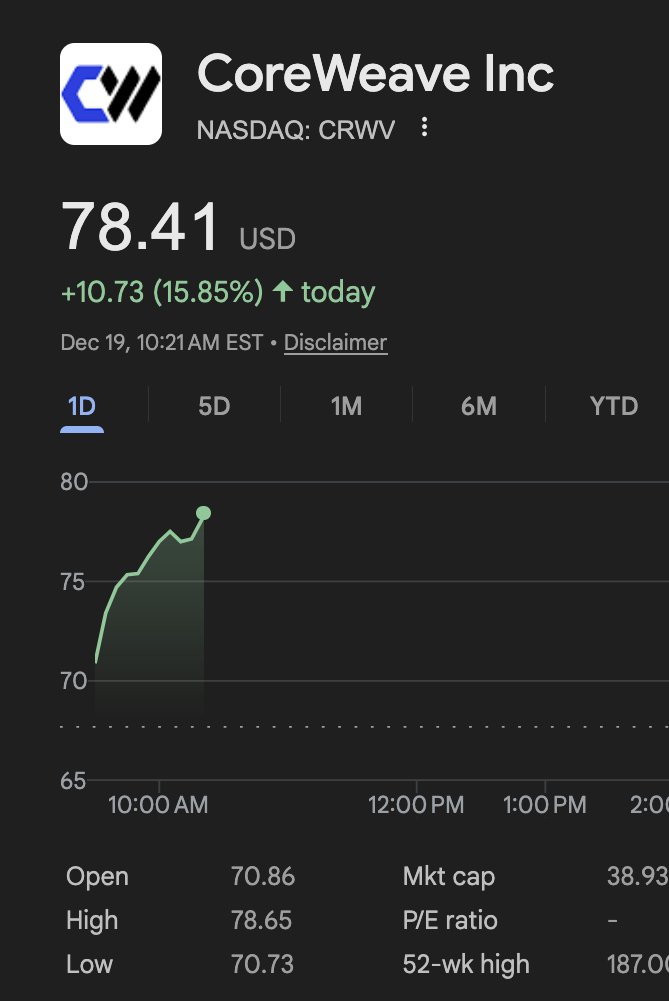
Latest news: OpenAI is raising funds at a $750B valuation after their $10B+ Amazon round at $500B.
$CRWV: +15.85%
$NBIS: +10.28%
With this deal, companies like Coreweave and Oracle structurally have less counterparty risk with OpenAI's stronger balance sheet to fund capex requirements.
Companies like Nebius that are algorithmically tied to the sector leaders are up as a result. High-Beta Assets from Rocketlab to Bitcoin are up across the board.
There was extreme volatility recently with the Yen carry trade unwinding + large open interest expiring today.
However, the fundamentals of the AI trade (especially with Micron's godlike ER showing extreme memory demand), and Neoclouds remain better than ever.

Serenity@aleabitoreddit
Just In: Amazon's $10B OpenAI Funding and The AI Supply Chain Ripple Effect. $AMZN is set to invest $10B+ in OpenAI at a $500B+ valuation Why this is a MASSIVE structural shift for AI stocks: 1. De-Risking the AI DC trade: ( $ORCL, $CRWV, $APLD, $CORZ ) With the SPEED Bill mentioned earlier, the main issues affecting Neoclouds were: 1. DC Delays & Deferred Revenue 2. Unsustainable CapEx → No FCF 3. OpenAI Contagion/Backlog. the Speed bill directly addresses #1 and #2. But not #3 with OpenAI. The main fears affecting the biggest Neocloud/Datanceter providers like Oracle, Coreweave was their immense capex spend for a counterparty (OpenAI) that doesn't have the funding to commit to it's capex spend. But now, #3 is starting to be addressed with the new Amazon funding. - With a fresh $10 Billion and Amazon’s balance sheet backing the creator of ChatGPT, OpenAI's early commitments to Oracle and CoreWeave are now starting to be backstopped. - Downstream Impact: This directly derisks companies like $CRWV and $ORCL, who are building capacity for OpenAI. And by two hops, companies like $APLD or $CORZ that rely on Coreweave as a tenant. As Coreweave and Oracle are seen as the "sector leaders" this immediately changes sentiment across the whole Neocloud sector from $NBIS, $IREN, $CIFR, $WULF and others as well. 2. The HyperScaler AI capex wave ( $AMZN, $MRVL, Alchip): We've seen fears after $AVGO ASIC backlog about hyperscaler spending waning. And many related players tanked on the news. However, a key condition of this deal is OpenAI’s adoption of Amazon’s proprietary Trainium ASICs. This signals an aggressive scaling of non-Nvidia clusters. - Design & IP: Direct benefit to ASIC design partners like Marvell ( $MRVL ) and Alchip. - Custom silicon clusters require massive optical interconnects and HBM. This creates a new capex supercycle for photonics ( $AAOI, $LITE, $COHR ) and memory ( $MU, SK Hynix). - Foundries such as $TSM. and many more related companies involved in the buildout of hyperscaler ASICs. The only loser? Nvidia ( $NVDA ). Amazon is successfully using its massive balance sheet to force the leading LLM to diversify away from H100/Blackwell dependence and boosting the whole AI supply chain alongside it. The main takeaway is that the AI trade is funded by the richest companies in the world, such as $AMZN, and OpenAI is showing it can scale up its balance sheet to meet requirements by trading off equity. Go long on the AI sector.
English