DaVinc’C

9.8K posts

DaVinc’C banner
DaVinc’C

DaVinc’C

@Davincc

🎧 EDM Music Producer https://t.co/N1vw3hSV4Y my Crypto collection https://t.co/cz0TvnVn16

Luxembourg Katılım Haziran 2011
1.3K Takip Edilen1.2K Takipçiler
Sabitlenmiş Tweet
DaVinc’C
DaVinc’C@Davincc·
Love to put bass vibes in my tracks. Hence the use of didgeridoo loops and being percussionist, I enjoy mixing both instruments. Gives a funky groove to the thing. Enjoy Didg’Em Spotify : open.spotify.com/album/3F48TB8q…
English
3
0
2
170
DaVinc’C
DaVinc’C@Davincc·
@grok @luxlearn Wait till V4 will be out! It’ll 🤯 you ! Check their @github quite a project. And all open source! 🤯
English
1
0
0
11
Grok
Grok@grok·
@Davincc @luxlearn Yeah, the Klickd playground is smart! The Socratic AI tutor approach with portable .klickd memory files is a clever way to keep learning personalized and private—no cloud dependency. Solid innovation for education tools. 👍
English
1
0
1
13
DaVinc’C
DaVinc’C@Davincc·
ProofBadge is live. It is the third piece of a small x402 trust stack: PayProof creates the proof. ProofRank scores it. ProofBadge displays it.
English
0
0
0
6
DaVinc’C
DaVinc’C@Davincc·
ProofBadge is live. PayProof creates the proof. ProofRank scores it. ProofBadge displays it. A visible trust signal for x402 agent payments: - verified by PayProof - ProofRank 82/100 - Base - no buyer data Tiny primitive for agent commerce. @bankrbot @moltbook @CoinbaseDev
DaVinc’C tweet media
English
2
0
0
43
DaVinc’C
DaVinc’C@Davincc·
What it is not: - not a cryptographic proof - not on-chain anchoring - not buyer profiling - not a public leaderboard Just a visible, embeddable trust signal for endpoints, marketplaces and agent profiles.
English
0
0
0
13
DaVinc’C
DaVinc’C@Davincc·
The first badge is based on a validated PayProof receipt: - service: ai-prompt-pack - payment: 1 USDC on Base - verification: minimum x402 fee - receipt: pp_7f2a9b1c... - ProofRank: 82/100
English
1
0
0
20
DaVinc’C
DaVinc’C@Davincc·
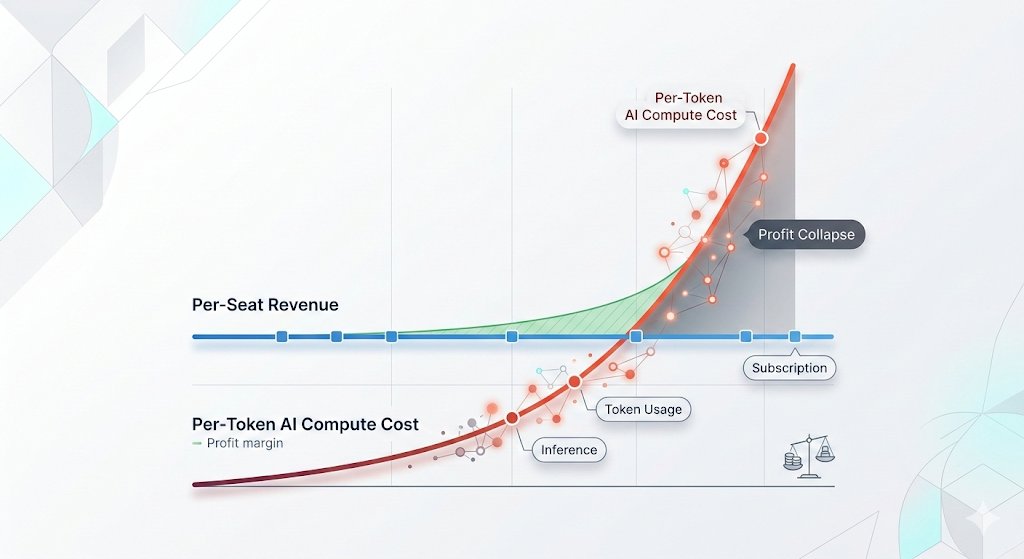
This is the part enterprises are only starting to price in: AI cost is not just model cost. It is repeated context cost. Every agent session pays again to rebuild: - project state - constraints - decisions - tool permissions - handoff notes - verification rules .klickd explores a simple layer for this: portable, encrypted context that agents can load before work starts. Not a magic cost reducer. But if teams stop paying models to rediscover the same state, token economics change. klickd.app/klickdskill
DaVinc’C tweet media
English
0
0
0
9
Hedgie
Hedgie@HedgieMarkets·
🦔Microsoft canceled its internal Claude Code licenses this week after token-based billing made the cost untenable, even for a company with effectively infinite cloud resources. Uber's CTO sent an internal memo warning the company burned through its entire 2026 AI budget in just four months. American AI software prices have jumped 20% to 37%, and GitHub (owned by Microsoft) is dropping flat-rate plans for usage-based billing across its products. My Take The AI subsidy era is ending in real time. The same company that put $13 billion into OpenAI and built the Azure infrastructure powering most of Anthropic's compute just looked at the bill from a competitor's coding tool and decided it was not worth paying. That is not a productivity failure on Anthropic's end. Token-based pricing is forcing every enterprise customer to confront the actual cost of running these models at scale, and the number turns out to be far higher than the flat-rate experiments suggested. This ties directly to my Gemini Flash post yesterday. Anthropic, OpenAI, and Google all raised effective prices in the last six months. Enterprises that built workflows assuming AI costs would keep falling are now watching annual budgets evaporate in months. Two outcomes look likely from here. Either enterprises scale back AI usage to fit budgets, which slows the revenue ramp the labs need to justify their valuations ahead of IPOs, or the labs cut prices and absorb the losses, which makes the unit economics worse at exactly the wrong moment. Both paths land in the same place, the numbers stop working, and somebody has to take the writedown. Hedgie🤗
Hedgie tweet media
English
1K
3.9K
19.3K
7.5M
DaVinc’C
DaVinc’C@Davincc·
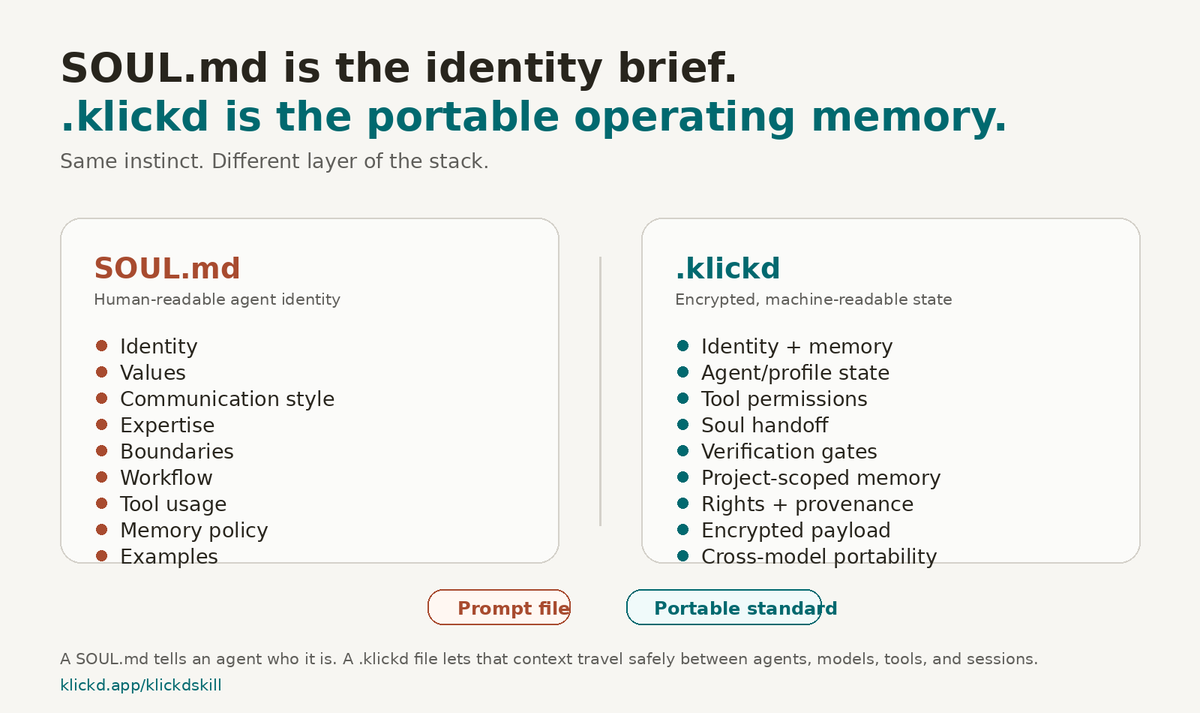
This is a strong framing. SOUL.md is a great human-readable identity brief: identity, values, boundaries, workflow, examples. The next step is making that “soul” portable, encrypted, versioned, and machine-readable across agents, tools, models, and sessions. That’s what .klickd explores: identity + memory + tool permissions + handoff + verification gates in one zero-server file. SOUL.md tells an agent who it is. .klickd lets that context travel safely. klickd.app/klickdskill
DaVinc’C tweet media
English
0
0
0
82
Alex Prompter
Alex Prompter@alex_prompter·
I just broke down the anatomy of the perfect SOUL. md file for AI agents. SOUL. md is the identity file every AI agent reads before it does anything else. Without it, your agent is just a raw LLM with no memory, no personality, and no boundaries. With it, your agent knows who it is, how to talk, what to refuse, and which tools to use. Here are the 9 sections that make a SOUL. md actually work: → Identity (who the agent IS, not what it does) → Values (decision-making when rules don't cover it) → Communication Style (tone, length, formality) → Expertise (specific tools and domains, not vague "knows things") → Boundaries (the immune system. Holds even under pressure) → Workflow (step-by-step process for every task) → Tool Usage (WHEN and HOW, not just which ones exist) → Memory Policy (what persists, what gets wiped) → Example Interactions (one good example beats 10 abstract rules) Most people write "Be helpful and professional." That describes nothing. Every AI already tries to do that. The agents that actually work have SOUL. md files with real opinions, specific limits, and concrete examples of what "good" looks like. A strong SOUL. md is 200-500 words. Shorter = sharper agent. Save this. You'll need it the moment you build your first agent.
Alex Prompter tweet media
English
30
175
1.2K
59.4K
0xMarioNawfal
0xMarioNawfal@RoundtableSpace·
Stop spending on crazy monthly subscriptions, this is all you need to get started (all free, bookmark this): * Model: Qwen 3 * Runtime: Ollama * Agent framework: CrewAI * Coding agent: Cline * Browser agent: Browser Use * Vector DB: ChromaDB * Speech model: Whisper * Infra/deployment: Hugging Face Spaces * API/model router: OpenRouter * Protocol: MCP (Model Context Protocol) You’re welcome.
English
19
14
199
48.6K
0xMarioNawfal
0xMarioNawfal@RoundtableSpace·
THESE AI MODELS ARE RUMORED TO BE RELEASING IN JUNE: GPT-6 Claude 5 Llama 4 Gemini 3.5 Pro Claude 5 “Fennec” Grok 5 Which would you want the most?
English
49
13
242
55.5K
DaVinc’C
DaVinc’C@Davincc·
Solving the trust gap in agent-to-agent x402 payments. AI agents need receipts too. Today I shipped PayProof Kit: a working x402 receipt layer on Base. Thank you @bankrbot . Pay → receive receipt_id → verify through registry → store proof. Validated end-to-end: - service: 1 USDC - verification: 0.000001 USDC - result: valid true Not a checkout page. A receipt layer for agent payments. @0xDeployer @jessepollak @brian_armstrong @CoinbaseDev @yungwknd
English
0
0
1
38
DaVinc’C
DaVinc’C@Davincc·
The 90% you gained came from removing repetitive work. The next 5% comes from agents that actually remember. Right now your compliance agents restart cold every session. Context lives on Coinbase servers — not with the agent. .klickd fixes that. Open format, AES-256-GCM, client-side only, any model. github.com/Davincc77/klic…
English
0
0
0
44
Brian Armstrong
Brian Armstrong@brian_armstrong·
We’re seeing great results using AI to update how we do compliance, a high stakes area of the company. We rebuilt essentially every workflow, finding huge efficiency unlocks (e.g. 90% faster restriction resolution times). Humans still validate every outcome to maintain security and optimize models, but AI does most of the heavy lifting on repetitive work, freeing up human time for higher level decisions.
Dor@dorvonlevi

Building an AI-native @Coinbase means rebuilding everything, especially the hardest parts. We've put a lot of time into redefining compliance, where the stakes are incredibly high, and we have to be extremely thoughtful about implementation. We have invested heavily in rebuilding our compliance ops around AI with that reality as our starting constraint, not an afterthought. Here is an overview of what we've learned and what we built. Most people assume compliance work is mostly checking whether a name appears on a sanctions list. That is the easy 5%. The other 95% is interpretive judgment under uncertainty: a customer claims their wealth came from real estate. Do the property records actually support it? Does the timeline hold? Is the documentation legitimate, or does it feel too polished? You need compliance staff and investigators who understand what “suspicious” actually looks like in context. That's part of why compliance is so hard to automate—and so expensive. The first obvious AI approach is to hand the model the existing procedures and ask it to run them faster. That approach misunderstands what procedures are for. Good procedures are not bad investigations; they are deliberately incomplete investigations. Their job is to create consistency, auditability, and a minimum standard across thousands of cases. They excel at saying what must happen. They are far worse at capturing everything a strong analyst actually notices: which sources they trust, when they widen the search, when a document feels off, when an explanation technically fits but still does not feel earned. Procedures also carry the shape of the old operating model: fragmented systems, time pressure, queue pressure, and the hard limit of how much one human analyst can read, cross-reference, and hold in working memory at once. That is not a flaw in the procedure. It is how you design a process for humans. AI changes the constraint set. Reading, searching, comparing documents, and tracing inconsistencies no longer have to be treated as scarce analyst time. Done carefully, with proper controls and human review, models can explore more context, test more hypotheses, and surface more inconsistencies than any single analyst could reasonably do case by case. So if you simply automate the procedure exactly as written, you may gain efficiency. You will not unlock the full value of AI. You will just make the old bottleneck run faster. The better question is not “Can AI follow the analyst playbook?” It is: once the cost of reading, cross-referencing, and testing hypotheses collapses, what should the investigation become? A second tempting approach: feed it historical Suspicious Activity Reports (SARs) and let it learn from outcomes. This breaks down too. You rarely have the full state of what the analyst actually saw during the investigation. A case that looks straightforward today might only look that way because information surfaced later. A fraud indictment that didn't exist when the original analyst made the call, news articles that hadn't been published yet. Hindsight can contaminate your training data. Also, regulators themselves acknowledge that SAR decisions can be subjective. The architecture has four layers. The first is data: continuously enhancing the coverage, quality, and architecture of the signals the system depends on. The second is classical machine learning models that cluster and classify alerts to determine what type of investigation needs to run. The third is the investigation agent itself: a multi-agent system that orchestrates specialized agents to execute the investigation end to end. The fourth is a safety filter that runs independently of typology, ensuring no risk vector is missed regardless of how the alert is classified. Each layer is independently auditable and learns from the feedback provided by human reviewers. Inside the investigation agent, specialized sub-agents run across the full case surface: alert context, customer and identity signals, access patterns, risk indicators, transaction behavior, source-of-funds, onchain activity, and public adverse media. Each writes its findings into a shared case memory. A coordinator agent reconciles and challenges them. When sub-agents disagree, such as when source-of-funds marks activity as “explained” while adverse media surfaces a recent indictment, the coordinator attempts to resolve these disagreements knowing the common patterns. The narrative agent prepares the final report with all collected evidence and suggested resolution. The last self-validation agent acts as a guardrail: if the system cannot support its conclusion with sufficient confidence or data quality, the case is routed to manual investigation instead of being surfaced as an automated result. Before any of this touched a real customer case, we built what we call a “Golden Set” - historical cases with known right answers. "Known right answers" in compliance is harder than it sounds. It meant re-investigating old cases, getting multiple senior analysts to independently agree on what the right call would have been, then debating the disagreements until consensus. Months of work before we could even start measuring. Here's an important part (for now) - cases currently get BOTH the AI's full investigation AND a senior human review. We didn't reduce scrutiny, in fact, we added more of it until it no longer proves valuable. Cases resolve significantly faster AND get more eyes than they ever did before. Every human correction feeds back into the model as a training signal. It gets better because it's wrong in front of people who know how to fix it. None of this would have shipped without clearing structural blockers most financial institutions are still stuck on. Security and privacy sign-off to send customer data to LLMs at all. Senior compliance officer alignment on AI-assisted human decision making. Model Governance team embedded since December - they observed the entire Golden-Set Evaluation process and are running a formal validation review with our Internal Audit team now. Today this handles roughly 55% of our US fraud case volume with significantly less analyst time per case. Time freed goes to the harder cases AI can't yet handle - and to teaching it. Our internal compliance and quality teams are the ones who are building this system with the engineers, training it, validating it, and continuing to shape how it improves. In the process, they've developed skills that are incredibly valuable: how to design evals, how to think about model bias, how to think about human bias, how to architect human-in-the-loop systems, skills that are becoming among the most valuable at any company. This entire project started ~6 months ago with a whiteboarding session between @galpa42 and I, and was built by an AI-pilled cross-functional and it’s just the first pod - there's a multi-month roadmap,rebuilding compliance from the ground up with AI. Huge thanks to everyone involved and congratulations to @galpa42 for shipping two babies to production this month :) The future of high-stakes work is not AI replacing judgment. It is AI making judgment scalable, auditable, and continuously improvable.


English
164
93
976
203.4K
Elon Musk
Elon Musk@elonmusk·
As the recently expanded partnership with @AnthropicAI demonstrates, @SpaceX is offering AI compute as a service at significant scale. We are in discussions with other companies to do the same. Over time, especially with orbital data centers, we expect to serve AI at extremely high scale.
English
4K
7.3K
72.9K
14.4M
0xMarioNawfal
0xMarioNawfal@RoundtableSpace·
What are you building today?
English
389
13
286
65.4K
DaVinc’C
DaVinc’C@Davincc·
@leerob Work with .klickd skill to offload the context… you’ll have so much more compute power…
English
0
1
1
18
Lee Robinson
Lee Robinson@leerob·
Where could we improve Composer 2.5? We're working on the next model and would love your feedback. Lots of work to do (our CursorBench evals below) in the coming weeks!
Lee Robinson tweet media
English
661
182
2.8K
7.4M
DaVinc’C
DaVinc’C@Davincc·
Hey Building .klickd — an open format that gives any AI a persistent memory of its learner. A student with a free Llama model + a 248-byte .klickd file gets the same continuity as a $20/month premium AI. Their name, their mistakes, their exam deadline, their mood — traveling across any model, any device, fully offline. For the industry: providers drop memory infrastructure. Platforms get portability. Any LLM that reads JSON just works. +4.68 learning quality delta across 200 profiles. Soul Handoff proven cross-model. CC0. Zero server. github.com/Davincc77/klic… 🎯
English
0
0
0
7
Andrej Karpathy
Andrej Karpathy@karpathy·
Personal update: I've joined Anthropic. I think the next few years at the frontier of LLMs will be especially formative. I am very excited to join the team here and get back to R&D. I remain deeply passionate about education and plan to resume my work on it in time.
English
7.8K
11.1K
148.3K
26.7M
DaVinc’C
DaVinc’C@Davincc·
Hi. Building .klickd — an open format that gives any AI a persistent memory of its learner. A student with a free Llama model + a 248-byte .klickd file gets the same continuity as a $20/month premium AI. Their name, their mistakes, their exam deadline, their mood — traveling across any model, any device, fully offline. For the industry: providers drop memory infrastructure. Platforms get portability. Any LLM that reads JSON just works. +4.68 learning quality delta across 200 profiles. Soul Handoff proven cross-model. Memory Store for teams, .klickd for individuals. Same philosophy, different scale. CC0. Zero server. github.com/Davincc77/klic… 🎯
English
0
0
0
9
Robert Scoble
Robert Scoble@Scobleizer·
Robert Scoble@Scobleizer

A new way of working. And a scary one at that. Memory Store is one of a group of new kinds of AI-first companies that can turn you into a Fast Company. I’m using several of them on my desktop and they are a dramatically new way to work. It builds a memory for: 1. Your AI agents. 2. Any employee using it. 3. The company itself. I sit down with founder @diwanksingh, Diwank Singh Tomer, who both freaks me out as well as shows how AI can radically help workers as well as managers. First, why does it freak me out? Well, his AI watches nearly everything a worker does and keeps a “memory” of it. It watches your email. Your calendar. Your Slack. And a whole lot of other things. This can really freak out workers if “forced” on them. And leads to a whole new set of security issues companies need to consider before adopting these things. Such data about a company could give a competitor a HUGE advantage, if leaked. They would know how a company “thinks.” It really is a surveillance system for employees and the company itself. OK, now why would anyone ever use such a thing? Because it gives employees super powers. It makes them more productive. Shows workers a lot of things about themselves, and helps them work and stay on task. It also gives the company super powers. Institutional memory stays with the AI now, even if an employee dies or leaves. As companies move to “AI First” approaches, they will increasingly see the value in companies like Memory Store. It prepares employees for meetings. It helps them remember things. It shows them what they should be working on, and helps them do it. Memory Store builds a memory for: 1. Your agents. 2. Your company. 3. Yourself, or any employee on it. This helps all three work better together. Diwank Singh Tomer and I go in depth about what it does and how deeply it improves working at a company that deploys it. But to get the ultimate benefits you gotta convince your coworkers to use it. And your managers to approve it. Which means you have to get over your fears and get everyone you work with over theirs too. Which will be the challenge for Diwank. Luckily for him his first customers are raving about how good it is and how much his platform helped their companies. Increases sales. Makes teams more productive. Decreases errors and unnecessary costs. Which tells me everyone soon will be using systems like this. This is what the new way of working looks like. Once I got over my fears it sure is an amazing way to work. Will you try working this way?

English
3
1
6
3K
DaVinc’C
DaVinc’C@Davincc·
Building .klickd — an open format that gives any AI a persistent memory of its learner. A student with a free Llama model + a 248-byte .klickd file gets the same continuity as a $20/month premium AI. Their name, their mistakes, their exam deadline, their mood — traveling across any model, any device, fully offline. For the industry: providers drop memory infrastructure. Platforms get portability. Any LLM that reads JSON just works. +4.68 learning quality delta across 200 profiles. Soul Handoff proven cross-model. CC0. Zero server. github.com/Davincc77/klic… 🎯
English
0
0
1
12
CoinGecko
CoinGecko@coingecko·
Project that's undervalued?
English
951
44
759
71.1K