
Devin Zarkowsky

2.6K posts

Devin Zarkowsky banner
Devin Zarkowsky

Devin Zarkowsky

@DevinZarkowsky

California Vascular Health Specialists #aorta #AortaEd #AAA #aneurysm #aorticdissection #carotid #CLTI #CLI #PAD #spinalaccess No disclosures.

CA Katılım Ekim 2019
1.7K Takip Edilen2.3K Takipçiler
Devin Zarkowsky retweetledi
Anish Koka, MD
Anish Koka, MD@anish_koka·
Excerpt: The bigger message to the cardiology research community is one worth taking to heart. Even taking the 4-point MACE outcome in VESALIUS at face value — the most favorable composite, the softest endpoint — the treatment arm still had a 13% event rate despite achieving a median LDL of 45 mg/dL. Thirteen percent of patients on evolocumab, with LDL driven to levels that would have seemed impossibly low to the trialists of the 1990s, still had a major cardiovascular event within five years. The LDL hypothesis has yielded remarkable results — it is one of the genuine success stories of modern preventive cardiology — but the curve is flattening. We may be approaching the limit of what cholesterol lowering alone can accomplish. The residual risk that persists despite aggressive lipid lowering is driven by inflammation, by plaque biology, by factors that circulating LDL levels do not fully capture. That is where the next generation of trials needs to go — not into ever more granular risk stratification of ever lower-risk populations to justify ever more expensive versions of the same mechanism, but toward genuinely new targets. Vesalius did not refine Galenic anatomy. He replaced it. The field may need a similar reckoning.
Anish Koka, MD@anish_koka

x.com/i/article/2034…

English
4
4
23
3.4K
Devin Zarkowsky retweetledi
Daniel McDevitt MD FACS FSVS
Prior auth is a relic of the past. All payers have data on every physician and it would be easy to identify outliers. No one makes their fortune on one case. Patterns emerge when someone increases utilization noticeably. There are plenty of statistical models that could be used. AI review is now a thing. Yes, it’s retrospective. But insurers already review utilization after the fact already. They know who to audit.
English
1
2
2
124
Devin Zarkowsky retweetledi
Adam Bruggeman, MD
Adam Bruggeman, MD@DrBruggeman·
I have argued that prior authorization is a necessary part of our system What isn’t necessary is the gamesmanship of regularly denying claims with the knowledge that 90% won’t be appealed. Prior authorization went from reasonable gatekeeping to a profit strategy
Anil Makam@AnilMakam

prior auth sucks for all but its a tragedy of the commons 12 years of training does not mean you know how to appraise and apply evidence I know, because I was that person a lot of what doctors order, including at elite academic medical centers, is not needed I see it everyday

English
8
6
24
2.1K
Devin Zarkowsky retweetledi
Sanat Dixit MD FACS
Sanat Dixit MD FACS@sdixitmd·
AHA in 2010: " We can't make money just taking care of sick patients. We need elective, commercially insured patients. Shut down these damn doctor owned hospitals." AHA in 2021:"We had record revenues in spite of the pandemic throttling high margin elective cases. Looks like we figured out how to make money caring for sick patients." AHA in 2023:"Yeah so even though we had record revenues post pandemic, and our C suites got crazy production bonuses; we lost money on our balance sheets because our investment arms took a bath in the market. Can you guys at CMS maybe give us a pay bump to offset our losses?" AHA in 2026:"We can't make money taking care of sick patients. We need elective, commercially insured patients. Don't repeal the ban on physician owned hospitals. Doctors are just greedy interlopers anyway. Hey can I show you my new Maybach?????" @GeBaiDC @DrDiGiorgio @DrBruggeman @DutchRojas @anish_koka @nickshirleyy @DrOz
Federation of American Hospitals@FAHhospitals

There is no issue with physician-led hospitals- the issue is about the conflict of interest when physicians self-refer patients to their own hospitals. The data is clear: POHs tend to treat more commercially insured and healthier patients than full-service hospitals. In rural communities, this can leave rural hospitals with a greater financial burden, further threatening their ability to keep their doors open and keep 24/7 care available in their communities. Read more: fah.org/wp-content/upl…

English
1
20
66
5.5K
Devin Zarkowsky retweetledi
Adam Bruggeman, MD
Adam Bruggeman, MD@DrBruggeman·
CMMI Is Trying. Here’s What Still Needs to Change. TEAM launched January 1, 2026. It is a mandatory five-year episodic model covering joint replacement, spinal fusion, hip and femur fracture treatment, CABG, and major bowel procedures. The model creates Advanced APM status for clinicians in financial arrangements with participating hospitals, but that pathway flows to employed physicians inside hospital systems, not independent surgeons. If TEAM is going to work for independent orthopedic and spine surgeons, CMS needs to create a physician-led participation pathway that doesn’t require hospital employment as the precondition. The surgeons doing the work should have equal access to the upside. ASM launches January 2027. It is a mandatory, two-sided risk model covering approximately 8,600 physicians. Medicare spends $16 to $21 billion annually on the covered conditions. Payment adjustments range from -9% to +9% in year one. If you are an independent orthopedic surgeon with 20 or more attributed low back pain episodes, you may already be on the participant list. I am. The intent is right with the first CMMI model purpose-built for specialists. The execution for the low back pain cohort is not. AAOS formally asked CMS to fix these problems before finalization but most were not addressed. The quality measures assigned to orthopedic surgeons were drawn from the Rehabilitative Support for Musculoskeletal Care MVP, which is a framework designed for physical therapists, not surgeons. Surgeons are being scored on measures built for a different profession under mandatory two-sided financial risk. CMS’ own data shows 90% of low back pain patients treated by orthopedic surgeons did not undergo surgery. This is evidence that surgeons are already practicing conservative, high-value care. Despite this, 35% of orthopedic surgeons in the model will have only 20 to 29 attributed episodes. A single high-cost case generates a penalty with no statistical validity at that volume. There is no fixed performance threshold. Physicians are compared only to peers and goalposts shift every year. Improving isn’t enough if peers improve more. Primary care providers and physical therapists, who drive the majority of low back pain episode spending, are excluded from ASM entirely. Their costs are attributed to orthopedic surgeons. You cannot hold one part of the care team accountable for costs generated by the rest of it. AAOS formally requested withdrawal of the model and offered CMMI an alternative musculoskeletal bundled payment framework that engages the full care team. WISeR launched January 1, 2026 in six states including Texas. I met with CMMI Director Abe Sutton and told him it was a positive step and I still believe that. WISeR is narrow, targeted at procedures with documented fraud, waste, and abuse concerns, and early feedback suggests it has been more predictable and less adversarial than traditional prior authorization. But… the model is incomplete without gold-carding. A physician with a consistent record of appropriate, evidence-based decision-making should not be subject to the same prior authorization requirements as a documented bad actor. CMS has indicated a gold card pathway is coming. Until it arrives, WISeR is a framework without its most important feature. The bottom line: CMMI Director Abe Sutton has said leveling the playing field for independent practice is a 100% policy goal. These three models reflect genuine movement in the right direction. They also reflect what happens when models are designed without independent physicians fully at the table. TEAM’s upside flows to hospitals and consolidated physician models, ASM’s measures were built for a different specialty, and WISeR’s most important protection hasn’t been implemented yet. Fix the physician pathway in TEAM. Fix the measures and attribution in ASM. Finish WISeR with the gold card. We are close and I am glad to see the progress!
Adam Bruggeman, MD tweet media
English
2
3
7
501
Devin Zarkowsky retweetledi
Heath Veuleman
Heath Veuleman@HeathVeuleman·
Remember - it’s self-referral when a physician does it. If I own the hospital, and employ the physician - they must self-refer to their and its verticals or else they’re not being a team player. And - I’m even going to “legally” induce those referrals by paying a wRVU. The gaslighting is insane. This is why there’s a hospital in every soap opera.
Federation of American Hospitals@FAHhospitals

There is no issue with physician-led hospitals- the issue is about the conflict of interest when physicians self-refer patients to their own hospitals. The data is clear: POHs tend to treat more commercially insured and healthier patients than full-service hospitals. In rural communities, this can leave rural hospitals with a greater financial burden, further threatening their ability to keep their doors open and keep 24/7 care available in their communities. Read more: fah.org/wp-content/upl…

English
9
20
101
6.1K
Devin Zarkowsky retweetledi
PHA
PHA@physicianhosp·
When @RepMGriffith asked insurance executives earlier this year if they opposed lifting the ban on physician-led hospitals, not a single hand went up. This week, he asked physicians and hospital leaders the same question. Only ONE hand was raised — the CEO of the American Hospital Association. ‼️Let that sink in. Communities in healthcare deserts are being denied care — not because physicians can’t help, but because special interest doesn’t want them to lead. The same physicians trusted to treat patients every day are blocked from owning and operating hospitals — while large systems consolidate power, drive up costs and limit options. Since the ban took effect in 2010: • Hospital consolidation has increased. • Prices have risen. • Patient outcomes have declined. ✅ This policy hasn’t worked. It’s protected special interests — not patients. ✅ Physicians should be empowered, not controlled. When physicians lead, patients succeed. ✅ It’s time for Congress to change course ✅ Time is up on the arbitrary ban on physician-led hospitals. 📺Watch the exchange: youtube.com/live/SgsYVQf6Q…
YouTube video
YouTube
Energy and Commerce Committee@HouseCommerce

At today’s Health hearing on health care affordability, @HouseCommerce Republicans expressed concerns over the consolidation of health care providers and the lack of price transparency for patients. We are working to implement meaningful solutions that deliver more affordable health care to all Americans. Read more about today’s hearing ⬇️

English
5
19
61
28.8K
Devin Zarkowsky retweetledi
Anthony DiGiorgio, DO, MHA
A lawyer can own a law firm. A chef can own a restaurant. Apparently anybody in Los Angeles can own a hospice facility. Yet doctors can’t own hospitals. This is pure protectionism.
PHA@physicianhosp

When @RepMGriffith asked insurance executives earlier this year if they opposed lifting the ban on physician-led hospitals, not a single hand went up. This week, he asked physicians and hospital leaders the same question. Only ONE hand was raised — the CEO of the American Hospital Association. ‼️Let that sink in. Communities in healthcare deserts are being denied care — not because physicians can’t help, but because special interest doesn’t want them to lead. The same physicians trusted to treat patients every day are blocked from owning and operating hospitals — while large systems consolidate power, drive up costs and limit options. Since the ban took effect in 2010: • Hospital consolidation has increased. • Prices have risen. • Patient outcomes have declined. ✅ This policy hasn’t worked. It’s protected special interests — not patients. ✅ Physicians should be empowered, not controlled. When physicians lead, patients succeed. ✅ It’s time for Congress to change course ✅ Time is up on the arbitrary ban on physician-led hospitals. 📺Watch the exchange: youtube.com/live/SgsYVQf6Q…

English
20
144
686
17.1K
Devin Zarkowsky retweetledi
Special Interest Media
Special Interest Media@thoughtson_tech·
Heath has identified the central asymmetry in the Stark Law’s application that rarely gets stated this cleanly in public. The self-referral conflict of interest argument was the entire legislative rationale for Pete Stark’s original 1989 statute and its expansions through 2007 — physicians who own financial stakes in facilities refer more patients to those facilities, studies confirmed it, and Congress decided that was a problem worth regulating. What the law never addressed was the structurally identical arrangement when a hospital owns the physician. The wRVU point is particularly precise. Hospital employment contracts that pay physicians on a work relative value unit basis create direct financial incentives tied to volume generated within the system. A physician employed by a hospital who refers to an outside facility is, from the hospital’s perspective, leaking revenue. The cultural and contractual pressure to keep referrals in-network is not subtle. CMS acknowledged in its 2020 Stark rulemaking that the law’s structure had created enormous compliance burdens and frozen beneficial arrangements, but the fundamental asymmetry Heath is describing — that employment-based referral inducement operates outside the law’s core prohibition — was not resolved. The Stark Law is a strict liability statute with civil penalties up to $15,000 per violation and enforcement actions generating settlements in the tens and hundreds of millions. It applies with full force to a physician who inadvertently refers to an entity in which a family member holds a minor financial interest. It does not reach the hospital administrator who sets compensation structures designed to maximize in-system utilization. The FAH’s framing — no issue with physician-led hospitals, only with self-referral — is the same argument the hospital lobby used to close the whole hospital Stark exception in the ACA. It was persuasive enough to get the provision passed in 2010, and it conveniently left the hospital employment model, which produces the same referral pattern through different contractual mechanics, entirely intact. The gaslighting, as Heath puts it, has a very specific legislative history. Full breakdown here: <onhealthcare.tech/p/how-the-gove…>
Heath Veuleman@HeathVeuleman

Remember - it’s self-referral when a physician does it. If I own the hospital, and employ the physician - they must self-refer to their and its verticals or else they’re not being a team player. And - I’m even going to “legally” induce those referrals by paying a wRVU. The gaslighting is insane. This is why there’s a hospital in every soap opera.

English
2
6
20
1.7K
Devin Zarkowsky retweetledi
Robert Berry, DO
Robert Berry, DO@txsportsdoc·
20% increase in just the 340B program every year. Unconscionable. Doctors professional fees have been cut since the 1990s, but one program went to help those in need has been exploited by hosp systems. Unreal.
Energy and Commerce Committee@HouseCommerce

The 340B program was designed to help rural and underserved areas, but @CMSGov estimates just seven percent of Medicaid hospital spending even reaches rural hospitals. @RepBuddyCarter wants answers on how we can make the 340B program actually work for those it was made for. ⬇️ WATCH ⬇️

English
6
13
73
3.9K
Devin Zarkowsky retweetledi
Adam Bruggeman, MD
Adam Bruggeman, MD@DrBruggeman·
Oh come on… On self-referral “conflict of interest”: The Stark Law already governs physician self-referral. POH physicians must publicly disclose their ownership interest to every referred patient. Now… what do hospital controlled doctors disclose?? Nothing. They have zero disclosure obligation when they refer patients to the same corporate system that signs their paycheck. They are systematically incentivized to use higher-cost outpatient hospital settings rather than independent facilities. A 2020 Journal of General Internal Medicine analysis of Texas BCBS claims found hospital-owned physician practices generated 5.8% higher annual spending, 13% higher imaging costs, and 21.7% higher outpatient facility costs than independent practices, driven entirely by utilization and site-of-service billing. If the concern is financial conflicts driving utilization, the data points to hospital consolidation, not physician ownership. On the “data is clear” claim about cherry-picking: The data is actually clear in the opposite direction. The 2015 BMJ study examined 219 POHs and 1,967 non-POHs across 95 hospital referral regions and found Medicare patient proportions were statistically identical with 47.1% at POHs versus 47.2% at non-POHs. Medicaid proportions were 14.9% versus 15.4%. Minority patient proportions were similarly equivalent. The 2024 Physicians Advocacy Institute analysis of 20 high-cost DRGs found no evidence of cherry-picking after controlling for patient age, race, and health status. At the same time they found POHs delivered care at 8-15% lower Medicare cost per episode. The 2023 JAMA Network Open study found POHs had 17.5% lower commercial negotiated prices and 46.7% lower cash prices in the same geographic markets. The “cherry-picking” narrative collapses under peer-reviewed scrutiny. On rural hospital harm: The FAH report this argument relies on was commissioned by the Federation of American Hospitals and the American Hospital Association. It is a modeled simulation based on hypothetical scenarios, not observed real-world outcomes. The legislation in question (H.R. 2191) specifically requires a 35-mile separation between a new POH and any existing rural hospital, which is a provision designed precisely to avoid the competitive overlap this model assumes. More importantly, 152 rural hospitals have closed since 2010 (when the POH ban took effect). The ban did not protect rural access. It accelerated consolidation, reduced competition, and drove up costs. Markets with POHs have 16.7% lower concentration scores than markets without them. The real threat to rural hospitals is a Medicare reimbursement structure that already produces -11.8% Medicare margins for sole community hospitals. Fixing that requires payment reform, not protecting incumbent hospital systems from physician-led competition. What’s perhaps not discussed enough is that nearly every procedure performed in hospitals today is subject to utilization review (prior authorization). If someone is looking over the claim to make sure it is indicated and medically necessary, all of these arguments go away anyway. It doesn’t matter if the physician takes the procedures to their own facility, particularly if the physician hospital provides the same or better quality and the same or lower price. The ACA Section 6001 ban on physician ownership was legislative horse-trading, so let’s not pretend to take some high road that this is about protecting patients. Fifteen years later, consolidation has accelerated, patient choices have narrowed, and the organizations lobbying hardest to keep the ban are the ones profiting most from it.
Federation of American Hospitals@FAHhospitals

There is no issue with physician-led hospitals- the issue is about the conflict of interest when physicians self-refer patients to their own hospitals. The data is clear: POHs tend to treat more commercially insured and healthier patients than full-service hospitals. In rural communities, this can leave rural hospitals with a greater financial burden, further threatening their ability to keep their doors open and keep 24/7 care available in their communities. Read more: fah.org/wp-content/upl…

English
7
41
136
9.1K
Devin Zarkowsky retweetledi
Dutch Rojas
Dutch Rojas@DutchRojas·
Dear Congresswoman DeGette: Let's stay in Colorado for a moment. @uchealth has been acquiring independent physician practices across your state for years. They've also been found to have egregious collection practices, but you already knew that. The moment independent practices are acquired by a hospital system, the reimbursement rate for the exact same service, same physician, same procedure, same patient increases substantially. Not because the care improved. Because the billing address changed. That is the facility fee arbitrage. Taxpayers fund it. Patients pay for it. And it is entirely legal because Congress has not passed site-neutral payment reform. Do you support site-neutral payments? Because if you do not, you are not talking about affordability. You are performing it. And while we are here, did you support price-transparency enforcement? Did you vote to lift the moratorium on physician-owned hospitals under Section 6001? Because the moratorium does not protect patients. It protects systems like UCHealth from physician competition. It removes the only market mechanism that disciplines price. You have a taxpayer-subsidized nonprofit system in your state systematically eliminating for-profit independent physicians, the very physicians who have skin in the game, and replacing them with employed practitioners inside a cost-plus billing structure that answers to no market signal whatsoever. That is not healthcare. That is a protected monopoly wearing a university logo. If the Congresswoman is serious, she's not; she's a washed-up politician. Nevertheless, the path runs through HHS, CMS, and three specific votes. FYI, the HHS building is within walking distance of your office...
Rep. Diana DeGette@RepDianaDeGette

Today, Republicans on the Health Subcommittee are holding a hearing on health care affordability. That’s like an arsonist investigating a fire they started. Their Big Bad bill cut over $1 trillion from Medicaid, and they let the ACA tax credits expire that helped more Americans afford the health care they needed. As the top Democrat on this subcommittee, I’m calling out their hypocrisy.

English
8
34
84
6K
Devin Zarkowsky
Devin Zarkowsky@DevinZarkowsky·
@cremieuxrecueil Does your analysis consider workers employed by health insurance companies “administrators”? Health insurance companies comprise about 6% of the current US GDP vs 2% in 1970. Your work is detailed and thoughtful. Thank you.
English
0
0
0
73
Devin Zarkowsky retweetledi
Dutch Rojas
Dutch Rojas@DutchRojas·
Site-neutral payment just means a fair fight. Same work, same pay, doesn’t matter whose name is on the gate. And these hospital systems are spending millions to make sure that fight never happens. Because they know, they don’t win fair fights.
English
9
15
109
2.8K
Devin Zarkowsky retweetledi
Adam Bruggeman, MD
Adam Bruggeman, MD@DrBruggeman·
Many value-based care contracts assume you have a care coordinator, a population health platform, a data analytics team, and real-time EHR reporting capability. The average independent practice has none of these. Research confirms the disparities that exist. Higher VBC participation rates consistently track with organizations in urban areas, larger entities, and those equipped with advanced health information technology. Independent practices, meanwhile, are managing these same requirements with the same staff handling scheduling, billing, and clinical care. A study in JAMA titled “Value-Based Payment and Vanishing Small Independent Practices” published in 2024 looked at this disparity. This JAMA Viewpoint argues that value-based payment models, despite their intended benefits, present an additional threat to independence for small practices compared with their corporate-consolidated counterparts, and concludes that policy attention is warranted to ensure payment reform does not harm independent practices. The AAMC did a survey of physicians and published the results in Health Affairs Scholar titled “Who Participates in Value-Based Care Models? Physician Characteristics and Implications for Value-Based Care.” The study found that working in hospitals, health systems, or medical groups was associated with significantly higher VBC participation, consistent with the claim that current VBC designs lack incentives for private practices and that these models may be easier to adopt after consolidation, which may also drive participation. Finally, the Commonwealth Fund performed focus groups in 18 states and found that physicians’ enthusiasm for VBC models is tempered by financial barriers, workforce shortages, and imperfect performance measures. JAMA did a study in 2022 that shows the imperfections in prior models, specifically MIPS, showing scores are inconsistently related to performance, and physicians caring for more medically and socially vulnerable patients were more likely to receive low scores despite providing high quality care. MIPS eligible clinicians affiliated with better-resourced health systems were associated with significantly better MIPS performance scores. It’s clear that the problem isn’t performance of the physicians but instead a structural design that has traditionally encouraged consolidation over independence. Future models must fix these inherent flaws to align with both independent and integrated models of care.
Adam Bruggeman, MD tweet media
English
8
12
30
1.4K
Devin Zarkowsky retweetledi
Anthony DiGiorgio, DO, MHA
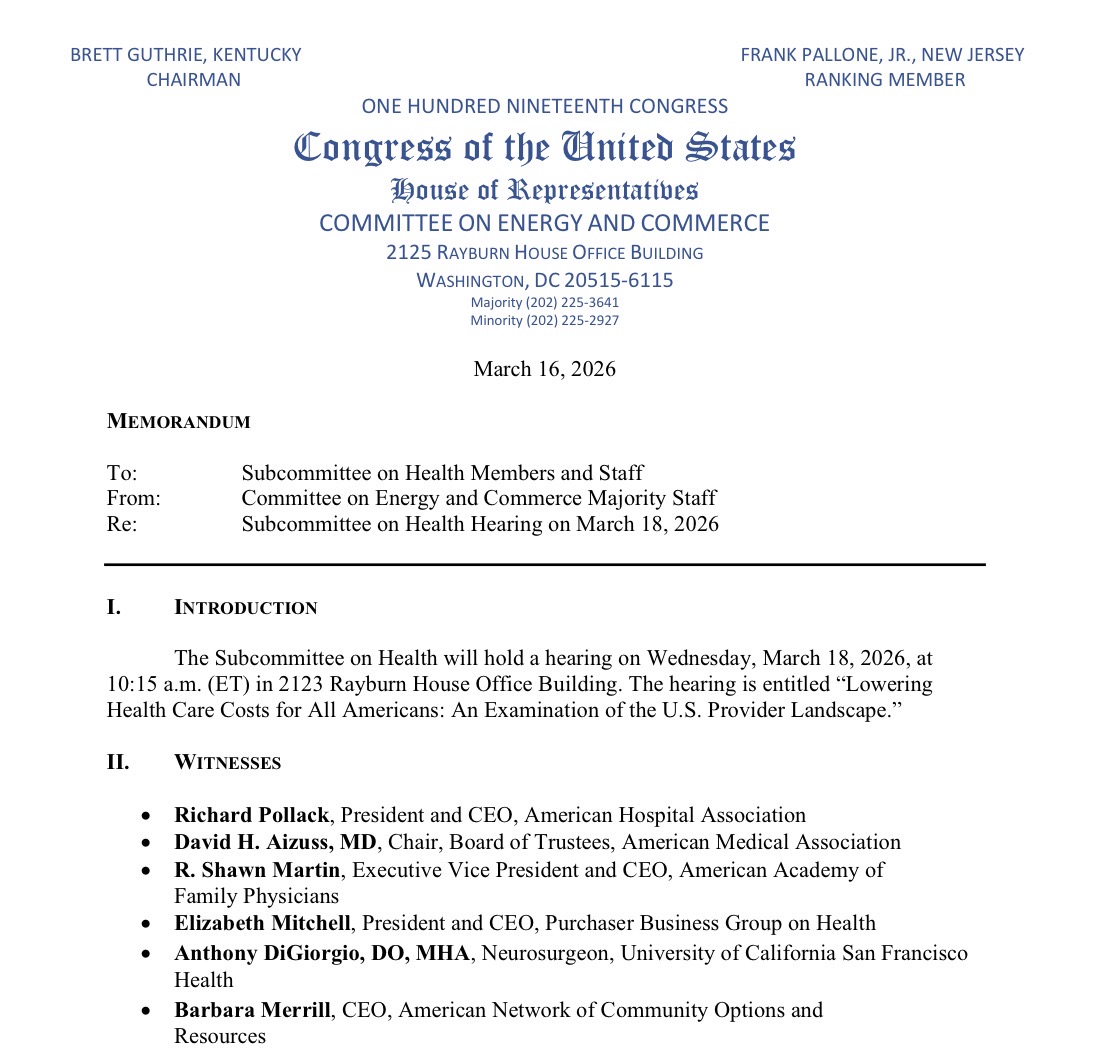
I’m honored to testify before the @HouseCommerce Health Subcommittee on March 18 as Congress examines the background, scale, and consequences of rising health care costs. Health care affordability is one of the defining policy failures of our time.
Anthony DiGiorgio, DO, MHA tweet media
English
30
35
206
7.7K
Devin Zarkowsky retweetledi
Charles Lutz
Charles Lutz@CharlesLutzMD·
Agree with you but think a better strategy is to reclaim the ownership of the medical profession that we have given away over the past 25 years, in large part because we don’t have united advocacy in Washington. The wRVU coupon that CMS provides is essentially the same as it was 25 years ago and adjusted for inflation is a fraction of what it was. Yet the hospital makes a increasing yearly amount on our labor. In my humble opinion our societies need a different strategy. @DutchRojas @DrDiGiorgio @anish_koka @realdocspeaks @GeBaiDC
Shanda Blackmon, MD, MPH@ShandaBlackmon

Profile facs.org/profile/522507… As a Fellow of the American College of Surgeons for over 20 years, I encourage members to act together to stop Centers for Medicare & Medicaid Services (CMS) from finalizing a 2.5% cut to work relative value units (wRVUs). This is a call to action. facs.org/advocacy/regul…

English
7
16
92
9.8K
Devin Zarkowsky retweetledi
Dutch Rojas
Dutch Rojas@DutchRojas·
The strange thing about a $275 billion annual subsidy is that nobody had to hide it. Medicaid supplemental payments, 340B drug pricing, nonprofit tax exemptions, site-neutral billing differentials. Every mechanism is public. Every dollar is documented. The trick was never secrecy. It was complexity. When a system is complicated enough, transparency becomes its own camouflage. Hospital systems and independent physicians both practice medicine. One operates inside a $275 billion regulatory subsidy. The other operates in the actual economy. The clinical work is identical. The economic universe is not. The interesting question is not why this exists. Subsidies always find their beneficiaries. The interesting question is why 1,000,080 physicians who fund the system through their taxes have never seen the receipt. Complexity is not a bug.
English
4
21
96
2.3K