Patrick Erickson

95 posts

Patrick Erickson banner
Patrick Erickson

Patrick Erickson

@DrPatrickE

🐙 postdoc in the levin lab at tufts studying cell learning, aging

Katılım Mayıs 2021
385 Takip Edilen94 Takipçiler
Patrick Erickson retweetledi
Haleh Fotowat
Haleh Fotowat@halehf·
It has been a great privilege to work with @drmichaellevin and an amazing team of scientists at @wyssinstitute and @TuftsUniversity to learn how neurons grow and form connections within completely novel bodies! @LaurieONeill99 @mmsperry @LPiolopez @DrPatrickE & Tiffany Lin
Michael Levin@drmichaellevin

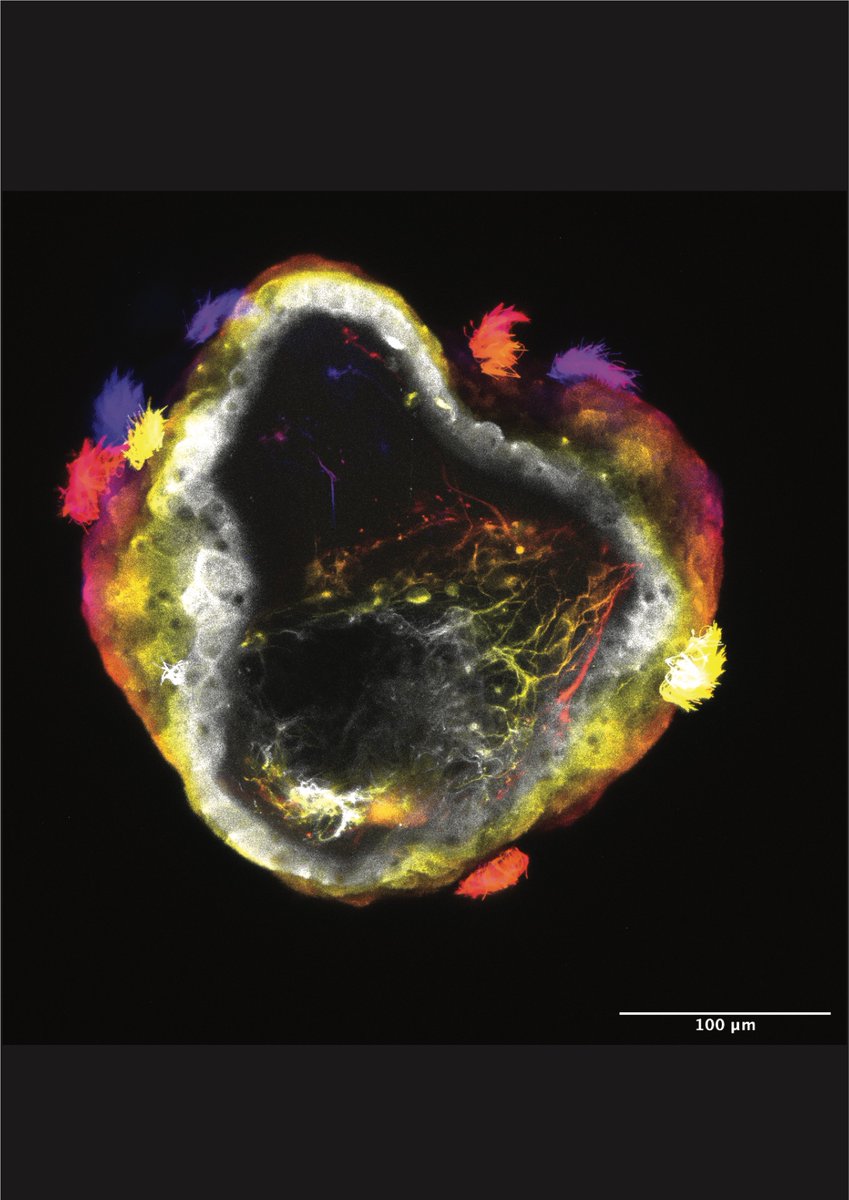
Ever wonder what a nervous system would look like if it self-assembled inside a novel being that hadn't faced a history of selection for its organism-level form and function? Or, perhaps you wondered how #Xenobots would look and act, or what their transcriptome would be like, if they had nervous systems? Well, here's the first step: advanced.onlinelibrary.wiley.com/doi/epdf/10.10… "Engineered Living Systems With Self-Organizing NeuralNetworks: From Anatomy to Behavior and Gene Expression" Our awesome team: led by @halehf: @LaurieONeill99, @mmsperry, @LPiolopez, @DrPatrickE, and Tiffany Lin. The @TuftsUniversity and @wyssinstitute press releases are here, for summaries: now.tufts.edu/2026/03/16/sci… wyss.harvard.edu/news/toward-au…

English
1
1
29
991
Patrick Erickson retweetledi
Michael Levin
Michael Levin@drmichaellevin·
Ever wonder what a nervous system would look like if it self-assembled inside a novel being that hadn't faced a history of selection for its organism-level form and function? Or, perhaps you wondered how #Xenobots would look and act, or what their transcriptome would be like, if they had nervous systems? Well, here's the first step: advanced.onlinelibrary.wiley.com/doi/epdf/10.10… "Engineered Living Systems With Self-Organizing NeuralNetworks: From Anatomy to Behavior and Gene Expression" Our awesome team: led by @halehf: @LaurieONeill99, @mmsperry, @LPiolopez, @DrPatrickE, and Tiffany Lin. The @TuftsUniversity and @wyssinstitute press releases are here, for summaries: now.tufts.edu/2026/03/16/sci… wyss.harvard.edu/news/toward-au…
Michael Levin tweet media
English
42
193
1.1K
114.2K
Patrick Erickson retweetledi
Elias Najarro
Elias Najarro@EIiasNajarro·
Call for papers for 'Artificial Life for Science and Engineering' We seek work applying ALife concepts and tools to model real-world systems and engineer solutions—and assist scientific discovery through open-ended and curiosity-driven search. Call info: alifeforscience.github.io
GIF
English
5
27
170
10.3K
Eric Topol
Eric Topol@EricTopol·
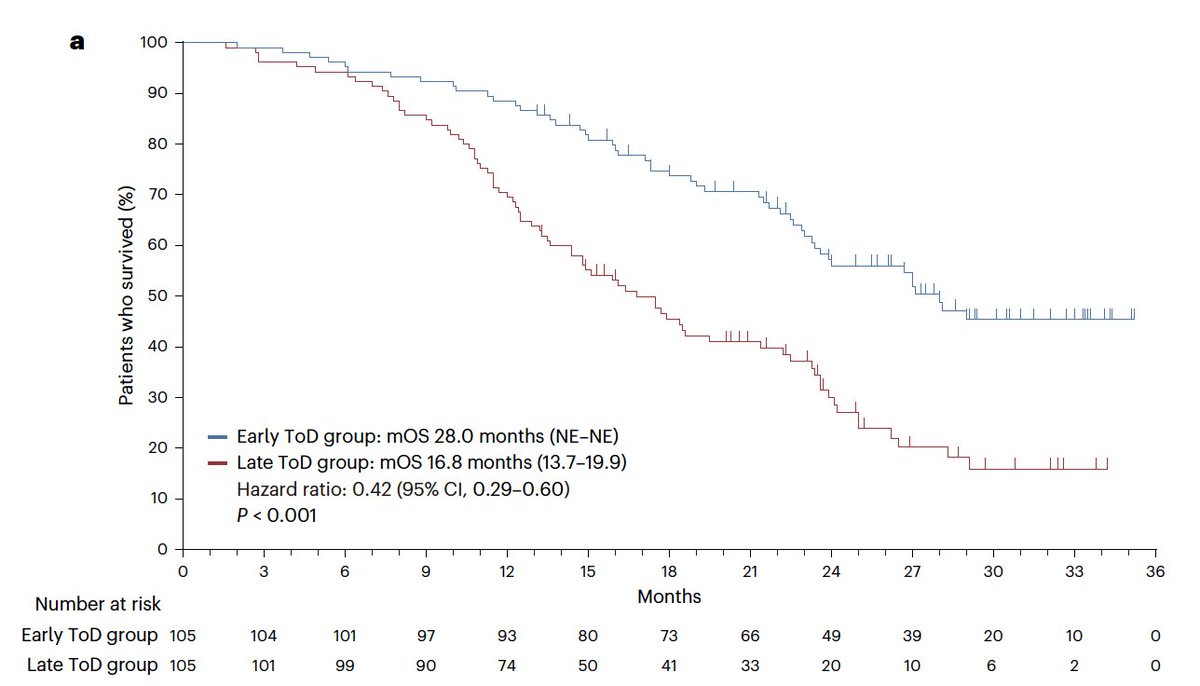
The time of day for cancer immunotherapy is associated with major outcomes. Early is better. Results from a randomized trial of lung cancer, backs up the importance of our circadian rhythm and immune system nature.com/articles/s4159…
Eric Topol tweet media
English
49
335
1.4K
541.4K
David Sinclair
David Sinclair@davidasinclair·
Introducing controlled DNA breaks accelerates biological aging without mutations, and animals can be cloned from old adults, suggesting aging is caused by information loss
English
17
38
491
30.8K
Madam Mitochondria
Madam Mitochondria@Madam_Mito·
@drmaclay I didn’t mention the term “academic intelligence”. I would throw Chris Field’s hat in the ring and he, like Dyson, has never held a PhD. Both men are/were smarter than anyone who’s entered academia via an institution;
Brian Roemmele@BrianRoemmele

Professor Freeman Dyson on the PhD system. His talks with me are one of the reasons I did not peruse a PhD or academia directly. “The PhD system is an abomination...it has ruined many lives”—2016 His views were not well received by many of his peers.

English
2
0
3
1.8K
Prof. Nikolai Slavov
Prof. Nikolai Slavov@slavov_n·
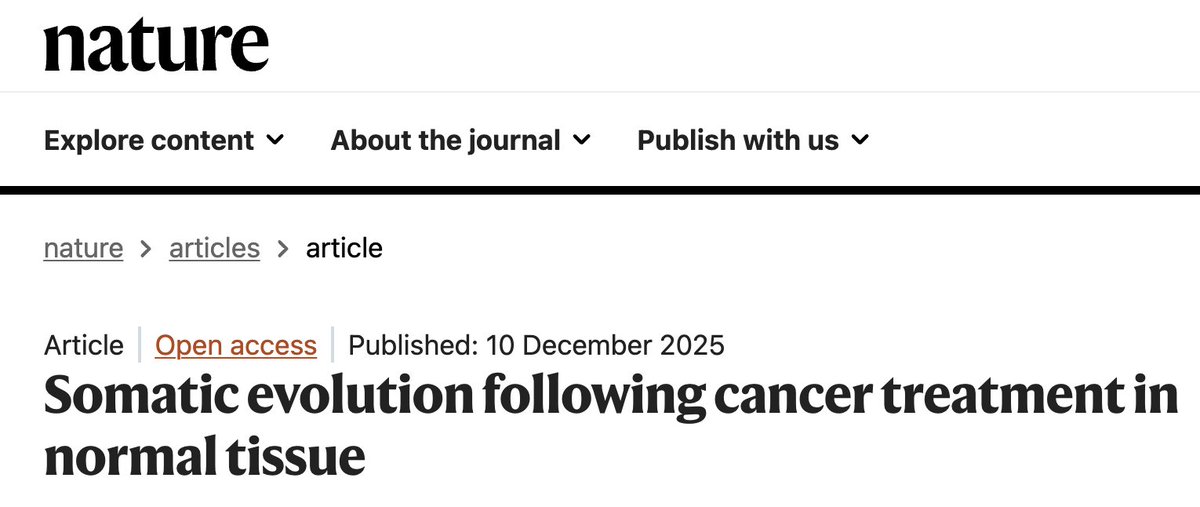
This article suggests that cancer treatment contributes to mutagenesis: "More than 25% of driver mutations in normal tissue exposed to systemic anti-cancer therapy, including in TP53, could be attributed to treatment."
Prof. Nikolai Slavov tweet media
English
9
68
268
37.3K
Patrick Erickson
Patrick Erickson@DrPatrickE·
@WallaceUcsf Is rapid mixing a process that they turn on and off? Or are they always mixing?
English
1
0
2
28
Wallace Marshall
Wallace Marshall@WallaceUcsf·
The low Reynolds number of cytoplasmic flow which makes mixing hard. In poster 359 at the CellBio2025 meeting Sunday Dec 7, Ulises Diaz shows how giant cells leverage reversible actin gel assembly to drive rapid mixing of cytoplasm, faster even than "chaotic mixing" schemes.
Wallace Marshall tweet media
English
2
1
9
658
Wallace Marshall
Wallace Marshall@WallaceUcsf·
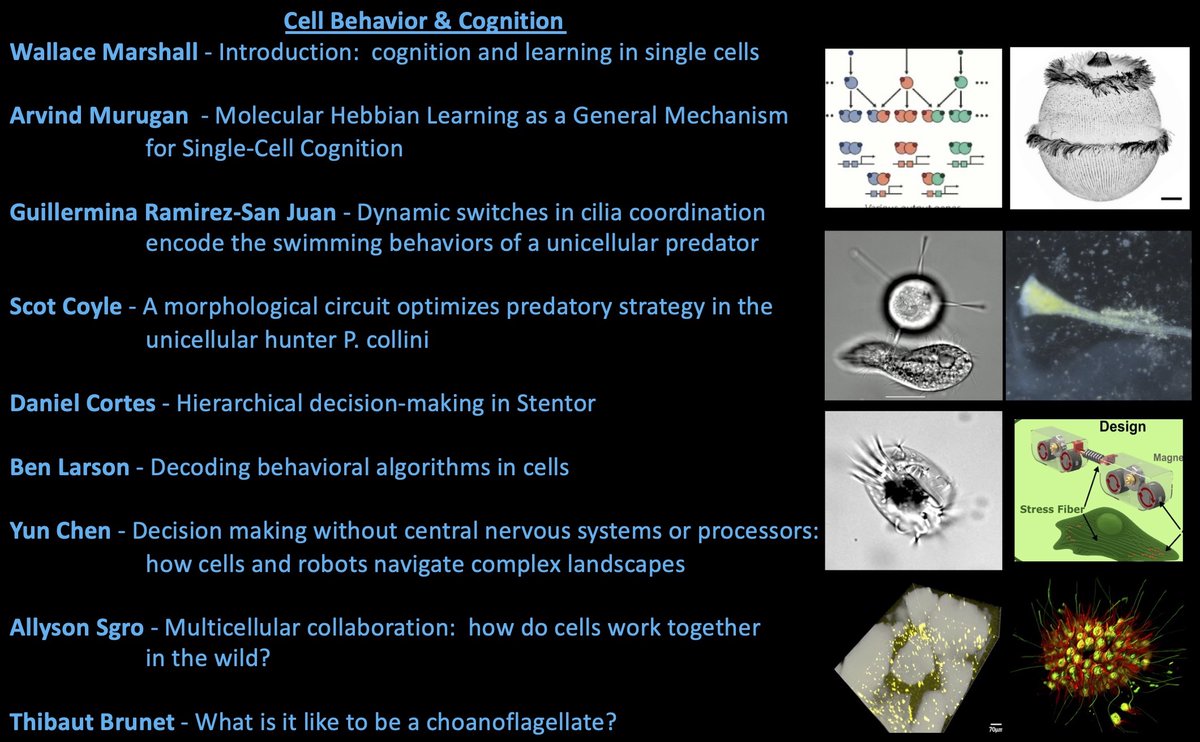
Cells can hunt prey, solve mazes, and learn from past experience. Does this mean they can think, at some level? Find out more at our upcoming session on "Cell Behavior and Cognition" at the ASCB/EMBO #cellbio2025 meeting, Saturday 1-3 pm rm 115.
Wallace Marshall tweet media
English
1
2
9
684
João Pedro de Magalhães
João Pedro de Magalhães@jpsenescence·
Why aren’t babies born old? I mean, if aging is caused by inevitable molecular damage due to imperfect repair systems, why doesn’t aging happen during the massive cell division that occurs in prenatal development? Some may argue that our cells during early development have better repair systems, but what is the evidence for this? And why would repair systems stop being effective later in life?
English
47
12
152
114.7K
Patrick Erickson
Patrick Erickson@DrPatrickE·
@jpsenescence Well some process seems to reset methylation patterns to a "ground zero" state during embryogenesis; we don't know what or how, but DNAm changes are undone. I have a preprint coming out on that soon. What other "damage" makes it through to the zygote? Any besides mutations?
English
0
0
2
128
Jun Wu Lab
Jun Wu Lab@leo_jwu·
Excited to share our new study uncovering and overcoming the molecular drivers of interspecies PSC competition to improve human chimerism in animals. Big congratulations to first authors Yingying, Hai-xian, and Saku, and to our collaborators! cell.com/cell/fulltext/…
English
6
17
62
6.4K
Patrick Erickson
Patrick Erickson@DrPatrickE·
@fedichev Hi Peter, I'm trying to get a better grasp on the meaning of the math in your preprint. Do you have an intuitive explanation of what z0 represents physiologically? Visualizing it with a simulation would go a long way. Also, how does your model explain lifespan scaling laws?
English
0
0
1
3.1K
Peter Fedichev
Peter Fedichev@fedichev·
We still don’t have a proper theory of aging. That’s remarkable, given how far biology has come. Despite centuries of speculation and decades of data, there is still no unified, quantitative framework that explains how and why living systems age—and how we might stop it. What we have instead is a long list of partial explanations. By some counts, there are over 300 different theories of aging. That’s not a sign of success. It’s a sign of fragmentation. But before building such a theory, we need to agree on aging phenomenology, decide what exactly needs to be explained. What are the core, undeniable features of aging that any model must capture? Here’s my proposal. First, mortality doesn’t just increase with age—it increases exponentially. Across a wide range of species, from flies to humans, the probability of death doubles every few years of adult life. This is known as the Gompertz law, and it defines a central quantitative signature of aging. Deviations from this pattern are rare and interesting. Some short-lived animals flatten out their mortality risk late in life. Naked mole-rats barely age at all in demographic terms, even though their molecules do. Humans, meanwhile, keep on aging Gompertz-style even past the average lifespan. What’s striking is how different this is from how machines fail. Most engineered systems don’t follow exponential mortality. They follow power laws. In mechanical systems—jet engines, turbines, bridges—the risk of failure usually increases according to a Weibull distribution: slow at first, then rapidly accelerating as wear accumulates. This is called “bath-tub shaped” failure. It's deterministic, often dominated by a single weak link. Biology doesn’t work like that. It’s noisy, redundant, and dynamic. Cells talk to each other, systems compensate, and failures emerge from the collapse of coordination—not the snapping of one part. That’s why mortality in organisms rises exponentially, not deterministically. And that’s a big clue. It tells us aging isn’t just wear and tear. It’s something else—something emergent, statistical, and deeply biological. Second, aging is fundamentally stochastic. Even genetically identical individuals in the same environment don’t die at the same time. They drift. And the spread of this drift—the variance of lifespan and age-related traits—actually increases with age. In humans, this variance seems to grow hyperbolically, as if all physiological systems are converging toward some kind of boundary near 120 years. The longer the species lives, the tighter this variance tends to be. We see the same thing in the genome. DNA methylation clocks—those predictive models based on epigenetic patterns—derive most of their power not from deterministic changes, but from accumulating noise. Epigenetic drift turns out to be the main signal. And recent work shows that 70 to 90 percent of what these clocks “learn” is just statistical dispersion. The rest is the fine structure, the deviations from pure noise, that carry biological meaning. Third, aging is scaled. Across mammals, bigger animals tend to live longer—and slower. Lifespan and developmental time follow predictable, quarter-power scaling with body size. Molecular damage, by contrast—mutations, methylation drift, oxidative stress—tends to scale inversely with lifespan. Bigger, longer-lived species accumulate this damage more slowly. There’s a deep geometry here, a kind of allometric constraint linking biology’s pace and its durability. A good theory of aging has to explain why. Fourth, despite all the complexity, aging turns out to be low-dimensional. If you analyze enough biomarkers—genomic, proteomic, clinical—you find that most of the variation with age clusters along just a few directions. A few principal components can describe most of the story. Even organism-level performance metrics—frailty, lung function, heart rate ceiling—decline in a surprisingly linear way: roughly one percent per year, across the board. At the same time, individual differences grow. Aging is drift along a narrow ridge, with widening variance. At last, let's remember that in practice nothing beats the effect of eating less. A good theory should give us a way beyond that. This is my proposal for what a theory of aging must explain. What’s yours? As usual, mind following, like and repost - In fact, there is apparently only one way to explain all the listed features within a single theoretical framework (see the link to our recent work in the first comment)
Peter Fedichev tweet media
English
60
31
196
36.1K
Michael Levin
Michael Levin@drmichaellevin·
Thanks, I was wondering how it looked - I couldn't see it. A huge Thank You to Martin Schwalm (linkedin.com/in/martin-schw…) for building the CogniFly! We have a lot of plans for its future development. And, to Luc Caspar, Oneris Rico, Alyssa Adams, and @okw for the effort of hosting it (and me).
English
2
1
6
190
João Pedro de Magalhães
João Pedro de Magalhães@jpsenescence·
Early embryos have high levels of DNA damage - partly from sperm DNA. Rejuvenation in early development is a potential trove of information for understanding aging. And the gradual decline of rejuvenation and regeneration during development also fits programmatic aging. 1/2
English
5
7
109
6.2K
Prof. Nikolai Slavov
Prof. Nikolai Slavov@slavov_n·
Life uses exploratory dynamics. It's a simple & powerful approach: ◼️ Variation followed by selection 1/2
Prof. Nikolai Slavov tweet media
English
2
1
19
5.1K