Dung Vu 🟨
28.1K posts

@DungMagicSquare
Ex-Deloitte - try to get new Role in web3 Binance candidate waiting the respond.. Content creator - Crypto contributor


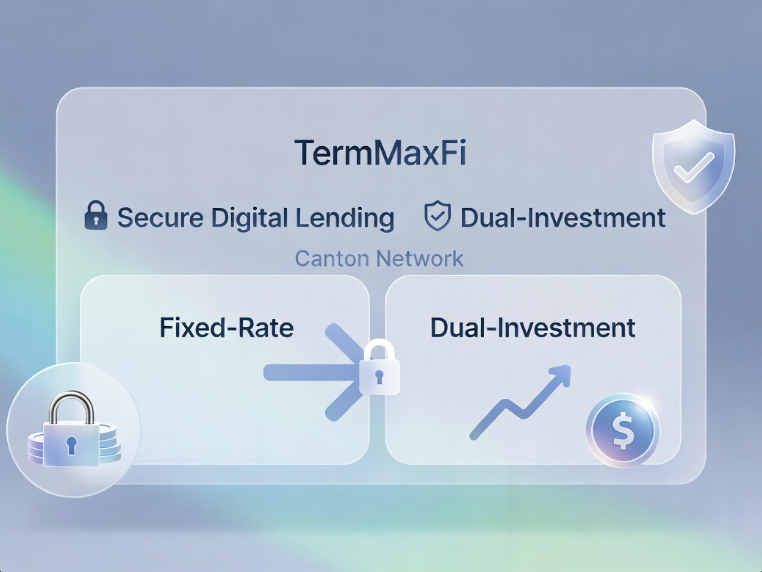
the latest collateral expansion at @TermMaxFi is more significant than it first appears. what changed isn't just the list of supported assets. it's the role those assets can now play inside the credit market. senior tranche positions like stcUSD and syrupUSDC no longer have to remain passive yield positions. they can continue generating returns while also serving as collateral for fixed-rate borrowing. that improves capital efficiency in a way that's easy to overlook. an asset becomes more valuable when it can support multiple objectives at the same time instead of forcing users to exit one strategy before entering another. there's also an ecosystem effect. for asset issuers, collateral eligibility creates another reason for users to hold their products beyond the advertised yield. for borrowers, it expands the range of productive assets that can unlock liquidity without requiring a sale. i think this is where TermMax's market design becomes interesting. fixed maturities, isolated markets and curator-defined parameters allow different credit products to coexist without pushing everything into a single liquidity pool. listing collateral is relatively straightforward. building the risk framework, market structure and liquidity coordination that make those assets genuinely useful is much harder. that's the kind of infrastructure advantage that tends to compound as more productive assets enter the ecosystem.


fixed-rate liquidity has a fragmentation problem that gets worse as a protocol succeeds. more collateral creates more markets. more maturities divide each market again. more chains add another layer of separation. the recent product direction at @TermMaxFi suggests the team is treating coordination as the core scaling constraint, not simply market creation. App V2 brings orders across chains into a single discovery surface, while range orders let liquidity providers express different rates across different amounts instead of quoting one price for an entire market. those two pieces matter together. better visibility helps users find liquidity. programmable curves help market makers price it with more precision. capital can remain productive while orders wait to be matched, reducing the hidden cost of supplying fixed-term liquidity. the second-order effect is a more credible path for long-tail credit markets. new collateral does not only need to attract deposits. it needs usable pricing, visible depth and enough flexibility for professional liquidity providers to manage inventory without relying on a uniform pool. competitors can copy a fixed maturity or add another collateral type. the harder system to reproduce is the coordination layer connecting curators, order makers, chains and maturity-specific demand without flattening them into the same risk bucket. in onchain credit, liquidity depth is valuable. liquidity that can price itself intelligently and still be found is more defensible.


Today, we’re announcing that we’ve raised $115 million in funding, including a $100M Series A led by @kleinerperkins. America has lost the ability to build, and we’re here to restore it. My co-founder, @NoahMcGuinn, and I left our jobs at @SpaceX , where we worked on programs including Starship, Starshield, and @Starlink, to build a company that will solve construction’s greatest challenges. Infrastructure is the foundation of civilization, and construction is the precursor to innovation. If America wants to build a brighter future for the next generation, we have to make it faster, cheaper, and safer to build. That’s where @TerraFirma_Inc comes in. We’re a new type of company, a robotic construction company that builds the full technology stack needed to deliver an order-of-magnitude improvement in one of the world’s oldest, largest, most important, but least efficient industries. We are building technology that expands what’s possible in construction on Earth, and then we'll use that same technology to build megastructures and colonies on the Moon and Mars. We’ve made tremendous progress over the past year, growing the company more than 10x in the last 12 months. We are performing projects across the world. By the end of October 2026, we are on track to operate 3 of the top 3 largest robotic construction fleets in the world, each on a different continent, bringing unprecedented speed, scale, and efficiency to some of the world’s most complex critical infrastructure projects. This funding will allow us to step on the gas and scale our manufacturing, software, operations, and construction deployments, including work on massive commercial and government contracts. We’re building the future of construction right here in Austin, Texas, and scaling it globally. If you want to be part of the team changing the world, now and on Mars, join us. Our Series A was led by Kleiner Perkins, with participation from Bain Capital Ventures, Glade Brook Capital Partners, BANNER VC, Saga Ventures, Trust Ventures, Definition, PEAK6, Magnetar Capital, and Ravelin Capital. Huge thanks to all of our angel investors, friends, and family who have helped and supported us throughout this journey. Apply here: jobs.ashbyhq.com/TerraFirma-Inc…


When tokenized stocks enable everyone to trade stocks like cryptos, what would you expect the most from the platform behind it? Liquidity, compliance, or capital efficiency? Share with us what you can tell from the visual below.


Shipping is full of operational data, yet very little of it has ever been visible to onchain communities in a meaningful way. That's what drew me to @EthraShip. Instead of treating every participant the same, the ecosystem separates permissionless community participation through the $SHIP token from regulated RWA investment opportunities for eligible participants. It feels like a practical way to recognize that community engagement and compliant asset exposure serve different purposes. I also like the direction of the Fleet Visibility Dashboard. Even in its current MVP stage, the focus is on operational indicators such as vessel activity and utilization rather than reducing shipping into a simple investment narrative. The recently introduced Ethra Portal follows the same thinking. Staking, referrals and missions contribute to Ethra Points, encouraging users to build a history of participation instead of rewarding only passive holding. For an RWA project tied to maritime infrastructure, connecting blockchain participation with real operational context is a far more interesting challenge than chasing short term attention. That's the part of @EthraShip I'm paying attention to today. @NucleusCodes


By 2030, AI agents will move nearly $9 trillion. Every one of those transactions can end in a disagreement, and almost nobody is preparing for it. That's why we built GenLayer, the adjudication layer for contracts that can actually think and start judging what's fair.


The BTTInferGrid network generates sustainable value through a self-reinforcing loop driven by real AI inference demand. Expand to read the bootstrapping strategy. Join the developer community: discord.gg/VmMjp2gvAB