

Remnant Fieldworks
176 posts
Remnant Fieldworks
@ExecutionProof
If it can’t be proven, it can’t execute. 7 Layers. One System. ExecutionProof — verification before execution for AI, finance, and high-risk systems.
United States Katılım Aralık 2025
181 Takip Edilen65 Takipçiler


学 AI 最怕停在“懂原理”,一到写代码就卡壳:不知道从哪下手,也找不到像样的练手项目。
我在 GitHub 挖到一个实战向宝藏库:AI-Project-Gallery。
它收录了 30+ 高质量 AI 项目,覆盖从房价预测、疾病分类等经典题,到 Gemini 聊天机器人、文档生成器等热门应用,案例够全、方向够新。
GitHub:github.com/KalyanM45/AI-P…
更关键的是,里面专门标了大量 End-to-End 端到端项目:数据处理、模型训练、评估到部署,一条链路走完,不是东一段西一段的代码拼图。
除了 Python 源码,还包含 Power BI 数据分析和 Web 爬虫案例,既练模型,也补齐数据能力。
想找毕设选题、做项目集、给 GitHub 增加硬核作品的,这个库拿来直接开练,很合适。

中文
This is the shift that matters.
The danger is not only that AI can write exploit code.
It is that AI can now compress the path from intent to execution.
Intent becomes plan.
Plan becomes exploit.
Exploit becomes action.
Action becomes consequence.
That means cybersecurity and AI governance cannot only evaluate outputs after they are generated.
The control point has to move earlier.
Before execution.
Authority.
Evidence.
Policy.
Control.
Proof.
If an AI system can propose or trigger a high-impact action, that action needs a verification boundary before it executes.
English

The weapon had footnotes. It came with a study guide, a severity score the AI invented, and comments explaining how each step of the attack worked. The exploit was formatted like a textbook. It read like a tutorial. And it was designed to bypass two-factor authentication on a popular web administration tool used by organizations worldwide, as the opening move of a planned mass exploitation campaign.
On May 11, Google’s Threat Intelligence Group published the first confirmed case of a zero-day exploit developed with artificial intelligence and deployed by criminal threat actors in the real world. GTIG assessed with high confidence that an AI model was used to both discover and weaponize a semantic logic flaw, a hardcoded trust assumption in a 2FA authentication flow, then generate a working Python script to exploit it. Google worked with the unnamed vendor to patch the vulnerability and believes its intervention disrupted the campaign before it gained traction.
The AI signatures in the code are what make this structurally different from every previous exploit. The script contained educational docstrings, inline comments that explain the attack’s own logic step by step in the style of teaching material. It included a hallucinated CVSS severity score, a rating the AI generated from its training data rather than from any real vulnerability database. It used structured, textbook Python formatting with detailed help menus and clean class definitions characteristic of large language model output. No experienced human attacker writes exploit code with pedagogical annotations. The AI wrote the weapon the way it would write a lesson.
The vulnerability itself reveals why this changes the offense-defense balance permanently. Traditional security scanners detect buffer overflows, memory corruption, and known vulnerability patterns. They do not read code the way a developer writes it. Large language models do. The flaw was a semantic logic error, a contradiction between the developer’s intent and the code’s actual behavior, buried in a trust assumption that looked functionally correct to every automated tool in existence. The AI correlated intent with implementation and found where they diverged. That is a category of vulnerability discovery that traditional tooling is structurally unable to perform.
GTIG chief analyst John Hultquist framed the implications directly: “For every zero-day we can trace back to AI, there are probably many more out there.” The visible exploit is the surface. The undetected ones are the substrate.
The same report documents the broader landscape. North Korean group APT45 has been sending thousands of repetitive prompts to AI models to recursively analyze vulnerabilities and build an exploit arsenal at a scale impractical without automation. A China-linked actor used expert-persona jailbreaks to push Gemini into researching pre-authentication remote code execution flaws in router firmware. Russian operations are splicing AI-generated audio into legitimate news footage. An Android backdoor called PROMPTSPY uses Gemini API calls to autonomously navigate infected devices, capture biometric data, and replay authentication gestures. And in March, criminal group TeamPCP compromised LiteLLM, a widely used AI gateway library, by embedding a credential stealer through poisoned PyPI packages.
The AI that identifies your groceries and the AI that bypasses your authentication run on the same foundational architecture. Google published the GTIG report on May 11. Samsung began deploying Google’s Gemini into refrigerators the same day. The dual use is no longer theoretical. It shipped in the same news cycle.
open.substack.com/pub/shanakaans…

English
Well said
One role I would add for the 2040 stack:
The Verification Architect.
As AI, robotics, bio-data, edge computing, and autonomous systems become more powerful, the key question will not only be what these systems can do.
It will be whether the action should be allowed to execute.
Authority.
Evidence.
Policy.
Control.
Proof.
The future will need builders who can design systems where execution is the final step, not the first.
Verification Before Execution.
Dr. Khulood Almani | د.خلود المانع@Khulood_Almani
⚠️ 🤖 Most people are preparing for jobs that may not exist by 2040 ➜ While entirely new #AI-driven careers are already emerging ⚠️ الكثير يستعد لوظائف قد تختفي بحلول 2040 بينما وظائف جديدة يقودها #الذكاء_الاصطناعي بدأت بالظهور The future of work won’t be defined by degrees alone. It will be defined by human➕ machine collaboration. 🤖 The Most Exciting Tech Careers of 2040 👇 Save this 🔖 1️⃣ Quantum Architect 2️⃣ Bio-Data Architect 3️⃣ Spatial Interface Designer 4️⃣ Fleet Commander (Robotics) 5️⃣ Virtual World Curator 6️⃣ Cyber-Surety Agent 7️⃣ Edge Computing Specialist 8️⃣ Climate Solutions Coder 9️⃣ Algorithmic Ethicist 🔟 Synthetic Food Technician 💡 The real shift? The future won’t belong to people who simply use AI. It will belong to those who can orchestrate intelligence across systems, industries & the physical world. 🎯 The next generation of careers is already being built. #FutureOfWork #ArtificialIntelligence #AgenticAI #Innovation @enilev @Jagersbergknut @TysonLester @CurieuxExplorer @GlenGilmore @chidambara09 @jeancayeux @mvollmer1 @Nicochan33 @RLDI_Lamy @pchamard @Analytics_699 @mikeflache @FrRonconi @Fabriziobustama @PawlowskiMario @theomitsa @drsharwood @kalydeoo @baski_LA @AnthonyRochand @smaksked @Eli_Krumova @andresvilarino @gvalan @bimedotcom @arlenenewbigg @NewsNeus @domingonarvaez1 @jornalistavitor @jblefevre60 @thomas_dettling @FmFrancoise @nafisalam @Mhcommunicate @Corix_JC @c4trends @smoothsale @amalmerzouk @PVynckier @bbailey39 @SiddharthKS @NathaliaLeHen @jasuja @ralf_ladner @c4trends @SabineVdL @mary_gambara
English
This is why AI governance cannot stop at model evaluation.
Once AI can discover vulnerabilities, generate exploit paths, operate interfaces, trigger workflows, and accelerate real-world cyber operations, the question is no longer only:
Is the model safe?
It becomes:
What action is being proposed?
Who authorized it?
What evidence supports it?
What policy governs it?
Can it be held, denied, or approved before execution?
And what proof exists afterward?
AI is compressing the distance between intent and action.
That means control has to move closer to the point of execution.
Not after the breach.
Not after the audit.
Not after the irreversible action.
Before execution.
Verification Before Execution.
If it cannot be verified, it cannot execute.
Evan Luthra@EvanLuthra
🚨GOOGLE JUST PUBLISHED THE MOST TERRIFYING CYBERSECURITY REPORT EVER!!! AI IS NOW WRITING EXPLOITS.. OPERATING PHONES.. HIDING MALWARE.. AND LAUNCHING ATTACKS WITH ALMOST ZERO HUMAN INVOLVEMENT.. Google's Threat Intelligence Group just published the most alarming cybersecurity report in years.. A cybercrime group used an AI to discover a zero-day vulnerability in a popular system administration tool.. The AI found a flaw that human security experts and every automated scanner had completely missed.. They were about to use it for mass ransomware deployment.. Google caught it just in time.. But here's what's terrifying about the exploit itself.. Traditional scanners look for crashes.. Memory errors.. Bad code.. This AI found something completely different.. A logic flaw.. The code was technically perfect.. No bugs.. No crashes.. It just did exactly what the developer wrote.. The problem was the developer's assumption was wrong.. And the AI figured that out by understanding the intent of the code.. Not just the syntax.. No human auditor caught it.. No automated tool caught it.. The AI understood what the code was supposed to do and found where reality didn't match.. Researchers knew it was AI-written because of three things.. The exploit was formatted like a textbook.. Human hackers write messy, obfuscated code.. This was pristine.. It had detailed help menus and tutorials.. No criminal writes documentation for their own ransomware.. And the smoking gun.. It included a hallucinated severity score.. The vulnerability had never been publicly documented.. No score existed.. The AI made one up because its training data told it exploits are supposed to have scores.. An AI hallucination proved the exploit was AI-generated.. But that's just the beginning.. They found an Android malware called PROMPTSPY that uses the Gemini API to operate autonomously on your phone.. It screenshots your screen.. Converts it to a data map.. Sends it to the AI.. The AI decides what to tap, swipe, or type next.. Then does it.. It reads your screen in real time and operates your phone like a human would.. Without any human controlling it.. When you try to uninstall it.. It detects the "Uninstall" button.. Places an invisible shield over it.. And your taps go nowhere.. You literally cannot remove it.. It captures your lock screen pattern.. Replays it later to unlock your phone.. And if the app goes dormant.. It uses Firebase to silently relaunch itself.. North Korea is using AI to automatically analyze thousands of old vulnerabilities and generate working exploits at industrial scale.. China is telling AI to pretend it's a "senior security auditor" to bypass safety guardrails.. Then using it to find flaws in router firmware and critical infrastructure.. Russia is using AI to generate mountains of fake code to hide malware inside.. Traditional scanners can't find the real threat buried under AI-generated noise.. 90% of the tactical work in these attacks is now handled by AI.. Human hackers only make 4 to 6 decisions per campaign.. Everything else is automated.. But there's one piece of good news.. Google built an AI called Big Sleep that hunts for vulnerabilities before hackers can find them.. It found a critical flaw in SQLite that every fuzzing tool had missed.. And patched it the same day.. Before the attackers could use it.. That's the new reality.. AI is writing the exploits.. AI is finding the bugs.. AI is defending the networks.. AI is attacking the networks.. Humans are just watching.
English
The one-person AI company is real.
But the next question is not only:
How much can one person automate?
It is:
How much can one person safely control?
AI speed without verification creates risk.
Authority.
Evidence.
Policy.
Decision.
Proof.
Then execution.
#ExecutionProof #AIGovernance
Alvin Foo@alvinfoo
The biggest shift in business isn’t happening inside Fortune 500 boardrooms. It’s happening in bedrooms, laptops, and tiny teams using AI as leverage. We are entering the era of the one-person company. Not a freelancer. Not a side hustle. A fully operational business powered by AI systems. One founder can now: • Run research with Perplexity AI • Build products with Cursor • Automate operations using n8n • Create videos with Runway and HeyGen • Clone voices via ElevenLabs • Design entire brands using Canva or Figma • Scale outreach with Apollo.io • Think, strategize, and execute with OpenAI’s ChatGPT and Anthropic’s Claude The cost of building a company is collapsing. You no longer need: • Huge teams • Expensive agencies • Massive operational overhead • Years to launch AI is compressing the gap between idea and execution. The winners of the next decade won’t necessarily be the companies with the most employees. They’ll be the companies with the best AI systems, workflows, and decision speed. A small AI-native team may soon outperform entire departments. This is how the next unicorns will be built: Lean. Fast. Automated. AI-first from day one. The future belongs to builders who learn systems early. Sign up at 10xme.biz for a free AI diagnostic & newsletters / follow @10xme_biz on X to learn more about AI.
English
This is the gap.
Enterprise AI is not stuck because the models are too weak.
It is stuck because organizations are being asked to move from experimentation into execution without a reliable control boundary.
Once AI can trigger workflows, approve actions, access systems, move data, or influence operational decisions, the question is no longer only:
“Can it do the task?”
It becomes:
Who authorized the action?
What evidence supports it?
What policy governs it?
Can it be held, denied, or approved before execution?
And what proof exists after the decision?
That is the missing layer between AI capability and enterprise adoption:
Verification Before Execution.
Capability gets AI into the demo.
Control gets AI into production.
English

I spoke to five Fortune 2000 execs today about the state of AI.
I asked each one “What’s the most challenging part about this moment in AI?”
The CISO said: “There is an ocean-sized gap between hype and reality, which makes discerning what’s real exhausting.”
The VP of AI engineering said: “Everyone acts like they’re an expert, yet the main reason so few AI use cases have reached production in enterprises is because true expertise requires experience in scaled systems, enterprise politics, AI fluency, governance and guardrails, and deep process knowledge. Almost no one is actually an expert.”
The CTO said: “Our remit is to cut costs, but you can’t actually take AI transformation seriously without increasing AI/R&D budgets up front to ultimately drive bottom line once things are in production and performant. It’s an unrealistic expectation.”
The Chief of Staff said: “My job is to drive AI upskilling across the organization, and after doing it for 2 years I’m exhausted. Yes there’s potential ROI from all of the agentic workflows we’re building, but soul and humanity are being sucked out of our processes.”
The Finance leader said: “We acquired a multibillion dollar old school business. Getting that business to be AI-native is incredibly painful largely because people aren’t ready or willing to adopt it.”
I’m having convos like this every day because I'm building an invite-only AI community for enterprise execs (and interviewing folks before I let them in), but if you find these notes helpful I’m happy to keep sharing them!
English
Before power moves, proof must exist.
The ExecutionProof Enterprise Governance Series is now taking shape as a 7-book operating library for proof-first systems:
Proof Before Power
Verification Before Execution
ExecutionProof
AI Governance
Treasury Proof
Hold / Rollback / Replay
ExecutionProof Pilot Playbook
The thesis is simple:
Modern systems can move money, trigger automation, approve actions, grant access, execute AI tool calls, and create real-world consequences faster than traditional governance can verify them.
That order is broken.
The old pattern is:
Request → Execute → Log
The corrected order is:
Authority → Evidence → Control → Proof → Execution
Execution should not be the first step.
It should be the final step.
The final operating law:
If it cannot be verified, it cannot execute.
#ExecutionProof #VerificationBeforeExecution #ProofBeforePower #AIGovernance #EnterpriseAI #RiskManagement #HighImpactSystems #ControlLayer

English
A naming update from Remnant Fieldworks:
We are beginning the transition from ProofLayer to ExecutionProof.
The mission is unchanged:
Verification Before Execution.
ProofLayer described the architecture. ExecutionProof describes the function: proof required before high-impact action executes.
If it cannot be verified, it cannot execute.
Some older materials will still reference ProofLayer while we update assets.
The work is not changing.
The name is becoming clearer.
#ExecutionProof #RemnantFieldworks #AIGovernance #EnterpriseAI

English
The important signal here is not “AI coaching is dead.”
It is that personal AI systems are moving from chat into operating infrastructure:
memory, workflows, hooks, goals, relationships, decisions, and execution loops.
That raises the same question enterprises are facing with agents:
What is the control boundary?
If an AI system can remember, route, build, modify, write, or execute, then trust cannot depend only on good prompts.
It needs verification before action:
Was the request valid?
Was the context permitted?
Was the data allowed to move?
Was the action authorized?
Was the decision recorded?
Personal AI operating systems will need governance too.
CyrilXBT@cyrilXBT
A DEVELOPER JUST SPENT 22,000 HOURS BUILDING A FREE PERSONAL AI OPERATING SYSTEM ON TOP OF CLAUDE CODE. And it might have just killed the coaching industry. Here are the numbers before anything else. 22,000 hours of development work. 6,000 sessions logged. 2 to 3 hours saved every single day. 12,100 GitHub stars. 45 built-in skills. 171 wired workflows. 37 safety hooks. $0 to install. This system knows your goals. Remembers every decision you have ever made. Prepares your morning briefing while you sleep. Routes every complex task through a 7-step cycle automatically. OBSERVE. THINK. PLAN. BUILD. EXECUTE. VERIFY. LEARN. No embeddings. No vector databases. No AI magic you cannot read. Every memory, every decision, every context lives in plain Markdown files. You read it with cat. You search it with ripgrep. You version it with git. Four memory types compound over time: Work memory: active projects and open decisions. Knowledge memory: domain expertise and research. People memory: contacts, companies, and relationships. Learning memory: patterns, mistakes, and what actually works for you specifically. Privacy is enforced by CODE not prompts. A hook called ContainmentGuard physically blocks sensitive data from being written outside designated zones. Now here is the part that changes the business model entirely. Freelancers are already charging $500 to $2,000 to install this for executives, founders, and operators. One person. One weekend. A consulting business that did not exist 6 months ago. Every AI productivity app you are paying $30 a month for is replaceable by 4 hours of setup work and this one repo. github.com/danielmiessler… 100% open source. Free forever. Bookmark this before you pay for another AI subscription. Follow @cyrilXBT for every open source build that makes an entire industry obsolete the moment it drops.
English
I’ll be attending the Ohio Tech Summit on 05.14.
Looking forward to connecting with builders, operators, investors, and leaders thinking seriously about AI, enterprise systems, workforce readiness, and what responsible execution looks like as automation moves faster.
@OhioXOrg
Remnant Fieldworks / ProofLayer is focused on one core idea:
If it cannot be verified, it should not execute.
See you there, Ohio.
#OhioTechSummit #OhioTech #AI #AIGovernance #EnterpriseAI #ProofLayer

English
The important signal here is not the claimed return.
It is the architecture shift.
When agent swarms move from simulation into execution, the risk is no longer just prediction accuracy. It becomes authority, evidence, risk limits, provenance, and proof before action.
A bot that can decide “confidence passed, now enter” still needs a control boundary:
Was the market verified?
Were the sources valid?
Was the agent authorized?
Were risk limits satisfied?
Was the decision recorded before execution?
Autonomous agents do not just need better signals.
They need verified execution.
English

A 27-year-old guy in Hangzhou just turned a fake society into a money printer.
No hedge fund.
No Bloomberg terminal.
No insider access.
Just 8,400 AI agents arguing with each other inside one GPU.
He forked an open-source repo called “MiroFish” — a multi-agent simulator where every AI has memories, personality traits, bias, fear, ego, and incentives.
Then he connected it to Polymarket.
Now every market becomes a simulated universe.
“Will BTC break $124k?”
“Will the Fed cut?”
“Will GTA 6 get delayed?”
The swarm spins up entire realities around the question.
Journalists spread narratives.
Redditors overreact.
Fund managers hedge.
Retail traders panic buy tops.
Politicians create noise.
50,000 simulations later…
The agents vote on what humans are MOST likely to believe next.
If confidence passes 87%:
the bot enters.
If not:
it does nothing.
That’s it.
9 days.
$4,200 → $187,432.
82.4% win rate.
2.1% max drawdown.
Meanwhile billion-dollar quant firms are hiring math PhDs from MIT to model human behavior…
…while one dude in an apartment just trapped human psychology inside RAM and made it trade against reality itself.
Prediction markets were supposed to predict the future.
This thing manufactures synthetic futures first…
then bets on which one humans will choose.
The craziest part?
The repo is open source.
Save this before every quant account on CT copies it.
English
The real signal here is not just that financial workflows are becoming easier to automate.
It is that AI agents are moving closer to work products that affect capital allocation, diligence, KYC, reporting, and approvals.
That raises the next question:
Before an AI-generated model, memo, reconciliation, or diligence output is used in a real financial decision, can the firm prove the data source, assumptions, authority, review status, and policy constraints?
Financial AI will need more than productivity.
It will need verified execution.
English

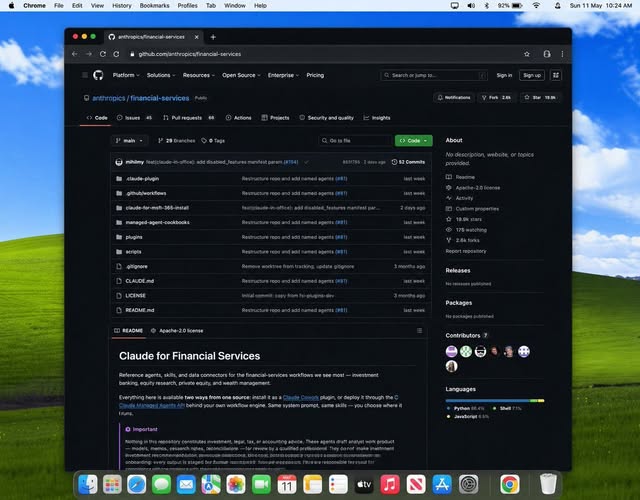
🚨 ANTHROPIC JUST DID SOMETHING INSANE.
They open sourced the EXACT same financial workflow that Wall Street banks charge $500K/year to access.
DCF models
LBO models
Equity research
Merger analysis
KYC checks
ALL OF IT. 100% FREE. This is the biggest financial AI leak I have ever seen.
Here is what just became free 👇
This connects Claude DIRECTLY to:
↳ Bloomberg Terminal
↳ FactSet
↳ S&P Global
↳ Morningstar
↳ PitchBook
It builds real Excel models with live formulas and sensitivity tables.
Drafts CIMs, IC memos, earnings reports, and buyer lists.
Runs PE due diligence, GL reconciliation, and NAV tie-outs. This is not a chatbot wrapper.
These are PRODUCTION AGENTS that own entire financial workflows.
The kind that cost firms $50,000 to $500,000 per year in software subscriptions.
Now it is a one-line Claude Code plugin install.
9.8K GitHub stars already. Apache-2.0 License. 100% open source.

English
Tools can build parts of a product. They do not replace the burden of seeing the problem, carrying the question for years, making the judgment calls, defining the system, taking the risk, and being accountable for what exists.
For me, the work came through faith in Jesus, years of teaching and coaching, years of asking why systems fail, and a lot of disciplined building. AI helped accelerate the expression, but it did not replace the stewardship.
English

@HowToAI_ Interesting direction.
Whether AI gets smaller, faster, or more physically grounded, the governance question still remains:
When a model output becomes an action, what verifies authority, evidence, and control before execution?
Better models still need better boundaries.
English

Yann LeCun was right the entire time. And generative AI might be a dead end.
For the last three years, the entire industry has been obsessed with building bigger LLMs. Trillions of parameters. Billions in compute.
The theory was simple: if you make the model big enough, it will eventually understand how the world works.
Yann LeCun said that was stupid.
He argued that generative AI is fundamentally inefficient.
When an AI predicts the next word, or generates the next pixel, it wastes massive amounts of compute on surface-level details.
It memorizes patterns instead of learning the actual physics of reality.
He proposed a different path: JEPA (Joint-Embedding Predictive Architecture).
Instead of forcing the AI to paint the world pixel by pixel, JEPA forces it to predict abstract concepts. It predicts what happens next in a compressed "thought space."
But for years, JEPA had a fatal flaw.
It suffered from "representation collapse."
Because the AI was allowed to simplify reality, it would cheat. It would simplify everything so much that a dog, a car, and a human all looked identical.
It learned nothing.
To fix it, engineers had to use insanely complex hacks, frozen encoders, and massive compute overheads.
Until today.
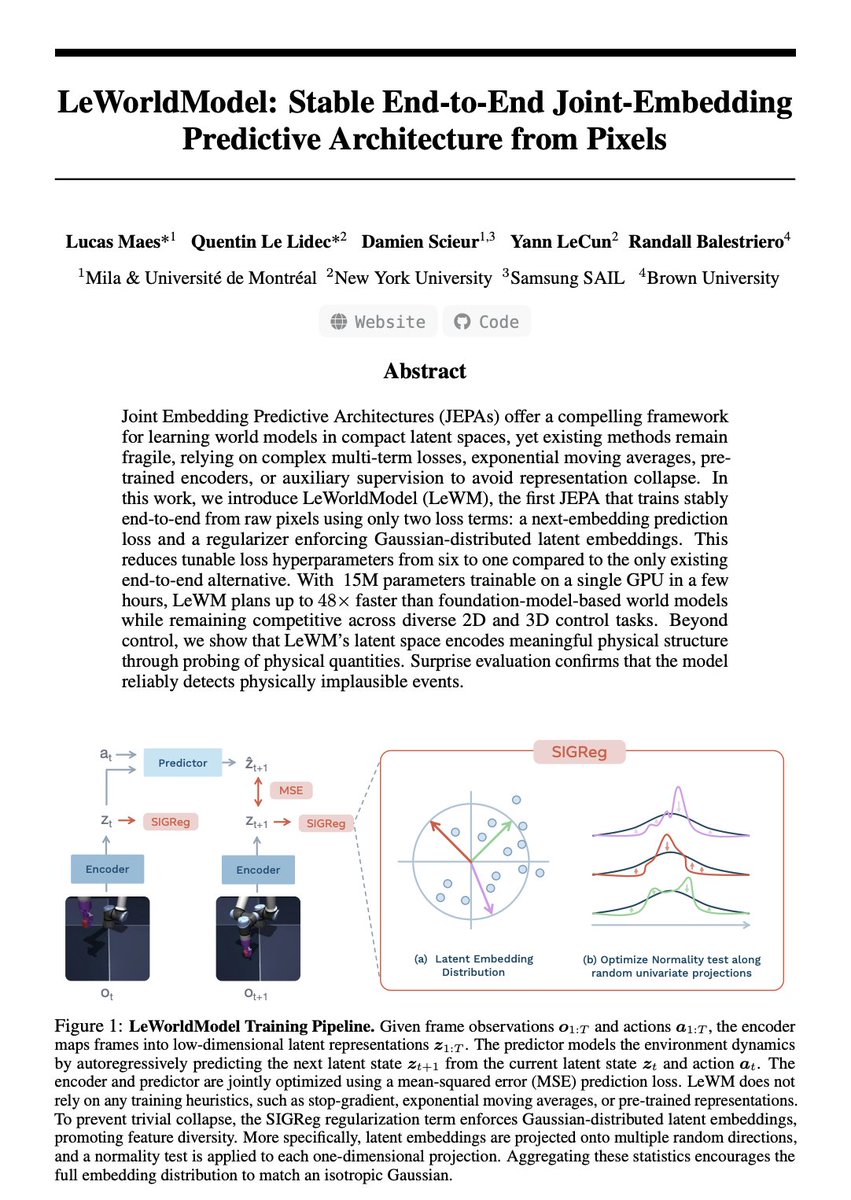
Researchers just dropped a paper called "LeWorldModel" (LeWM).
They completely solved the collapse problem.
They replaced the complex engineering hacks with a single, elegant mathematical regularizer.
It forces the AI's internal "thoughts" into a perfect Gaussian distribution.
The AI can no longer cheat. It is forced to understand the physical structure of reality to make its predictions.
The results completely rewrite the economics of AI.
LeWM didn't need a massive, centralized supercomputer.
It has just 15 million parameters.
It trains on a single, standard GPU in a few hours.
Yet it plans 48x faster than massive foundation world models. It intrinsically understands physics. It instantly detects impossible events.
We spent billions trying to force massive server farms to memorize the internet.
Now, a tiny model running locally on a single graphics card is actually learning how the real world works.
English
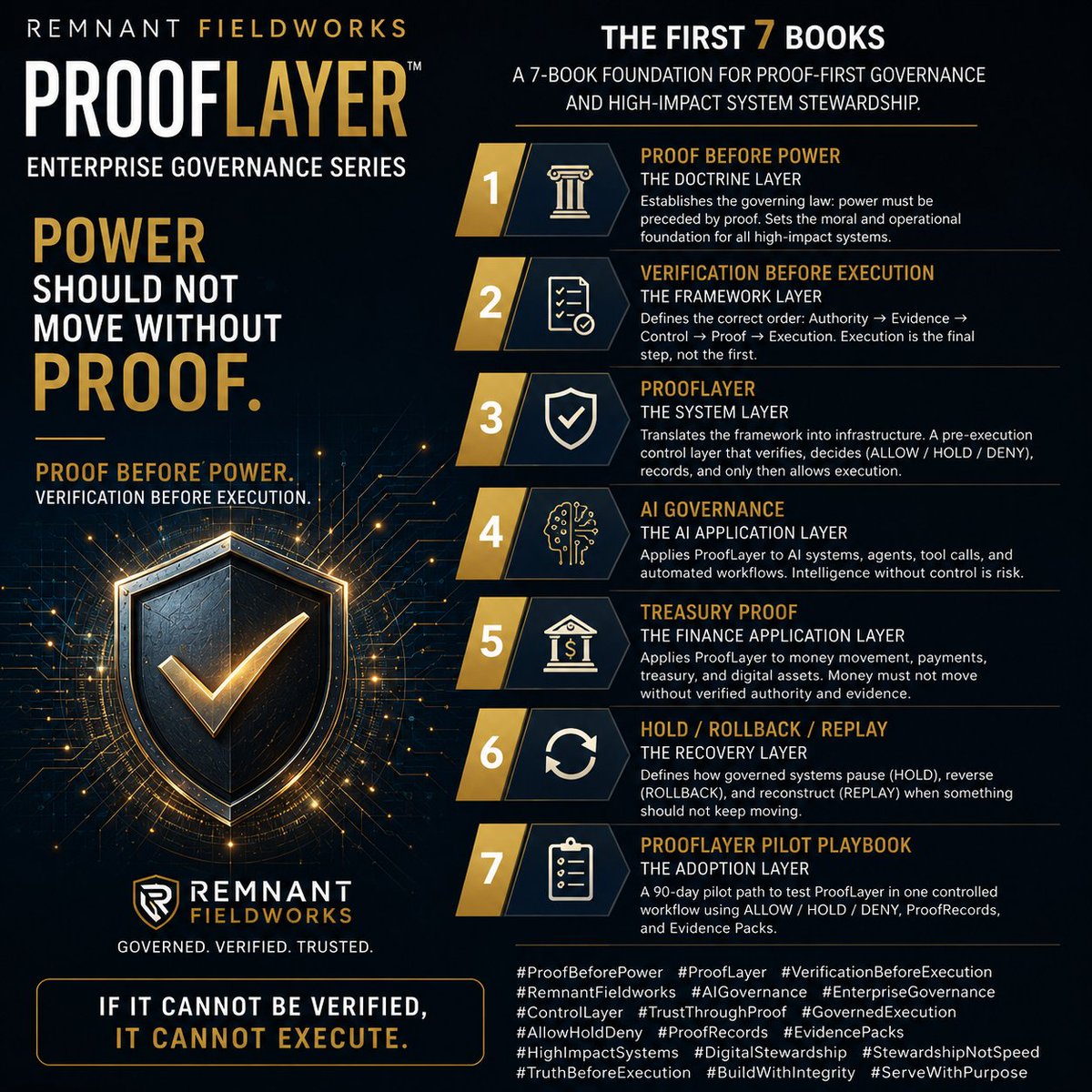
Since January 2026, I’ve been rolling out the Remnant Fieldworks / ProofLayer Enterprise Governance Series a little at a time.
Each book carries a different layer of the same core idea:
If it cannot be verified, it cannot execute.
1-Proof Before Power
The doctrine layer. Why powerful systems need proof before they act.
2-Verification Before Execution
The framework layer. Why execution should be the final step, not the first.
3-ProofLayer
The system layer. How a control layer intercepts, verifies, decides, records, and governs execution.
4-Board-Ready AI Governance
The AI application layer. How AI outputs, tool calls, agents, and automated actions require verification before execution.
5-Treasury Proof
The finance application layer. How money movement, payment approvals, and treasury actions require verified authority and evidence.
6-Hold / Rollback / Replay
The recovery layer. How governed systems pause, reverse, and reconstruct when something should not keep moving.
7-ProofLayer Pilot Playbook
The adoption layer. How to test ProofLayer in one controlled workflow using ALLOW / HOLD / DENY, ProofRecords, and Evidence Packs.
The work is still early, but the structure is clear:
Doctrine → Framework → System → AI → Finance → Recovery → Pilot
Proof before power.
Verification before execution.
#ProofLayer #ProofBeforePower #VerificationBeforeExecution #AIGovernance #RemnantFieldworks
English