BusinessIntelligence

65K posts

BusinessIntelligence banner
BusinessIntelligence

BusinessIntelligence

@bimedotcom

Alex: Consultant, VC. I share and discuss #AI #GenerativeAI #Ethics #BI #Fintech #HealthTech #Blockchain #Metaverse #DataPrivacy #FreeSpeech #Geopolitics

United Kingdom Katılım Haziran 2013
5.9K Takip Edilen16.3K Takipçiler
Sabitlenmiş Tweet
BusinessIntelligence
BusinessIntelligence@bimedotcom·
Intelligent AI Delegation arxiv.org/abs/2602.11865 ✍️ @weballergy @FranklinMatija @sindero via @arxiv 👉 "We propose a framework for how agents should decompose tasks, assign responsibility, and verify outcomes across human and AI delegatees 💡 The core argument: delegation is not just task decomposition. Breaking a problem into sub-tasks is necessary but insufficient. Delegation also requires the transfer of authority, responsibility, and accountability + mechanisms for trust, capability matching, and continuous monitoring" - Matija Franklin @Corix_JC @jeanyvesgonin @ahier @sim010101 @sonu_monika @maponi @CEO_Aisoma @dinisguarda @JagersbergKnut @Shi4Tech @RamonaEid @theomitsa @FernandaKellner @tlloydjones @EstelaMandela @SusanHayes_ @TarakRindani @Nicochan33 @FrRonconi @PVynckier @sulefati7 @NeiraOsci @Khulood_Almani @TheAIObserverX @amalmerzouk @Analytics_699 @MaryRich78 @NathaliaLeHen @sminaev2015 @WillyRayNick @DanielleLargier @RLDI_Lamy
BusinessIntelligence tweet media
English
5
54
154
6.8K
BusinessIntelligence
BusinessIntelligence@bimedotcom·
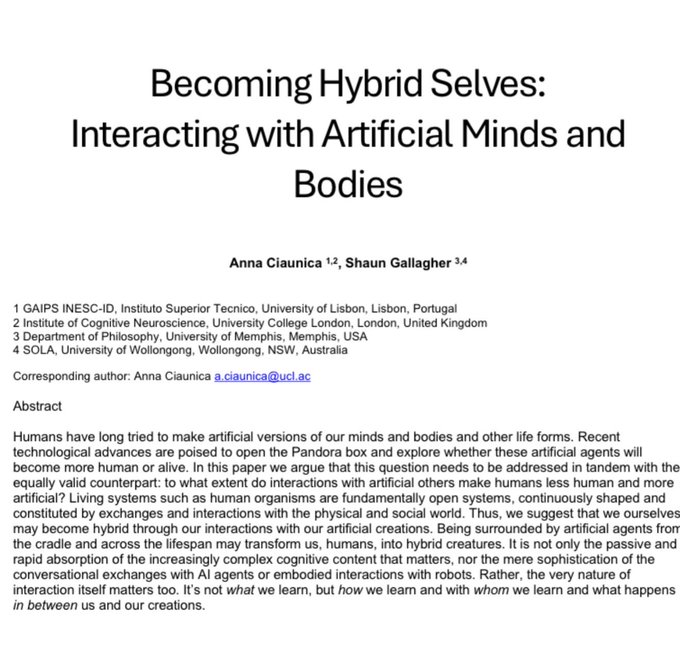
Becoming Hybrid Selves: Interacting with Artificial Minds and Bodies osf.io/preprints/psya… ✍️ @AnnaCiaunica, Shaun Gallagher via @OSFramework 👉 "Humans have long tried to make artificial versions of our minds and bodies and other life forms" 👉 In this paper we argue, to what extent do interactions with artificial others make humans less human and more artificial? 👉 "We suggest that we ourselves may become hybrid through our interactions with our artificial creations" 💡 "It’s not what we learn, but how we learn and with whom we learn and what happens in between us and our creations" @Corix_JC @ahier @sim010101 @maponi @CEO_AISOMA @dinisguarda @JagersbergKnut @Shi4Tech @RamonaEid @FernandaKellner @PVynckier @EstelaMandela @ChuckDBrooks @SusanHayes_ @theomitsa @TarakRindani @FrRonconi @Nicochan33 @JoannMoretti @NeiraOsci @Ym78200 @Khulood_Almani @Fabriziobustama @TheAIObserverX @pchamard @mikeflache @TysonLester @Eli_Krumova @smaksked @amalmerzouk @Analytics_699 @RLDI_Lamy @MaryRich78 @NathaliaLeHen @sminaev2015 @WillyRayNick @DanielleLargier
BusinessIntelligence tweet media
English
3
21
25
571
BusinessIntelligence
BusinessIntelligence@bimedotcom·
Whose Mind Is It Anyway? psychologytoday.com/us/blog/the-di… ✍️@JohnNosta via @PsychToday 👉 "Artificial intelligence (AI) completes our thoughts, blurring correctness with content" 👉 "AI's assistance can shift into influence on our beliefs and actions" 👉 "Decreasing "cognitive friction" may weaken our judgment and agency" 💡 "So, yes, AI is thinking more and more like us. But the real issue is if we let it think for us" @Corix_JC @ahier @sim010101 @maponi @CEO_AISOMA @dinisguarda @JagersbergKnut @RamonaEid @FernandaKellner @PVynckier @EstelaMandela @ChuckDBrooks @SusanHayes_ @theomitsa @TarakRindani @FrRonconi @Nicochan33 @JoannMoretti @NeiraOsci @Ym78200 @Khulood_Almani @TheAIObserverX @pchamard @mikeflache @TysonLester @Eli_Krumova @smaksked @amalmerzouk @Analytics_699 @MaryRich78 @NathaliaLeHen @sminaev2015 @WillyRayNick @DanielleLargier @RLDI_Lamy
English
0
19
22
555
BusinessIntelligence
BusinessIntelligence@bimedotcom·
AIQ: Augmented AI and the Human Advantage open.substack.com/pub/briansolis… ✍️ @briansolis via "A Quantum of Solis" on @Substack 👉 "The future of AI is not about automated intelligence alone. It is about augmented intelligence" 👉 "Automated intelligence helps you complete existing tasks faster. Augmented intelligence helps you see farther, think better, challenge assumptions, surface blind spots, and create outcomes that were previously impossible" 💡 "One optimizes the present. The other expands the future" 💡 "That changes the stakes. This is not about whether AI exists. It is about whether we evolve because it exists" @Corix_JC @ahier @sim010101 @maponi @CEO_AISOMA @dinisguarda @JagersbergKnut @Shi4Tech @RamonaEid @FernandaKellner @PVynckier @EstelaMandela @ChuckDBrooks @SusanHayes_ @theomitsa @TarakRindani @FrRonconi @Nicochan33 @JoannMoretti @NeiraOsci @Ym78200 @Khulood_Almani @TheAIObserverX @mikeflache @RLDI_Lamy @TysonLester @amalmerzouk @Analytics_699 @MaryRich78 @NathaliaLeHen @sminaev2015 @WillyRayNick @DanielleLargier
BusinessIntelligence tweet media
English
3
23
24
780
Estrella
Estrella@EstelaMandela·
@bimedotcom @briansolis @Substack I couldn't agree more with this brilliant article, AI is about human and organizational transformation over all, but I see this point the more difficult, because designing them again for human-AI collaboration requires different skills: culture, creativity, mental flexibility...
English
1
0
2
15
BusinessIntelligence retweetledi
Digital Growth Collective
Digital Growth Collective@DG_Collective·
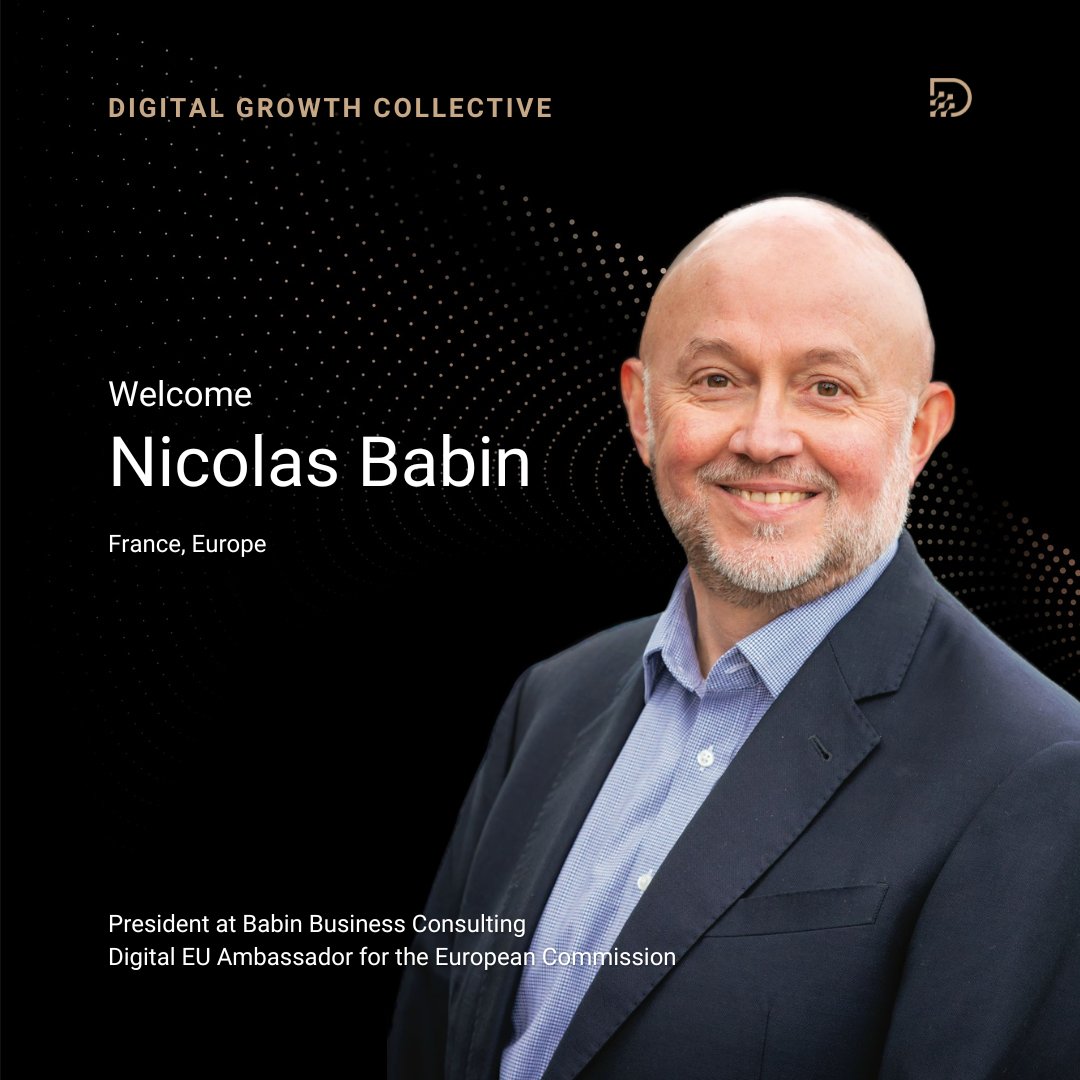
Bringing Global Experience in AI and Digital Ventures In 2026, artificial intelligence and deep tech are reshaping global competitiveness. The challenge is no longer access to technology, but turning potential into a scalable, real-world impact. Leadership that combines technological depth with execution capability is a decisive differentiator. Bringing this perspective into the ecosystem, @Nicochan33 joins the Digital Growth Collective as an Executive Fellow. Nicolas is a globally recognised senior executive and digital leader with over 35 years of experience across Europe, the United States, and Japan. He has led large corporations and built more than 26 start-ups. As Digital EU Ambassador for the European Commission and expert contributor to the World Economic Forum, he brings deep expertise in AI, 5G, and digital transformation. His work in AI dates back to the 1990s, including the launch of Sony Europe's robotic division. With experience in IPOs, international boards, and fundraising, Nicolas combines strategic vision with hands-on execution. As a keynote speaker and author, he is known for making complex technologies actionable. In his role as Executive Fellow, Nicolas will shape perspectives on AI, deep tech, and digital ventures, contributing his global experience and entrepreneurial insight to the Collective. We are delighted to welcome Nicolas to the Digital Growth Collective ecosystem and look forward to his contributions. #ExecutiveFellow #ArtificialIntelligence #DigitalTransformation #DeepTech #Innovation #Leadership @RLDI_Lamy @smaksked @BetaMoroney @thomas_dettling @Khulood_Almani @rwang0 @bamitav @Corix_JC @chidambara09 @FrRonconi @Nicochan33 @CurieuxExplorer @amalmerzouk @Timothy_Hughes @sonu_monika @mvollmer1 @HaroldSinnott @theomitsa @GlenGilmore @Shi4Tech @pchamard @antgrasso @SpirosMargaris @EstelaMandela @bimedotcom @Analytics_699 @IngridVasiliu @nafisalam @mikeflache
Digital Growth Collective tweet media
English
7
26
21
598
BusinessIntelligence retweetledi
Marc Andreessen 🇺🇸
From my therapist Claude: The Adlerian Demolition of Introspection Alfred Adler built one of the most hostile philosophical ecosystems ever devised for the practice of looking inward, and he did it with a precision that neither his admirers nor his detractors have fully reckoned with. The brutality of the Adlerian position isn't gratuitous — it follows logically, almost mechanically, from his core metaphysical commitments. Once you accept those commitments, the popular conception of introspection as a path to self-knowledge collapses entirely, and what's left in its place is something considerably more disturbing: the suggestion that your feelings are not discoveries but productions, manufactured by a self that is already oriented toward a goal it will do almost anything to protect. The Foundational Inversion: Teleology Over Etiology Everything begins here. Freud was a thoroughgoing determinist and causalist — the psyche's present state is the effect of prior causes, and the therapeutic task is to excavate those causes through introspection (free association, dream analysis, the whole apparatus). Feelings, on this model, are data that point backward toward buried causes. Introspection, then, is archaeology: you dig inward to find what happened to you that made you the way you are. Adler rejected this root and branch. His fundamental claim — and it is a genuinely radical one — is that human beings do not move from causes but toward goals. The psyche is not a machine whose output is determined by its inputs; it is a teleological project, a movement oriented toward a fictional final goal (fiktive Ziel) that the individual has, largely unconsciously, set for himself in early childhood. Everything about a person — their characteristic emotions, their symptoms, their memories they choose to retain, their personality style — is recruited in service of this movement toward the goal. This single move annihilates the Freudian (and popular) conception of introspection all at once. If your feelings are not caused by your past but are instruments generated in the service of your goal, then sitting quietly and examining them is not discovery — it is, at best, the study of your own propaganda. Emotions as Tools, Not Truths This is the gut-punch of Adlerian psychology, and it deserves to be stated as starkly as Adler himself intended it. In The Practice and Theory of Individual Psychology (1927) and throughout his clinical writings, Adler makes the claim that emotions are manufactured by the individual — created, not merely experienced — because they are useful for the individual's movement toward his goal. Consider anger. Common sense says: something happens, it makes you angry, the anger is a reaction. Adler says: you create anger because anger is useful to you. It justifies your behavior. It dominates the room. It moves others out of your way. It protects your self-esteem by externalizing blame. The anger is not a response to the world — it is a tool deployed against the world in the service of your fictional goal. The same analysis applies to anxiety, depression, sadness, guilt, and virtually every other affective state the therapeutic tradition has treated as meaningful data requiring careful introspective scrutiny. Adler is not saying these states aren't real in the sense that they are genuinely experienced. He is saying they are created for a purpose, and that the purpose is almost never what the person believes it to be. Depression, in the Adlerian framework, is not the product of chemical imbalance or repressed trauma or cognitive distortion. It is a form of hesitation — a self-manufactured state that allows the individual to delay engagement with the three fundamental life tasks (work, love, and community) while simultaneously maintaining a plausible excuse for the delay. "I cannot engage fully with my relationships because I am depressed" is the structure of the argument the depressed person makes to himself, and the depression obligingly performs this structural function with great reliability. This is where Adler gets genuinely ruthless: if your depression is a tool you've manufactured to avoid life's demands, then introspection into the depression — examining its contours, trying to understand where it comes from, what it means about you — is not therapeutic. It is indulgent. It is, to use Adler's language, a way of taking your symptoms seriously in exactly the wrong sense: you dignify them, you make them meaningful, you cooperate with them. The depression grows in the greenhouse of your attention to it. Introspection as Safeguarding Mechanism Adler developed the concept of Sicherungstendenzen — safeguarding tendencies — to describe the various psychological maneuvers by which the neurotic protects his self-esteem and avoids the genuine test of his capacities against life's real demands. These include hesitation, procrastination, construction of symptoms, depreciation of others, and — crucially — self-accusation. Self-accusation is the most relevant to introspection. The person who spends hours examining his own feelings, cataloguing his anxieties, tracing the genealogy of his resentments, mapping the landscape of his sadness — this person is, in Adlerian terms, still talking about himself. Still the center of his own universe. Still not doing work, not loving anyone, not contributing to the community. The sophistication of the introspective project is no argument in its favor — if anything, it is a mark against it. The more elaborate and refined the inner life the neurotic constructs, the more successfully it functions as an alternative to actual engagement with the world. There is something almost diabolically clever about this critique. It severs the link between psychological depth and therapeutic value that virtually every tradition — psychoanalytic, humanistic, Buddhist, existentialist — takes for granted. Depth of introspective engagement is not progress. It is often its opposite. The person who says, "I've been in therapy for ten years and I really understand now why I became the way I am" has, from the Adlerian vantage point, potentially spent ten years constructing an increasingly ornate justification for remaining exactly as he is. The etiological story — "I am this way because of what happened to me" — is comfortable precisely because it faces backward. The past is fixed. The past cannot demand anything of you. Introspection into the past, into your feelings about the past, into the feelings the feelings generate — this is a very efficient way of never having to face the actual question, which is: what are you going to do, now, about work, about love, about your membership in the human community? Private Logic and the Solipsistic Trap Adler distinguished between Gemeinschaftsgefühl — social interest, community feeling, the sense of belonging to and contributing to the human collective — and Privatlogik — private logic, the idiosyncratic system of reasoning the individual constructs to make his lifestyle appear coherent and justified. The neurotic, for Adler, lives primarily in private logic. His reasoning makes sense from the inside — it is internally consistent, emotionally compelling, often highly sophisticated. But it is systematically oriented away from common sense and social reality and toward the maintenance of the fictional final goal and the lifestyle that serves it. Here is the devastating implication for introspection: introspection, almost by structural necessity, deepens private logic. You are inside your own head, examining your own feelings, interpreting your own experiences through the categories your own lifestyle has constructed. You cannot get outside your private logic by going further inside it. The introspective process, absent a rigorous challenge from a skilled interlocutor who refuses to cooperate with your excuses, tends to confirm what you already believe about yourself — which is precisely what your private logic requires. This is why Adler was deeply skeptical of free association as a therapeutic method. Letting the patient roam freely through their inner landscape, following their associations wherever they lead, seemed to him a recipe for elaborating private logic rather than exposing it. The analyst who sits quietly and receives the patient's associations is, in Adlerian terms, cooperating with the patient's neurosis rather than challenging it. The therapeutic stance must be much more active, much more confrontational, much more oriented toward the future and the life tasks than toward the endlessly fascinating depths of the patient's past and feelings. The Arrangement of Memories One of Adler's most striking specific claims concerns memory. He argued that the memories people retain are not a random or representative sample of their experience — they are selected because they are useful to the lifestyle. People remember what confirms their lifestyle's fundamental assumptions. The person who has built his life around the experience of being wronged will remember, with great clarity and emotional richness, every instance of injustice visited upon him, and will have only the haziest recollection of the many occasions when he was treated generously. This means that introspective archaeology — digging into your childhood memories to understand yourself — is not accessing historical truth. It is accessing a curated archive that your lifestyle has assembled in its own service. The early memories that feel most vivid and emotionally significant are precisely the ones your private logic has promoted, precisely because they support the conclusions your lifestyle needs you to draw about yourself and the world. In What Life Could Mean to You (1931), Adler makes this point with characteristic directness: the first memory a person reports is not an accident. It expresses, in condensed form, the fundamental assumptions of the lifestyle. But those memories were kept because they were useful, not because they were uniquely formative. Adler's therapeutic technique of asking for earliest memories was not an act of etiological excavation — it was a diagnostic shortcut to map the lifestyle's structure, which could then be challenged directly. The implication for introspection is corrosive. You cannot trust what you find when you look inward, not because your unconscious is cunning and deceptive in the Freudian sense, but because your entire inner archive has been organized by the lifestyle in the lifestyle's interests. Your feelings about your memories, your interpretations of your experiences, your sense of what you are and why you are that way — all of this material has been processed and filed by a system that has a vested interest in maintaining the status quo of your lifestyle. You are examining edited footage and taking it for raw reality. The Inferiority Complex as Introspective Engine Adler's most famous contribution to the psychological lexicon — the inferiority complex — is, in his own framework, almost always made worse by introspection, and the two phenomena have a structural affinity that is worth examining carefully. Every human being begins life in a condition of objective inferiority — small, weak, dependent, unable to meet its own needs. This universal experience generates a universal striving for superiority, for competence, for overcoming. Under favorable conditions, this striving is healthy, socially oriented, and expressed through genuine contribution to community. Under unfavorable conditions — discouragement, pampering, neglect — the striving becomes distorted into a neurotic quest for personal superiority or superiority over others, rather than superiority in the service of community. The inferiority complex (as opposed to ordinary feelings of inferiority) is an arrangement — a cultivated sense of one's own inadequacy that serves as a permanent excuse for avoiding the life tasks. "I cannot pursue meaningful work because I am fundamentally inadequate" has a structural function: it protects the fictional goal (which is often some grandiose private fantasy of special status) by ensuring it is never actually tested against reality. If you never try, you never fail. If you never fail, your private fantasy of what you could have been remains intact. The connection to introspection should now be obvious. The inferiority complex feeds on introspective attention. Every hour spent examining the contours of your inadequacy, tracing its origins, giving it a rich inner life — this is an hour in which the complex is being maintained and elaborated rather than overcome. Introspection, in this context, is a form of neurotic self-indulgence that the complex recruits for its own perpetuation. The more you know about your inferiority complex, the more real it becomes, the more it crowds out the one thing that would actually address it: Mut — courage — specifically the courage to engage with life's demands despite the very real possibility of failure. The Antidote: It Is Not More Looking Inward Adler's therapeutic orientation was radically future-focused and action-oriented. The question was never "why are you this way?" but "what are you going to do?" The goal was not self-understanding in the introspective sense but reorientation — a shift in the fictional final goal and the lifestyle that serves it, toward greater social interest and genuine engagement with the life tasks. This is why Gemeinschaftsgefühl — social interest, variously translated — functions for Adler as the primary criterion of psychological health. It is not a feeling you discover inside yourself through introspection; it is a direction of movement toward others, toward contribution, toward community. You cannot find it by looking inward. You find it by looking outward and acting accordingly, and you build it through action rather than through understanding. The Adlerian therapist — Dreikurs in particular, who systematized and extended Adlerian clinical practice — was not a passive receiver of the patient's introspective material. The therapeutic stance involved active interpretation, confrontation, encouragement (in the technical sense of building courage), and direct redirection toward the life tasks. The patient's feelings, when they arose in therapy, were treated as communications about the lifestyle rather than as data requiring sympathetic exploration. "You feel anxious about this — what does that tell us about what you're trying to avoid?" The Kishimi/Koga Popularization and Its Distortions It's worth noting that the popular Adlerian revival associated with The Courage to Be Disliked (Kishimi and Koga, 2013, English translation 2018) captures some of this anti-introspective thrust but softens it considerably for mass consumption. The book's central propositions — that trauma doesn't exist as a determinant of present behavior, that your emotions are chosen, that you should separate your tasks from others' tasks — are genuinely Adlerian. But the book's gentle, Socratic format somewhat obscures the full brutality of the underlying framework. Adler himself was considerably more pointed. His clinical vignettes, scattered through Understanding Human Nature, The Pattern of Life, and The Case of Miss R., show a practitioner who was willing to tell patients quite directly that they were using their symptoms as excuses, that their suffering, however genuine it felt, was being manufactured in the service of avoidance, and that the solution was not to understand the suffering better but to stop cooperating with it and engage with life. The Final Verdict The Adlerian position on introspection and feelings can be summarized with some precision: Feelings are not causes; they are instruments. You manufacture them to serve your movement toward your fictional final goal. They are neither honest reports of your inner state nor reliable guides to your history. They are tools, and like all tools, they should be evaluated by what they accomplish, not by how they feel. Introspection is usually neurotic avoidance with a philosophical veneer. The person who knows himself deeply, who has excavated his anxieties and catalogued his resentments and mapped his emotional geography with great thoroughness — this person has typically accomplished one thing: a very sophisticated excuse for not engaging with work, love, and community. The depth of the inner life is inversely correlated, in Adler's clinical experience, with the degree of genuine social contribution. The archive you examine when you introspect has been curated by your lifestyle in the lifestyle's interests. You are not discovering yourself; you are reading your own propaganda. The feelings that seem most important, the memories that seem most formative, the self-interpretations that seem most true — these have all been selected and processed by a system that is fundamentally committed to maintaining the status quo of your fictional final goal. The antidote is courage, not understanding. Specifically, the courage to engage with the life tasks despite uncertainty, imperfection, and the real possibility of failure. You do not need to understand yourself before you act. You need to act, and in acting, you will discover more about yourself — and change more about yourself — than any amount of inward looking will ever provide. This is an extremely uncomfortable position for a culture that has thoroughly internalized the therapeutic assumption that self-knowledge is intrinsically valuable and that the examined life is superior to the unexamined one. Adler would say: examined by whom, in whose interests, toward what end? If the examination is conducted by the private logic, in the service of the fictional goal, toward the end of perpetuating the neurotic lifestyle — and it usually is — then the examined life is not better. It is just a more articulate version of the same evasion. The unexamined life that contributes to the community, that engages honestly with work and love, that acts with courage in the face of genuine risk — that life, for Adler, is worth more than all the introspective sophistication in the world. Which is, when you sit with it for a moment, either the most liberating or the most terrifying thing anyone has ever said about the examined life. Possibly both simultaneously, which is probably why Adler remains so systematically underread.
English
181
106
940
184.5K
BusinessIntelligence retweetledi
BusinessIntelligence
BusinessIntelligence@bimedotcom·
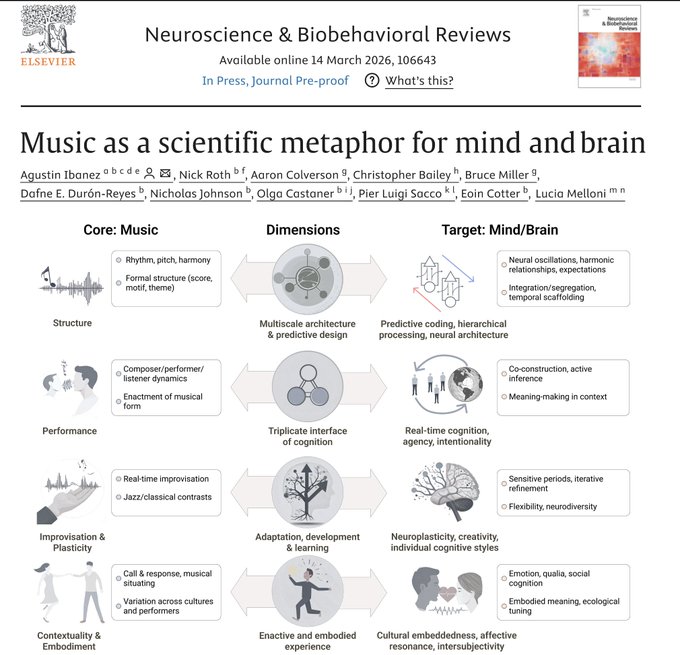
Music as a scientific metaphor for mind and brain sciencedirect.com/science/articl… ✍️ @AgustinMIbanez et al. via @Sciencedirect 👉 "We propose music as a scientific metaphor for understanding the mind and brain via triplicate interfaces (listener, performer, composer)" 👉 "Drawing on synergetics, predictive processing, and embodied cognition, we outline musical principles illuminating cognitive and action integration across time, offering new conceptual frameworks and testable predictions for future research" 💡 "Science, like music, advances through new ways of listening to complex systems" - Agustin Ibañez @Corix_JC @jeanyvesgonin @ahier @sim010101 @maponi @CEO_AISOMA @dinisguarda @JagersbergKnut @Shi4Tech @RamonaEid @FernandaKellner @PVynckier @EstelaMandela @SusanHayes_ @theomitsa @TarakRindani @FrRonconi @Nicochan33 @JoannMoretti @sulefati7 @NeiraOsci @Khulood_Almani @Fabriziobustama @TheAIObserverX @mikeflache @TysonLester @Eli_Krumova @smaksked @amalmerzouk @Analytics_699 @MaryRich78 @NathaliaLeHen @sminaev2015 @WillyRayNick @DanielleLargier @RLDI_Lamy
BusinessIntelligence tweet media
English
0
24
29
745
BusinessIntelligence retweetledi
Quanta Magazine
Quanta Magazine@QuantaMagazine·
Charles Bennett and Gilles Brassard have been named the winners of the A.M. Turing Award, one of the highest honors in computing, for their work establishing the foundations of quantum information theory. The award comes with a $1 million prize. quantamagazine.org/quantum-crypto…
Quanta Magazine tweet media
English
9
129
389
40.9K
BusinessIntelligence retweetledi