JosieJNS

5K posts

JosieJNS

JosieJNS

@FinnegansCoin

finance researcher / stocks

Katılım Ocak 2018
414 Takip Edilen209 Takipçiler
JosieJNS retweetledi
Roy Mattox
Roy Mattox@RoyLMattox·
Hyperscalers are the massive technology companies that provide large-scale cloud computing, data storage, and networking infrastructure to businesses globally. These are the companies who are spending Billions in the AI arms race. They primarily consist of $Amzn, $Meta, $Msft, $Googl, $Orcl, and $Baba. The market is concerned with how much these companies are spending and how quickly these companies will get a return of those Billions. This in a nutshell is why these big technology firms are performing poorly. They will continue to perform poorly until this aberration is discounted and this probably will take weeks and months. You will only be able to look back after the fact and say, yeah that was the bottom. In the meantime, catching a falling knife while can be profitable, the mental anguish can be debilitating. Wes and I are passing on these for the foreseeable future. $Aapl incidentally may be the big beneficiary of this trend as they own the ecosystem for potential AI for consumers and they have not spent Billions. They can partner with who they view has the best AI model and avoid all this anguish short term.

Roy Mattox tweet media
English
8
11
136
18.2K
JosieJNS retweetledi
amit
amit@amitisinvesting·
A TON OF THINGS HAPPENED IN THE STOCK MARKET TODAY. Here's a full recap: 1. Alphabet $GOOGL delivered a massive Q2 2026, with revenue up 24% YoY to $119.8B and operating income rising 30% YoY to $40.8B. Search revenue grew 17% YoY to $63.3B, while Google Cloud had its fastest growth quarter ever, surging 82% YoY to $24.8B and producing $8.8B of operating income. Net income jumped 298% YoY to $112.1B. On the AI side, the Gemini app reached 950M monthly active users, and Gemini models are now processing 22B API tokens per minute. The one major drag was free cash flow, which turned negative at -$5.8B, marking Google’s first negative FCF quarter in years. Still, this was the company’s strongest revenue acceleration in 3 years, driven by explosive cloud growth and rising AI usage. 2. AMD $AMD and Anthropic have reportedly signed an AI server deal worth tens of billions of dollars, per WSJ. Under the agreement, Anthropic would buy up to 2GW of AMD’s latest-generation Instinct MI450 chips beginning in the first half of 2027. AMD also plans to invest up to $5B in Anthropic as deployment milestones are reached, and is reportedly discussing a potential financial backstop for Anthropic’s future data center leases. The deal marks another major push by AMD to deepen its AI infrastructure footprint and compete more directly with Nvidia. 3. President Trump said the U.S. will respond to any Iranian attack on ships in the Strait of Hormuz by bombing and destroying one Iranian bridge or power plant each time it happens. Trump said the policy applies “from this point forward” and could include infrastructure located near or inside Tehran. 4. Tesla $TSLA reported a mixed Q2, with revenue beating at $28.24B vs $26.32B expected, up 26% YoY, but profitability coming in weaker as adjusted EPS was $0.33 vs $0.51 expected, gross margin was 16.8% vs 19.4% expected, and operating margin fell to 1.4% vs 5.4% expected. Automotive revenue grew 23% YoY to $20.52B, deliveries rose 25% YoY to 480,126, production increased 10% YoY to 451,758, and free cash flow was -$1.09B, better than the -$3.25B estimate. Tesla ended the quarter with $43.52B in cash and investments, while GAAP net income was $1.11B, helped by a $1.01B unrealized gain on its SpaceX investment. The bigger story was AI and autonomy: Cybercab production began at Gigafactory Texas, Robotaxi is now operating across seven major U.S. metros, active FSD subscriptions reached 1.48M, up 56% YoY, and more than 55% of new North American deliveries included an FSD subscription. Tesla also said Optimus production lines are being installed for expected production in 2026. 5. Nvidia $NVDA CEO Jensen Huang pushed back on fears around Kimi K3, DeepSeek, and China’s open-source AI models, saying U.S. companies should be allowed to use them because developers can download, fine-tune, and guardrail the models themselves. Huang said Chinese open-source models are “excellent” and argued the market misunderstood DeepSeek the first time and is now misunderstanding Kimi. His broader point is that strong open models should expand overall AI usage, not hurt closed models, and that more AI usage ultimately means more Nvidia systems, more data centers, and more demand for accelerated compute. 6. The top 10 most active options today by contracts traded were $NVDA with 5.1M contracts, $AAPL with 1.2M contracts, $TSLA with 844K contracts, $AMZN with 828K contracts, $MU with 803K contracts, $SMCI with 746K contracts, $SPCX with 745K contracts, $MSFT with 722K contracts, $INTC with 548K contracts, and $PLTR with 540K contracts. 7. Google $GOOGL raised its FY26 capex outlook to $195B–$205B, up from $180B–$190B, as the company pulls forward capacity to keep up with stronger demand. Google said only a small portion of revenue from existing TPU system sales agreements is expected to be recognized in 2026, with most of it flowing through in 2027. Because of supply constraints, Google also plans to lean more on third-party capacity in Q3 as a temporary bridge, which could create some modest near-term margin pressure. 8. ServiceNow $NOW delivered a strong Q2, beating on revenue, EPS, cRPO, and operating margin while raising its FY26 outlook. Total revenue came in at $3.99B vs $3.92B expected, up 24% YoY, with subscription revenue up 24.5% YoY to $3.88B. Adjusted EPS was $0.90 vs $0.86 expected, and cRPO reached $13.2B, up 21% YoY and ahead of estimates. The company raised FY26 subscription revenue guidance to $15.76B–$15.78B, while guiding for 81% subscription gross margin, 31.5% operating margin, and 35% free cash flow margin. AI was the biggest highlight, with ServiceNow AI ACV crossing $1B in Q2 and agentic deployments increasing 9x in just nine months. RPO rose to $29B, customers above $5M in ACV grew 23% YoY to 658, and deals over $1M in ACV jumped roughly 40% YoY to 123. 9. Stripe generated $3.2B in free cash flow in 2025, up 52%, as revenue climbed roughly one-third to $6.8B, its fastest growth since 2021, according to The Information. The company also reached $2B of revenue in Q1 2026. Stripe’s momentum is being helped by AI customers, with the company processing subscription and usage-based payments for OpenAI, Anthropic, and other AI companies. Its billing, invoicing, and tax products are also tracking toward a $1B annual run rate this year. That level of cash generation gives Stripe more flexibility to keep expanding, following its acquisitions of Metronome and Bridge, plus the reported Stripe and Advent International offer of more than $53B for PayPal $PYPL. 10. Apple $AAPL is reportedly gearing up for a major Mac refresh cycle starting this fall and continuing through 2027, per Bloomberg. The first wave is expected to include an M6 14-inch MacBook Pro and updated iMacs, followed later by redesigned 14-inch and 16-inch MacBook Pros featuring OLED touchscreens. Apple is also working on new MacBook Air, MacBook Neo, Mac mini, and Mac Studio models, though some release timing may depend on memory-chip availability. 11. Baird reiterated Nebius $NBIS at Outperform with a $250 price target, arguing the company is well positioned as AI workloads shift from training toward inference. The firm’s bullish view is built around Nebius’ full-stack platform, strong software attach, expanding customer base, sector-leading growth, and experienced team from the Yandex carve-out. Baird also said Nebius is moving quickly to strengthen its stack through high-quality acquisitions, helping it compete in a fast-changing AI infrastructure market. 12. OpenAI is now reportedly forecasting roughly $750B of compute spending through 2030, up from about $600B earlier this year, as it continues locking down cloud and data center capacity, per WSJ. The company also announced a $20B initial investment in Project Camellia in Georgia, where OpenAI will serve as lead designer and developer for the first time, with 3.2GW of power contracted between 2028 and 2032. Other reported infrastructure commitments include 6GW with Oracle, $138B over eight years with AWS, and another $250B tied to Microsoft Azure. WALL STREET IS THE GREATEST SHOW ON EARTH.
English
85
153
2.7K
462.8K
JosieJNS retweetledi
Pavel | Robuxio
Pavel | Robuxio@PKycek·
Robuxio Equities is officially launched! Why to get exposure:
Pavel | Robuxio tweet media
English
4
1
11
1.3K
JosieJNS retweetledi
gemchanger
gemchanger@gemchange_ltd·
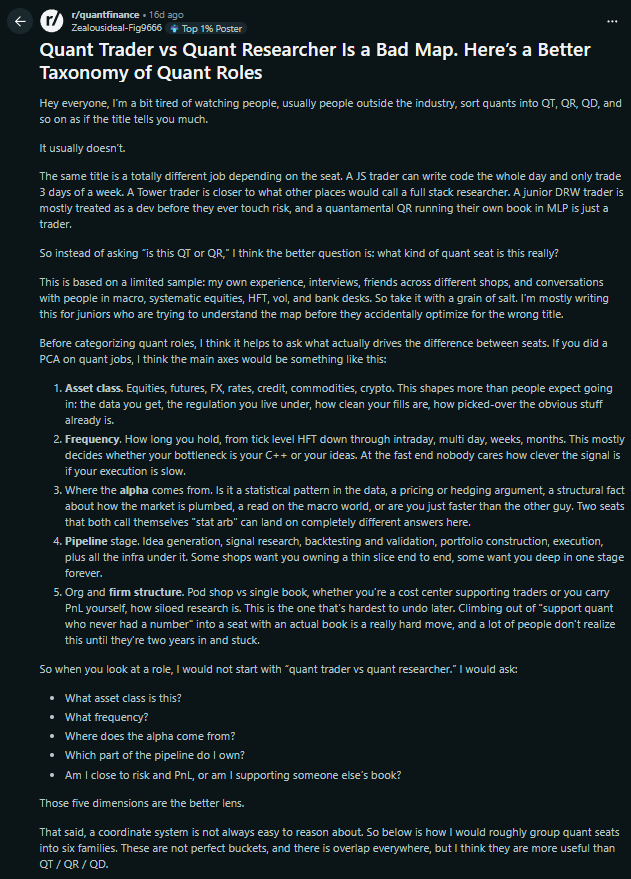
Found a guy who worked inside the most secretive, highest-paying industry on earth. Quant finance, where kids straight out of college clear $500k+ and 24-year-olds out-earn surgeons. He just leaked what nobody warns you about. The 5 things that ACTUALLY decide your career: > What you trade > How fast you trade it > Where the money really comes from > Which part of the job you own > Whether you control real profits… or just babysit someone else's
gemchanger tweet media
gemchanger@gemchange_ltd

x.com/i/article/2028…

English
9
62
530
90.6K
JosieJNS retweetledi
David Capablanca
David Capablanca@reverselong·
Earlier this year I had the opportunity to contribute to this cool book on algo short selling titled “Algorithmic Short Selling with Python” If you’re a system/ago trader, this is the book for you. Also make sure to get my book and send me a dm of the preorder for your bonus materials! shortsellingmaster.com
English
1
7
54
6.4K
JosieJNS retweetledi
Ihtesham Ali
Ihtesham Ali@ihteshamali·
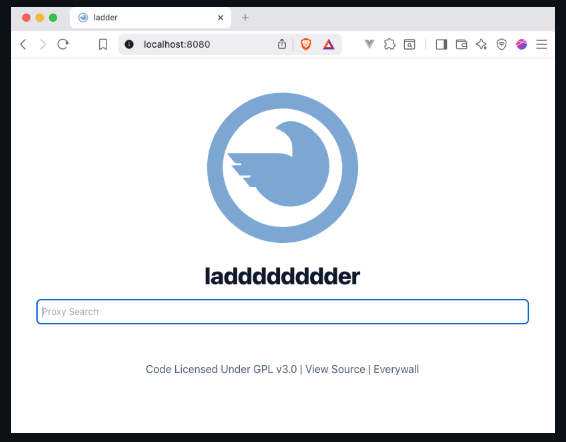
Publishers killed 12ft Ladder months after Elon made paywall bypassing famous. In August 2023, Elon Musk told his followers they could read the New York Times for free using a paywall bypass site. That single post pulled in 37 million views. Back then, the bypass everyone actually built their workflow around was called 12ft. io, nicknamed 12ft Ladder. Paste a locked article's link in, get the readable page out. It ran on one domain, owned by one company. That made it an easy legal target. In July 2025, the News Media Alliance got it shut down for good. So a developer rebuilt the same idea with one difference. This time there is no domain to kill. It's called Ladder, and it lives on GitHub. You run it yourself. One Docker command spins it up on your own server, under your own name, with your own rules for which sites it touches. Nobody can pressure a registrar that was never theirs to pressure. There is no single company holding the project hostage, because every person who runs it becomes their own company. 8.5K stars. GPL-3.0 license. 100% open source. github.com/everywall/ladd…
Ihtesham Ali tweet media
English
13
89
625
44.2K
JosieJNS retweetledi
Rohan Paul
Rohan Paul@rohanpaul_ai·
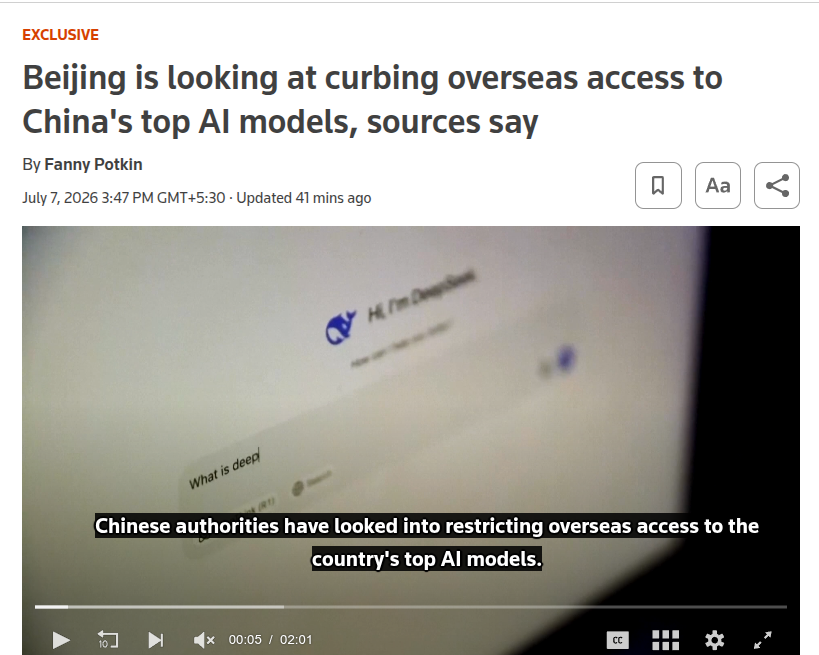
🇨🇳This is bad news. Now, frontier open source access also will probably no more be available for all. China is preparing to limit foreign access to its strongest AI models, a move that could raise global AI costs and split the model market by nationality. Beijing has held recent talks with Alibaba, ByteDance, and Z .ai about keeping advanced Chinese models inside China, including models not yet released. The Ministry of Commerce led the discussions, with China’s state planning agency also present, which signals export control rather than routine platform regulation. The targets include closed models and open-weight systems, so the issue is not only API access but downloadable model power. Chinese officials also discussed treating leaks or theft of proprietary AI as a national security offence, not merely an IP dispute. New limits on who can fund Chinese AI startups were also discussed, which would tighten control over capital, talent, and model access together. Foreign companies could lose access to low-cost Chinese models just as those models become strong enough for serious production work. Washington has already restricted access to advanced U.S. models on security grounds. China now fears Mythos could find software vulnerabilities and be used against Chinese interests, so both sides are treating AI as strategic infrastructure. Beijing has also investigated Chinese AI startups that moved abroad and pushed Meta to unwind a $2B Manus deal. A likely path is tiered control: basic open tools get filings, stronger systems face reviews, and frontier models stay domestic. This would be a major setback for open AI access because model progress would no longer spread mainly through product quality and price. --- reuters .com/world/beijing-is-looking-curbing-overseas-access-chinas-top-ai-models-sources-say-2026-07-07/
Rohan Paul tweet media
English
49
53
249
40.6K
JosieJNS retweetledi
Ted Zhang
Ted Zhang@TedHZhang·
What are the signs CRYPTO has bottomed? And what is my next highest conviction opportunity? My podcast segment from last Thursday. See the relative strength and signs before everyone sees it and wants in months later.
English
30
9
118
22.9K
JosieJNS retweetledi
Top 7 | Tech, AI & Crypto Analytics
Robinhood Chain Landscape @RobinhoodCrypto went live less than a week ago - and the ecosystem map already looks like this. 100+ teams across infrastructure, trading, lending, analytics, wallets, ramps and bridges, with names like Uniswap, Lido, Morpho, Chainlink, MetaMask and LayerZero deployed or committed from day one. This isn't a chain waiting for builders - it launched with the full DeFi stack pre-installed and 28M retail users on top. Save the map, some of these teams will be running points programs on Robinhood Chain soon.
Top 7 | Tech, AI & Crypto Analytics tweet media
English
6
34
85
9.6K
JosieJNS retweetledi
Criptolawyer
Criptolawyer@criptolawyer·
most neobanks will not survive the next 18 months. not because demand disappears. $245M in top-ups in a single week proves demand is the least of your problems, they will die because of what they built underneath: i review compliance infrastructure for a living since 2017. here is the full map of what actually holds this market together, layer by layer, and who is powering each one right now cards your card program is a three-party compliance relationship: you, your issuer, and the network. the network's enhanced due diligence sits on top of your issuer's requirements. if either loses confidence in your stack, the card stops. not slowly. overnight @binance lost Visa in Europe July 2023. lost @Mastercard in latam two months later. gone by December. @ready_co gave non-EEA users one hour's notice in June 2026 when their issuer relationship broke. one hour what the network actually wants to see: account-level OFAC and sanctions screening, not batch, not periodic, continuous. a transaction monitoring system that produces real alerts. a KYC layer defensible across every jurisdiction you operate in. one audit trail running through every product the customer touches Starlingbank had a system that produced zero individual sanctions alerts for six months. £29M fine. that is the floor the infrastructure powering this layer right now: @raincards (Visa and Mastercard principal member, BIN sponsor for 200+ programs, one API for issuance, compliance, FX and onchain settlement), @pomelo_latam ($160M raised, powers bbva , santander , @Bancolombia , @WesternUnion , Binance across latam, just launched global stablecoin card across 150+ countries), @marqeta ($383B processing volume in 2025), @lithic, @GalileoFintech, @unit_co_, @treasuryprime, @Adyen, @Stablecoin @eldoradoio @Uglycash the compliance layer that makes the issuer relationship survivable is what @blend_money is built around: screening, audit trails, per-jurisdiction reporting, the infrastructure that keeps the card program intact at scale on and off ramps every ramp is a compliance event before it's a UX event on-ramp: you are opening a new account. source of funds, identity verification, risk scoring before a single dollar moves off-ramp: withdrawal with a clean audit trail, documented source of funds, per-jurisdiction reporting. this is where most teams underinvest because users don't see it. regulators do best practice: per-account screening on every transaction, not customer-level screening on signup and never again. your banking partner will pull a sample during their quarterly review. if the trail isn't clean per transaction, you find out at the worst moment the infrastructure powering ramps right now: @moonpay (eliminated fees on stablecoin onramps, enterprise stablecoin services live), @Transak (published the Q2 2026 compliance cliff report, most serious public documentation of what payment companies need before july), @Stablecoin (acquired by Stripe for $1.1B, trust charter approved february 2026), @belo_app @AlchemyPay, zerohashx, @Bitso , @RipioApp @daimo @dakota_xyz @RampNetwork @tazapay earn (im biased here just a little bit) the most misunderstood compliance surface in the stack shared vaults feel like a product architecture decision. they are actually a legal structure decision. commingled user funds create fiduciary exposure, insolvency complexity, and a direct failure point in any serious institutional diligence process the question that kills shared vault structures is simple: show me the ledger entry for user X's balance. if the answer requires reconstructing it from pool accounting, you don't have an answer best practice: isolated per user from day one. each account its own ledger entry. yield calculated individually. never commingled. this isn't conservative. it's the only structure that survives the question above from a banking partner, a regulator, or an institutional LP doing diligence on your cap table this is the architecture @blend_money runs. isolated accounts, clean ledger, never commingled for the institutional layer on top: @noon_capital brings the DeFi stack diversification and insurance coverage that makes yield products viable for institutions. diversified protocol exposure across @MorphoLabs, @eulerfinance, @pendle_fi, tokenized treasuries, CLOs and private credit. insurance gating on every deployment, no capital deployed without coverage. that is the version that survives institutional diligence the broader earn infrastructure: @opentrade_io (RWA-backed yield-as-a-service, bank-grade legal structure with bankruptcy-remote SPC, powers Littio, Kredete, Criptan), @OndoFinance, @maplefinance, @goldfinch_fi, @SuperstateInc in europe, MiCA Article 50 prohibits interest on euro-denominated stablecoins. the compliant path runs through tokenized T-bills and RWA wrappers. yield from an underlying asset, not from the stablecoin itself. whoever builds this first owns european earn cashback and rewards every rewards program with monetary value has reporting obligations (ps @itstuyo set the new standart here: buy now pay maybe) the cleanest structure: rewards funded from interchange revenue, paid in a regulated stablecoin, accounting that reconciles per user per period, tax-reportable from day one in every jurisdiction paying rewards in your own token introduces volatility risk for the user and securities classification risk for you. the question "is this a security?" becomes harder to answer the moment the token fluctuates and users expect returns compliance screening, the layer underneath all of it most teams assemble this reactively. something breaks, a regulator asks a question, a banking partner flags a transaction. then the compliance stack gets built. that is the wrong order the teams that survive build it preventively. before the card. before the ramp. before the earn product. one continuous audit trail across every product the customer touches the point tools doing parts of this well: @chainalysis (blockchain analytics, OFAC and sanctions screening, regulator-accepted in US, EU and UK), @elliptic, @trmlabs, @Sumsubcom (KYC, AML and Travel Rule in one integration, MiCA and FATF ready), @ComplyAdvantage, @notabene_id, @sardine, @unit21inc, @jumio, @Onfido but point tools create point gaps. your KYC vendor does not talk to your transaction monitoring. your transaction monitoring does not feed your sanctions screening. your sanctions screening does not generate the audit trail your banking partner needs to read. every gap is a reconciliation problem you find at the worst moment what @blend_money built is the integrated layer. AML screening, OFAC checks, KYC, transaction monitoring, per-jurisdiction reporting, all running together as preventive infrastructure before a single user touches a product. not a compliance dashboard bolted on top. the foundation the card, the ramp and the earn product sit on IDmerit's February 2026 breach of approximately 1 billion records made this clear: your compliance infrastructure is now a counterparty risk decision, not just a regulatory one the right order of operations 1) screening and transaction monitoring, then issuer relationship, then card 2) source of funds framework, then ramp, then volume 3) isolated ledger, then earn product, then institutional partners 4)interchange accounting, then rewards, then retention teams that invert this order ship faster in year one and rebuild in year two. sometimes year two doesn't come the $245M is not a card story. it's not a yield story. it's a survival story the neobanks still standing when this market hits $2.45B will be the ones that figured out compliance is not the last thing you build. it's the only thing that lets you build everything else WaveCrest taught this lesson in 2018. Wirecard taught it in 2020. Ftx in 2022. Binance in 2023. Ready in 2026 the lesson does not change. only the names do.
Paymentscan@Paymentscan

JUST IN: Neobanks set a massive all-time high this past week, with over $245M in top-ups. This is 18% higher than ever recorded.

English
48
43
493
126.8K
JosieJNS retweetledi
Mark Minervini
Mark Minervini@markminervini·
At present, the consensus on Wall Street of those who expect the Fed to hike rates points toward a relatively modest tightening campaign, with many economists expecting only a single rate increase—possibly as soon as September—before the Fed pauses to reassess economic conditions. Historic analysis suggests that how quickly the Federal Reserve raises interest rates can be just as important as the hikes themselves. The pace of rate increases can be classified as follows: a. Rapid Cycle b. Slow Cycle c. Non Cycle A rapid tightening cycle occurs when the Fed raises rates at a cadence of more than once every two meetings, on average. A gradual or slow cycle features longer intervals between hikes, while a limited or non cycle consists of only one or two increases before the Fed pivots back toward easing. Historically, the market has responded very differently to each scenario. Aggressive tightening cycles have been the least favorable for equities, with the S&P 500 posting an average decline of roughly 3.6% during the first year following the initial rate increase. Stocks have generally struggled most during the early phase of these faster tightening campaigns. By contrast, markets have fared considerably better when the Fed has moved at a more measured pace. During gradual tightening cycles, the S&P 500 has historically gained about 10.5% over the year following the first hike, while limited tightening cycles have produced average returns of approximately 11.5%. Sector leadership has also differed. Faster tightening periods have tended to favor more defensive areas of the market while reducing the performance of cyclical and growth-oriented sectors. Slower and shorter tightening cycles, on the other hand, have generally provided a more constructive backdrop for broader equity leadership. minervini.com
Mark Minervini tweet media
English
44
117
948
166.5K
JosieJNS retweetledi
Pavel | Robuxio
Pavel | Robuxio@PKycek·
Even professional capital allocators are quietly making the most basic backtesting mistake there is. The less efficient the asset, the more damage this mistake does.
English
2
6
14
1.8K
JosieJNS retweetledi
Jeff Sun, CFTe
Jeff Sun, CFTe@jfsrev·
This is exactly the kind of stock @OliverKell_ talked about in his 2021 interview: a stock that can double in price in 3 months, but still give you just a low 10% win rate over 20-30 attempts, with low profit factor, while putting your equity through a -5% drawdown. Recent price linearity is a very important factor in stock selection, it can skew your win rate % heavily.
English
1
5
49
8.2K
JosieJNS retweetledi
Pavel | Robuxio
Pavel | Robuxio@PKycek·
My very first message to anyone serious about allocating to crypto is don't buy-and-hold. Do this instead.
English
1
1
11
1.2K
JosieJNS retweetledi
Peter - Cracking Markets
Peter - Cracking Markets@SystematicPeter·
+63.9% this year with -16.9% drawdown so far. And I will share 100% of the rules here. Not from AI. Not from some complex quant model. Just a very basic monthly Nasdaq 100 rotational system. The rules: * Trade only when $NDX is above its 200-day moving average * Every month scan Nasdaq 100 stocks * Keep only stocks above their own 200-day moving average * Keep only stocks with positive 250-day percentage change * Rank them by 250-day percentage change * Buy the top 10 * Hold for one month * Repeat That is it. No prediction. No macro forecasting. No discretionary chart reading. No secret sauce. Just: market regime filter stock trend filter momentum ranking monthly rebalance Of course, not every year will look like this. Some years will be choppy. Some years will underperform buy and hold. Some years will feel too simple to trust. But this is exactly why I trade systematically. The edge is not in predicting the next winner. The edge is in building a repeatable process. And once you understand the basic concept, you can push it much further. A great way to start testing this properly: RealTest + Norgate data. Especially because Norgate gives you survivorship-bias-free Nasdaq 100 constituents through history, so you are not accidentally testing today’s winners in the past.
Peter - Cracking Markets tweet media
English
14
40
426
31.4K
JosieJNS retweetledi
Louis Gleeson
Louis Gleeson@aigleeson·
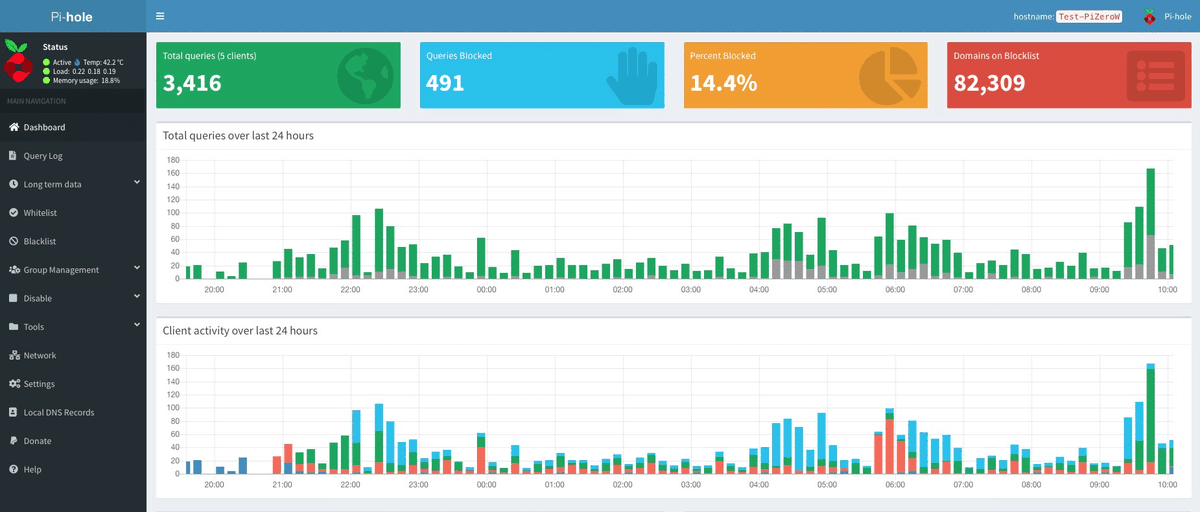
A group of developers gave away a piece of software for free that does what a $200-a-year premium subscription promises, except it works on every single device you own at once and nobody can ever shut it down. It is called Pi-hole, and it runs on a computer so small and so cheap it costs less than a single month of most ad-free streaming plans. Most people fight ads device by device. A blocker on the laptop. A premium account on one app. A different trick for the smart TV that usually fails anyway. It is exhausting and it never fully works. Pi-hole ends the whole war in one move. It installs in one place and protects everything connected to your home network. Phones, tablets, consoles, speakers, the smart fridge nobody asked for. The trick is where it sits. Every device on your wifi has to ask for directions before it can load anything, including ads. Pi-hole becomes the thing giving directions. When something asks for the address of an ad server, Pi-hole sends it nowhere. No app to install on each phone. No login. No company holding your data, because the data never leaves your house. The ad companies built their entire model on you not understanding the plumbing. Pi-hole is just someone who understood the plumbing and refused to pay.
Louis Gleeson tweet media
English
5
18
49
5.6K
JosieJNS retweetledi
Shruti
Shruti@heyshrutimishra·
ChatGPT is blocked in China. So is Claude. Most people visiting don't even know there are options to make your trip seamless.. I've been here 2 weeks. Here are the 3 apps that is actually helping me the entire time. 𝟭 𝗔𝗹𝗶𝗽𝗮𝘆 handles everything money-related. Metro, taxi, noodles at a street stall, hotel checkout. Almost no one takes cash anymore and card readers are weirdly rare. Link your international card, top it up once, and you stop thinking about money for the rest of the trip. 𝟮 𝗞𝗶𝗺𝗶 𝗔𝗜 is the OG. Claude and ChatGPT are blocked in China, and the answers they give for local stuff are bad anyway. Wrong place names, outdated metro info, no read on what's culturally appropriate. Kimi is built for the country. Point your camera at a menu, it reads it. Talk to it, it translates back in the right tone. Ask where to eat nearby and it knows. Navigating a place with an AI that actually understands it is a different experience. 𝟯 𝗪𝗲𝗖𝗵𝗮𝘁 is how people actually talk to each other. iMessage works for friends back home but inside China everything runs on WeChat. Your driver will WeChat you. The restaurant menu is a WeChat mini program. The front desk, your guide, the guy who sold you a SIM card, all WeChat. You'll use it more than your inbox. That's the kit. People still think going to China is a huge deal. It really isn't. You land, turn on data, open three apps, and you're moving. If you've been talking about visiting for years, just go.
Shruti tweet media
English
220
42
581
102.2K
JosieJNS retweetledi
Ted Zhang
Ted Zhang@TedHZhang·
The new @Deepvue charts are the fastest charts I've ever used with zero lag thus far. I finally have some charts that can load faster than my eyes and brain can process. Well done @AmeetRai @RichardMoglen @RossHaber!
English
14
9
230
26.8K
Jeff Sun, CFTe
Jeff Sun, CFTe@jfsrev·
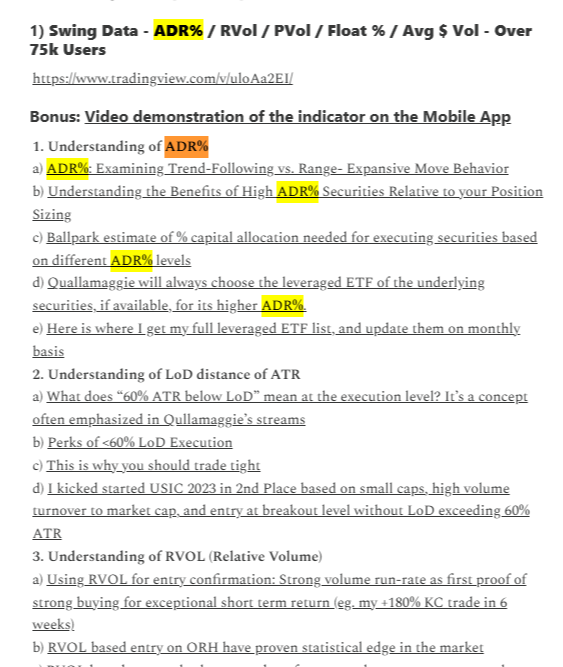
Fully immerse yourself in understanding why ADR%-based stock selection and LoD < ATR execution matter to your trading account % performance jfsrev.substack.com/i/171965773/my…
Jeff Sun, CFTe tweet media
Jeff Sun, CFTe@jfsrev

@Qullamaggie was the reason I started diving deep into the importance of ADR%, volume run rate (his vol buzz) and LoD @markminervini @DanZanger @dryan310 concept, but i was more interested in understanding the thought process behind his volatility based stock selection and entry criteria. Stock selection alone can skew win rate statistics and it’s your consistency in decision making across 10,000 trades that truly reflects performance and edge — and also to be paired with the right situational awareness of course. I am still trying to improve, I feel I am so way behind in terms of perfecting some volume based concept still

English
5
40
276
30.2K