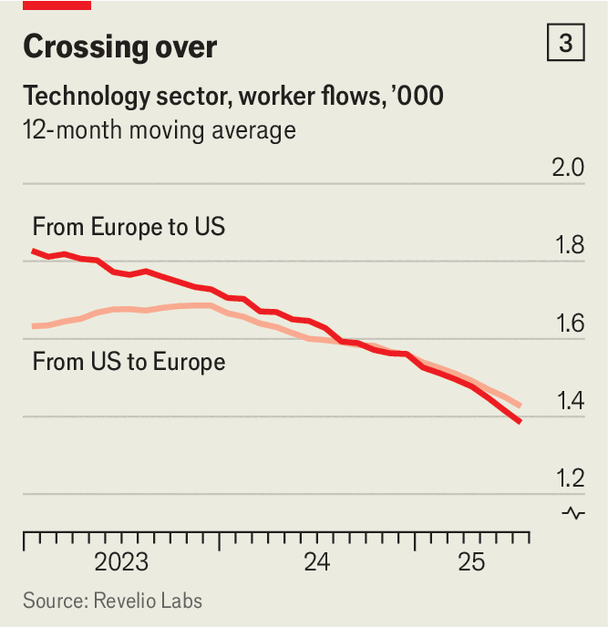
@pietergaricano and on top they decided that you can offer up to four year temporary contracts without any reason (compared to two before), which should increase flexibility more broadly as well
English
Frauke Stehr
167 posts

@FraukeStehr
Economist | Policy Officer Innovation Policy @Stifterverband interested in innovation for social good | 🇩🇪→🇩🇰→🇳🇱 →🇩🇪→ 🇦🇹→🇩🇪| 🇪🇺 | she/her


Why don't European companies innovate? It is common to blame expensive energy, high taxes, anti-growth politicians, interest groups, and green regulations. But California has the same problems, and has created the world's most innovative companies. Europe's problem is labor law. Compared with America, it's far harder to let workers go when a business doesn't work out. worksinprogress.co/issue/why-euro… - It costs a large company roughly four times more to fire a worker in Germany or France than the US. - German law requires employers to consider age, years of service, family obligations, and disability status when deciding who to lay off. Employees who would be least impacted by losing their job are prioritized for dismissal. - German employees who take on a caregiving role are fully protected from dismissal for two years from the date they begin caregiving. - Factory closures in Germany regularly lead to payments of over €200,000 per employee. - French companies must be prepared to show a court that their financial results are struggling enough to make layoffs necessary. - To avoid the difficulties of formal dismissals, many European companies entice workers to depart voluntarily, with payouts of up to four years' salary. Taken together, a German worker is ten times less likely to be fired in a given year than an American worker. This high cost of firing makes failures more expensive. It pushes big European companies away from taking risks and leads them to concentrate on safe, unchanging areas. Europe has the ingredients needed to succeed. Its citizens are educated and inventive; it has excellent infrastructure and the rule of law; and its culture is not that different from the one it had fifty years ago, when its companies were world-beating. If Europe wants to a Tesla or a Google, it only needs to make it cheaper for companies to fail. My new piece for @WorksInProgMag.

At @IFP, we’ve spent the past 3 years thinking about all the different ways the US government & philanthropy fund R&D. Until now, R&D funders haven’t had a systematic way to match the innovation problem to the right funding tool. We built THE ATLAS OF INNOVATION to fill that gap. atlasofinnovation.org Alongside @UChi_MSA, we’ve boiled down thousands of hours of research into a handful of questions covering how much the R&D funder knows about: - the problem they want to solve - the solution it should have - the team that should build the solution Why the Atlas matters: The US government spends close to $200 billion every year on R&D. And after the Anthropic and OpenAI IPOs, there will be hundreds of billions of dollars in new philanthropic giving. Choosing the correct funding approach to the social problems they’re trying to solve will mean the difference between success and failure. For example, NSF research grants have helped seed breakthroughs from MRI machines to search engines, but grants aren’t built to deliver the kind of industrial speed and scale that a project like Operation Warp Speed required. Picking the wrong funding approach can leave programs behind schedule, over budget, or without anything to show for all the money they spent. How we built the Atlas: 1. We began by creating a matrix of dozens of considerations that a thoughtful policymaker or funder would ideally weigh before deciding how to fund a project. 2. We looked at every major funding approach, from grants to R&D tax credits to advance market commitments, analyzing when they work well and when they fail to meet the mission. 3. We spent months deep in the weeds of contract theory and incentive design, looking at historical examples and the state-of-the-art research in innovation economics. 4. We then worked to turn that research into a tool that time-strapped policymakers and philanthropic funders could rely on at the start of an innovation funding cycle. 5. Three years later, we are launching just that: a new (and visually stunning) website to help funders decide how to best incentivize innovation. And all they have to know… is what they currently know about their innovation goal! The Atlas takes care of the rest. How to navigate the Atlas: Answer questions about your goal to find the funding approach aligned with the information you have. Each funding mechanism has its purpose for particular technologies and specific moments in development. There shouldn’t be an ARPA for every field, just like we don’t need a prize or AMC for every innovation. The Atlas helps you navigate those tradeoffs.


@LucaFornaro3 I think this is a really important constraint. We won't be able to commit to a single European innovation hub, so our model *must* be different from the American one & we should think about how to get the knowledge spillovers of physical proximity in multi-innovation-hub Europe.
We stopped everything to write an answer (link below) to Paul Krugman's two posts of today (one informal, one with a simple model) arguing that Europe is broadly not falling behind the United States. The change measured by the Draghi report, he argues, is mostly due to growth in the technology industry, which has distorted GDP numbers without actually leading to higher standards of living. We should believe our eyes when we walk around France and walk around Mississippi. Krugman is wrong. The measures he uses understate European stagnation. This matters enormously. Divergence with the United States is the strongest evidence for reform in Europe. 1. The growth numbers Krugman compares the United States, France, and Germany at purchasing power parity in current prices. On that measure, France's and Germany's position relative to America has been roughly constant since 2000. But current price comparisons miss productivity gains in sectors where prices fall. If America produces twice as much software while the price of each unit halves, the value of American software output looks unchanged even though the volume has doubled. Most economists therefore use constant prices, which fix the base-year PPP level and apply each country's real output growth on top of it. American output growth has concentrated in tech, where prices have fallen tremendously as productivity rises. In terms of the volume of things produced, America has pulled away from Europe. 2. Is it all the tech industry? Krugman concedes this tech divergence but says it is not welfare-relevant. The American growth lead is an accounting artefact of measuring more iPhones at base-year prices, not a sign that Americans are actually richer, because Europeans buy the same iPhones at the same world prices. This is not the right way to think about the world today, as an earlier Paul Krugman would have argued. His model assumes tradable goods, interchangeable workers, marginal-cost pricing, and no profits. Each assumption fails. Most of what households buy is non-tradable: housing, healthcare, childcare, education. When American tech firms bid workers from haircutting to coding, American haircut wages rise. Germany has no growing tech sector to do the bidding, so German wages stay flat. Technology is not priced at marginal cost. Apple's margins are around 40 percent. Anthropic's inference margins are at 70 percent. The major platforms enjoy network effects, switching costs, and lock-in that hold prices well above what a competitive market would deliver. A large share of the productivity gains in technology stays as profit. A lot of the value of American technology dominance shows up in equity, not in wages. Apple, Microsoft, Nvidia, Alphabet, Meta, and Amazon together are worth $21 trillion, more than the entire combined stock market value of all European stock markets. Around 60 percent of US equity is held by American households. The median French or Spanish household holds almost no equity. The median employee at Meta, a company with almost 80,000 employees, earned $388,000 in 2025. This advantage is not going to go away. Krugman's own 1991 paper, cited in his Nobel prize, showed that comparative advantage in modern industries is produced by increasing returns to scale, specialized labor markets, supplier networks and the agglomeration of suppliers, workers, and ideas in particular places. Once an industry concentrates somewhere, the concentration is self-reinforcing. Europe is being pushed away from the next round of technology industries (AI!). 3. What about inequality? Another retort is that GDP per capita hides substantial inequality, and so even if America is rich on average, this is mostly due to the super wealthy. But despite the US's high pre-tax income inequality, it also achieves higher median incomes than Europe, in part because of such a high base, and in part because it actually redistributes more than many European countries. The cleanest comparison is median equivalised disposable household income: income after cash taxes and transfers, adjusted for household size and purchasing power. According to the OECD's 2021 numbers, the median American earns 30 percent more than the median Dutchman, about 31 percent more than the median German, and about 52 percent more than the median Frenchman. 4. What about hours worked? Krugman points out that while American GDP per person is higher, most of this is because Americans work more. For this divergence to be an hours worked story, Americans must work more relative to Europeans now than they did in 2000. The opposite has happened. Birinci, Karabarbounis, and See in a 2026 NBER paper show that about half of the American-European hours gap that existed in the 1990s has reversed by the end of the 2010s. Americans work fewer hours per person than they did in 2000, while most Europeans work more. 5. Is America not a bad place to live? Walk around Alabama and France: surely the former cannot be substantially richer than the latter? American cities often have poorer centres and richer suburbs or exurbs. European cities preserve richer and more attractive historic cores. A visit to a city as a tourist in America compared with a city in France will leave one having seen different spots on the income distribution. Americans in Europe go to the nicest and richest European cities. Rather than a walking around test, do a driving around test. Go to the periphery of any modern American city and see a level of new-built material wealth that is extremely uncommon in Europe, with thousands of enormous four- or five-bedroom homes. In the South, in places like Nashville and Austin, drive around the downtowns to see hundreds of luxury apartment buildings springing from the ground. This construction boom is replicated virtually nowhere in Europe today. The other question is generational. Housing often costs more in Europe than in the United States, despite the quality of the housing stock generally being much better. Europe has nice city cores but these are inaccessible to young Europeans. Consider the salaries available to entry-level workers. The starting pay for a London police officer is $57,000. In Washington, DC, $75,000. The entry-level Deloitte consultant job in Madrid pays around €28,000, roughly $33,000 per year. In Charlotte, the entry-level Deloitte job pays $63,000. There are many things to dislike about life in America. But relative to 25 years ago, the gap in material wealth has shifted dramatically in America's favor. siliconcontinent.com/p/european-sta…

Why is it so hard to build transport infrastructure in Germany? Next Tuesday, 19.05., I’ll be giving a talk on that question at a Stripe / Works in Progress event. If you are in Berlin and interested in Progress Studies, make sure to come!





Why do new buildings seem, on average, uglier than old buildings? We discuss some options: - Survivorship bias: only the beautiful old buildings have survived (we reject this option); - Cycles of taste: everyone always finds new buildings uglier (we mostly reject this too); - Ornament became too expensive because of rising labour costs (we reject this); - Ornament became too cheap because of mechanisation and then became low status (we reject this); - Some sort of Protestant or Puritan anti-beauty inheritance (we are doubtful); - Some kind of elite status game, perhaps a response to democratisation or elite overproduction (we think there is promise here, but serious work is needed on the details). I discuss this and more with @Aria_Babu and @bswud. Apple podcasts: podcasts.apple.com/gb/podcast/did… Spotify: open.spotify.com/episode/2pIka6… Youtube: youtube.com/watch?v=qvueKt…