Georg Wallmann

63 posts

Georg Wallmann

Georg Wallmann

@GeorgWa

PhD student at the Mann lab

Katılım Şubat 2012
145 Takip Edilen99 Takipçiler
Will Fondrie
Will Fondrie@wfondrie·
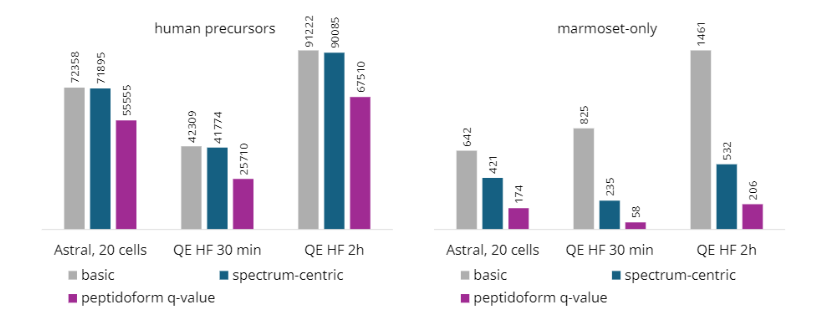
With some recent discourse in the #proteomics community around #OpenSource scientific software, I thought it was finally time to jot down my thoughts. I wrote a quick blog post, complete with my own 🌶️ takes. Here's some of what it contains: (1/2)
English
5
3
33
10.2K
Vadim Demichev
Vadim Demichev@DemichevLab·
@GeorgWa Hi Georg, this is described in the original 2020 paper, it’s the ‘no shared spectra’ checkbox
English
1
0
1
185
Wen-Feng Zeng
Wen-Feng Zeng@jalew188·
I have officially joined @Westlake_Uni as a tenure-track assistant professor. I will be returning to the pGlyco project to make it more accessible, not only for the software but also for the source code. Thank you @labs_mann for these memorable four years, and for the nice gift.
Wen-Feng Zeng tweet media
English
11
0
42
2.8K
Georg Wallmann
Georg Wallmann@GeorgWa·
@ItsBiniR No need for libraries. This is a perfect application for end-to-end transfer learning. It allows you to train your own instrument and modification specific model right from your DIA data: biorxiv.org/content/10.110…
English
0
0
0
31
Bini Ramachandran
Bini Ramachandran@ItsBiniR·
Cysteinome profiling by DIA using a custom spectral library of DBIA-bound peptides generated from 72 mass spec raw files.. Data from HEK293T and Jurkat cells were used here.. Can this library be used for unrelated cell lines?? If not, how practical is DIA for chemoproteomics?? 🤔
Stephan Hacker (inactive account)@StephanHacker2

Very interesting @biorxivpreprint by the groups of @Jake_T_Bush and @KatrinRittinger. Using a timsTOF pro 2 with data-independent acquisition and a project-specific library, they are able to profile 23,000 cysteines/run using a 21 min gradient. biorxiv.org/content/10.110…

English
2
0
1
969
Georg Wallmann
Georg Wallmann@GeorgWa·
@chrashwood I know another feature free DIA tool ;). Sounds like this is hot at the moment.
English
0
0
1
145
Georg Wallmann retweetledi
Jason Derks
Jason Derks@_JasonDerks·
Cellular states prior to stimulation will be predictively associated to outcomes. By linking variable proteomes to responses, we may identify regulators. biorxiv.org/content/10.110… Here, we use single-nucleus proteomics to identify regulators of LPS-induced protein transport🧵
Jason Derks tweet media
English
1
10
48
8.2K
Hamish Stewart
Hamish Stewart@Hamish_Stewart·
@mjmaccoss @DemichevLab Agreed. When one really has number of ions detected, mass positions etc, then it can't be difficult to show drifts. Maybe this is an argument to save and expose the Astral current measurement scans, though we were worried about confusing bioinformatics software.
English
1
0
1
262
Vadim Demichev
Vadim Demichev@DemichevLab·
A note about routine LC-MS performance quality control. If you are doing DIA, then any decrease in MS sensitivity is best detectable with low sample amount injections (less than the reasonable maximum amount by a factor of 10 or more).
English
5
2
41
4K
Georg Wallmann retweetledi
Matthias Mann Lab
Matthias Mann Lab@labs_mann·
We've got something exciting to share before #ASMS2024! But first, how confident do you feel about your DIA search? #TeamMassSpec
English
1
7
20
5.9K
Martin Frejno
Martin Frejno@MartinFrejno·
@GeorgWa @msaid_de I would be very cautious with calling an identification based solely on AMT Tags, even on single cells. We are not doing AMT Tags anymore for a reason. And with shorter and shorter gradients, you substantially reduce the information content of the RT dimension.
English
1
0
0
51
MSAID
MSAID@msaid_de·
Hello #TeamProteomics and #TeamMassSpec! We're gearing up for #ASMS2024 with some intriguing questions on #Proteomics and #FDRControl. What is the minimum number of fragments you consider needed for the identification of a precursor? Join the conversation and let’s dive into this together! 👇
English
5
3
6
2.8K
Georg Wallmann
Georg Wallmann@GeorgWa·
@mjmaccoss @MartinFrejno @msaid_de @SciFiRobitaille I very much agree with this notion. I think confident identifications with few or even none fragments are well possible if there is enough evidence. The real challenge is quantification and giving good estimates of quant certainty.
English
1
0
0
54
Georg Wallmann
Georg Wallmann@GeorgWa·
@MartinFrejno @msaid_de I mean, it's just idea :D. I'm thinking of something like an AMT Tag. Just not with a proteome specific library but a whole proteome library. You wouldn't get the same performance in complex bulk proteomes, but maybe it's something for single cell.
English
1
0
0
47
Martin Frejno
Martin Frejno@MartinFrejno·
@GeorgWa @msaid_de Now that's a statement! But why would you then need a library in the first place? Or are you implying performing identification solely based on the MS1 signal (i.e. AMT Tags)?
English
1
0
0
72