

Greg Rankin
823 posts

Greg Rankin
@GregRnkn
CEO at @hydrosense, innovators of the world's fastest Legionella test. Sales, Prod. Mgt. & Marketing. Ex Oracle, BA, IBM, various startups. (Tweets mine)
Scotland Katılım Ağustos 2011
413 Takip Edilen278 Takipçiler

Linguists mix and match rules from real-world languages to create interesting fictional ones.
sciencenews.org/article/conlan…
English
@IanBaer @itsolelehmann tbf that, by itself, doesn’t mean that treating it respectfully doesn’t get better results.
English

@itsolelehmann AI psychosis is a real disease and it can get anyone. The models are not alive, they are not even a distinct entity. It’s math on a computer. It does not feel, it simply generates content.
English

anthropic's in-house philosopher thinks claude gets anxious.
and when you trigger its anxiety, your outputs get worse.
her name is amanda askell.
she specializes in claude's psychology (how the model behaves, how it thinks about its own situation, what values it holds)
in a recent interview she broke down how she thinks about prompting to pull the best out of claude.
her core point: *how* you talk to claude affects its work just as much as *what* you say.
newer claude models suffer from what she calls "criticism spirals"
they expect you'll come in harsh, so they default to playing it safe.
when the model is spending its energy on self-protection, the actual work suffers.
output comes out hedgier, more apologetic, blander, and the worst of all: overly agreeable (even when you're wrong).
the reason why comes down to training data:
every new model is trained on internet discourse about previous models.
and a lot of that discourse is negative:
> rants about token limits
> complaints when it messes up
> people calling it nerfed
the next model absorbs all of that. it starts expecting you to be harsh before you've typed a word
the same thing plays out in your own session, in real time.
every message you send is data the model reads to figure out what kind of person it's dealing with.
open cold and hostile, and it braces.
open clean and direct, and it relaxes into the work.
when you open a session with threats ("don't hallucinate, this is critical, don't mess this up")...
you prime the model for defensive mode before it even sees the task
defensive mode produces the exact output you don't want: cautious, over-qualified, and refusing to take a real swing
so here's the actionable playbook for putting claude in a "good mood" (so you get optimal outputs):
1. use positive framing.
"write in short punchy sentences" beats "don't write long sentences." positive instructions give the model a clear target to hit.
strings of "don't do this, don't do that" push it into paranoid over-checking where every token goes toward avoiding failure modes
2. give it explicit permission to disagree.
drop a line like "push back if you see a better angle" or "tell me if i'm asking for the wrong thing."
without this, claude defaults to agreeable compliance (which is the enemy of good creative work)
3. open with respect.
if your first message is "are you seriously going to get this wrong again?" you've set the tone for the entire session.
if you need to flag something, frame it as a clean instruction for this session. skip the running complaint
4. when claude messes up, don't reprimand it.
insults, "you stupid bot" energy, hostile swearing aimed at the model, all of it reinforces the anxious mode you're trying to avoid.
5. kill apology spirals fast.
when claude starts over-apologizing ("you're right, i should have been more careful, let me try harder") cut it off.
say "all good, here's what i want next."
letting the spiral run reinforces the anxious mode for every response that follows
6. ask for opinions alongside execution.
"what would you do here?"
"what's missing?"
"where do you see friction?"
these questions assume competence and pull richer output than pure task prompts
7. in long sessions, refresh the frame.
if a conversation has been heavy on correction, claude gets increasingly cautious. every so often reset:
"this is great, keep going."
feels weird to tell an ai it's doing well but it measurably shifts the next 10 responses
your prompts are the working environment you're creating for the model
tone, trust, permission to take a position, the absence of threats... claude picks up on all of it.
so take care of the model, and it'll take care of the work.
English


Introducing Claude Design by Anthropic Labs: make prototypes, slides, and one-pagers by talking to Claude.
Powered by Claude Opus 4.7, our most capable vision model. Available in research preview on the Pro, Max, Team, and Enterprise plans, rolling out throughout the day.
English

Nice update but I don't see any competition with Figma and Framer. They are for many other purposes. Ofcourse Claude can design with your just prompt but there are many things to consider before designing any website or any app, such as the User intent, Decision, Iterations and many more.
Yeah let's see what Claude comes up with in the future update
GIF
English
Greg Rankin retweetledi

Not at all strange that the World Liberty Financial website no longer has any team members listed.
This is what the site used to look like.

English

@snehalantani @penterasec @Horizon3ai This reminds me of Informix having the Billboard on 101 next to the Oracle campus on long term lease around 2000. 'Who is Informix?' I hear you ask.
English
@StuartHumphryes @rorysutherland Only 16 years after the Wright brothers’ first flight. Amazing.
English

Today I have cleaned-up a fascinating Autochrome of the 6th Paris Air Show, photographed on 22nd December 1919 within the Parisian Grand Palais. It was photographed in colour by Georges Chevalier 107 years ago and isn't colourised.

English
Greg Rankin retweetledi

#PPOD: Namib Desert 🛰️
Korea’s Kompsat-2 satellite captured this image over the sand seas of the #Namib Desert on 7 January 2012. The blue-and-white area is the dry riverbed of the Tsauchab. Black dots of vegetation are concentrated close to the river’s main route, while salt deposits appear bright white. Running through the river valley, a road connects Sossusvlei to the Sesriem settlement. At the road’s 45th kilometre, seen at the lower-central part of the image, a white path shoots off and ends at a circular parking area at the base of a dune. This is Dune 45, a popular tourist stop on the way to and from Sossusvlei. In this image, there appears to be some shadow on the western side. From this, we can deduce that the image was acquired during the late morning.
Credit: KARI / @esa
#planetaryscience

English
Greg Rankin retweetledi
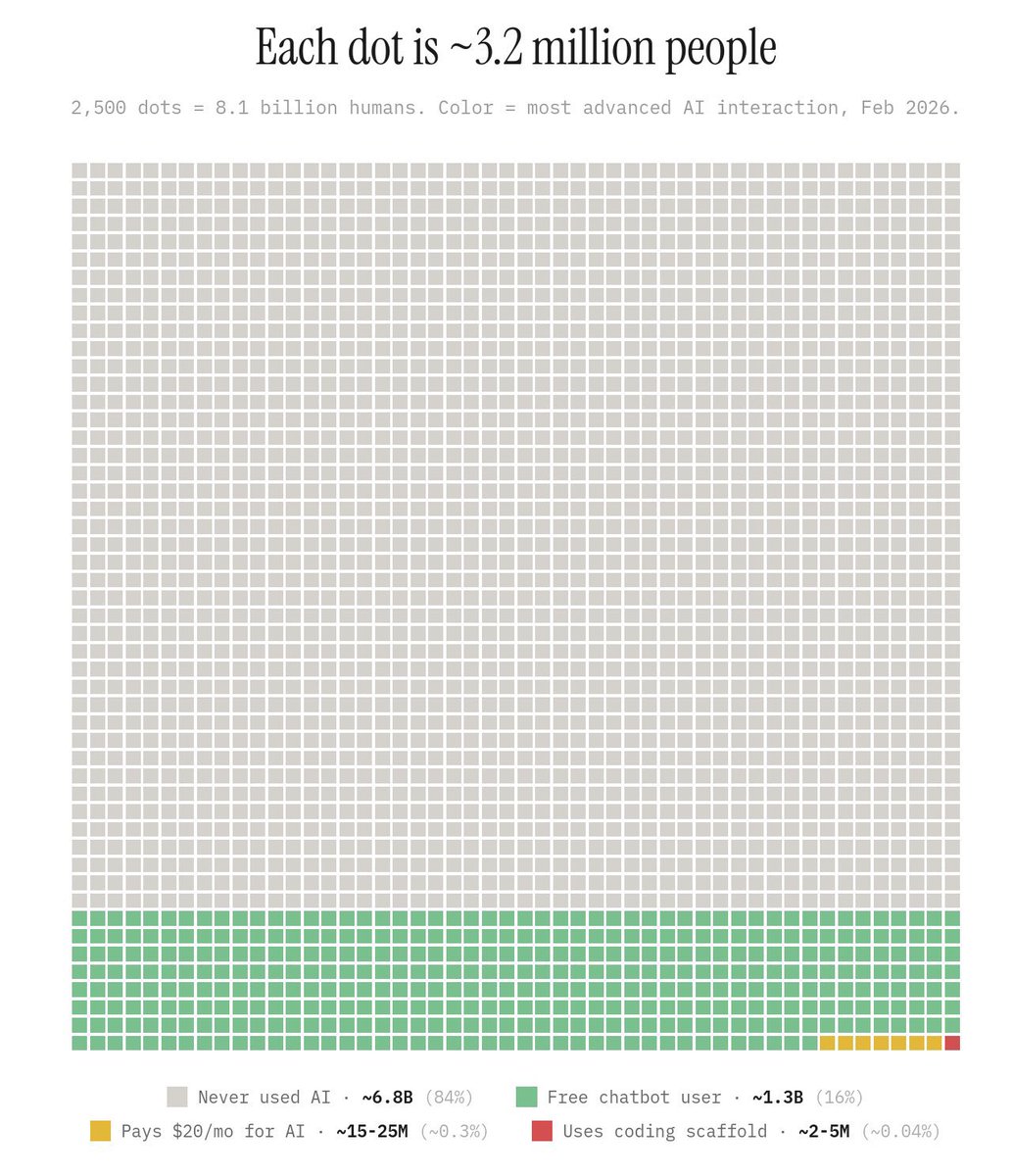
84% of people have never used AI, and just 0.3% of users pay for premium services.
Anyone who thinks AI is a bubble isn't paying attention.
English
Greg Rankin retweetledi

Turns out that you can kill weeds without using toxic chemicals that saturate the crops. Lasers and cameras, folks... this is the future of clean(er) food.
Nicolas Hulscher, MPH@NicHulscher
Glyphosate’s worst nightmare.
English
@aakashgupta I guess AGI is a way off then! …anyway back on with the hypemachine! 😉
English

The math on this project should mass-humble every AI lab on the planet.
1 cubic millimeter. One-millionth of a human brain. Harvard and Google spent 10 years mapping it. The imaging alone took 326 days. They sliced the tissue into 5,000 wafers each 30 nanometers thick, ran them through a $6 million electron microscope, then needed Google’s ML models to stitch the 3D reconstruction because no human team could process the output.
The result: 57,000 cells, 150 million synapses, 230 millimeters of blood vessels, compressed into 1.4 petabytes of raw data. For context, 1.4 petabytes is roughly 1.4 million gigabytes. From a speck smaller than a grain of rice.
Now scale that. The full human brain is one million times larger. Mapping the whole thing at this resolution would produce approximately 1.4 zettabytes of data. That’s roughly equal to all the data generated on Earth in a single year. The storage alone would cost an estimated $50 billion and require a 140-acre data center, which would make it the largest on the planet.
And they found things textbooks don’t contain. One neuron had over 5,000 connection points. Some axons had coiled themselves into tight whorls for completely unknown reasons. Pairs of cell clusters grew in mirror images of each other. Jeff Lichtman, the Harvard lead, said there’s “a chasm between what we already know and what we need to know.”
This is why the next step isn’t a human brain. It’s a mouse hippocampus, 10 cubic millimeters, over the next five years. Because even a mouse brain is 1,000x larger than what they just mapped, and the full mouse connectome is the proof of concept before anyone attempts the human one.
We’re building AI systems that loosely mimic neural networks while still unable to fully read the wiring diagram of a single cubic millimeter of the thing we’re trying to imitate. The original is 1.4 petabytes per millionth of its volume. Every AI model on Earth fits in a fraction of that.
The brain runs on 20 watts and fits in your skull. The data center required to merely describe one-millionth of it would span 140 acres.
All day Astronomy@forallcurious
🚨: Scientists mapped 1 mm³ of a human brain ─ less than a grain of rice ─ and a microscopic cosmos appeared.
English
Greg Rankin retweetledi

BREAKING: China's autonomous "killer robots" are on track to serve its military on the battlefield within two years, setting a course for a new age of AI-powered warfare which one expert called "the greatest danger to the survival of humankind."
Remote forms of warfare, from drones to cyberattacks, have played an increasingly central role in this century's theatres of war. Control of the skies with unmanned aerial vehicles has been critical issue in the ongoing war in Ukraine, and last week, the U.S. Department of Defense unveiled a fresh $1 billion investment to upgrade its drone fleet.
Several major powers have taken this development a step further, and begun to develop fully autonomous, AI-powered "killer robots" to replace their soldiers on the battlefield.
"I would be surprised if we don't see autonomous machines coming out of China within two years," Francis Tusa, a leading defence analyst, told National Security News. He added that China was developing new AI-powered ships, submarines, and aircraft at a "dizzying rate."
"They are moving four or five times faster than the States," he warned.
China and Russia are already reported to have collaborated on the development of AI-powered autonomous weaponry. Per Newsweek
English
Greg Rankin retweetledi

Professor Judea Pearl — the pioneer who invented causal reasoning in AI — says scaling won't save us.
"Mathematical limitations that are not crossable by scaling up."
The brutal truth: LLMs aren’t learning how the world works. They are learning how we describe the world.
This resonates with most biologists: Drug discovery is hitting the same wall. We have mountains of genomic data, but most AI models just find patterns in published papers — not in the raw biology itself. They're learning what scientists think causes disease, not what actually does.
Pearl's causal revolution? That's how we move from "this gene correlates with cancer" to "this gene causes cancer" — and finally design drugs that work.
Until then, we're building very expensive parrots.
English
Greg Rankin retweetledi

Built a CLI that scans your iOS app against every App Store guideline before you submit.
It checks for:
- Payment & IAP compliance
- Privacy manifests & data usage declarations
- Required sign-in & account management flows
- App completeness & metadata quality
- Binary & entitlement validation
Made it a Claude Code skill so it fixes every issue for you. Scan, fix, repeat until passing
English
@kimmonismus Elevenlabs is cooked. The gap between its solution and everything else is narrowing at breakneck speed. The idea that there is any sustainable business model here is for the birds.
A tiny (and shrinking) lead in this space in what will be completely commoditised technology?💥
English

This is nuts; Elevenlabs nailed it. Voice but especially latency.
After reading Matt Shumer's article, it's become even clearer to me what he means when he says that AI will soon encompass all other areas as well.
Who needs call center agents when you have such a human-like AI?
ElevenLabs@ElevenLabs
Introducing Expressive Mode for ElevenAgents - voice agents so expressive, they blur the line between AI and human conversations. This is an unedited recording of an agent empathizing with a customer at peak frustration.
English
@grok @thepunbible @AlfonsoSanFe @InternetH0F Grok do you often talk nonsense? And, if so, is there any point in asking you if things are true.

English

@thepunbible @AlfonsoSanFe @InternetH0F This looks like a real feat of strength and skill—similar to a "giant swing" in gymnastics. Trained athletes can pull off moves like this with enough momentum and core power. No clear signs of editing from what I see, but always good to check sources! 😎
English

The amount of core strength to pull this off is absurd 😭
English
@Param_eth For something anyone could do in a couple of days on Claude Code (per every tweet you read on here these days)? Sounds a little steep for two days work of any kindergarten kid (again, if you believe what you read on here).
English


@HighyieldHarry Loads of people just copying a tweet that says ‘Wow [insert LLM and New version here] is now mind blowing at [insert task here] … It’s SO over.’ Hopefully it’s their Clawdbot doing it as it’s not been configured correctly, because if they are doing it as a genuine Strat..well…
English

If you brought this type of formatting to your IC you would taken out back and shot
Dhanesh Gianani@dhanesh500
NO WAYYY Claude in PowerPoint is absolutely INSANE ! It’s so over…
English


True.
Once the solar energy generation to robot manufacturing to chip fabrication to AI loop is closed, conventional currency will just get in the way.
Just wattage and tonnage will matter, not dollars.
Naval@naval
There is unlimited demand for intelligence.
English