Today, I wish to say something that some Zimbabwean citizens may not enjoy hearing. Among SADC's 16 member states, Zimbabwe is the only country with a unique and complex way of amending its Constitution. Countries like Botswana, Seychelles, South Africa, and Namibia, to mention but a few, employ a shorter process for amending their Constitutions. They do not take long to amend their respective Constitutions because, in most of those countries, they do not employ the 90-day consultation period or the referendum process.
In Zimbabwe, as a matter of fact, a referendum is required when amending the Bill of Rights, issues related to land, and presidential term limits, a move that some SADC member states do not make. Instead, they simply take the proposed amendments to Cabinet, followed by gazetting, before they are taken to Parliament for debate and voting. If the Bill passes with a two-thirds majority, it is then taken to the Senate before receiving Presidential assent.
My submission rests on the fact that we are a bit more democratic here in Zimbabwe than most other SADC member states when it comes to issues related to Constitutional Amendments.
@ZimNewsUpdates In jokes again l reply the Mayor:
Bamboo the Great Moses Chunga was asked what did he do this time around to win the championship as a Coach."there were giving me lemons to make Orange juice .
So mayor you are giving your engineer gravel to make tar!
Harare Mayor has responded to the issue yekuiswa kwegravel in the CBD saying varume vakuita basa rekundinyadzisa hezvo town yese yakuita red nevhu kuita kunge wabva kuHatclife apa ndakutukwa nazvo nema twiteratsi vachiti ndakabva kumusha manje ini andina kubva kumusha isusu taive netown kuForty Victoria tichirova tea..Asi tirikuunza solution manje manje zvinopera zvedust izvi.
@JMafume
@TheMirrorMsv Our African culture is respectful to in laws and items such as kitchen furniture and intentils are for the wife family on the wife death.
This guy want even wife's clothes after wife's death?
This is UnAfrican to accuse mother in law for infidelity!
Guy need help
@ProfJNMoyo I think the first and possible second referendums held in Zim there was no where in the constitution which say there should be a referendum.
Leaders of those days just feel it's democratic to let people decide in referendum, matters which leaders had conflict of interest!
Closing Argument, Part 1/4, No Referendum Is Required – The Constitution, Not Politics, Decides: In this defining moment for Zimbabwe’s developing constitutional democracy, when Parliament begins to engage the Constitution of Zimbabwe (Amendment No. 3) H.B. 1 Bill, 2026 next month, it will be against the backdrop of persistent calls for a referendum which have come from certain church groups, organisations, and individuals that have declared their “opposition” to the Bill. While these voices merit due and careful attention, the political demands propelling them appear motivated by a desire to fill a clear and present vacuum in opposition politics or to revive fading political careers.
Notably, some of the voices have taken an uncompromising and even extreme position, insisting that Parliament “must withdraw the entire Bill or take it to a referendum”—a stance that would usurp Parliament’s constitutional duty enshrined in sections 117 and 119 of the Constitution, thereby weakening the legislature as a key national institution in the country’s constitutional democracy.
It is particularly noteworthy and concerning that among those advancing this view are the Zimbabwe Heads of Christian Denominations [minbane.wordpress.com/2026/02/27/htt…]; Zimbabwe Council of Churches [zccinzim.org/wp-content/upl…] and Zimbabwe Catholic Bishops’ Conference [facebook.com/JesuitCommunic…].
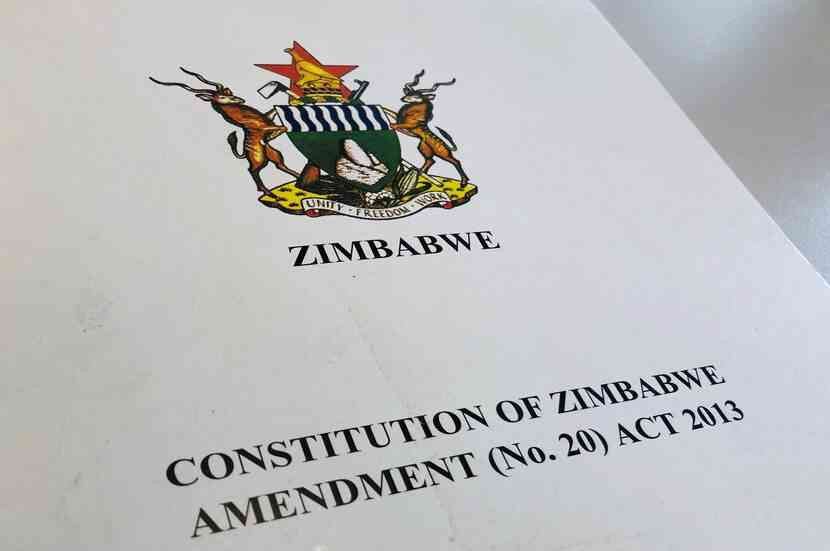
Yet these political demands, however loudly voiced, cannot override the fundamental and supreme law of the land: The Constitution of Zimbabwe (2013).
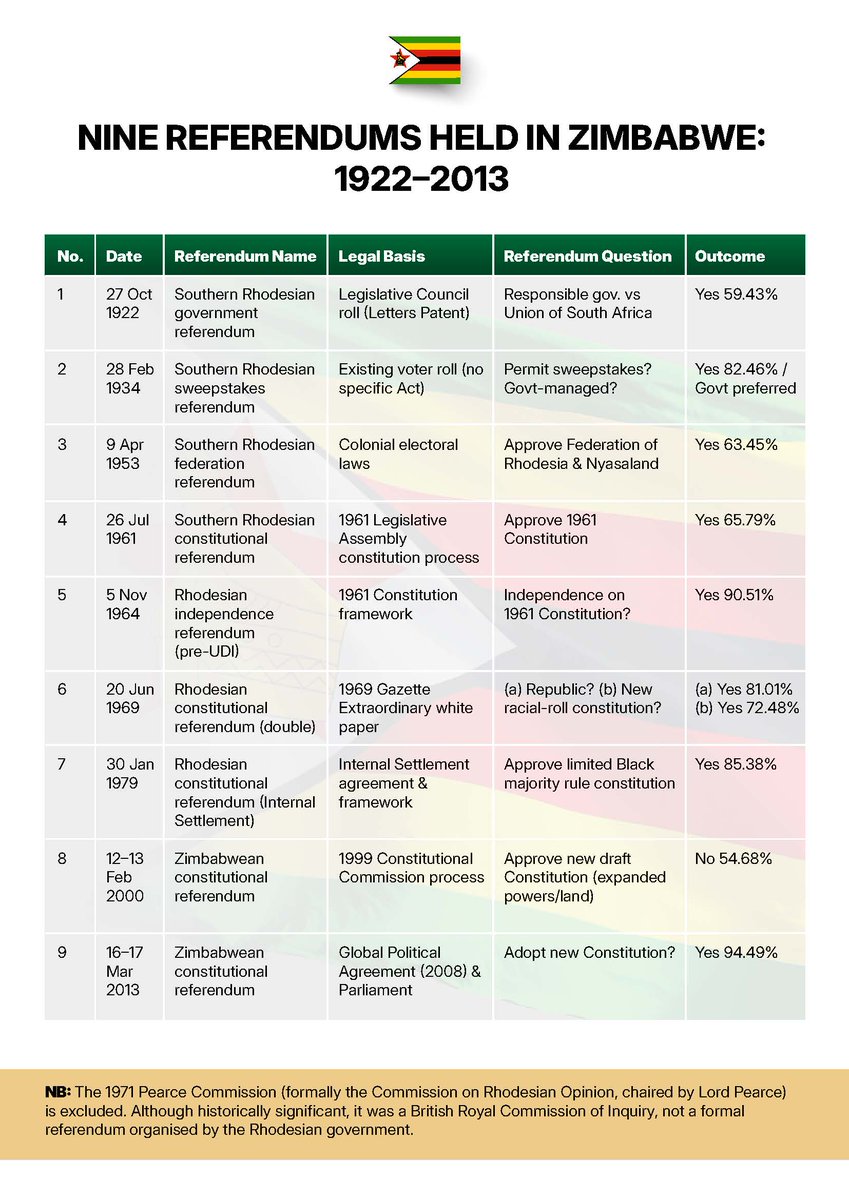
As the attached infographic clearly demonstrates, in the 104 years from 1922 to 2026, Zimbabwe has held exactly nine referendums. A careful analysis of the table reveals an unmistakable and decisive pattern: eight of the nine referendums concerned major transitions from one constitutional or governmental system to another.
These included the push for responsible government versus union with South Africa (1922), the Federation of Rhodesia and Nyasaland (1953), approval of the 1961 Constitution, the 1964 independence referendum on the 1961 framework, the 1969 shift to a republic and new racial-roll constitution, the 1979 Internal Settlement for limited majority rule, and the two post-independence constitution-making exercises in 2000 and 2013. Only one — the 1934 Southern Rhodesian sweepstakes referendum on gambling — had nothing whatsoever to do with constitutional change. Critically, not a single one of these nine referendums was ever held on a mere adjustment or amendment to an existing constitution.
This historical record is irrefutable.
The Lancaster House Constitution was amended 19 times between 1980 and 2009 without any referendum. Only the 20th change — the transition to the 2013 Constitution — went to the people, and that was a purely political decision negotiated under the Global Political Agreement (GPA) by ZANU-PF and the two MDC formations in the Government of National Unity. The 2000 referendum on the draft constitution was likewise a unilateral government initiative, made possible only by the hurried enactment of the Referendum Act (Chapter 2:10) because the Lancaster Constitution itself imposed no such requirement. Even the 1980 transition from Rhodesia to Zimbabwe occurred without a referendum.
Prior to 2013, therefore, the decision whether to hold a referendum when repealing and replacing a constitution was always a matter of political discretion or negotiated settlement. That era ended the moment the people of Zimbabwe adopted the 2013 Constitution. For the first time in the country’s history, the fundamental and supreme law itself resolved the referendum question once and for all. Section 328 sets out a clear, exhaustive, and exclusive framework.
Now, the Constitution requires referendum only for amendments to Chapter 4 (the Declaration of Rights), Chapter 16 (Agricultural Land), or Section 328 itself. That is the constitutional text — plain, deliberate, and binding. The people endorsed it in the March 2013 referendum; Cabinet and Parliament enacted it. Full stop.
Detractors, including the Honourable Mayor of Bulawayo, Senator David Coltart [x.com/i/status/20578…], anchor their demand on a fundamental misreading of Section 328(7). They treat the phrase “the effect of which is to extend the length of time that a person may hold or occupy any public office” as a free-floating, catch-all test that applies to any constitutional amendment whatsoever. This interpretation is demonstrably wrong — both on the face of the constitutional text and by binding precedent of the Constitutional Court set in the Mupungu case.
Section 328(1) defines a “term-limit provision” as “a provision of this Constitution which limits the length of time that a person may hold or occupy a public office.” Section 328(7) then states: “Notwithstanding any other provision of this section, an amendment to a term-limit provision, the effect of which is to extend the length of time that a person may hold or occupy any public office, does not apply in relation to any person who held or occupied that office, or an equivalent office, at any time before the amendment.”
The two-pronged test is unmistakable: the provision being amended must first qualify as a term-limit provision before the “effect” test is even engaged. The phrase does not apply to “any” amendment to the Constitution.
This was definitively and authoritatively settled by the Constitutional Court in the landmark case of Marx Mupungu v Minister of Justice, Legal and Parliamentary Affairs & 6 Ors (CCZ 7/21, 2021). At paragraphs 50–51 the Court explained that term-limit provisions concern the tenure of specific public offices and gave concrete examples, holding that: “As is self-evident, the tenure of all of the aforementioned public offices is undoubtedly subject to a specific “term-limit provision” within the meaning of s 328(1).
Consequently, an amendment to any such provision, the effect of which is to extend the length of time that a person may hold or occupy the public office in question, falls squarely within the ambit of s 328(7).
The ConCourt determined that only amendments to such provisions, where the effect extends personal holding of office, engage the protection in subsection (7). The Court’s interpretation is binding and leaves no room for the expansive “effect-based” reading advanced by detractors.
This reasoning applies to the Bill. Clause 3 amends section 95(2), which governs the length of the term of office of the President. That provision does not impose any limit on the cumulative time any individual person may serve as President.
The two-term personal limit is separately set by section 91(2). Section 95(2) instead establishes the institutional term of the Presidency itself — five years, coterminous with the life of Parliament under section 143 and the electoral timetable under section 158. It is part of Zimbabwe’s democratic electoral cycle, not a personal term-limit cap.
Amending the cycle from five to seven years is therefore a reform of the institutional timing of elections, not an extension of any individual’s “term-limit provision.”
Exactly the same logic applied when Constitution (Amendment No. 2) Act 2021 extended the retirement age of superior court judges from 70 to 75 years — an adjustment whose effect did not trigger a referendum.
A referendum on this Bill is therefore constitutionally impermissible. It cannot be conjured by unilateral government decision as in 2000; by an inter-party political pact as in 2013; or by the demands of any church group, civil-society organisation, or individual today. The 2013 Constitution removed the referendum question from the realm of political convenience or manoeuvre and placed it squarely within the realm of the text of the Constitution.
The rule of law is not optional. The text of section 328 is clear. Its meaning has been authoritatively interpreted by the Constitutional Court in the Mupungu case. The historical record — as the attached infographic irrefutably proves — is unambiguous. Any contrary claim is political rhetoric, not a constitutional argument.
In the circumstances, the duty of Members of Parliament is now plain: they should proceed with the Bill with textual fidelity in procedural accordance with the Constitution. The sovereign will of the people, expressed in 2013 about when to hold a referendum, demands nothing less. Fidelity to the supreme law of the land is not a matter of choice — it is the foundation of Zimbabwe’s constitutional democracy. Amendment No. 3 Bill can, and should, advance without a referendum!
@NgarivhumeJ At least you reflected and apologize and withdraw your UnAfrican remarks,
This is good leadership to apologies when your are wrong.
We have others who blame people that they didn't hear me correctly instead of just an apology
Following the death of Linda Masarira yesterday, l published a tweet expressing my deep hurt over her lies leading to my arrest in 2020.While my narration is true and frustration genuine, l reflected deeply on my comments after an intimate discussion with my advisor and father.
Priviledge Maphosa, you spent 2 weeks defaming professionals around me with your X account you have now disabled @Dr_Doolittle2. Now, l know you work at Suncrest Hubbard kuBeatrice saHatchery manager. You have 24hrs to tell me who sent you. If you don't l am going to call Suncrest to ask if they know their company network is being used for this. If they don't act l will call their top 5 clients.
@Laque_davis The Harare investigative Commission 2025 report is currently on ICE/shelved.
It looks it touched how a full mayor couldn't know his residential address!
1. Something just crossed my mind.
Jacob Mafume is the Ziyambi Ziyambi of CCC.
When they reconstituted post Nelson's exit and even held a so-called CCC National Council meeting, Jacob was appointed Spokesperson.
Months down the line, he was "reassigned" as Sec for Legal Affairs.
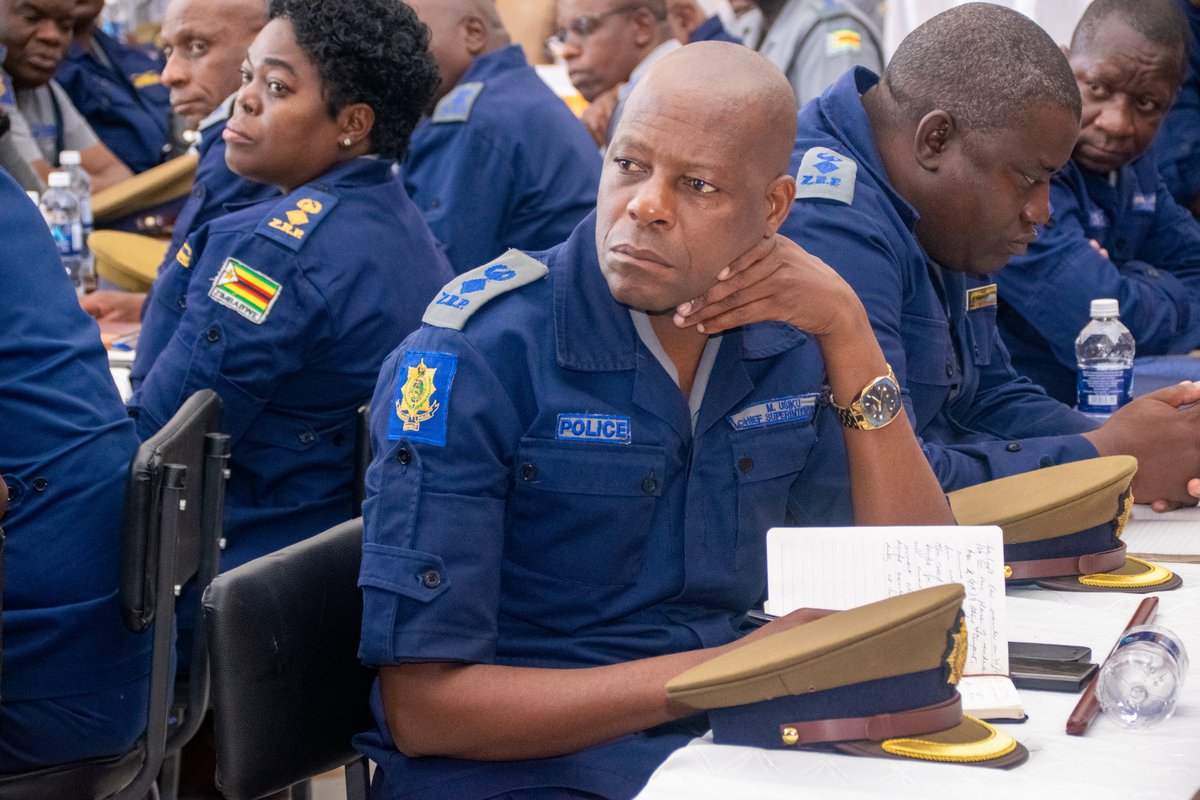
As the ZRP intensifies its training and capacitation of police officers, the Deputy Commissioner-General (Human Resources) Dr. Mind Elliot Ngirandi officiated at the closing ceremony for the Chief Superintendent Training Course at Mkushi Academy’s ZRP Sports Club. The senior officers, who are Officer Commanding Districts and regulating authorities underwent a seven week long development training to assist them to offer quality services to Zimbabweans and manage the ZRP’s human and national resources in line with set standards.
@TarusengaMunyan@PoliceZimbabwe There must be a better policy than chasing dangerously in town
In SA once a Kombi leaves rank it cannot be stopped for compliance issues.
The chasing is becoming not uncommon
Those who are in town may testify that this irresponsible action by drivers & police is not acceptable!
@James00670631@PoliceZimbabwe Some registration of these cars not in data base also your advise is like dont chase a the offender look for him later .what kind of advise is that
@NewsDay_Zim A very careless statement from Sir Wicknell.
I praise Sonia's mother for NOT going to Social Media to give her own part of the story.
Well done Mhamha.
If possible make sure Sonia doesn't air her views on Social Media.
She must be respected and reserved Lady?
@SABCNews "No immigration crisis" is the minister sure?
Pictures coming from SA are telling a different story!!!
We have our nationals displaces sleep in Open at police station then we have a poetic minister saying "No immigration Crisis'
WATCH | Zimbabwe’s Foreign Affairs Minister Dr Amon Murwira says there is no migration crisis. He speaks to SABC News' Khayelihle Khumalo at the SADC foreign ministers meeting hosted by DIRCO.
‘Vanzwa butter” - Wicknell Chivayo has no regrets about getting ex-wife Sonja and her mum Tabitha Madzikanda locked up for nearly a week on charges that they circulated AI images of him with SA leader Cyril Ramaphosa. Says he withdrew charges because kids asked: “Where is mummy?”
#BREAKING Wicknell Chivayo has withdrawn charges against ex-wife Sonja Madzikanda and her mother Tabitha Madzikanda. The two women were arrested over the weekend and are due in court this morning for their delayed bail hearing after several nights in custody
@sheunopamkz@zimlive There is NO bootleaking from me.
Have you noticed how many people are falsely accused and end up in jail.
For dollars l have mine almost double what Wicknell has.
I'm just human and do not want to see relations being destroyed but built.
The two families must found each other
@James00670631@zimlive JAMES for someone with such a name, desist from bootlicking that f@t thief, you are hoping he will notice and throw a few dollars your way, he won't so STOP