
James Seymour-Lock retweetledi
James Seymour-Lock
45.3K posts


James Seymour-Lock
@JamesSLock
🇬🇧 British 👽 living in NYC 🇺🇸 🎨 Ex designer & FE dev 🌟 PM @RakutenUS & Partner @simpleasmilk
New York, NY Katılım Kasım 2009
2.2K Takip Edilen7.7K Takipçiler

James Seymour-Lock retweetledi

James Seymour-Lock retweetledi

Consider this if you’re ever thinking of becoming a manager.
In addition to potentially not enjoying being a manager, having a manager in a role they hate is usually hell for the people that report to them. You run the risk of upending people’s career progression too.
The Random Recruiter@randomrecruiter
One of the biggest mistakes you can make in your career is getting into management "just because." Too many people think the only way up is a linear path from IC to manager to director to VP without realizing management isn't a promotion but an entire career change. Becoming a manager is a lot like becoming a coach. You stop playing the game. You stop getting individual credit, and your job now becomes making other people successful. If you got into it for the title, the pay bump, or because you thought it was "the next step" you're probably going to burn out. The best managers I've worked with genuinely wanted to develop people. The worst ones wanted the corner office and ended up micromanaging everyone into the ground because they couldn't let go of being the best individual performer.
English
James Seymour-Lock retweetledi

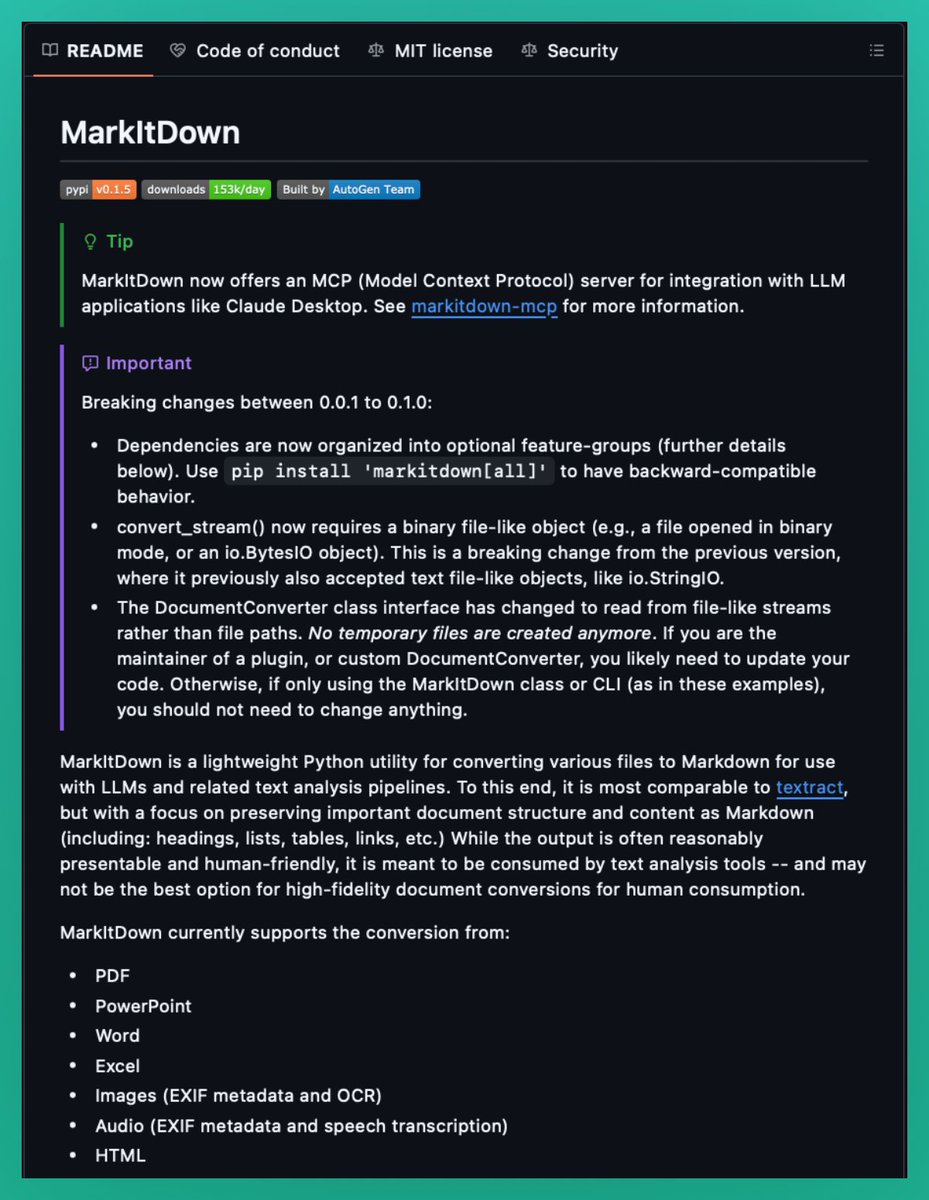
🚨Shocking: Microsoft just open sourced a Python tool that converts any file into Markdown for LLMs.
It's called MarkItDown. And it's not a document formatter.
It's a lightweight conversion utility built specifically for AI pipelines - takes any file you throw at it and outputs clean Markdown that LLMs can actually read and reason about.
Here's what it converts:
→ PDF - full text extraction with structure preserved
→ PowerPoint - slides, headings, bullet points
→ Word - full document with lists, tables, links
→ Excel - tabular data as Markdown tables
→ Images - EXIF metadata + OCR text extraction
→ Audio - EXIF metadata + speech transcription
→ YouTube URLs - fetches transcription automatically
→ HTML, CSV, JSON, XML, EPubs, ZIP files - all supported
Here's the wildest part:
LLMs natively speak Markdown. They've been trained on vast amounts of it.
When you convert your PDF or Excel file to Markdown before feeding it to an LLM, you get better extraction, better reasoning, and more token-efficient output than raw text or HTML.
One command:
`markitdown path-to-file.pdf > document.md`
Also ships as an MCP server for Claude Desktop integration.
87K GitHub stars. Used by 2,200+ projects. Built by the AutoGen team at Microsoft.
100% Open Source. MIT License.
(Link in the comments)
English
James Seymour-Lock retweetledi

Anthropic explique comment faire bosser Claude en autonomie pendant des heures et le concept clé à retenir s'appelle le "harness".
Un harness, c'est l'architecture qui entoure le modèle : les agents, les règles, les boucles de feedback. C'est pas le modèle lui-même, c'est le système qu'on construit autour pour le faire performer.
Prithvi Rajasekaran, de l'équipe Labs chez Anthropic, raconte comment le bon harness a permis de débloquer Claude sur deux terrains : le design frontend et le développement d'apps complètes sans humain dans la boucle.
Deux problèmes de fond quand un agent code seul sur une tâche longue.
Premier problème : il perd le fil.
Plus le contexte s'allonge, plus il dérive.
Pire, il "sent" qu'il approche de sa limite et commence à bâcler pour en finir.
Deuxième problème : il est incapable de se juger honnêtement.
Quand tu lui demandes d'évaluer son propre travail, il se met des bonnes notes même quand le résultat est médiocre.
La solution : ne jamais laisser un agent se noter lui-même.
L'équipe s'inspire des GA (les réseaux adversaires du deep learning) et sépare le boulot en deux rôles distincts.
Un agent qui produit, un autre qui évalue.
Pour le frontend, l'évaluateur navigue la page en live via Playwright, note le résultat sur quatre critères (qualité visuelle, originalité, rigueur technique, fonctionnalité) et renvoie un retour détaillé. Le générateur reprend sa copie et itère entre 5 et 15 fois.
Résultat → des sorties beaucoup plus ambitieuses.
Dans un cas marquant, le modèle a spontanément abandonné son approche classique pour réinventer un site de musée néerlandais en expérience spatiale 3D, avec un sol en damier en perspective CSS et une navigation par portes entre les salles.
Et pour coder des apps complètes ?
L'équipe applique le même principe mais avec trois agents. Le premier est un planificateur : tu lui files une phrase genre "créer un éditeur de jeux vidéo rétro 2D" et il te pond un vrai cahier des charges avec une dizaine de fonctionnalités détaillées.
Le deuxième est le développeur : il code l'app fonctionnalité par fonctionnalité.
Le troisième est le testeur : il ouvre l'app, clique partout comme un vrai utilisateur, et remonte les bugs concrets au développeur pour correction.
Le test grandeur nature est parlant.
Avec un agent seul, tu obtiens en 20 minutes un éditeur de jeux où le mode "jouer" est tout simplement cassé.
Avec le système à trois agents, au bout de 6 heures de travail autonome, tu obtiens une app complète avec des éditeurs de sprites fonctionnels, des niveaux jouables, et même une intégration IA pour générer du contenu au prompt.
C'est plus cher, mais c'est surtout la différence entre un truc qui marche et un truc qui marche pas.
Avec Opus 4.6, tout se simplifie. Le modèle tient mieux la route tout seul plus besoin de lui découper le travail en petits morceaux.
L'équipe allège l'architecture et teste sur un nouveau défi : "construire un studio de musique dans le navigateur."
-> Résultat après environ 4 heures de travail autonome : une vraie station audio avec vue arrangement, table de mixage, et un agent Claude intégré capable de composer un morceau basique de A à Z.
Le point à retenir -> l'amélioration des modèles ne rend pas l'ingénierie d'orchestration obsolète.
Elle déplace le curseur.
Ce qui nécessitait un échafaudage complexe hier devient natif demain.
Mais les nouvelles capacités ouvrent des combinaisons multi-agents qu'on n'aurait même pas pu tenter avant.
L'espace des possibles ne rétrécit pas, il bouge.
Bref à lire attentivement.
Anthropic@AnthropicAI
New on the Anthropic Engineering Blog: How we use a multi-agent harness to push Claude further in frontend design and long-running autonomous software engineering. Read more: anthropic.com/engineering/ha…
Français
James Seymour-Lock retweetledi

This week, ChatGPT will go from a few to millions of Shopify merchants.
Mani Fazeli@mcfazeli
Starting this week, millions of @Shopify merchants can sell in ChatGPT, into the US. Their PDP, their checkout, their customizations, no extra setup. AI is a new front door to commerce. Shopify is what’s behind it everywhere.
English
James Seymour-Lock retweetledi

AI is killing traditional design.
There is a new breed of designer:
Peter Yang@petergyang
A designer who can ship code is one of the most valuable hires in tech today. Here's my new episode with @felixleezd (CEO of @ADPList) where he showed me how to use Claude Code and Figma MCP to go from: ✅ Figma → Code: Design to website in 15 min ✅ Code → Figma: App back to editable design Felix also demoed a few apps he's designed and built in Claude Code, including a 3D globe website and a landing page analyzer. Some takeaways from Felix: 1. Stop pasting screenshots into Claude Code. Instead, use Figma MCP to pull in all your assets, icons, and images automatically. 2. You can use the same MCP to convert code back into editable Figma layers to explore more variations. 3. An underrated way to build: Use FigJam to plan a flowchart of your app first, then paste the link into Claude Code with the MCP. 📌 Watch now: youtu.be/ydiMKfljb-I Thanks to our sponsors: @Replit: Plan, design, and build with AI agents replit.com/?utm_source=cr… @linear: The AI agent platform for modern teams linear.app/behind-the-cra…
English
James Seymour-Lock retweetledi

Wake up, designers. While jobs across other functions are surging through the AI transition, design roles are stagnant.
Don’t take refuge in craft and taste. All members of technical staff must demonstrate newfound productivity. If that’s a topic you’ve avoided because it involves shipping or knowing your business model inside-out, you will struggle to make the case for your own field.
When designers can’t articulate their company strategy, it’s usually because they are neither its authors nor its executors.
Seeking new leverage is no longer optional.
Lenny Rachitsky@lennysan
4/ Design roles have plateaued Unlike PM and engineering, open design jobs have been relatively flat since early 2023, and there are also fewer of these roles than PMs and engineers in absolute terms (about 5,700 globally).
English
James Seymour-Lock retweetledi

James Seymour-Lock retweetledi

The real reason AI is failing inside companies? Let’s say it.
A company decides to go all-in on AI.
The CEO announces the vision.
The CTO aligns.
The CIO gets the budget.
Then the real transformation begins.
Chief AI Officer.
AI Center of Excellence.
AI Ethics.
AI Governance.
AI Steering Committee.
AI Committee for the AI Committee.
Soon, you have 12 people managing AI.
And one person using it.
The intern.
The only one actually shipping anything.
Everyone else is busy… aligning on the prompt.
AI doesn’t fail because of the technology.
It fails because we turned it into a meeting.
So here’s a thought:
Are you building with AI… or scheduling it?
#ArtificialIntelligence #AITransformation #Leadership #FutureOfWork #Innovation

English

Deleted all my Shopify apps
Base: Horizon Theme (Free)
Upgrade: Section Store (Ready-to-use sections)
ROAS: 0.6 → 3.2 💸
- 100% Mobile Optimized
- 100% Native Shopify sections
- Everything can be customized in the editor
Comment “UPGRADE” and I’ll show you exactly how to upgrade your store
(must be following)
English
James Seymour-Lock retweetledi

Code is an output. Nature is healing.
For too long we treated code as input. We glorified it, hand-formatted it, prettified it, obsessed over it.
We built sophisticated GUIs to write it in: IDEs. We syntax-highlit, tree-sat, mini-mapped the code. Keyboard triggers, inline autocompletes, ghost text. “What color scheme is that?”
We stayed up debating the ideal length of APIs and function bodies. Is this API going to look nice enough for another human to read?
We’re now turning our attention to the true inputs. Requirements, specs, feedback, design inspiration. Crucially: production inputs. Our coding agents need to understand how your users are experiencing your application, what errors they’re running into, and turn *that* into code.
We will inevitably glorify code less, as well as coders. The best engineers I’ve worked with always saw code as a means to an end anyway. An output that’s bound to soon be transformed again.
English
James Seymour-Lock retweetledi

Evals are the new PRD.
The companies building AI products that actually work are running 12.8 eval experiments per day. Here is the playbook with @ankrgyl, Founder and CEO of @braintrust ($800M valuation, behind Vercel, Replit, Ramp, Zapier, Notion, Airtable):
⏱ 1:43 Why vibe checks stop scaling
⏱ 6:35 Evals are the new PRD
⏱ 8:45 The Claude Code evals controversy
⏱ 18:48 Building an eval live from zero
⏱ 29:51 Connecting Linear MCP and iterating
⏱ 39:12 Why you need evals that fail
⏱ 43:36 Offline vs online evals
⏱ 47:40 Three mistakes killing eval culture
The core framework: every eval is exactly three things. A set of inputs your product needs to handle. A task that takes those inputs and generates outputs. A scoring function that produces a number between 0 and 1.
We built one from scratch on camera. Score went from 0 to 0.75 in under 20 minutes.
English
James Seymour-Lock retweetledi

James Seymour-Lock retweetledi

And the most important part: we open sourced the /autoresearch plugin for pi. Just tell it what you want, it will do the rest.
github.com/davebcn87/pi-a…
English
James Seymour-Lock retweetledi

How we build software @intercom is unrecognisable vs 12 months ago. We're fully Claude Code pilled and seeing enormous productivity gains. Excellent thread here from Brian on some things we're doing.
Brian Scanlan@brian_scanlan
We've been building an internal Claude Code plugin system at Intercom with 13 plugins, 100+ skills, and hooks that turn Claude into a full-stack engineering platform. Lots done, more to do. Here's a thread of some highlights.
English
James Seymour-Lock retweetledi

This is how you run a zero human AI Agent Company in 2026.
OpenClaw, Cursor, and Codex agents organized under one org structure, pointed at one goal.
Get started in just one command.
100% Opensource.
Shubham Saboo@Saboo_Shubham_
This is what a one-person AI Agent run company looks like in 2026. 6 AI agents. 20 cron jobs. 0 human employees. Every role is a folder. Every job description is a md file. No standups. No Slack. No payroll. Just a directory on a Mac that runs the whole thing.
English
James Seymour-Lock retweetledi

We migrated @v0’s codebase from ESLint + Prettier to Oxlint + Oxfmt by @oxcproject, CI is now 3x faster. Love the OSS ecosystem.
English
James Seymour-Lock retweetledi

James Seymour-Lock retweetledi

Built an MCP server that runs on your Mac and tunnels your @obsdmd vault to @claudeai or @ChatGPTapp anywhere: phone, browser, laptop. No cloud storage, no open ports, your files stay on your machine, and doesn't break Obsidian Sync.
github.com/jimprosser/obs…
English