

Jeff Wyszkowski
20.4K posts


JD Vance appears to call for jailing Democrats who oppose MAGA: “We gotta get them out of this country and we gotta get them in prison.”
English
@WhiteHouse What's historic is a pedo not being prosecuted yet. But that will change. Soon. And then the ICC...


English

President Donald J. Trump departs Beijing following a historic summit, heading home to the United States. ✈️🇺🇸

English


@krassenstein Those aliens with their fuckin' crop circles!!!
English

AMAZING!
This just appeared near Trump’s Bedminster, NJ Golf course.
I agree 100%.
English
@WhiteHouse Trump's a stupid dick. You know it. I know it. The ICC will verify it. Den Hague, baby! 🤣


English
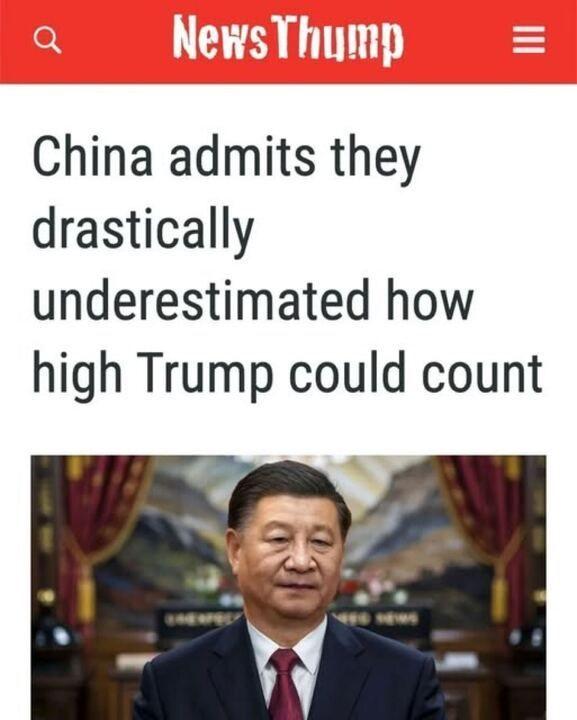
Both countries agreed that Iran can never have a nuclear weapon.

English
@WhiteHouse That scared, little weakling! Biden left the most robust economy in the world, because he knew what levers to pull. This pathetic, pedo, rapist, racist, con man doesn't know his ass from a hole in the ground. Den Hague, baby! 🤣🤣🤣


English
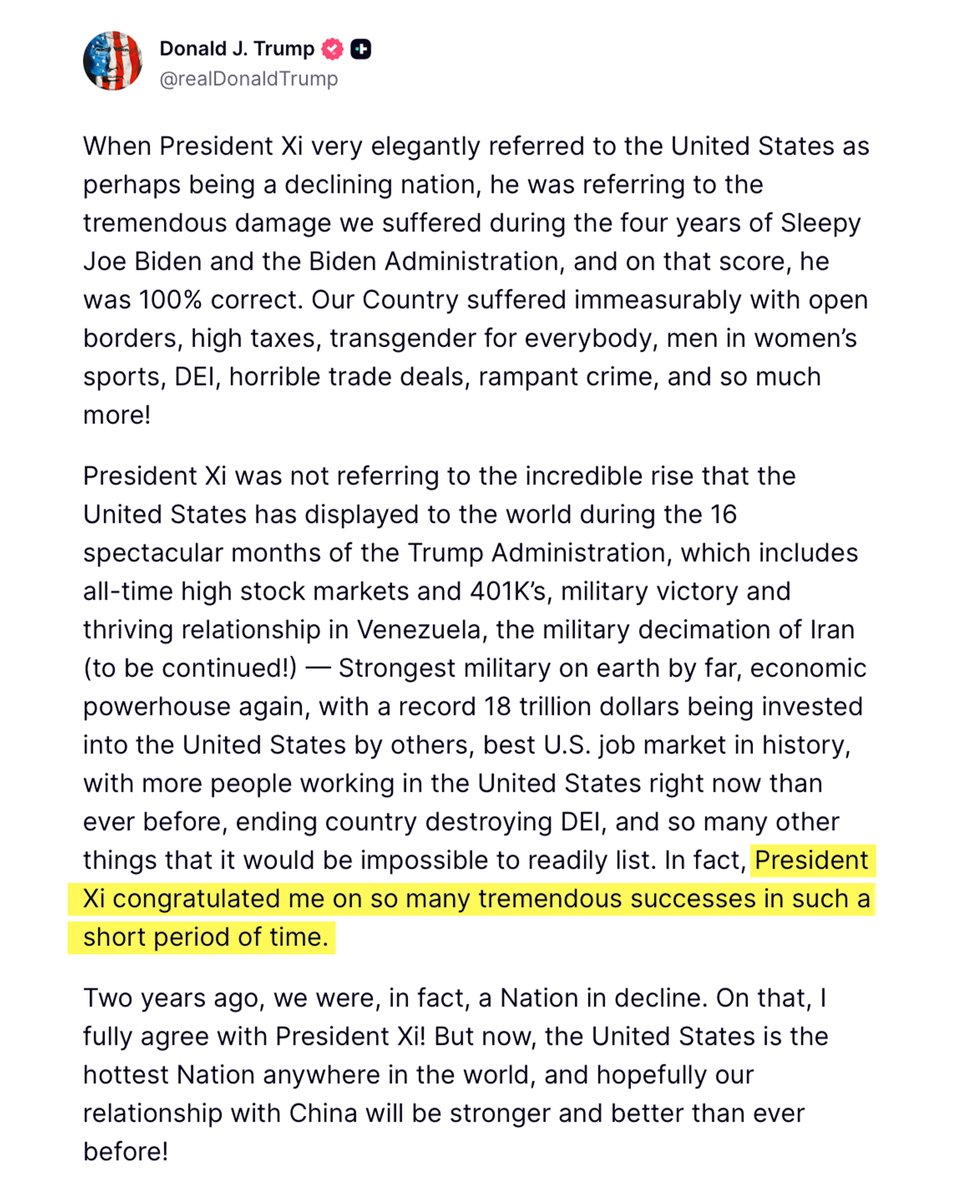
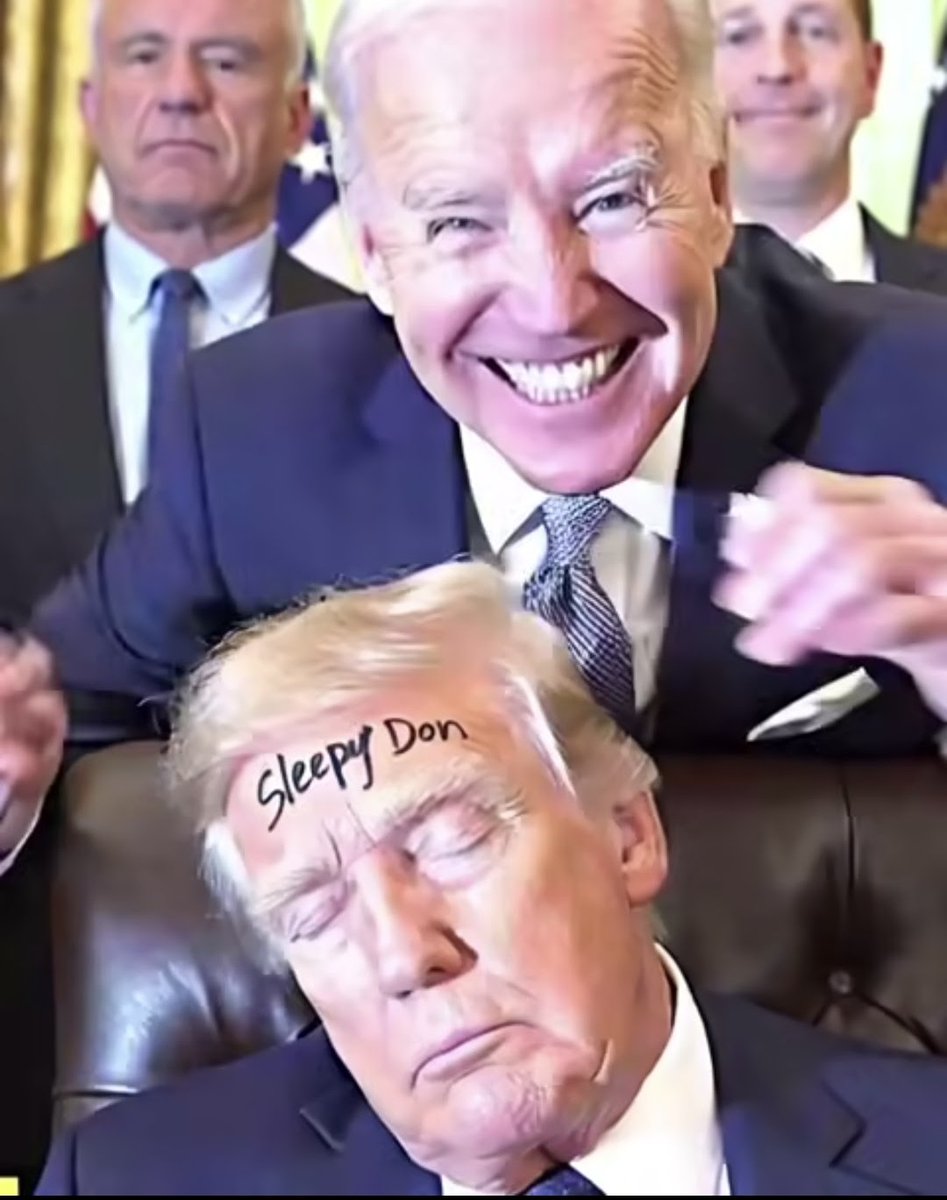
"When President Xi very elegantly referred to the United States as perhaps being a declining nation, he was referring to the tremendous damage we suffered during the four years of Sleepy Joe Biden... But now, the United States is the hottest Nation anywhere in the world" - President Donald J. Trump 🇺🇸
English



English
BREAKING: The Texas televangelist who claimed God is using the Iran War to begin the Biblical Apocalypse and Rapture up all the Christians to Heaven on Trump's birthday this June 14th because Trump is the "2nd Messiah" just got arrested for cooking meth in his church basement.
English
@Gerashchenko_en Great summation. A Taoist-like world view. 👍🏻
English

On the first day of talks in Beijing, Donald Trump and Xi Jinping visited the Temple of Heaven together - a symbolic place associated in Chinese tradition with legitimacy, order, and harmony. By doing so, China presented the summit not merely as negotiations over Iran or tariffs, but as a meeting of two civilizational centers of power.
Effectively, Beijing is inviting the United States into the space of China’s own vision of world order. And to understand how serious this claim is, it is worth looking at how Chinese diplomacy actually functions and what leverage stands behind this invitation.
Chinese diplomacy has three defining characteristics.
First, it avoids open confrontation where dependency can be created. China rarely says: "We will force you." More often, it creates a situation in which the other side calculates for itself the cost of conflict with Beijing.
Second, China operates not only through its foreign ministry, but through the entire state apparatus: banks, state-owned companies, ports, telecoms, export licenses, party channels, universities, media, and military contacts. This is not classical diplomacy, but whole-of-state statecraft.
Third, China almost always speaks in the language of "stability," "development," "mutual benefit," and "multipolarity," while in practice promoting an order in which state sovereignty matters more than human rights, regime security matters more than political liberalization, and the United States no longer has the right to serve as the sole arbiter of global rules.
China’s strongest levers today are the following.
The most powerful one is production-chain leverage. China is the central node of global production: electronics, batteries, solar panels, chemicals, industrial equipment, and components for green energy. This gives Beijing not just trade power, but the ability to generate political leverage.
The second tool is critical minerals, especially rare earth elements. China primarily controls processing capacity. In 2025-2026, Chinese export restrictions on heavy rare earths already affected defense, automotive, aerospace, and technology supply chains across the United States, Japan, and Europe.
The third is the market itself. For many countries, access to China’s market is economically critical. This is particularly visible in the cases of Germany, South Korea, Japan, Australia, ASEAN countries, as well as luxury, automotive, and agricultural exports.
China does not necessarily need to impose formal sanctions. It can simply create regulatory obstacles.
The fourth lever is infrastructure and debt. Belt and Road Initiative creates long-term dependency through loans, construction contracts, logistics, energy projects, telecommunications, and industrial zones.
In the Middle East, Chinese projects include port modernization in the UAE, industrial zones along Egypt’s Suez Corridor, railways, telecommunications systems, and state-owned companies’ EPC contracts.
The fifth lever is energy. China does not control the Persian Gulf, but it is such a massive buyer of oil that it is difficult to make regional calculations without it. Iran, Saudi Arabia, the UAE, Iraq, and Qatar all view China as a long-term customer. This gives Beijing political weight without the need to build U.S.-style military infrastructure.
The sixth is diplomacy "without moralizing." For many authoritarian and hybrid regimes, China is attractive precisely because it does not demand political reforms or lecture others on human rights.
This is a major asset in the Global South. Chinese initiatives such as the Global Development Initiative, Global Security Initiative, and Global Civilization Initiative are precisely about this: an alternative language of international order, where "development," "stability," and "non-interference" are meant to replace human rights.
Yet many countries want Chinese money and access to Chinese markets, while rejecting Chinese hegemony. Why?
Because China does not operate through the logic of equal partnership. It offers investments, loans, infrastructure, market access, and technologies - but uses them as instruments of influence and dependency.
Where economic levers are insufficient, China shifts toward direct pressure: trade blackmail, diplomatic pressure, gray-zone coercion, salami slicing, and the slow reshaping of the status quo without formal war. This is exactly how Beijing acts in Bhutan and in the South China Sea - gradually creating a new reality through small steps, each individually insufficient to trigger a major response, but collectively shifting the balance of power in China’s favor.
In this context, the invitation to the Temple of Heaven carries an additional subtext: China thinks in centuries - and can afford not to rush.

Anton Gerashchenko@Gerashchenko_en
President Trump is heading to China for the May 14-15 summit, and not from a position of strength. He is going at a moment when the United States is simultaneously bogged down in several foreign policy crises, facing rising domestic polarization, inflation risks, and growing strain on its military-industrial system. That is precisely why Beijing currently holds the stronger position. The Strait of Hormuz crisis has become almost an ideal scenario for China. Washington cannot drag this out any longer: ▪️ a blockade of the strait; ▪️ another sharp spike in oil prices; ▪️ a new inflation shock; ▪️ market turmoil ahead of the election cycle. Beijing, meanwhile, can afford to wait and negotiate. China wants to push the United States out of its role as global hegemon - but without triggering outright chaos. Beijing’s real strategy right now is not the sudden collapse of the United States, but the slow dismantling of American hegemony through exhaustion - through the accumulation of crises where America: ▪️ overstretches its resources; ▪️ loses control; ▪️ unnerves its allies; ▪️ is forced into negotiations; ▪️ increasingly appears not as the guarantor of order, but as an overloaded superpower. Against this backdrop, President Trump is effectively arriving to ask China to help stabilize a system the United States can no longer stabilize alone. In itself, that represents a major geopolitical victory for Beijing. What can China demand in return? First and foremost - technology. Beijing’s main priority is access to advanced semiconductors, AI, and high-tech components. China understands that if the United States cannot defeat it economically, it will try to strangle it technologically. That means Beijing is likely to push for: ▪️ easing chip restrictions; ▪️ access to advanced equipment; ▪️ partial sanctions relief; ▪️ stability in trade relations. The second major issue is Taiwan. The third is status. China wants to demonstrate that the United States can no longer resolve major global crises without Beijing. For Xi Jinping, that is strategically just as important as economics. What cards does President Trump still have? Some exist - but nearly all of them are costly. The United States still controls critical technologies, which remains Washington’s most painful pressure point against China. Beijing is genuinely vulnerable to restrictions in AI and semiconductors. A second lever involves secondary sanctions against Chinese companies working with Iran, though that would amount only to targeted pressure. The third is Taiwan - but that is also dangerous. China has repeatedly made clear that this issue is non-negotiable. And this is President Trump’s central problem: almost any major blow against China would also hurt the United States itself. The American economy remains deeply dependent on Chinese supply chains, critical materials, and manufacturing. These are now negotiations between two centers of power, where for the first time in many years the United States appears to be the side that needs stabilization more than China does. And Beijing understands that perfectly - and will use it accordingly.
English
Jeff Wyszkowski retweetledi


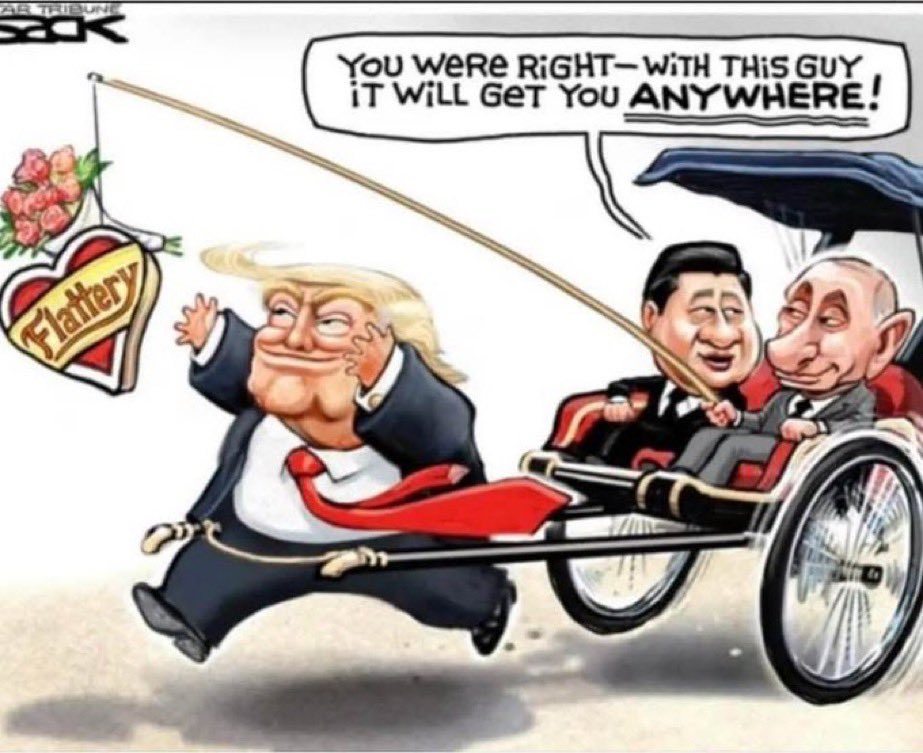


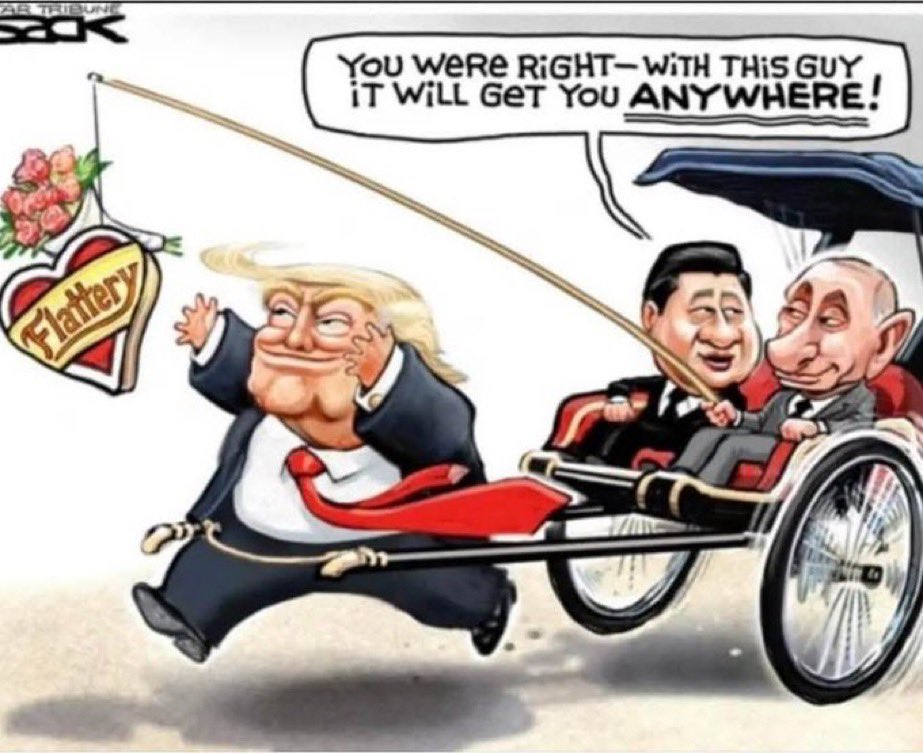
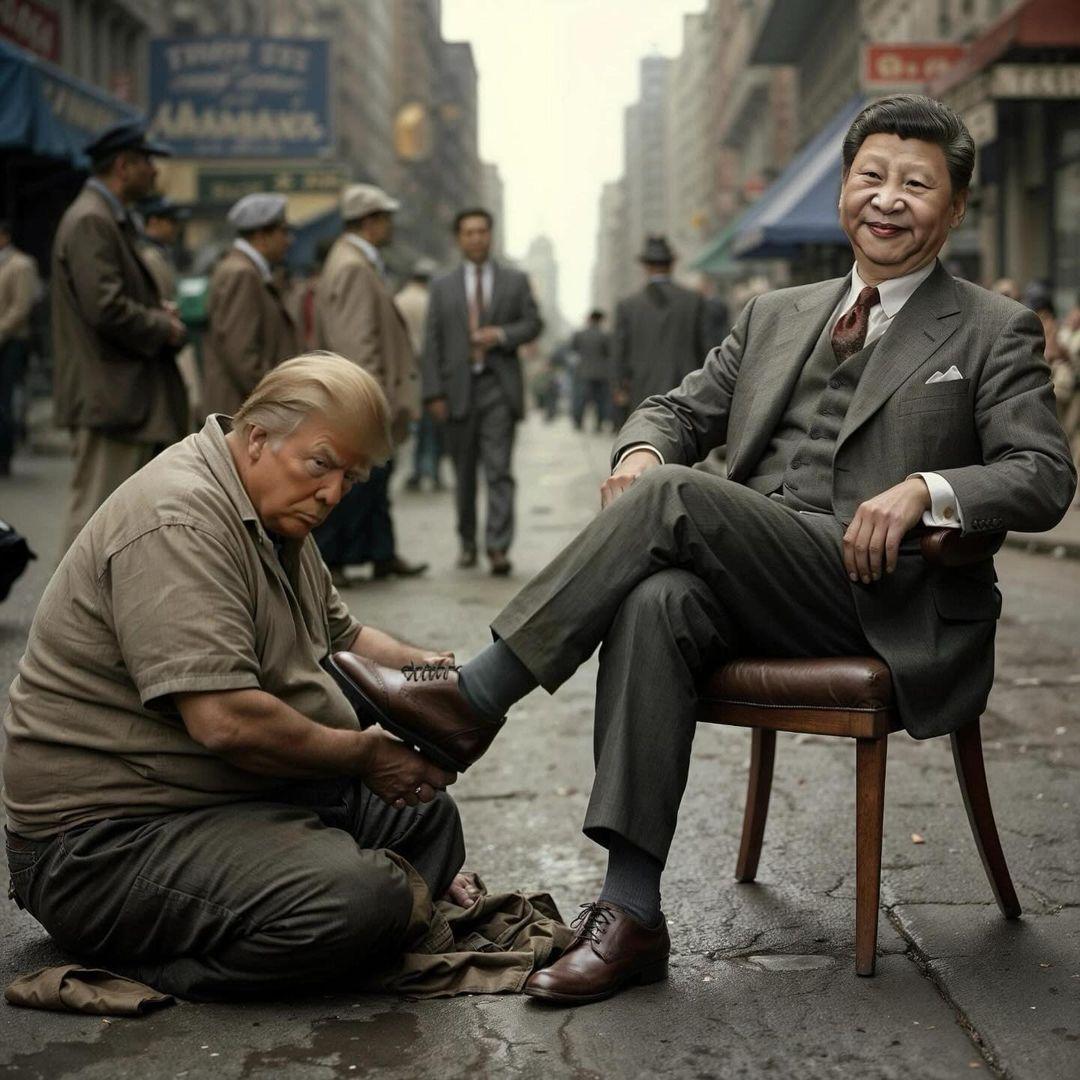
"It's an honor to be with you, it's an honor to be your friend, and the relationship between China and the USA is going to be better than ever before." - President Donald J. Trump 🇺🇸
English




The $1.5 trillion investment is a GENERATIONAL DOWN PAYMENT on America’s national defense.
This investment guarantees the United States maintains overwhelming strength and unmatched deterrence against any adversary for generations to come.
English



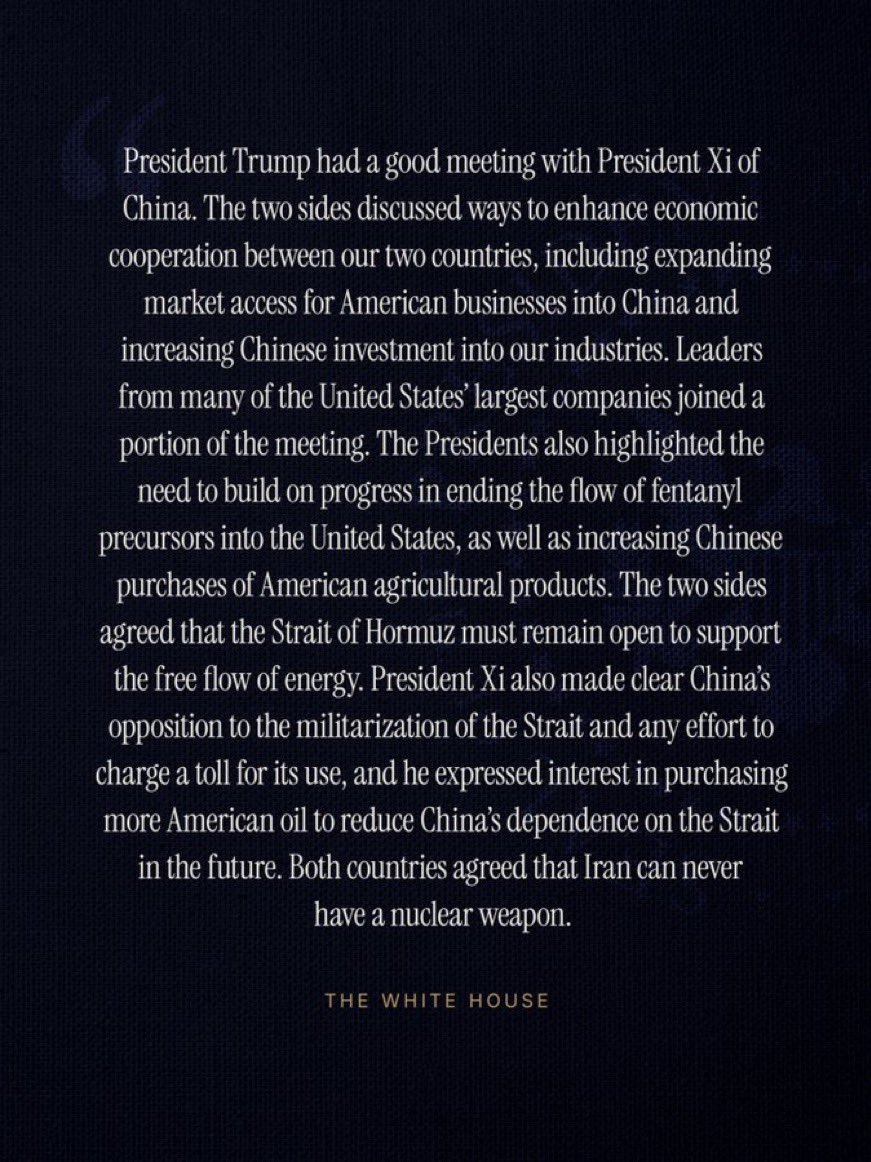
Following the bilateral U.S.-China talks in Beijing, China earlier today, the White House has released a statement saying that the two delegations discussed issues such as market access into China, Chinese investment in U.S. industries, drugs, specifically fentanyl, the “free flow” of trade through the Strait of Hormuz, and other key issues.
English

US President Donald Trump praises "extremely positive" talks in Beijing after Xi Jinping says US-China relations world's "most important"
Follow live: bbc.in/4d7FYj0
English

Second Japan-linked oil tanker sails via Strait of Hormuz as PM asks Iran to help out reut.rs/3RlgWUY reut.rs/3RlgWUY
English
Jeff Wyszkowski retweetledi

Jeff Wyszkowski retweetledi

@JHornes @greendragonhq Not against America, dimwit. Against the sham, pedo, con man -- Trump. Go back to your mom's basement.
English

@greendragonhq Amazing how so many of you gladly root against America as long as you can bash Trump…. Sick … plain n simple
English

Here is what will happen with Trump’s meeting in China..
1. Trump announces a deal with China. The details will be murky, and unclear, but he will say we won.
2. MAGA influencers celebrate. They flood our timelines with Trump’s propaganda.
3. The details of the deal come out, they are not what Trump said but the lie has already taken over the truth.
4. MAGA influencers will quietly move the goal post, and not acknowledge that we got lubed up, and bent over by China.
5. They quietly stop talking about the trip.
English
@WhiteHouse Hopefully you mean real fraud -- not just the bullshit @VP spouts to get headlines.

English
The Trump administration has made it loud and clear to all states: if you commit fraud, you will lose medicaid funding.

English