Josh Hamlet

158 posts

Josh Hamlet banner
Josh Hamlet

Josh Hamlet

@Josh_Hamlet

Tax attorney. 🎰 Gambling · 🌿 Cannabis · 🎥 Creators · 🤝 Nonprofits

New York, NY Katılım Ekim 2011
618 Takip Edilen373 Takipçiler
Josh Hamlet
Josh Hamlet@Josh_Hamlet·
The state deduction helps but it's sitting downstream of a number that's already blown up, and it pulls the federal problem in with it. 105-153.5(a)(2)e gives you "the amount allowed as a deduction for wagering losses under section 165(d)," which means the 90% haircut just rides along. NC imported the phantom income instead of fixing it. And with the "to the extent not deducted in arriving at AGI" language, a Schedule C pro gets nothing out of it at all. The $2,000 threshold being net or gross is the difference between a nothing and a disaster. Let me know if your records requests turn up whether the player gets a copy, because if they don't, nobody can reconcile against it anyway. And I think your last line is the actual answer. Calendar year sessions per operator doesn't need Congress, that's a Rev Proc. #NewItemizedDeductionforGamblingLosses-17305" target="_blank" rel="nofollow noopener">ncdor.gov/taxes-forms/in…
English

0
0
1
26
Brett Chandler
Brett Chandler@bachandler27·
The NC D-400 starts with federal AGI Line 6. I have filed public records requests for SB 595 (2026-31) to get implementation information for N.C. G.S. 105-251.2 (so far nothing). It mandates that DOR ask the operator for 1-5 but then later states may request. We don’t know what the form looks like, will the player get a copy, and is the $2,000 threshold net winnings or gross? As a side note, the original bill required the lottery’s digital instants (slots) to report the same thing, but they conveniently removed that requirement in a secret conference committee. Fortunately, we were able to get a state deduction for wagering losses passed last month. Most state audits do not result in coordination with the IRS so there will be some hard decisions from NC players on how to proceed with their federal 1040. I suspect many will just wait for the state algo audit based on the compliance return and just pay what the state asks to avoid having to report gross winnings, lose standard deduction, and have AGI phaseouts from the federal return. Of course all of this could be avoided with a federal law or rule authorizing calendar year sessions per operator.
English
2
0
1
88
Josh Hamlet
Josh Hamlet@Josh_Hamlet·
Two guys bet $500 on Spain. One on DraftKings, one on Kalshi. One is a degenerate, one is a trader. Only one gets taxed on money he didn't make. x.com/i/article/2081…
English
10
4
36
7.4K
Josh Hamlet
Josh Hamlet@Josh_Hamlet·
Calvao's useful here, though the AGI point is in footnote 6 rather than the holding. Shifting the deduction from Schedule C to Schedule A raised his AGI, which then limited his other itemized deductions under section 68. The court didn't treat that as incidental either. It flagged that the trade-or-business question didn't change the allowable gambling loss deduction at all, but still changed the deficiency, purely because of where the deduction sat on the return. Worth noting he lost on Groetzinger and lost partly on records, since his reconstructed schedule contradicted both his own summary and the W-2Gs. On NC Session Law 2026-31, the interesting part is what it produces: DOR will hold annual per-operator wagering records for every registered player, which is close to the evidentiary predicate Camp's per-establishment annual netting needs. Close, but not there. The records are only as good as the account map, and plenty of volume runs through accounts registered to someone else once a player gets limited. The state built an enforcement tool and handed taxpayers most of a substantiation case at the same time.
English
1
0
1
62
Brett Chandler
Brett Chandler@bachandler27·
In that proposed rule, the IRS projects only 673,000 taxpayers will take an itemized deduction for wagering losses for tax year 2026. It is estimated that 60 million Americans engage in sports wagering with 165 billion in annual state regulated handle (this is only sports gambling). It is hard to imagine a scenario where a government agency could be more disconnected from reality. It would make no sense for the agency not to support a taxpayer using the net annual profit/loss from each online regulated sportsbook. Unlike a casino, a player can’t engage in untracked play and the report is 100% accurate (no hiding chips in your pocket). As Calvao v Commissioner pointed out, it is a huge disadvantage because a wagering loss deduction does not reduce AGI. Less than 15% of taxpayers itemize so we have millions of cases of evasion taking place because there is no way people are paying income tax on phantom income as most players are net losers. In NC, we have a new state requirement for informational compliance returns which essentially turns over your entire wagering history to the NC DOR. I realize most consumers have nothing reported as W-2G threshold are rarely met. The current rules hurt honest taxpayers the most. It is amazing to me that something so simple and common is not fixed.
English
3
0
0
90
Josh Hamlet
Josh Hamlet@Josh_Hamlet·
@CT_Legacy Might have to write another piece on this. Federal at least lets you subtract 90%. A number of states tax the gross winnings and allow nothing, so the phantom income is 100%. Break even at the tables, owe real money to your state.
English
0
0
1
23
CT Legacy
CT Legacy@CT_Legacy·
@Josh_Hamlet Go further now to the states that recognize 0% of gambling losses, instead of 90% like federal does.
English
2
0
1
54
Josh Hamlet
Josh Hamlet@Josh_Hamlet·
Camp's read is that (d)(1)(B) anchors the measuring period to the year, which supports the per-establishment annual netting from Boneparte and Bright. Two things I'd flag though. The article is from August 2025 so before Treasury proposed 1.165-10, and the proposed reg is silent on session boundaries. Live argument with no agency support. And "during such taxable year" appears in (A) too, where it can only mean which year's losses count. Tough to have it doing different work two subparagraphs later. I think the most important thing in the article is his last paragraph though. H.R. 4304 keeps the new language and just swaps 90 for 100. S. 2230 reverts entirely and deletes it. The repeal bills aren't interchangeable and almost nobody has noticed.
English
1
0
1
104
Brett Chandler
Brett Chandler@bachandler27·
@Josh_Hamlet The silver lining in this may be that they likely changed the statute to support a yearly session which is extremely helpful for AGI purposes and not losing the value of the standard deduction. taxnotes.com/special-report…
English
1
0
2
155
Josh Hamlet
Josh Hamlet@Josh_Hamlet·
@DereksFinTwit Same. "Session" is doing enormous work here and there's still no statutory definition of it. It's been IRS guidance and case law since 2008.
English
0
0
1
30
DB
DB@DereksFinTwit·
@Josh_Hamlet Great read. Hopefully we get some clarity by end of year or at least what exactly a “session” is
English
1
0
1
82
Josh Hamlet
Josh Hamlet@Josh_Hamlet·
@melvinitiss Yes, and I think that's most of the answer. In reconciliation the bill has to hit its number. Pulling a $1.1B raiser means finding $1.1B somewhere else, and nobody wants to be the member who opened that hole to help gamblers.
English
1
0
1
31
Melvini
Melvini@melvinitiss·
@Josh_Hamlet Josh great article. Would you argue to at a point it was not removed because of budget implications? It was forecasted revenue where they would have had to shift and recover it elsewhere.
English
1
0
1
62
Josh Hamlet
Josh Hamlet@Josh_Hamlet·
Moore isn’t really the obstacle, and the Court kept it deliberately narrow. Kavanaugh limited it to attributing an entity’s realized income to shareholders and expressly left unrealized appreciation and mark-to-market for another day. The Moores’ CFC had realized income. The gross winnings here are realized too. Congress just won’t let you subtract against them. And wherewithal to pay was never a constitutional doctrine. It explains why Congress defers tax in 1031 and installment sales. It’s never been a limit on what Congress can reach. The actual wall is New Colonial Ice: deductions are a matter of legislative grace. Cannabis companies tried a similar argument against 280E (gross receipts, 16th Amendment) and lost. One major difference though: the 280E cases leaned on the underlying activity being illegal. There’s no illegality hook here. So the precedent isn’t a perfect fit, it’s just the closest thing to one.
English
1
0
1
33
Charles Richardson
Charles Richardson@viachicago99·
@Josh_Hamlet Thanks for this, great article. Is Moore v. The United States a killer for making the wherewithal to pay argument?
English
1
0
0
24
Josh Hamlet
Josh Hamlet@Josh_Hamlet·
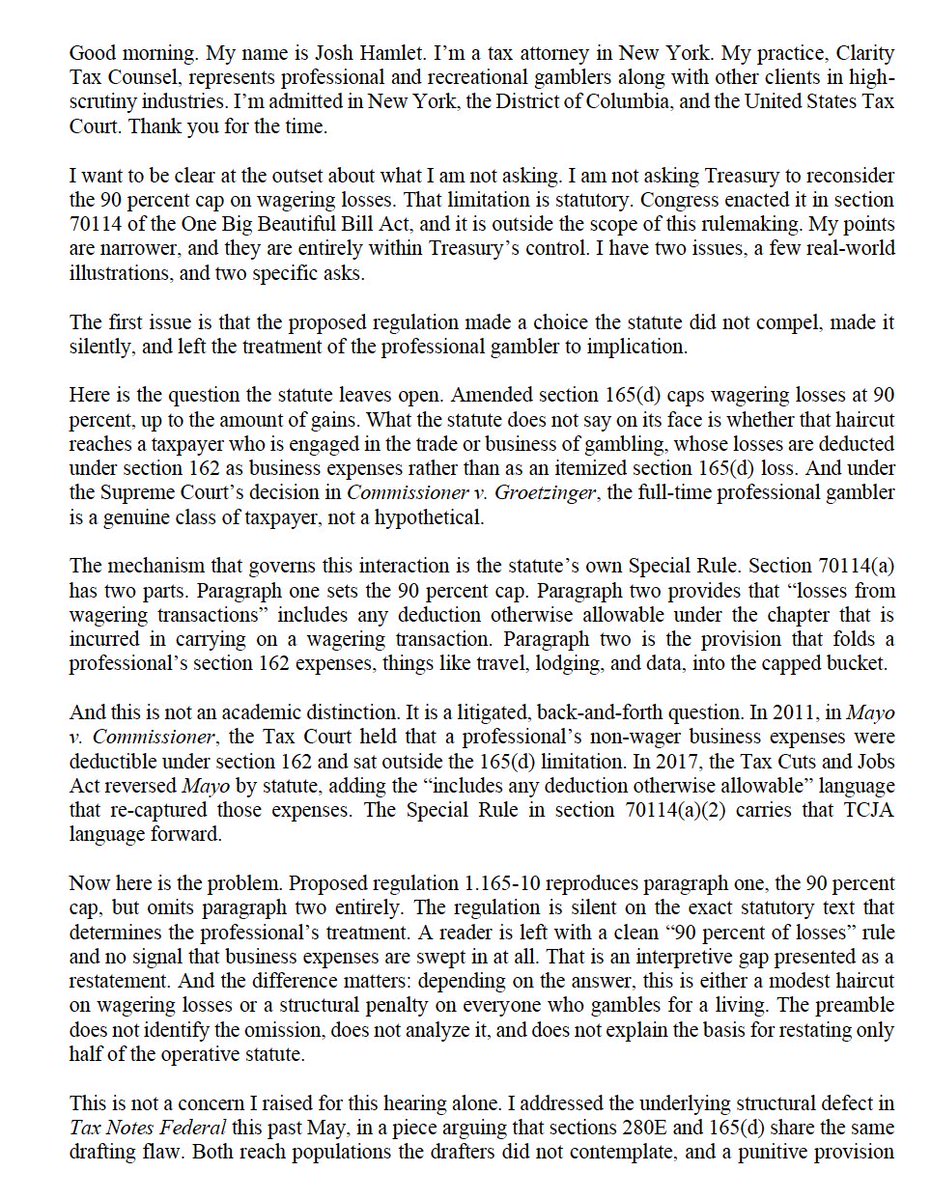
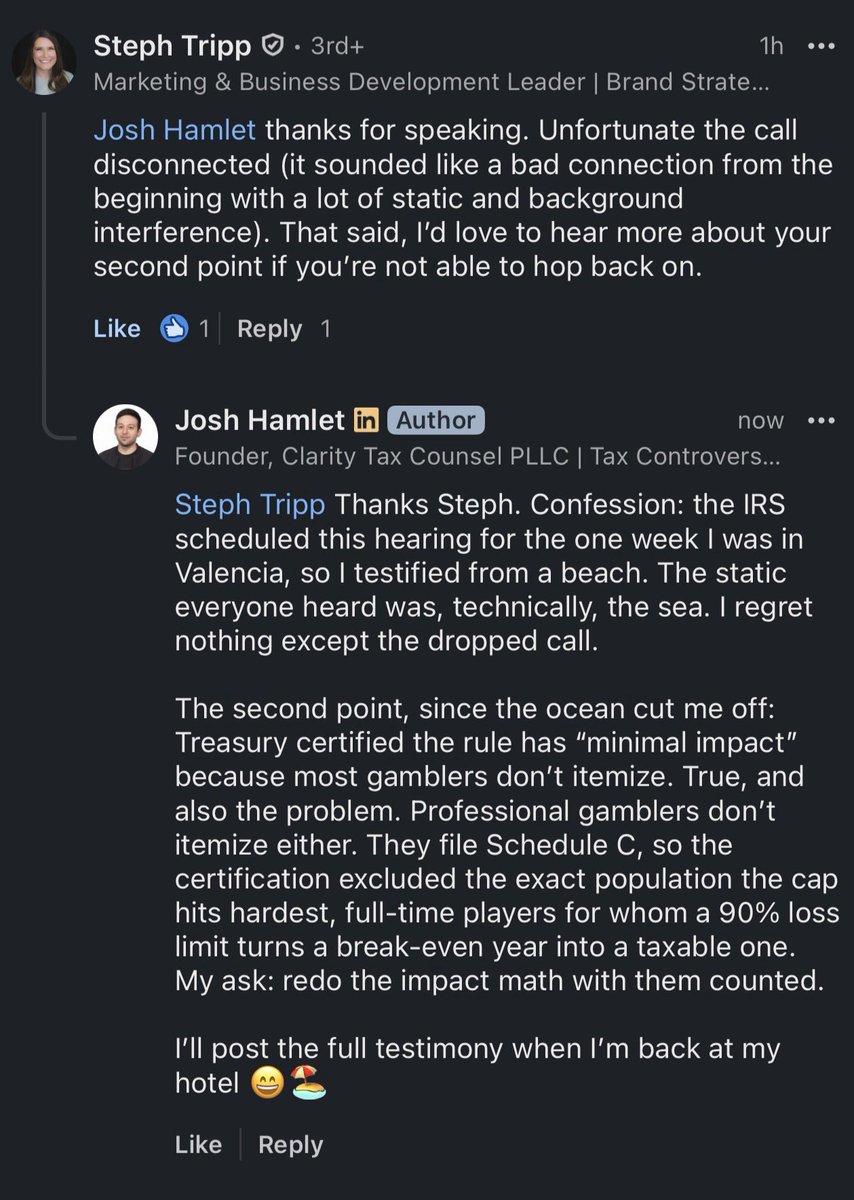
Last week I testified at the IRS hearing on the 90% gambling loss cap from a beach in Spain. The static everyone heard was the sea. Then the sea hung up on me mid-argument. I have now testified before a federal agency for less time than the average WSOP main event tank. A week to digest, and here's what sticks. Everyone at that hearing knew the rule taxes money nobody made. Win 500k, lose 500k, owe tax on 50k. Congress knew the math when it wrote the provision. It passed anyway, because gamblers have no defenders in a markup. And there's no upside to trade against. The projected revenue assumes people keep betting where the IRS can see them, while the former bookie who testified says the money goes offshore and underground where nothing gets reported at all. Follow it through and this rule is an administrative nightmare (matching notices built on phantom numbers), an ethical one (the burden lands entirely on honest reporters), a legal one (an income tax should require income), and a public health one (the players least able to absorb it get pushed to unregulated markets). Full testimony below, including the part the ocean kept off the record. @fairplaygov @PokerCPAs @ToddWitteles @repdinatitus @SaraSmartist
Josh Hamlet tweet mediaJosh Hamlet tweet mediaJosh Hamlet tweet media
English
7
2
21
2.7K
Joe Franchise
Joe Franchise@sprusfwitter·
@Josh_Hamlet This is a great point and something I wondered. To tell a recreational gambler they can only deduct 90% is unfortunately constitutional, a deduction is like a gift they can give or take. For a pro though this gets murky, because its not a deduction its an expense of business.
English
1
0
3
137
Josh Hamlet
Josh Hamlet@Josh_Hamlet·
@viachicago99 Nothing credible that I've found, and I did look. Got a longer answer to that question coming later today.
English
1
0
1
34
Josh Hamlet
Josh Hamlet@Josh_Hamlet·
I've written about the 90% cap enough times to be embarrassed. Nobody has ever told me I'm wrong. That's what this one is actually about.
English
0
0
0
200
Todd Witteles
Todd Witteles@ToddWitteles·
I'm presently on the telephone-based IRS panel regarding implementation the 2026 "90% gambling loss limitation" law. My testimony will be last, and will be exclusively focused upon implementation suggestions to make this easier on us. So far Dina Titus and Sara O'Connor have spoken, and we are presently hearing from recreational gambler Henry Fung. At least two of the scheduled 12 speakers were not able to make it today. My testimony will likely be at approximately 8:30am PDT. I will be preceded by Katie Stone, a well known east coast poker community figure. I'll post any comments on the testimony and IRS responses/questions in this thread. As it isn't legal to record and post this hearing online, I can't do so. Otherwise, I would have. I will post a transcript later regarding my testimony, and then I will request a full transcript of the hearing, and post that when I receive it.
English
26
8
141
26.5K
Josh Hamlet
Josh Hamlet@Josh_Hamlet·
Your friends' business model is being written by the tax code right now. The player who stays in the regulated system and thinks the cap is wrong has two options: (1) disclose the position on Form 8275 (and essentially hand-raise for an audit), or (2) skip the disclosure and carry penalty risk if it's caught. Meanwhile, the player who takes his action off the books files nothing, discloses nothing, and hopes enforcement never comes looking. Congress made honesty the highest-risk option on the board.
English
1
0
1
46
PLO Professor
PLO Professor@Poker906·
@Josh_Hamlet I mean…. It is a small sample size - but I still have plenty of friends in the booking biz. They LOVE the new tax law - it’s increased their business dramatically…. Keep it off the books and ignore the new tax law!
English
1
0
0
51
Fairplaygov
Fairplaygov@fairplaygov·
The IRS hearing on the 90% rule has wrapped. Great job by the speakers. Good summary & play-by-play in the posts below. I have a solid handle on both the written & oral testimony now on the record and hope to submit a report to House Ways & Means tax subcommittee members by end of month. Not waiting around for the IRS. It’s time for @repdinatitus or @RepHorsford / @RepMaxMiller bills repealing the 90% cap to get scheduled for markup.
Sara O'Connor@SaraSmartist

I was able to stay for everyone's testimony and think there was a wealth of knowledge and experiences that were shared. We truly did our best. @ToddWitteles did a superb summary of everyone's testimony by person, so please visit his thread (which I retweeted here ⬇️) While there was a running thread that taxpayers must not be required to pay phantom income and the IRS should put that before Congress to revisit, speakers provided testimony addressing real economic and social behavior consequences of this rule. Speakers addressed the need for more guidance, because the law is difficult to implement - particularly (but not limited to) what is a "session." I was thrilled by the diversity of speakers, including but not limited to: - Representative Dina Titus - recreational gamblers (all kinds, not just poker) - professional gamblers (poker), including @Poker906 - Mike Vanaki, the Director of Government Relations at the American Gaming Association - a CPA (who REALLY knocked it outta the park, imo, and even included a great question applicable for stakers) - Katie Stone (@KatieStonePoker) provided some harrowing ramifications that Black Friday had as an example of why this 90% law will fall hardest on honest taxpayers. - Todd focused on implementation suggestions, such as defining "session" for each gambling activity Things I was not thrilled about: - 2 (or 3?) speakers were no-show and one had a call drop - the IRS panel didn't ask a single question

English
7
17
103
20.8K
Josh Hamlet retweetledi
Sara O'Connor
Sara O'Connor@SaraSmartist·
Just got an email re: testifying on the 90% gambling loss deduction issue. I'm slated to speak third and there is a nice group of people who will also be testifying. Let's go!!!
Sara O'Connor tweet mediaSara O'Connor tweet media
English
5
5
72
11K
Josh Hamlet retweetledi
Fairplaygov
Fairplaygov@fairplaygov·
AGA, @RepDinaTitus, @PokerCPAs, @Josh_Hamlet (both are gambling tax pros) & several poker players / gamblers to speak at Friday's IRS tax hearing on the 90% gambling loss deduction cap. *This IRS panel doesn't have the power to change the rule but hopefully there will be some takeaways from testimony and panel comments to bring to Congress.
Sara O'Connor@SaraSmartist

Just got an email re: testifying on the 90% gambling loss deduction issue. I'm slated to speak third and there is a nice group of people who will also be testifying. Let's go!!!

English
5
3
18
12.2K