Julian Busch

1.2K posts

Julian Busch

Julian Busch

@JulianBusch2

Journalist

Katılım Kasım 2013
1.7K Takip Edilen1.1K Takipçiler
Julian Busch retweetledi
Hamidreza Azizi
Hamidreza Azizi@HamidRezaAz·
Well...it seems that Trump’s genius idea to open the Strait of Hormuz is to close it further! This can, of course, put pressure on #Iran in the long term, but the short- to mid-term effects on the U.S. and global economy are likely to be much more significant. One should not forget that in the past 40 days, Iran has been able to ship and sell its oil through the strait, while other oil-producing countries in the region have not. This means Iran is already 40 days ahead of others. At the same time, it is quite probable that, if Iran is not allowed to sell its oil, it will try to make it impossible for other actors, like Saudi Arabia and the UAE, to sell their oil by bypassing the Strait of Hormuz. And once again, a casual reminder that the Bab el-Mandab Strait is not closed yet...
English
0
912
3.6K
286.3K
Julian Busch retweetledi
Robert Malley
Robert Malley@Rob_Malley·
The main asymmetry is that Iran appears to have a better alternative to a negotiated agreement than does the US: In the absence of a deal, strikes on Iran will resume, but with diminishing marginal returns for the US, while the closure of the Strait will persist, with growing marginal returns for Iran. It doesn't mean Iran won't pay a significant price in the event talks collapse, which is a good reason why they agreed to them. It means that, rightly or wrongly, Iran feels it can sustain the price of a breakdown longer and better than the US can.
English
0
203
922
138.8K
Julian Busch retweetledi
Trita Parsi search. ..
Here's the Iranian delegates to the talks. Never during the JCPOA did I see such a large & senior Iranian delegation. And Qalibaf may meet directly w/ Vance(!) Before, the Iranians refused such meetings. They agree now because they see themselves in a far stronger position.
Trita Parsi search. .. tweet media
English
285
854
2.8K
265.7K
Julian Busch retweetledi
Alex Shams
Alex Shams@alexshams_·
Why is no one reporting that Israel bombed a synagogue in Tehran? This would be front page news if anyone else had done it.
English
4
34
159
2.9K
Julian Busch retweetledi
Drop Site
Drop Site@DropSiteNews·
🇨🇳🇦🇫🇵🇰 China brokers Afghanistan-Pakistan agreement to halt escalation in fighting Afghanistan and Pakistan agreed on Wednesday not to escalate their conflict and to pursue a comprehensive resolution to their disputes following seven days of peace talks mediated by China in the western city of Urumqi, Beijing’s Foreign Ministry announced. Chinese Foreign Ministry spokesperson Mao Ning said all parties acknowledged that “terrorism is the core issue” in the relationship and agreed to continue dialogue, though Islamabad offered no public comment on the outcome.
Xu Feihong@China_Amb_India

Representatives of #China, #Pakistan and #Afghanistan held week-long informal talks in Urumqi, Xinjiang🇨🇳 from April 1 to 7. The Afghan and Pakistani sides reiterated that they follow the purposes and spirit of the UN Charter and the Five Principles of Peaceful Coexistence, stay committed to resolving differences as soon as possible, work for the turnaround of Afghanistan-Pakistan relations, and agree to refrain from actions that may escalate or complicate the situation. The three sides agreed to discuss a comprehensive plan to resolve issues in the relations between Afghanistan and Pakistan, and identified the core and priority issues.

English
15
303
1.2K
60.8K
Julian Busch retweetledi
Michael Kugelman
Michael Kugelman@MichaelKugelman·
Tonight, Pakistan achieved one of its biggest diplomatic wins in years. It also defied many skeptics and naysayers that didn’t think it had the capacity to pull off such a complex, high stakes feat. But what matters the most is it helped avert a potential catastrophe in Iran.
English
521
3.7K
14.6K
523.9K
Julian Busch retweetledi
Yaroslav Trofimov
Yaroslav Trofimov@yarotrof·
I must say I had to doublecheck this was real.
Yaroslav Trofimov tweet media
English
286
668
6K
830.4K
Julian Busch retweetledi
Hamidreza Azizi
Hamidreza Azizi@HamidRezaAz·
#Iran War Update No. 36 (focus on Iranian strategic narrative): 🔹A key development on April 4 was Trump’s 48-hour ultimatum to reopen the Strait of Hormuz. In Tehran, this ultimatum has been analyzed from multiple angles. On the one hand, particularly in state media, there is an emphasis on portraying Trump’s threat not as a sign of strength but as an indication of desperation in dealing with a problem that did not exist prior to the war and has now become Iran’s primary lever. On the other hand, there is an expectation that Trump – especially in light of the recent setback suffered by U.S. air forces – may take bold action against Iran even before the ultimatum expires. 🔹At the same time, Israel’s strike on a key Iranian petrochemical complex in Mahshahr has been interpreted as a serious escalation, effectively initiating a campaign against Iran’s critical infrastructure even before the expiry of Trump’s ultimatum. In other words, this action is viewed not as an isolated event but as a precursor to a broader U.S.-Israeli escalation targeting vital infrastructure. 🔹This perception has fueled serious debates within pro-government analytical circles regarding the necessity of a firm and deterrent Iranian response. A recurring theme in these discussions is that threats of escalation and a focus on U.S. and Israeli military infrastructure have thus far failed to produce deterrence. Instead, the argument is that Iran should not wait for Trump’s threats to materialize but should act preemptively and decisively. The earlier strike on Ras Laffan in Qatar is frequently cited as a successful example that should be replicated elsewhere in the region. 🔹At the official level, however, Iran’s response so far has combined threats of broad escalation with continued attacks on “U.S.- and Israel-related targets.” In this context, claims of attacks on U.S.-linked industrial, radar, and commercial targets in Bahrain, Kuwait, and the UAE are intended to signal that any expansion of the conflict into Iran’s economic infrastructure would expose the wider U.S.-oriented regional system. 🔹At the same time, part of Iran’s response continues to focus on the Strait of Hormuz. Some Iranian sources claim that among vessels stranded in the Persian Gulf and the Sea of Oman, those with links to Israel or the United States can be selectively targeted for retaliation. Reports suggest that the targeting of the MSC Ishyka, described as having Israeli ties, falls within this pattern. 🔹Another notable development on Day 36 of the war is a shift in how the Strait of Hormuz is being framed in Iranian media and analytical circles. Following earlier indications that Iran is seeking to establish a new legal regime for the strait – potentially in coordination with Oman – after the war, Iranian sources are now presenting it as a legitimate wartime order that even hostile powers may ultimately be compelled to negotiate around. 🔹This gives Tehran a stronger bargaining narrative. If Hormuz is framed as a governed space rather than a disrupted one, reopening it becomes a matter of political recognition rather than mere de-escalation. This helps explain why, over the past two weeks, Iranian sources have largely refrained from discussing a full closure or mining of the strait. While this could change, it nonetheless points to a longer-term political approach to this strategic waterway. 🔹At the same time, in a significant development, Iran’s armed forces announced that Iraq is exempt from “any restrictions we have imposed in the Strait of Hormuz,” allowing Iraqi vessels to transit freely. This marks the first time since the start of the war that ships from a specific country have been fully exempted from restrictions in the strait. 🔹This announcement followed large-scale public demonstrations in Iraqi cities such as Baghdad, Maysan, and Mosul in support of Iran and in condemnation of the U.S.-Israeli war. In effect, Iran appears to be implementing a system of reward and punishment in the strait. At the same time, Tehran likely hopes that this move will increase popular support for Iran in Iraq and across the wider region. 🔹At the operational level, Iran is emphasizing air denial as a capability it is increasingly restoring. Officially, Iran’s armed forces claim to be deploying “new air defense systems” capable of countering U.S. and Israeli aircraft. However, at the expert level, it is suggested that Iran’s recent success in targeting U.S. aircraft reflects tactical adaptation rather than a structural upgrade – particularly through the use of thermal detection and portable air defense systems (more on this to follow). 🔹Iranian reporting has also pushed back strongly against the notion that reduced missile visibility indicates reduced capability. The argument is that increased drone usage or mixed salvos should be understood as controlled expenditure and adaptation – especially in the context of a war of attrition – rather than depletion. In this regard, reporting by non-Iranian outlets such as The New York Times and CNN is also cited as evidence of Iran’s residual capabilities. 🔹On the diplomatic front, there are still no clear signs of Iranian willingness to compromise. However, Iranian officials have not categorically ruled out negotiations. After reports suggested that the Islamabad mediation track had collapsed due to Iranian objections, Iran’s foreign minister emphasized that Tehran has no issue with Pakistan, and that the core problem lies in Washington’s demands, which remain unacceptable to Iran. 🔹At the regional level, the Iraq, Lebanon, and Yemen fronts remained active, though at varying intensities. In Lebanon, exchanges between Hezbollah and Israel continued. In Iraq, there were reports of new strikes on PMF positions, alongside the temporary closure of the Shalamcheh crossing following strikes near the border. The Houthis also announced the launch of their fifth missile attack against Israel since entering the war. At the same time, a major development is that all components of the “Axis of Resistance,” including Iran, are now explicitly emphasizing coordination and joint operations. 🔹Overall, Day 36 reflects both a gradual escalation in the infrastructure domain and the anticipation of a more sudden and severe escalation by Trump. Iran continues to pursue a combination of threats and calibrated actions to generate deterrence, though this approach is increasingly being questioned within Tehran. All of this is unfolding as there are not only no signs of Iran backing down on the Strait of Hormuz, but the strait itself is becoming more formally embedded as a core component of Tehran’s political-military strategy.
English
0
129
413
47.9K
Julian Busch retweetledi
Hamidreza Azizi
Hamidreza Azizi@HamidRezaAz·
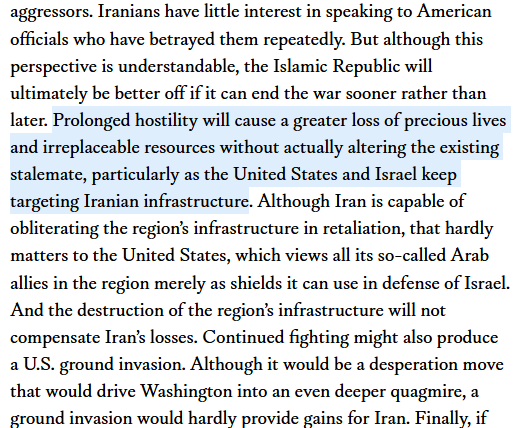
One should not read too much into Zarif’s article. It in no way represents a consensual view within the current Iranian leadership. As I told @BeckyCNN today, the very fact that he had to turn to Foreign Affairs to outline what #Iran should do to end the war is, in itself, a telling indication of his position within the current political landscape. There is indeed a faction within the broader political elite that supports the views expressed in the article, but these are not the actors currently shaping strategic decision-making.
English
1
105
348
66K
Julian Busch retweetledi
Drop Site
Drop Site@DropSiteNews·
NEWS: U.S. and Israeli officials acknowledged that Iran downed a U.S. fighter jet over its territory, according to The New York Times, as a search-and-rescue operation was underway and the fate of the crew remained unclear. Earlier, Drop Site reported that an Iranian official said a U.S. F-15 warplane was shot down over southern Tehran Province, with intense fire at the crash site, and that the strike prevented the pilots from ejecting, with no remains found.
Drop Site@DropSiteNews

🚨 BREAKING | An Iranian official told Drop Site News that a U.S. F-15 warplane struck by Iranian forces went down over southern Tehran Province, with intense fire reported at the crash site. The official said the nature of the strike prevented the pilot[s] from ejecting before the aircraft crashed. No remains have been found. 📸 Photos of the wreckage were published by Iran’s state-affiliated Fars News Agency.

English
12
241
1.1K
86.9K
Julian Busch retweetledi
TOLOnews English
TOLOnews English@TOLONewsEnglish·
A local source told TOLOnews that this evening (Thursday), the Pakistani military fired 15 mortar rounds on civilian areas in Moqbal area of Dand Patan district, Paktia province. According to initial reports, two civilians were injured. Meanwhile, Abdul Haq Fida, spokesperson for the 203 Mansoori Corps, also confirmed the clash to TOLOnews but said that the fighting has now stopped. #TOLOnews_English
TOLOnews English tweet media
English
1
7
24
2.3K
Julian Busch retweetledi
Ali Vaez
Ali Vaez@AliVaez·
Help is on the way…
English
0
27
276
17.2K
Julian Busch retweetledi
Drop Site
Drop Site@DropSiteNews·
⚡️NEW from @DropSiteNews: Pakistan Plays Peacemaker While Bombing and Blockading Afghan Civilians While working to mediate an end to the U.S.-Israeli attack on Iran, the Pakistani government is escalating its own war against civilians on the border with Afghanistan. By @Emran_Feroz dropsitenews.com/p/pakistan-pea…
English
32
368
836
50K
Julian Busch retweetledi
Liz Cookman
Liz Cookman@liz_cookman·
It is a choice to work as a freelancer in conflict zones, but… It’s a choice made inside a system with limited alternatives, jobs are scarce and allocated through networks rather than merit alone. The industry also depends on freelancers while not always offering protections
English
4
24
130
12.5K
Julian Busch retweetledi
Liz Cookman
Liz Cookman@liz_cookman·
This story on US journalist Shelly Kittleson is an unsettling read for freelancers - the framing is one of personal choice over systematic failure. A disproportionate number of the journalists killed, kidnapped and injured in conflicts are freelancers. apnews.com/article/iraq-k…
English
6
199
472
60.6K
Julian Busch retweetledi
Mohammad Ali Shabani
Mohammad Ali Shabani@mashabani·
Reports emerging that more major Iranian pharmaceutical site have been hit. Aim of these kinds of bombings is obvious: to project state failure/collapse once the war is over. Remarkable how a tiny country of 8 million is singlehandedly destroying international law.
Vali Nasr@vali_nasr

First sanctions denied Iranians access to medicine and pharmaceuticals and now targeted bombing is denying them to produce their own. The war is increasingly waged on the people.

English
16
230
485
22.4K
Julian Busch retweetledi
Hamidreza Azizi
Hamidreza Azizi@HamidRezaAz·
#Iran War Update No. 33 (focus on Iranian strategic narrative): 🔹Iran significantly intensified its missile attacks on Israel on April 1 compared to the days before, launching multiple waves with higher missile counts, with some sources describing it as the most sustained barrage in recent weeks. This escalation suggests a shift toward more concentrated strike patterns aimed at increasing cumulative pressure on Israel. 🔹The timing of these attacks during the Passover period indicates a deliberate effort to maximize psychological impact on Israeli civilians. In this sense, Iran appears to be applying timing-based pressure more systematically as part of its broader attritional strategy. 🔹Iranian pro-government sources also point to increased coordination, including simultaneous launches from multiple missile bases across the country as well as parallel activity from Lebanon and Yemen. This reflects a move toward more integrated multi-front operations. The coming days will show if this can turn into an established pattern. 🔹At the same time, Israeli strikes on the Mobarakeh Steel Company in Isfahan on the day before have caused severe structural damage, reportedly rendering production largely inoperable. 🔹Given the company’s central role in Iran’s economy, the attack is widely interpreted as part of a broader effort to undermine postwar recovery capacity. This suggests a growing Israeli emphasis on long-term economic degradation of Iran. 🔹Strikes on infrastructure in western Iran, including bridges and logistical nodes, alongside attacks on airports and multiple cities around Isfahan, point to a parallel effort to disrupt mobility and support networks. These patterns have fueled speculation about preparations for potential ground or airborne operations targeting critical assets. 🔹On the economic front, estimates from the International Energy Agency indicating large-scale disruption to global energy supply highlight the systemic impact of the conflict. This aligns with Iran’s increasing emphasis on economic warfare as a core dimension of escalation. 🔹Developments in the Strait of Hormuz, including growing number of foreign vessels seeking Iranian permission for transit, are viewed in Tehran as evidence of de facto control. The longer this dynamic persists, the more it reinforces Iran’s perception that its leverage over global energy flows is consolidating. 🔹At the same time, continued Iranian-linked incidents in the Persian Gulf, including reported strikes in Kuwait and near Qatar, demonstrate a willingness to sustain pressure on regional energy infrastructure. Even when damage is limited, such actions reinforce the perception of persistent vulnerability. 🔹Against this backdrop, statements by Donald Trump suggesting that the war could end within weeks, while downplaying regime change, have generated mixed interpretations. Some analysts view this as laying the groundwork for a controlled exit, while others interpret it as signaling a potential final – more expansive – escalation. 🔹Speculation about possible U.S. moves, including commando-style operations targeting nuclear materials or strikes on energy infrastructure, has heightened concern in Tehran. As a result, Trump’s messaging is often interpreted as either strategic deception or pre-escalation signaling. 🔹This has led to growing calls within Iranian strategic circles for a more assertive posture. The underlying concern is that failing to act decisively could invite a more damaging U.S. intervention. 🔹At the same time, continued U.S. troop deployments are widely interpreted in Tehran as indicators that options for a larger-scale operation remain under consideration. Some analysts point to the Easter period as a potential window for escalation. 🔹Within this context, debate in Iranian expert circles has intensified over the risk of losing escalation momentum. Concerns about a narrowing set of viable targets in Israel highlight a dilemma between sustaining pressure and avoiding increasingly symbolic or low-impact attacks. 🔹By contrast, escalation options in the Gulf remain available but carry significantly higher risks of regional expansion. This underscores a central strategic dilemma in Iranian thinking: how to restore deterrence without triggering uncontrollable escalation. 🔹Alongside these dynamics, Israeli statements indicating that a ceasefire with Iran would not extend to Lebanon have heightened concerns in Tehran. This has reinforced the perception that Israel seeks to sustain or expand operations on the Lebanese front regardless of broader de-escalation. 🔹From the Iranian perspective, such signaling reflects a willingness to pursue a more aggressive and potentially open-ended strategy in Lebanon, including maintaining a long-term presence in southern areas. In this sense, Lebanon is increasingly viewed as central to the war’s trajectory. 🔹Accordingly, Iranian analysts emphasize that Tehran must insist on a comprehensive framework for ending the war, encompassing all fronts, particularly Hezbollah. This reflects concern that fragmented agreements could allow Israel to consolidate gains in Lebanon while reducing pressure elsewhere. 🔹At the same time, Yemen’s role continues to expand, with additional Houthi attacks toward Israel. These operations are widely interpreted as part of an effort to stretch Israeli air defenses and redistribute military resources. 🔹Beyond their immediate impact, such attacks carry a signaling function, indicating that escalation could extend to Gulf economic targets if the conflict intensifies. 🔹Despite growing coordination, Iranian officials such as Abbas Araqchi continue to frame these actors as independent. This reflects an effort to preserve plausible deniability while benefiting from distributed escalation. 🔹At the same time, statements by these groups emphasizing joint operations highlight the increasing difficulty of maintaining this narrative as coordination deepens. This points to a widening gap between official messaging and operational realities. 🔹Pressure from Washington on European allies has intensified, including threats to reconsider commitments to NATO. This reflects how the war is contributing to growing transatlantic tensions. 🔹At the same time, Russian condemnation of Israeli strikes in Tehran highlights Moscow’s continued rhetorical alignment with Iran, while criticism in Tehran of Chinese and Pakistani mediation efforts points to a more selective approach to external diplomacy. 🔹Specifically, the use of the term “Gulf” instead of “Persian Gulf,” along with what is seen as an overly neutral framework that avoids addressing Iranian concerns directly, is interpreted as an attempt to accommodate Arab positions and prioritize stability over Iranian strategic interests, reinforcing perceptions of bias rather than genuine neutrality. 🔹Domestically, there has been criticism of Masoud Pezeshkian over remarks perceived as signaling openness to ending the war. Critics argue such statements undermine Iran’s broader economic pressure strategy and strategic messaging. 🔹Reports of diplomatic contacts alongside the targeting of figures such as Kamal Kharrazi, believed to have been linked to potential negotiations, have fueled speculation that ceasefire pathways may be actively disrupted by Israel. This reinforces Iranian narratives that the Israeli side seeks to prolong the war. 🔹Overall, Day 33 highlights a growing tension in Iran’s strategy between expanding coordinated, multi-front pressure and the risk of diminishing returns on escalation, particularly as target constraints in Israel become more apparent. At the same time, rising concerns over U.S. intentions and the trajectory in Lebanon are reinforcing a shift in Iranian thinking toward how to regain escalation dominance without being drawn into a phase of the war dictated by the adversary’s moves.
English
0
175
513
128.8K
Julian Busch retweetledi
TOLOnews English
TOLOnews English@TOLONewsEnglish·
#BREAKING Sources told TOLOnews that a five-member delegation of the Islamic Emirate will depart for China within the next two hours for peace talks with Pakistan. The delegation includes representatives from the Ministry of Foreign Affairs, Mohibullah Wasiq and Abdulhai Qanit; a representative from the Ministry of Interior, Arifullah; a representative from the Ministry of Defense, Ruhullah Omar; and a representative from the General Directorate of Intelligence, Yahya Takal. The peace talks with Pakistan will be held in the city of Urumqi, China. #TOLOnews_English
TOLOnews English tweet media
English
1
5
64
5.2K