Justin Tipton

1.4K posts

Justin Tipton

Justin Tipton

@JustinRTipton

When the causes are more important than the system, the system is in jeopardy.

Austin, Texas Katılım Şubat 2010
123 Takip Edilen374 Takipçiler
Raging Capital Ventures
Raging Capital Ventures@RagingVentures·
You may have to hold your nose, but my bet is that a basket of current perceived AI losers such as $WDAY / $TOST / $BL / $HUBS nicely outperforms perceived AI winners such as $MU / $SNDK / $BE / $GLW over the next 18 months. Valuation matters more than good looks. Godspeed!
English
18
3
199
28.6K
Ian Cassel
Ian Cassel@iancassel·
It sometimes feels like a thin line between evolving as an investor and reaching/FOMO for returns. The differentiator is always position sizing, valuation and margin of safety. Grow and make mistakes without blowing yourself up.
English
7
8
58
8.4K
Justin Tipton
Justin Tipton@JustinRTipton·
@systvest absolutely. And the Homelander golden statue and depicting himself as god were filmed before Trump's golden statue and "red cross worker" tweet. So good. Nailed it.
English
0
0
1
33
Systematic Microcaps ⚙️
I don't understand the hate for the final season of "The Boys". Sure, a bit too fast-paced and plot armor over the top but we loved it. Entertaining af.
English
3
0
6
800
Justin Tipton
Justin Tipton@JustinRTipton·
@AlephBlog The government already has a 21% non-voting stake in all companies
English
0
0
0
8
David Merkel
David Merkel@AlephBlog·
The Trump administration is awarding $2 billion in grants to nine quantum-computing companies in deals that include U.S. government equity stakes, the Commerce Department said wsj.com/tech/quantum-c… The government should not be taking stakes in corporations
English
1
0
2
182
Justin Tipton
Justin Tipton@JustinRTipton·
@wolfejosh No, he is not. He isn't advocating for no self-employment taxes, or this will cost a lot more than 3%.
English
0
0
0
24
Josh Wolfe
Josh Wolfe@wolfejosh·
His proposal is that the bottom 50% SHOULD pay ZERO in taxes
English
8
2
17
5K
Josh Wolfe
Josh Wolfe@wolfejosh·
Jeff Bezos with straightforward simple logic. Bottom 50% pay no taxes + costs government 3%. Yet 100% life changing for this bottom half of America A smart and simple approach worth doing.
Jeff Bezos@JeffBezos

Thank you. The important part is zeroing out taxes on the bottom half. Best way to put money in someone’s pocket is to not take it out in the first place. Bottom half is only 3% of total tax revenue. But it’s very meaningful to that person. Zero it out.

English
417
207
3.3K
497.6K
Justin Tipton
Justin Tipton@JustinRTipton·
@JeffBezos I think you mean zero out income taxes only. Zeroing out employment/self-employment taxes would cost more than 3%. --- Not to mention you'd be removing skin in the game.
English
0
0
0
4
Jeff Bezos
Jeff Bezos@JeffBezos·
Thank you. The important part is zeroing out taxes on the bottom half. Best way to put money in someone’s pocket is to not take it out in the first place. Bottom half is only 3% of total tax revenue. But it’s very meaningful to that person. Zero it out.
Chris | Venture X Media@thecoachchris_

Facts It's great that Jeff Bezos thinks this way, because too many people who don't make money think that giving money to the government will solve a lot of their problems. They think these government programs are the answer, and it's clearly not. You can look at the federal level or at the state level, and you will see that a lot of government programs are simply waste.
English
3.3K
5.4K
54.5K
8.6M
Mohamed A. El-Erian
Mohamed A. El-Erian@elerianm·
Here's a question that, IMO, is yet to attract sufficient analysis: Where will all the funding come from for the mega IPOs and the projected surge in both sovereign and corporate bond issuance this year? This comes at a time when foreign investors have been reducing their US Treasury holdings—primarily to meet heightened foreign-exchange demands triggered by the fallout from the Middle East War. This shifting landscape is highlighted by this morning’s Bloomberg report, which notes that “Turkey offloaded almost all of its US Treasuries in March as it stepped up efforts to support its currency during the first month of the Iran war, according to Bloomberg calculations based on US Treasury data.” #economy #bonds #markets #Turkey
Mohamed A. El-Erian tweet media
English
31
44
213
28.4K
Justin Tipton
Justin Tipton@JustinRTipton·
@bubbleboi Most experts I've listened to think a blockade is a much higher risk than an invasion. Why do you assume an NDF means invasion?
English
0
0
0
41
bubble boi
bubble boi@bubbleboi·
I find it quite surprising that the FX market is accurately pricing in an invasion of Taiwan which you can see if you look at the option prices on Non Deliverable Forwards (NDFs) that reference TWD. The 1Y 25-delta risk reversal has been bid for USD calls / TWD puts at a level that’s roughly 1.5 vols rich to its 5Y median, and the wing skew on 10-delta strikes is doing something even more interesting… If you strip out the carry component and decompose the forward into a deliverable proxy basket (DXY, CNH NDFs, KRW NDFs) the residual vol premium on TWD is the cleanest read you’re going to get on tail risk. Which in this case I would call the implied probability of a “regime change event.” My back of the envelope calculations: If you assume a binary outcome where invasion implies a ~25-30% spot move in USD/TWD and no-invasion implies mean reversion to forward fair value, the risk-neutral probability embedded in the 1Y wing is somewhere in the 8-12% range. That’s risk-neutral, so you need a haircut to account for the variance risk premium, which in tail-heavy EM could be 30-40% of the headline number. Running the numbers I get a real-world implied probability of ~5-8% over the next 12 months of an actual invasion of Taiwan. If you compare that to Polymarket (~3-4% for the same window) you’ve got a ~3 vol point arb between retail prediction markets and the institutional FX vol surface and surprisingly the FX market is more worried than the betting markets.
English
35
15
467
42.9K
Miller
Miller@MillerBiran·
@realroseceline The big question is whether $DLO is a 'bridge' or a 'destination.' Since e-commerce is their biggest vertical, and giants like $SE and $MELI are aggressively building internal fintech arms, isn’t there a massive risk of TPV 'evaporating' as these whales insource?
English
1
0
1
572
Rose Celine Investments 🌹
Rose Celine Investments 🌹@realroseceline·
$DLO Processing $47b TPV with 50%-60% expected growth while producing strong profits, generating cash, and buying back stock is honestly pretty unusual. Most companies growing this fast are deeply unprofitable. Most profitable payment companies are not growing anywhere near this fast.
English
14
2
163
11.1K
Justin Tipton
Justin Tipton@JustinRTipton·
@adrewrogers I think it's that simple too. Where it gets complicated to me are the companies like AAPL that have run out of ideas to deploy new capital. An ROIC of 20% doesn't mean much when your capital employed hasn't gone up for five years, your returns are coming from something else.
English
1
0
0
27
Andrew Rogers
Andrew Rogers@adrewrogers·
9) We are all watching a show here that is designed to drastic us from very basic things. The day-in and day-out of the stock market feels important. The truth is very simple, we are just going to earn what the business earns. The secret to realization is simply patience.
English
1
0
2
194
Andrew Rogers
Andrew Rogers@adrewrogers·
Thoughts on investing. The truth about investing is something that Warren Buffett demonstrated intentionally over the Berkshire letters. Over the long-term as investors, we earn the returns on capital that our investments earn. Reference: - berkshirehathaway.com/letters/2018lt…
Andrew Rogers tweet media
English
1
2
14
1.8K
Justin Tipton
Justin Tipton@JustinRTipton·
@nntaleb Well formed democracy isn't made up of a single election
English
0
0
1
289
Nassim Nicholas Taleb
Nassim Nicholas Taleb@nntaleb·
If a lobby can buy an election, it's not a democracy, period. And if an evil lobby can buy an election, it's far worse than any form of autocracy. Let that sink in.
English
145
1.5K
6.8K
181.2K
Justin Tipton
Justin Tipton@JustinRTipton·
@benitoz won't radiating heat in space require getting heavy liquid up there?
English
0
0
0
324
Ben Pouladian
Ben Pouladian@benitoz·
I read a lot of Peter Lynch. Met him once. The one rule I carry into tech investing is the most boring one he ever wrote, know what you own, down to the physics if the position demands it. For me that has meant living inside NVIDIA's stack for years, and pulling apart the alternatives next to it, Trainium, the TPU, every serious accelerator someone is willing to tape out against Jensen. I was also an early investor in Mellanox, the networking company NVIDIA bought to own the switched fabric the entire scale up era now runs on. So when the conversation turns to networking as the real moat, this is not theory to me. It is a position I watched become the thesis. You do not understand what you own until you understand what could take it. @GavinSBaker at @SohnIdeaContest just gave the most physically grounded read on AI infrastructure I have heard this cycle, and it is a Lynch lesson in disguise. The reframe that matters: The last terrestrial mega data center may already be on someone's drawing board. Everything else follows from two constraints, watts and wafers, and Gavin walks both down to first principles. That is the work. Most people are pricing the narrative. Lynch would have asked what the thing actually is. 1. TSMC is the global rate limiter Jensen reportedly visits every quarter asking to double or triple leading edge capacity. TSMC expands at roughly 5 percent. A handful of disciplined operators in Taiwan are the physical governor on the entire AI buildout. This is the part the bubble crowd misses. The constraint is not demand and it is not capital. It is one fab's deliberate refusal to overbuild. That stretches the cycle longer and smoother instead of bubble and bust. It reads like the mid 1990s capacity cycle, not a standard 25 year memory peak where a 60 to 70 percent price spike would be your signal to cut the weed and walk. I have held NVIDIA since 2016 for exactly this reason. Owning it meant understanding it. The thesis was never the chip. It was the chokepoint. 2. The most underestimated silicon is Trainium Consensus is still pricing a one horse race. Gavin's sharpest non NVIDIA call is AWS Trainium, specifically Trainium 3 ramping in the back half of 2026. Here is the part that took me a while to internalize from studying these architectures side by side. As frontier models go fully Mixture of Experts, inference stops being a matmul problem and becomes a networking problem. You need a switched scale up fabric, not just fast chips. Today two organizations on earth have a working one. NVIDIA and Amazon. NVIDIA's came from Mellanox, which is the whole reason I sized that position the way I did years ago, the bet was always that networking would decide this, not raw flops. The TPU is formidable in its own lane, but the scale up fabric is the moat people are not modeling, and it is why I track every accelerator, not just the one I own. 3. The neocloud moat is operational, not arbitrage The lazy take is that CoreWeave and Crusoe are just renting hyperscaler slack. Gavin's counter is that running dense GPU clusters is like driving an F1 car. Looks easy until you try it. Top tier neoclouds run 2 to 3x the hardware utilization per hour of lower tier providers. That is an execution and inventory moat, and it compounds. 4. The structural short nobody is pricing Watts and wafers eventually force the buildout off the planet. Gavin expects orbital data infrastructure to prove technical and economic viability within roughly two years and take meaningful share by the end of the decade. Space solves power with unattenuated solar and solves cooling with massive radiators in the satellite's own shadow. Dense single rack nodes stitched together with lasers into a virtual hyperscale cluster in orbit. The unpriced risk is everything that over expanded to serve a terrestrial buildout. Cooling, power, industrial equipment names sized for a curve that may bend down within seven years. The whole interview is a lesson in pattern recognition over narrative. Lynch built a career on retail investors knowing their companies better than Wall Street did. The same edge exists in AI infrastructure right now, it just requires you to understand watts and wafers instead of same store sales. If you are not modeling the physical boundaries of the stack through the lens of history, you are not underwriting the position. You are following it.
English
27
64
607
92.5K
Justin Tipton
Justin Tipton@JustinRTipton·
@realroseceline This is looking like classic Nick Sleep to me. Economies of scale *shared with the customer*.
English
0
0
1
439
Rose Celine Investments 🌹
Rose Celine Investments 🌹@realroseceline·
Thoughts on $DLO Investing is not always predictable, sometimes you get a perfect quarter and the stock goes up. Other times the numbers look messy underneath the surface even while the actual business keeps getting stronger. That is kind of how I look at this quarter from $DLO. They processed over $14b in TPV, up 73%. Crazy growth at this scale, the network is still expanding rapidly, merchants are integrating deeper, and $DLO is becoming more important inside the global commerce ecosystem. I think one of the biggest mistakes investors make with $DLO is analyzing it like a simple payment processor when the business is increasingly becoming financial infrastructure for emerging markets. That is a very different thing because processing payments alone eventually becomes commoditized. But building the rails that help global merchants move money, settle funds, handle payouts, FX, integrate local wallets, and operate across 60+ fragmented markets is much harder to replicate. Most investors see emerging markets and immediately think about risk and instability. But for a company like $DLO, the complexity is exactly what creates the opportunity. Every country has different banking systems, regulations, tax structures, FX controls, local payment methods, fraud patterns, and settlement. Global merchants do not want to rebuild all of that country by country themselves, which is why once they integrate deeply into $DLO. You can already see this happening with merchants like $UBER expanding with them across dozens of countries. Once a merchant operationally builds around your infrastructure across multiple regions, leaving is not nearly as simple as someone else offering a slightly cheaper payment rate somewhere else. The operational complexity becomes a massive moat. Margins moved from 40% down to 35%, but management has been saying this would happen as they onboard large enterprise merchants offer the, volume discounts. The tradeoff is lower margins upfront in exchange for much larger and stickier relationships over time. And the payment itself is really just the starting point because they cross sell treasury, payouts, FX, financing, wallets, and settlement. To me, if a company is processing over $14b a quarter growing 73%, maybe the more important question is not whether margins were 35% or 39%. Maybe the more important question is whether the company is becoming embedded into the movement of global commerce across emerging markets. The market seems nervous because the quarter looked messy underneath the surface. There was a one time tax issue for $10m, operating expenses were elevated, and free cash flow looked weaker because of working capital timing. But honestly this looks much more like an investment cycle and timing than a broken business model. One thing I also think investors are underappreciating is the balance sheet. The company still has a pristine financial position with hundreds of millions in cash and a very asset light model with strong underlying economics. They have flexibility, liquidity to invest aggressively while also returning capital to shareholders. I also like that management authorized a buyback representing roughly 10% of the company. Honestly I was a little disappointed they did not repurchase more stock last quarter, especially with the stock trading at attractive levels. Hopefully they become more aggressive here. That is another thing I think people miss with businesses like this. If the underlying engine keeps compounding and the company simultaneously reduces share count over time, the long term math can become very powerful for patient shareholders. At the end of the day, investors need to decide what matters more. One noisy quarter, or the fact that $DLO processed roughly $47b in payment volume over the last twelve months and still appears to be expanding rapidly across emerging markets while maintaining what I still think is a great economic model. 🌹
English
30
21
307
59.2K
Justin Tipton
Justin Tipton@JustinRTipton·
@bryan_johnson The mRNA covid vaccine was finished before the US shutdown. This time would be no different. Still takes a long time to run the trials.
English
0
0
1
10
Bryan Johnson
Bryan Johnson@bryan_johnson·
If Hantavirus mutated into a global threat, it would unleash AI + biotech unlike anything we've ever seen. > genome sequenced and public in 4 hours > AlphaFold maps every protein target > AI screens 10,000 drugs in 24 hrs > 50 vaccine candidates designed simultaneously > AI designed antibodies in days > risk of death computed instantly > decentralized trials launch globally > enroll from home > 20 countries manufacturing at once > first doses in three weeks > real-time dose characterization > your genome + biomarkers determine your protocol > variant map updates every hour No one would wait for governments.
English
520
245
4.6K
574.5K
Justin Tipton
Justin Tipton@JustinRTipton·
@ElliotTurn @systvest Impossible. The "not AI" is being bought by someone and the "AI" is being sold by someone. Your logic is severely flawed here. The prices are changed, that's all.
English
1
0
0
35
Rose Celine Investments 🌹
Rose Celine Investments 🌹@realroseceline·
The stock market is one of the only places where people become LESS interested when prices go down and MORE interested when prices go up. 🌹
English
22
8
226
19.8K
Justin Tipton
Justin Tipton@JustinRTipton·
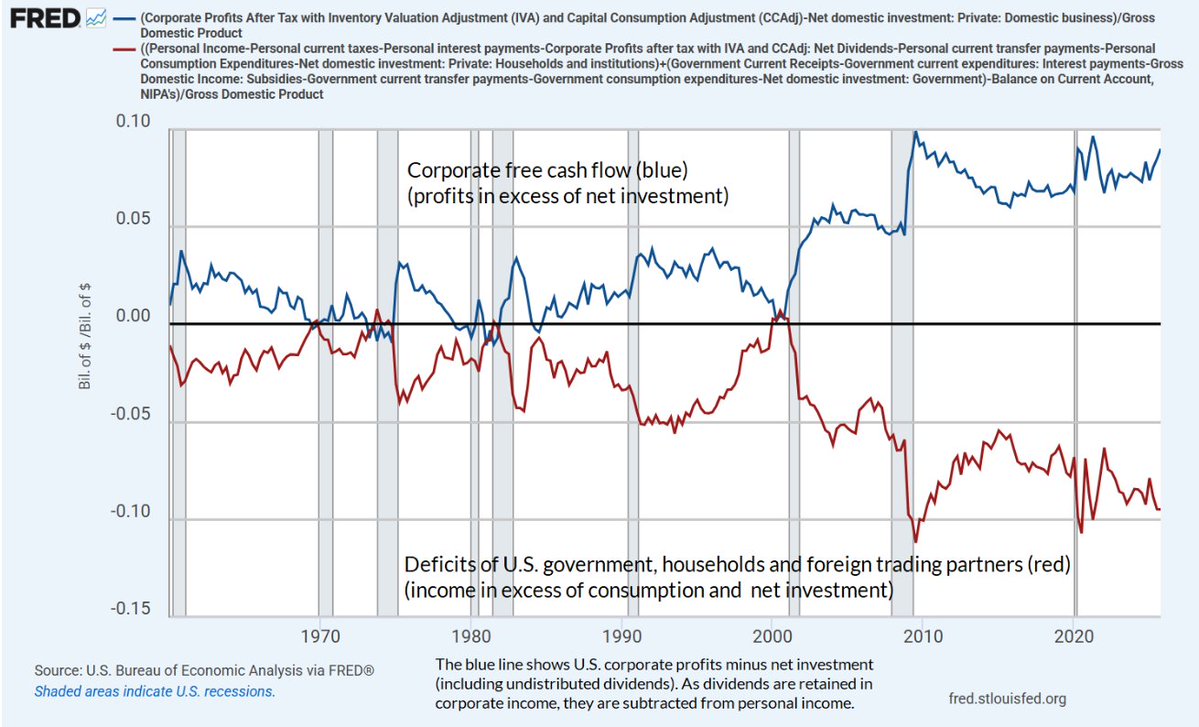
@AlephBlog As long as the government is running a 6% deficit to GDP, it'll stay that way. I'm 100% in stocks until I see Congress start balancing the budget.
Justin Tipton tweet media
English
0
0
0
6
David Merkel
David Merkel@AlephBlog·
Michael Burry Warns of Stock Crash as Tech Jump Echoes 2000 Peak bloomberg.com/news/articles/… Stock market capitalization as a ratio of free cash flow looks reasonable.
English
1
0
1
275