Sabitlenmiş Tweet
Kris Collo
141 posts

Kris Collo
@Kris_Collo
Entrepreneur & Investor | founder MicroPact | Retired | 🇺🇸 🇵🇭
Katılım Nisan 2010
4.8K Takip Edilen1.2K Takipçiler
Kris Collo retweetledi

Chamath: “I Was Completely Brainwashed by Mainstream Media Like Everyone Else”
“It’s about the truth.
There was a moment where I was basically like everybody else and pretty brainwashed.
My media diet was very much the same as everybody else’s.
I read the New York Times and the Wall Street Journal.”
Source: @KatieMillerPod @chamath
English
Kris Collo retweetledi

The human brain, a marvel of biological engineering, boasts an extraordinary storage capacity estimated at around 2.5 petabytes—equivalent to 2.5 million gigabytes or roughly 300 years of nonstop high-definition television playback.
This immense capability arises from its roughly 86 billion neurons, which interconnect to form more than 100 trillion synapses. Each synapse acts as a microscopic information-storage site, enabling the brain to encode, process, and retrieve vast amounts of data with exceptional efficiency and minimal energy use compared to digital systems. Neuroscientists and computer scientists increasingly draw inspiration from this neural architecture to design more energy-efficient neuromorphic computers and advanced AI models that replicate the brain's parallel, adaptive processing.
Yet the brain's storage feats pale in comparison to the potential of DNA as a data medium. A single gram of synthetic DNA can theoretically hold up to 215 petabytes of information—enough to archive enormous datasets in an extraordinarily compact form. Researchers have already demonstrated this by successfully encoding digital files (including books, images, and even operating systems) into DNA's four nucleotide bases (A, C, G, T), then retrieving them accurately via sequencing. This approach promises a revolutionary shift in archival storage: the entirety of humanity's accumulated digital data could one day fit into a space the size of a small room, offering far greater density, longevity (potentially millennia), and lower energy demands than today's sprawling, power-intensive data centers.
While challenges remain—such as synthesis and readout costs, error correction, and scalability—the convergence of biological principles from the brain and DNA highlights exciting frontiers where nature's solutions could transform how we preserve and access the world's ever-growing information trove.
[Erlich, Y., & Zielinski, D. (2017). DNA Fountain enables a robust and efficient storage architecture. Science, 355(6328), 950–954. DOI: 10.1126/science.aaj2038]

English
Kris Collo retweetledi

I welcome in-kind creations and redemptions for crypto-asset ETPs, a feature that ETP sponsors and investors have wanted since the initial approvals of crypto-asset ETPs: sec.gov/newsroom/press…
English
Kris Collo retweetledi

In the top 5 now.
One for the history books.

Joe Consorti@JoeConsorti
Just $28B away from passing Amazon as the 5th largest asset. Bitcoin now up to $119,000.
English
Kris Collo retweetledi

Now that the budget bill has passed Congress, we can see what the projections look like for deficits, government debt, and debt service expenses. In brief, the bill is expected to lead to spending of about $7 trillion a year with inflows of about $5 trillion a year, so the debt, which is now about 6x of the money taken in, 100 percent of GDP, and about $230,000 per American family, will rise over ten years to about 7.5x the money taken in, 130 percent of GDP, and $425,000 per family. That will increase interest and principal payments on the debt from about $10 trillion ($1 trillion in interest, $9 trillion in principal) to about $18 trillion (of which $2 trillion is interest payments), which will lead to either a big squeezing out (and cutting off) of spending and/or unimaginable tax increases, or a lot of printing and devaluing of money and pushing interest rates to unattractively low levels. This printing and devaluing is not good for those holding bonds as a storehold of wealth, and what’s bad for bonds and US credit markets is bad for everyone because the US Treasury market is the backbone of all capital markets, which are the backbones of our economic and social conditions. Unless this path is soon rectified to bring the budget deficit from roughly 7% of GDP to about 3% by making adjustments to spending, taxes, and interest rates, big, painful disruptions will likely occur.
English
Kris Collo retweetledi

After spending time in Washington, DC discussing the budget deficit with senior people on both sides of the aisle, it’s clear to me that we are unlikely to change the debt trajectory we’re on and avoid the painful consequences.
While virtually everyone agrees on the need to address our debt problem in a balanced way that includes tax increases and cuts to benefits, they also agree that they cannot speak up because politics have become absolutist.
We must find a solution around absolutist pledges like, ”I will not raise taxes,” or “I will not reduce benefits,” when they are desperately needed.
English
Kris Collo retweetledi

$IBIT just blew through $70b and is now the fastest ETF to ever hit that mark in only 341 days, which is 5x faster than the old record held by GLD of 1,691 days. Nice chart from @JackiWang17

English
Kris Collo retweetledi

It was 180 just 2 weeks ago.
Bitcoin Treasuries is rapidly becoming the standard.

BitcoinTreasuries.NET@BTCtreasuries
Some recently updated entities: - @metaplanet $3350.T — 7,800 BTC - iShares Bitcoin Trust $IBIT — 633,212 BTC - Lightning Network Public Channels — 4,318 BTC - @liquid_btc — 3,986 BTC CC @dylanleclair, @gerovich, @iShares, @adam3us, @Blockstream
English
Kris Collo retweetledi

Kris Collo retweetledi

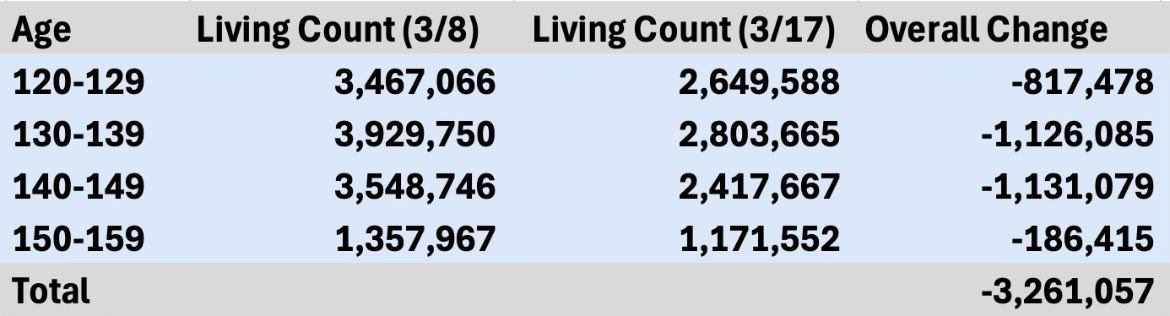
For the past two weeks, @SocialSecurity has begun a major cleanup of their records. Approximately 3.2 million numberholders, all listed age 120+, have now been marked as deceased. More work still to be done.

English