Lydia Polgreen

18.9K posts

Lydia Polgreen

Lydia Polgreen

@lpolgreen

Reachable via email or on Signal @lpolgreen.39

Katılım Kasım 2008
2.3K Takip Edilen101.2K Takipçiler
Lydia Polgreen retweetledi

John W. Sullivan
John W. Sullivan@jwsxia·
Jessica Chen Weiss subtly and effectively handles Matt Pottinger (and the Pottinger-Jake Sullivan “China strategy consensus”) and articulates a realistic, practical, manageable and thoughtful approach to actually moving the Sino-U.S. relationship forward. @jessicacweiss
Fareed Zakaria@FareedZakaria

Part 2 of my conversation with Matt Pottinger, the deputy national security adviser in Trump 1.0, and the scholar @jessicacweiss on Trump's China summit and what it means for the most explosive issue in the US-China relationship — Taiwan:

English
6
12
71
17K
Lydia Polgreen retweetledi
Farnaz Fassihi
Farnaz Fassihi@farnazfassihi·
Executions surge in Iran since cease-fire, rights groups Say many were detained during January’s mass protests, amid concerns the authorities are trying to intimidate Iranians from returning to the streets. @ErikaSolomon @SanamMahoozi nytimes.com/2026/05/15/wor…
English
0
40
46
12.8K
Lydia Polgreen retweetledi
Ahmed Shihab-Eldin
Ahmed Shihab-Eldin@aseisfree·
These attacks on healthcare workers and facilities represent a deliberate strategy to make southern Lebanon uninhabitable—a calculated campaign of collective punishment that violates international humanitarian law at every turn. substacktools.com/sharex/a208N0EN
Ahmed Shihab-Eldin tweet media
English
3
39
66
2.4K
Lydia Polgreen retweetledi
Isaac Stone Fish
Isaac Stone Fish@isaacstonefish·
It's hard to overstate how wrong the media narrative that China is predictable and stable and the United States is unpredictable and unstable is. I've been thinking about, visiting, and analyzing China and the Chinese Communist Party for most of my short life and it never seizes to amaze, surprise, impress and unsettle me. Who predicted the purges, who knew when they would happen, and to whom? Who knows who will succeed Xi Jinping? Who knows what the next DeepSeek will be? Who knows if China will invade Taiwan, and if so, when? Who knows who the secret Ministry of State Security informers are in businesses? Who knows what gets said in a Politburo meeting, and what that means for the future of the country? We need a lot more humility and perspective in our understanding of China.
English
50
48
195
54.1K
Lydia Polgreen retweetledi
Jacob Weisberg
Jacob Weisberg@jacobwe·
The cover:
Jacob Weisberg tweet media
English
20
72
551
315K
Lydia Polgreen retweetledi
Hamidreza Azizi
Hamidreza Azizi@HamidRezaAz·
A non-aggression pact between #Iran and Saudi Arabia? 🔹The Financial Times report on Saudi Arabia’s proposal for a regional “non-aggression pact” between Iran and neighboring states is not merely a temporary diplomatic initiative. Rather, it signals Riyadh’s attempt to redefine the Middle East’s security architecture in the aftermath of the U.S./Israeli war on Iran. 🔹The significance of this idea lies less in the pact itself – after all, this is not the first time such an idea is being discussed – than in the strategic logic behind it. Saudi Arabia appears to have concluded that the perpetual cycle of deterrence, limited strikes, and proxy warfare can no longer be managed solely through reliance on the American security umbrella. 🔹The Saudis’ reference to the 1970s “Helsinki process” is also far from accidental. That model was designed precisely to manage competition between hostile blocs, not to fully resolve ideological and geopolitical disputes. In other words, the objective is not to eliminate tensions, but to contain them. 🔹In effect, Riyadh now seems to be moving toward a form of implicit acceptance of a new regional balance of power, in which Iran, despite the heavy costs of the recent war, remains an indispensable actor in the region’s security equations. 🔹This shift also reflects a broader change in the Saudi conception of “stability.” For years, many Arab states defined regional security in terms of containing or weakening Iran’s regional influence. Now, however, the primary priority appears to be preventing Iran-Israel conflict from escalating into a permanent regional war. 🔹From this perspective, the proposal for a non-aggression pact should be understood as part of the broader trend toward the “regionalization” of Persian Gulf security. This process began with the China-mediated Iran-Saudi rapprochement in 2023 and may now enter a more complex phase, i.e., the establishment of rules of conduct for crisis management. 🔹At the same time, comparisons between the Middle East and Cold War-era Europe have serious limitations. Unlike Europe, the region lacks durable institutional structures, clear deterrence lines, and even a minimal consensus over the foundations of a regional security order. Moreover, the role of non-state actors and multilayered conflicts makes the equation far more complex. 🔹More importantly, any such initiative would remain inherently fragile without some degree of mutual understanding between Iran and Israel regarding the acceptable limits of escalation. Any new direct confrontation could easily destroy the entire process of regional de-escalation. 🔹At the same time, the proposal itself demonstrates that the Arab states of the Persian Gulf are increasingly concerned about the spillover of Iran-Israel rivalry into their energy infrastructure, trade corridors, and economic development projects. This concern has now become a major driver of regional policy. 🔹For this reason, even if the idea of a “non-aggression pact” never materializes into a formal agreement, the very fact that it has been proposed carries an important message, that a significant part of the Arab world is no longer seeking to exclude Iran from the region’s security equations, but rather to make patterns of interaction with Tehran more predictable.
English
0
133
407
132K
Lydia Polgreen retweetledi
Rush Doshi
Rush Doshi@RushDoshi·
Day 1 of the Trump-Xi summit is over. Here are my key takeaways from the readouts, interviews, and the banquet. (1) New Chinese Formulation: Most interesting takeaway for me is that China is out with a new frame for the relationship: “I have agreed with President Trump on a new vision of building a constructive China-U.S. relationship of strategic stability. This will provide strategic guidance for China-U.S. relations over the next three years and beyond.” Beijing appears to me to wish to lock in a "truce" favorable to them, and they want to do so beyond Trump, with this post-trade war detente setting the baseline. Presumably, any U.S. actions to reckon with excess capacity or deter conflict could be framed by Beijing as a violation of this new frame. Beijing acknowledges the relationship as competitive - as they did with us in 2023 - but talks about keeping it within acceptable limits. (2) Rare Earths, Export Controls: Surprisingly absent from both readouts despite their centrality to the current detente. (3) Taiwan: China emphasizes mishandling it could cause "clashes and even conflicts," elevated public language, while the U.S. doesn't mention it. (4): Artificial Intelligence: Nothing in readouts, but Bessent said to CNBC after (1) there will be talks and (2) that U.S. leadership in AI is the reason why China is willing to talk at all: "The two AI superpowers are gonna start talking. We’re gonna set up a protocol in terms of how do we go forward with best practices for AI to make sure non-state actors don’t get a hold of these models....The reason we are able to have wholesome discussions with the Chinese on AI is because we are in the lead. I do not think we would be having the same discussions if they were this far ahead of us." (5) Iran and Characterizing Xi: Normally we don't say, "Xi Jinping said X" in a readout, because that's for them to say. But the White House readout does so over Iran: "President Xi also made clear China's opposition to the militarization of the Strait and any effort to charge a toll for its use, and he expressed interest in purchasing more American oil to reduce China's dependence on the Strait in the future. Both countries agreed Iran can never have a nuclear weapon." (6) Chinese Investment in the US. This is mentioned in the White House readout. Bessent then said on television, "we’re going to talk about a board of investment that will be responsible for investment in nonsensitive areas." (7) Fentanyl. The US readout emphasizes "the need to build on progress in ending the flow of fentanyl precursors into the United States. No mention in the Chinese readout. (8) Mil-Mil Channels: Notably, the Chinese readout calls to "make better use of communication channels in the political and diplomatic and military-to-military fields." No mention in the U.S. readout, and historically something the US - not China - keeps in the foreground. (9) Xi Visit: At the banquet, Trump invited Xi to visit in September. Seems like it may align with the UN General Assembly, which Xi hasn't addressed in some time.
English
22
221
628
194.6K
Lydia Polgreen retweetledi
Patrick Wintour
Patrick Wintour@patrickwintour·
China - as summit with US starts - has back in Tehran just struck a deal with Iran to ensure its ships pass the Strait, in compliance with new Iranian regime for the Strait, Iran news agencies claim. Would set a welcome precedent for the US. Japan and India also seem to have a more limited deal. Iran - with Oman - is introducing a tax close to dollar a barrel and might require a small price increase at the pump, according to Roxane Farmanfarmaian speaking at RUSI. Iran reports framed to indicate China will be asked to pay.
انتخاب@Entekhab_News

فارس به نقل از یک منبع آگاه: آغاز عبور کشتی‌های چینی از تنگۀ هرمز از شب گذشته به گزارش یک منبع آگاه، با تصمیم جمهوری اسلامی، امکان عبور تعدادی از کشتی‌های چینی از تنگه هرمز با رعایت پروتکل مدیریت ایرانی تنگه میسر شد. بر پایه گفته‌های این منبع آگاه، پس از پیگیری‌های وزیر خارجۀ چین و سفیر این کشور در ایران، تسهیل در عبور و مرور کشتی‌های چینی بر مبنای روابط عمیق دو کشور و شراکت راهبردی دنبال و در نهایت جمع‌بندی شد که تعدادی کشتی چینی مورد درخواست این کشور پس از تفاهم درباره پروتکل‌های مدیریت ایرانی تنگه از این منطقه عبور کنند که این عبور از شب گذشته آغاز شده است. کارشناسان معتقدند این اقدام که مبتنی‌بر پروتکل‌های داخلی ایران است، هرگونه بهره‌برداری سیاسی از ظرفیت تنگه برای اعمال فشار خارجی را خنثی کرده و جایگاه مدیریت هوشمندانه تهران بر این مسیر حیاتی را تقویت می‌نماید.

English
1
38
85
18.6K
Lydia Polgreen retweetledi
Andrew Day
Andrew Day@AKDay89·
"Tactical successes but strategic failure" increasingly seems like a rose-tinted view of America's military campaign against Iran. (NYTimes)
Andrew Day tweet media
English
6
13
69
3K
Lydia Polgreen retweetledi
Dilan Esper
Dilan Esper@dilanesper·
I've had my fill of the arguments about dog rape, but @ZaidJilani has posted material that dramatically refutes the arguments that dogs cannot be used in sexual assaults, so you can go to his feed if you want to. Warning-- the text he reproduces is VERY explicit.
English
14
5
37
9.9K
Lydia Polgreen retweetledi
Ellen Nakashima
Ellen Nakashima@nakashimae·
SCOOP by @john_hudson: China is exploiting the Iran war to boost its advantage over the U.S. in a range of fields, inc military & economic, a U.S. intelligence report finds. It has raised alarm within the Pentagon about the war's geopolitical costs. shorturl.at/jUzCI
English
8
64
84
21K
Lydia Polgreen retweetledi
Gregory Brew
Gregory Brew@gbrew24·
China has been telling Iran in private that tolls are a no-go. Notable that they are willing to agree with the US on it, and to say so publicly. reuters.com/world/china/ch…
English
144
362
1.2K
183.3K
Lydia Polgreen retweetledi
Malachy Browne
Malachy Browne@malachybrowne·
Zambia cancelled RightsCon – a global gathering of human rights advocates, policy makers, lawyers, techies – days before its annual conference and as participants were flying in. China exerted pressure because of Taiwanese attendees, a statement says. rightscon.org/rc26-statement/
English
0
2
2
1.2K
Lydia Polgreen retweetledi
Max Tani
Max Tani@maxwelltani·
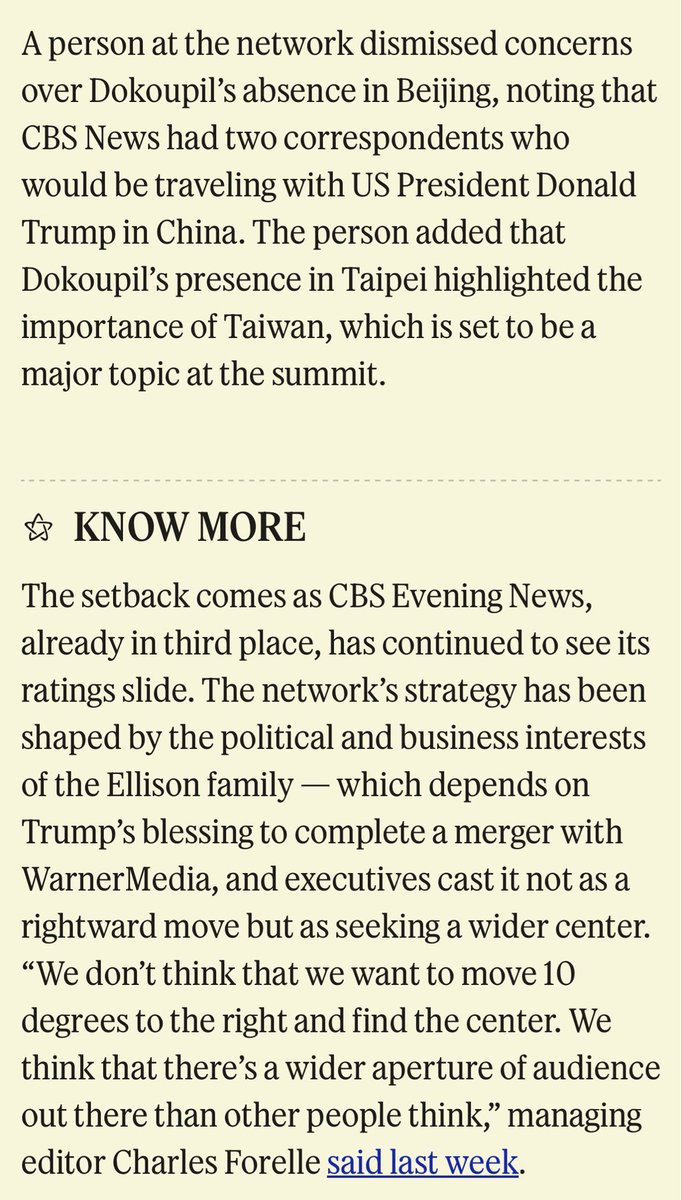
New: While the rest of the TV news world is traveling with Trump to China, CBS Evening News is broadcasting from Taiwan after the network failed to secure a Chinese visa in time for anchor Tony Dokoupil.
Max Tani tweet mediaMax Tani tweet media
English
82
370
1.9K
504K