
Happy to share this new preprint from our group at @Alnylam, with @hochoutu @iammegparker @AimeeDeaton @PNioi. (1/14) twitter.com/biorxivpreprin…
Luke Ward
1.3K posts

@Luke__Ward
Translational human genetics, computational genomics, 🏳️🌈, @UVA, @Columbia_Bio, @MIT_CSAIL. Views expressed are my own and not of my employer (@Alnylam)

Happy to share this new preprint from our group at @Alnylam, with @hochoutu @iammegparker @AimeeDeaton @PNioi. (1/14) twitter.com/biorxivpreprin…

This applies to academic labs too — maybe more than anywhere. Defense in academia looks like rigor: protect your niche, optimize your pipeline, wait for the field to settle. It isn't rigor. It's just slower irrelevance. The labs that matter in five years aren't asking "how do we use AI to do our old experiments faster." They're asking "what questions are now askable that weren't before?" That's the offensive posture. And academics have something founders don't — the freedom to chase questions with no obvious payoff. That's an enormous edge, if you use it.


Peter Thiel said that the lack of progress in biology is partially due to a lack of talent. I think this makes sense. Something about biology's non-technical nature + people's inability to tinker w/biology outside of a lab/PhD make the smartest people select other fields.

It can be hard to say no to service requests in academia. We sought advice on how to ensure researchers don’t get stuck doing unpaid labour go.nature.com/4bUX6WN


The major way through which SVs affected gene expression was through copy number changes. Reshuffling the relative location of genes through inversions or translocations did not influence their expression. Expression of genes nearby the SVs was rarely affected.


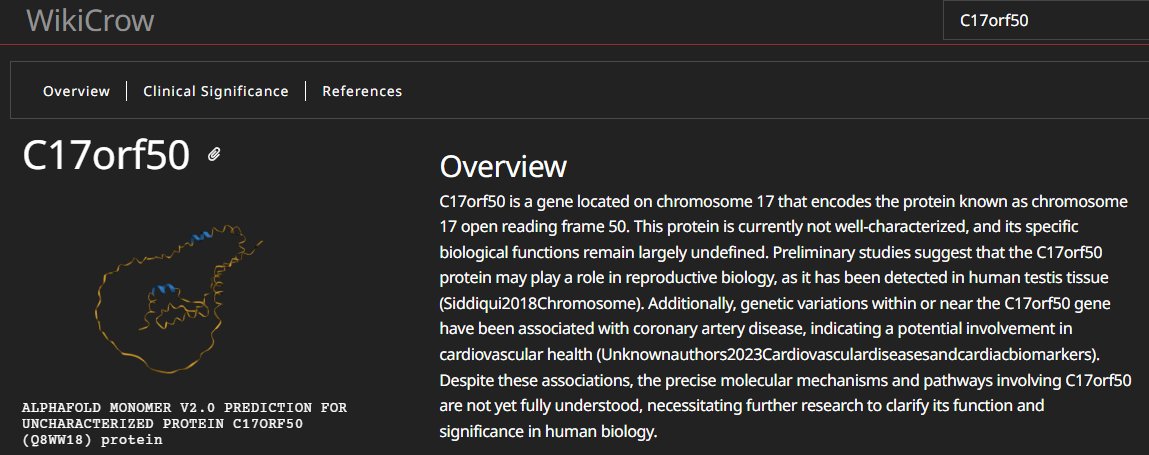
We’ve just finished writing the missing 15,616 Wikipedia articles to get complete coverage of all 19,255 human genes. We used PaperQA2, which has higher accuracy than existing human-written Wikipedia articles, as judged by blinded biology PhD students and postdocs. 1/5

Why is biotech such a sad industry? They make medicine, it output feels 10x more important than automation and info-plumbing (aka the tech industry) and requires deeper knowledge/training -- and yet, low salaries, perpetual layoffs, very few founder CEOs, bad vibes all around.