
M ll
1.1K posts


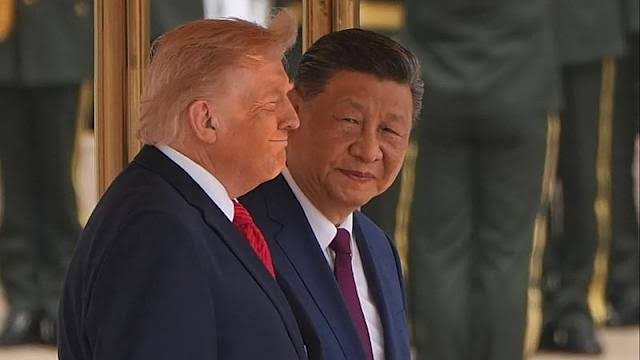
Trump to Fox News: "Xi said I would like to be of help on Iran."
English
@WarMonitor3 With this poor performance of the
US army China has zero problems taking Taiwan .
English

Pretty surprised how direct Xi Jingping has been about Taiwan to Trump really shows how committed he is too Taiwan agenda.
English
Trump: Xi agreed not to supply Iran with military equipment.
English
Trump: President Xi would like to see a deal made. He said, 'If I can be of any help at all, I would like to be of help"
English
@FoxNews @seanhannity Everybody manipulates him xi Putin and ayatollah.
Indonesia

NEW: President Trump reveals to @seanhannity that Chinese President Xi Jinping has committed to withholding military equipment from Iran following their high-level discussions.
Trump noted that while China continues to purchase Iranian oil, Xi expressed a strong desire to see the Strait of Hormuz remain open and free of interference.
"He said he’s not going to give military equipment, that’s a big statement... But at the same time, he said you know they buy a lot of their oil there and they’d like to keep doing that. He’d like to see Hormuz straight opened."
The full interview airs tonight at 9pm ET.
English
@EricLDaugh Everybody just manipulate trump Chinese Russian and Iranian.
English

🚨 JUST IN: Chinese President Xi has offered to help OPEN THE STRAIT OF HORMUZ and strike an Iran deal with President Trump 🇺🇸🇨🇳🇮🇷
TRUMP: "Xi would like to see a deal. He offered — he said, 'If I can be of ANY help at all, I would like to be of help.'"
"Yeah, he did say that. And look, anybody that buys that much oil has obviously got some kind of a relationship with them."
"But he said, 'I would love to be help. If I could be of any help whatsoever,' he'd like to see the Hormuz Strait open. He said, if I could be of any help whatsoever, I would like to help."
Let's see if they step it up, then!
English
@FoxNews @seanhannity Imagine ask your enemy to ask your enemy to compromise
English
EXCLUSIVE: Secretary of State Marco Rubio outlines the high-stakes push for China to confront Iran over its actions in the Persian Gulf in an exclusive sit-down with @seanhannity aboard Air Force One:
“The Chinese have ships stuck in the Persian Gulf... A Chinese cargo got hit over the weekend. I'm sure Iran didn't do it deliberately but they did it, it happened. And so that's why these Chinese ships are stuck in there.”
“It's a huge source of instability. It threatens to destabilize Asia more than any other part of the world because it's heavily reliant on the straits for energy.”
“It’s in [China’s] interest to resolve this. We hope to convince them to play a more active role in getting Iran to walk away from what they're doing now and trying to do now in the Persian Gulf."
English
Secretary of State Marco Rubio is pressing China to use its leverage against Iran over Tehran's actions in the Persian Gulf.
English
@sentdefender It doesn't matter how much power you have it matter how much you can use it the Iranian regime discovered trump's weakness he has to face the reality.
English
In a post on his Truth Social app, U.S. President Donald J. Trump said that news reporting negatively on the conflict with Iran is “virtual[y] treason[ous], adding that they are aiding and abetting the enemy through such reporting.

English
@SpencerGuard Of course the USarmy has the capability but can America and trump pay the price ?! The answer is NO
English
The common counterargument, often driven by anti-Trump narratives, is that because the United States has not seized control of the Strait of Hormuz, it therefore cannot, and that Iran is somehow demonstrating a lasting strategic advantage it will carry forward. That logic is deeply flawed. The absence of a U.S. operation to fully secure the Strait is not evidence of military incapability. It is evidence of political restraint and strategic calculation.
Just because the President has not ordered a combined air, naval, and ground campaign to seize and secure the Strait does not mean the U.S. military lacks the capability to do so. It means there are economic, diplomatic, escalation-management, and broader strategic reasons such an operation has not been ordered.
The United States has spent decades building the exact naval, airpower, logistics, ISR, mine-clearing, amphibious, and strike capabilities required to dominate chokepoints like Hormuz if directed.
Confusing political decision-making with military capability is a common uniformed mistake. Iran’s threats to shipping, harassment operations, mining efforts, or missile attacks do not demonstrate that the United States is unable to secure the Strait. If anything, they reinforce why freedom of navigation operations and deterrence have been central pillars of American power for decades.
The question has never been whether the United States could impose control over the Strait. The question has always been whether the political leadership believes the costs, escalation risks, and global economic consequences of doing so outweigh the benefits at a given moment.
John Spencer@SpencerGuard
English

@TerryMoran The Iranian regime is always looking for nuclear weapons with jcpoa or without and now nothing has been changed if this regime remains in power they will make nuclear weapons in the coming few years.
English

Virtually every gram of highly enriched uranium Iran now has in its possession--enough to make 10 nuclear weapons--was produced after Trump withdrew from the Iran Nuclear Deal in 2017...without any effort to replace it.
Trump tore up the deal, so Iran got back to work.
The White House@WhiteHouse
They will be laughing no longer!
English
According to what I’m reading about Irans response, bombing is more likely to resume than not.
(Unless Pakistan requests otherwise)
English
@SpencerGuard Regime change was a good goal but trump Lost his way the Iranian regime discovered his weakness and this made them more arrogant it doesn't matter if they accept Trump's terms or not If this regime remains in power they will make nuclear weapons in the coming few years.
English
No one can predict the future with certainty. No analyst possesses a crystal ball capable of forecasting whether the Islamic regime can survive the long-term political and economic consequences of this war. But based on every serious measure of national power, Iran is weaker today than before the conflict began. Its military has been shattered across multiple domains. Its economy is under severe strain. Its proxies are degraded. Its deterrence credibility has suffered. Its strategic ambitions have been rolled back. The United States and its partners still hold the upper hand because the foundations of Iranian power have been systematically reduced, and rebuilding them may take far longer than many observers are willing to admit."
John Spencer@SpencerGuard
English
@citrinowicz Regime change was a good goal but trump Lost his way the Iranian regime discovered Trump's weakness and this made them more arrogant there is zero chance to stop them by deal if this regime remains in power they will make nuclear weapons in coming few years
English

I hope these messages sink in within the administration:
A. Iran does not believe it lost this confrontation. On the contrary, from Tehran’s perspective, it proved resilience and strategic staying power.
B. Iran has no intention of capitulating or accepting Washington’s demands, not now, and not in the foreseeable future.
C. No matter how much Trump threatens “the end of civilization,” Iran is unlikely to back down. Even if military confrontation resumes, Tehran is not expected to reverse course under pressure alone.
D. The only realistic paths to an agreement are either:
compromising on key Iranian demands, or pursuing regime change in Iran.
If the administration is unwilling to commit the enormous military, political, and economic resources required for regime change, then it likely lacks the leverage to force Tehran to accept maximalist terms.
E. Neither sanctions, blockades, nor other “silver bullet” pressure tactics are likely to compel Iran to fundamentally alter its negotiating position. Claims otherwise are increasingly detached from reality.
F. Iran and its regional proxies retain significant capacity to inflict economic and strategic pain on Gulf states, particularly in the energy and maritime domains.
G. Any agreement with Iran is unlikely to include meaningful restrictions on its missile program or regional proxy network, and will almost certainly acknowledge, at least implicitly:
Iran’s right to enrich uranium, and its Hormuz straits control.
H. Most Gulf states are deeply concerned about escalation and understand that toppling the Iranian regime would be extraordinarily difficult and destabilizing.
I. The United States did not achieve a decisive strategic victory. Despite operational successes by both the U.S. and Israel, the broader strategic balance in the region has not fundamentally changed.
J. Iran is not Venezuela. It is a far larger, more institutionalized, ideologically committed, and strategically resilient state with deep regional networks and a much higher tolerance for prolonged confrontation.
The bottom line us simple: There is an illusion in Washington that Iran emerged weakened, isolated, and ultimately cornered by military pressure, sanctions, and the threat of escalation. From Tehran’s perspective, the recent confrontation did not end in defeat. Quite the opposite. The Islamic Republic believes it demonstrated resilience, survivability, and an ability to absorb enormous pressure without surrendering politically. In the eyes of Iran’s leadership, simply enduring against the combined pressure of the United States and Israel reinforces the regime’s central narrative: that resistance works.
The administration must recognize an uncomfortable reality: coercion has limits. If the United States truly seeks to compel Iran to abandon its core strategic doctrine, there are only two possible paths. The first is compromise, meaning accepting that any sustainable agreement will have to accommodate at least some Iranian red lines. The second is regime chang. No more no less.No middle ground.
#Iran
#IranWar
Ali Hashem علي هاشم@Alihashem
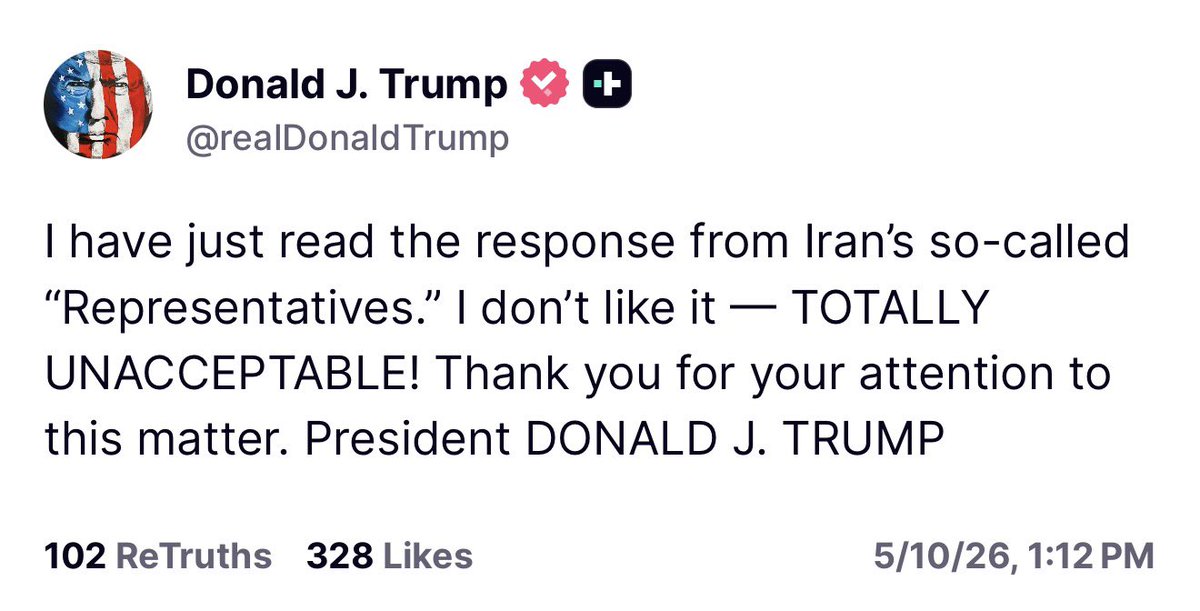
Unacceptable… so?
English
@RapidResponse47 Regime change was a good goal but trump Lost his way the Iranian regime discovered his weakness and this made them more arrogant
English


Does Washington want to change certain policies of Iran, or does it want to change Iran?
That tension has run through U.S. policy for almost half a century. And President Trump is right back to the same dilemma.
My take:
English
@SenatorWicker Regime change was a good goal but trump Lost his way the Iranian regime discovered his weakness and this made them more arrogant
English
Mr. President, you have been generously patient with the murderous Iranian Islamist regime. Now, let's get back to business. Restart Project Freedom.
The White House@WhiteHouse
"I have just read the response from Iran’s so-called 'Representatives.' I don’t like it — TOTALLY UNACCEPTABLE! Thank you for your attention to this matter." -President DONALD J. TRUMP
English
@sentdefender The poor performance of the US army and Trump's weakness makes the Iranian regime more arrogant
English
Iran’s state-backed news agency Irib News details Iranian conditions for negotiations with the U.S., following U.S. President Donald J. Trump’s reaction that called their response “totally unacceptable.” The terms, just a reiteration of their previous statements, include, but are not limited to, releasing frozen Iranian funds and assets, war reparations, and Iranian sovereignty over the Strait of Hormuz.

English