Matthew Ryan Tucker

199 posts

Matthew Ryan Tucker

Matthew Ryan Tucker

@MattRyanTucker

Energy Engineer

Katılım Ocak 2012
514 Takip Edilen53 Takipçiler
Matthew Ryan Tucker
Matthew Ryan Tucker@MattRyanTucker·
@DuncanMcClement Not really: the drop in the capacity market spend for 2029/2030 doesnt really have anything to do with transmission spend. To be fair the results hadn't been published when you wrote the blog so completely fair enough to use older information at the time, just not so relevant now
English
0
0
1
5
Duncan Mcclements
Duncan Mcclements@DuncanMcClement·
@MattRyanTucker @bswud @TACJ Yep mean substitutes in econ sense: can spend more at margin on transmission upgrades to reduce CM (imports/diversification so less need for reserves). Means that CM drop overstates saving bc driven by transmission substitution, breaking this apart messy so used today's values
English
1
0
0
26
Ben Southwood
Ben Southwood@bswud·
Our latest two nuclear power projects are going to end up disgracefully expensive. Mind you, I think that their transmission and balancing costs will be near zero, so they are probably still cheaper than marginal solar or wind on a CfD, which costs about £200 per mwh once spillover costs are included.
Francisco Beirão@fbeirao

Sizewell C (3.2 GW) electricity will cost consumers more than Hinkley Point C (£131–155/MWh vs £129/MWh, in 2024/25 prices), with total costs potentially reaching £102bn and full delivery only by 2039. Expensive. Delayed. Predictable. ft.com/content/c3bf8b…

English
2
8
53
4.9K
Matthew Ryan Tucker
Matthew Ryan Tucker@MattRyanTucker·
@DuncanMcClement @bswud @TACJ How are the capacity market and transmission substitutes? You'd still need a capacity market with maximal transmission investment. Do you mean that balancing charges and transmission upgrades are substitutes? That would make more sense
English
1
0
1
29
Duncan Mcclements
Duncan Mcclements@DuncanMcClement·
@MattRyanTucker @bswud @TACJ CM/transmission are substitutes: T-4 cleared low partly bc more transmission, Ben James has TNUoS £40→£105/HH. Low CM/more transmission are mirror image. Used current values for both in blog, didn't decide split; headline maybe lower but gap not v big: if full £22 ~9% of total
English
1
0
1
47
Matthew Ryan Tucker
Matthew Ryan Tucker@MattRyanTucker·
@bswud @TACJ @DuncanMcClement Completely agree about considering transmission costs and cannibalisation etc alongside wholesale, but you've really got to model it on an hourly basis to get good results. I've got an hourly wholesale model which can answer some of these qus
English
1
0
1
21
Matthew Ryan Tucker
Matthew Ryan Tucker@MattRyanTucker·
@bswud @TACJ your capacity market is kind of a binary fixed cost in a renewable based system: its only fair to spread those costs properly per mwh
English
1
0
1
23
Matthew Ryan Tucker
Matthew Ryan Tucker@MattRyanTucker·
@bswud @TACJ The biggest issue is assuming gas at a load factor of 95% as a counterfactual: this is not possible in the UK! Even in the mid 2000s fossil fuel generation would only get a load factor of 50%
English
1
0
1
24
Matthew Ryan Tucker
Matthew Ryan Tucker@MattRyanTucker·
@bswud @TACJ Thanks for sharing. Points around cannibalisation and transmisison are valid, but several mistakes: if you accept the premise that renewables should shoulder all capacity market costs, you can't use a fixed price per MWh: as more renewables come online this would get spread out
English
2
0
1
53
Matthew Ryan Tucker
Matthew Ryan Tucker@MattRyanTucker·
@bswud @TACJ Where are the calculations? Not sure how you're getting from the table which shows ~£80/MWh to £230/MWh?
English
1
0
1
51
Ben Southwood
Ben Southwood@bswud·
@TACJ I can’t find any errors in Duncan’s calculations
English
2
0
1
77
Matthew Ryan Tucker
Matthew Ryan Tucker@MattRyanTucker·
@bswud maybe: requirement for the existing AGRs to stand up to a 1 in 10,000 year earthquake is quite strong!
English
0
0
1
203
Ben Southwood
Ben Southwood@bswud·
A very surprising fact I learned from this was that although the first Advanced Gas-cooled Reactor was a disaster, the others were built pretty cheaply and quickly, and, when turned over to professional operators, run safely at a high capacity factor. They never had any incidents in their lifetimes, despite very minimal safety features by modern standards. If we had completed the AGR programme, we would have saved tens of billions in price support during the Ukraine/Russia gas crisis, plus we would have retained more of our industry, both because of the ‘industrial policy’ and its spillovers, and because of cheaper energy.
Sam Bowman@s8mb

Between 1956 and 1971, Britain built 26 nuclear reactors. By 1965, it had built more nuclear plants than the US, USSR, and France combined. Today, Hinkley Point C will be the most expensive nuclear power station ever built, anywhere, and Britain hasn't completed a reactor since 1995. worksinprogress.co/issue/how-the-… What the hell happened? Many explain the decline of British nuclear power by pointing to particular misfortunes: a bad bet on a flawed reactor design (the AGR), Three Mile Island, or Chernobyl. But the real explanation is the abuse of technocratic authority and public trust. In the early decades, Britain's nuclear engineers operated with a degree of latitude that would be almost unthinkable today. The Atomic Energy Authority enjoyed immunity from civil liability and most regulation. To build reactors, the Central Electricity Authority would briefly study possible sites, announce its choice The London Gazette and the local press, and notify any landowner or leaseholder. Any objections would be heard at local inquiries that usually lasted less than a week, after which construction could start. But the technocrats used this freedom badly: • The tender for Dungeness B in 1965 went to moribund company that had submitted a token bid with no expectation of winning, that went bust four years into the project. • The reactor came online 13 years late and four times over budget. • Officials and engineers refused to take public concerns about nuclear waste seriously. Britain tried dumping nuclear waste in the Forest of Dean in the 1950s and dumped it at sea for decades until Greenpeace publicized the practice in 1978. • The Central Electricity Generating Board secretly subsidized nuclear with revenue from coal and oil plants for years. Eventually, the industry lost its privileges. The Trawsfynydd planning inquiry of 1958 ran to fifty pages; Hinkley Point C's environmental assessment alone runs to forty-four thousand. The Nuclear Installations Inspectorate had thirteen inspectors in 1959; its successor has more than four hundred. Where regulators once deferred to the engineers, they now demand revisions on an almost unimaginable scale — some seven thousand design changes at Hinkley Point C, producing a reactor with a third more steel and a quarter more concrete than its counterparts in China, France, or Finland. Every nuclear programme that has worked – Britain's, France's, or China's today — has four things in common: clear political backing, regulators with reason to approve, predictable demand, and a public willing to go along. Between 1965 and 1995, Britain lost all four. New at Works in Progress, @chalmermagne on how Britain forgot how to build cheap, clean nuclear power. worksinprogress.co/issue/how-the-…

English
5
26
281
18.7K
Chris Smith
Chris Smith@renewablesmiffy·
Just 800MW of Gas running on the GB Grid and in April solar topping out the generation. We should not underestimate how big a deal this is and how the source of GB supply is changing.
Chris Smith tweet media
English
19
36
249
10.7K
Matthew Sitman
Matthew Sitman@MatthewSitman·
I didn't know, but find incredibly funny, that Peter Thiel's "senior quote" in his high school yearbook was from The Hobbit—but not the book Tolkien wrote. He actually cited a song written for the 1977 animated version by the creator of ThunderCats
English
22
49
1.2K
46.1K
Matthew Ryan Tucker
Matthew Ryan Tucker@MattRyanTucker·
@RobertBoswall Why are you claiming wholesale is only 1/3 of revenue? This is only true for offshore, not onshore or solar. The majority of RO wind is onshore
English
0
0
2
160
Robert Boswall
Robert Boswall@RobertBoswall·
DESNZ is 'breaking the link' with a Wholesale CfD for existing RO-subsidised and merchant generators, alongside an EGL-tax rise from 45% to 55% with the 2028 sunset removed. The WCfD is the carrot. The EGL is the stick. The package only coheres when you read them together. A voluntary fixed-strike offer on its own, generators could decline. Raise the levy on wholesale revenue to 55% with no endpoint, and the alternative to signing gets worse. The greater the levy threat, the lower the strike DESNZ can set and still attract uptake. What WCfD actually covers is the third of RO generator revenue that comes from wholesale. ROC income, the two thirds consumers already pay through supplier charges, is untouched. A policy framed as protecting consumers from electricity prices does not touch the part of the stack consumers pay directly. And the wholesale share is the share DESNZ's own scenarios expect to fall as renewables cannibalise capture prices. This is the logical endpoint of fifteen years of CfDs. Each round moves another tranche of supply onto an administered strike and off the price signal. If WCfD uptake is high, the share of GB power priced by administrative decision goes from roughly 40% to roughly 70%. At that point the wholesale market is a residual clearing venue, not a coordinating signal. The EGL rise is presented as a temporary response to gas prices. It removes a legislated sunset and raises the rate 10 points with no review mechanism. A windfall tax with no sunset is not a windfall tax. The incidence falls on long-dated power buyers through forward PPA premia, not on generator rents. Consultation in H2 2026. The first number to check is contract length. Residual RO life is 5-10 years. Briefing suggests 15-20. Anything longer is extension, not conversion. doloop.energy/item/08956a7f4…
English
9
7
17
10.4K
Matthew Ryan Tucker
Matthew Ryan Tucker@MattRyanTucker·
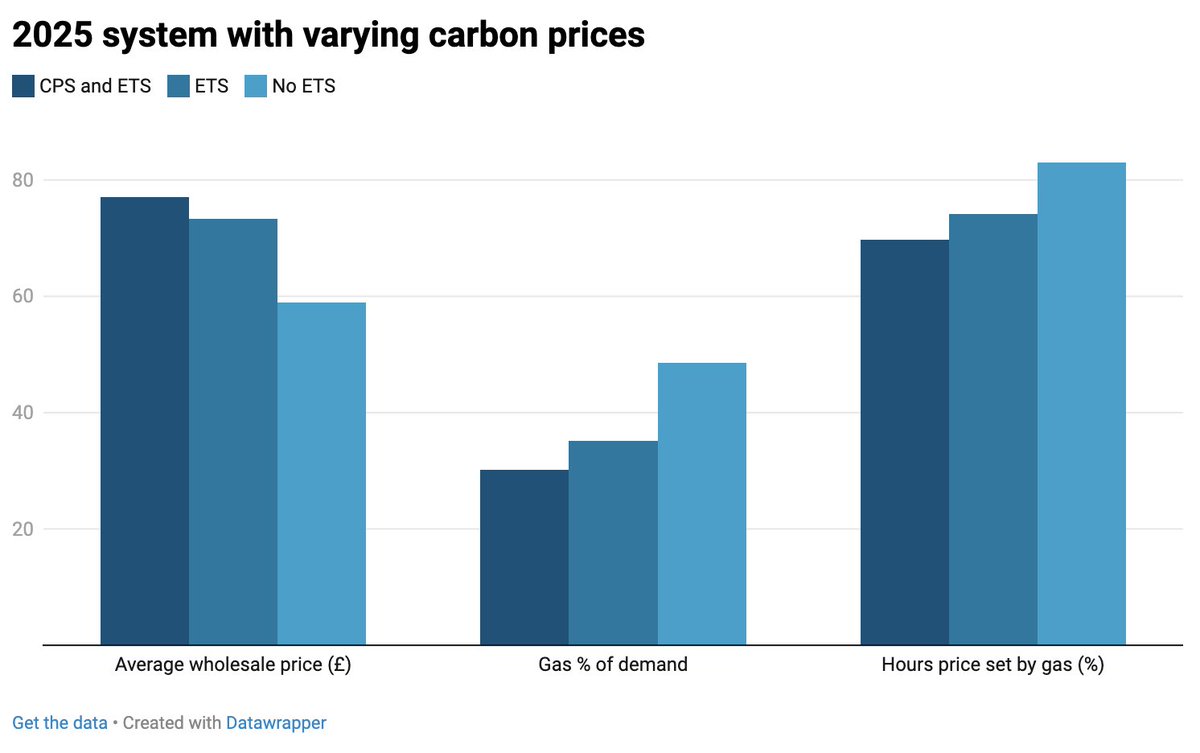
@JeremyNic666 The CPS does slightly reduce domestic gas generation. There are still valid reasons to remove it: x.com/i/status/20448…
Matthew Ryan Tucker@MattRyanTucker

Modelling by @BritishProgress and others on CPS/carbon prices is interesting but missing the key details in how carbon prices influence the UK electricity market. Some claim that carbon prices have no impact on dispatch: this is not true when you look at the whole picture!

English
0
0
0
20
Jeremy Nicholson
Jeremy Nicholson@JeremyNic666·
Good. Some of us would have preferred a market based/technologically neutral approach to power decarbonisation driven in response to carbon pricing. But with coal off the system and renewables/nuclear subsidised through other means, CPS merely adds cost for no environmental gain.
Sam Dumitriu@Sam_Dumitriu

New: The Government are abolishing the 'Carbon Price Support' - a bonus carbon tax that only applied to electricity. I support the principle of carbon pricing, but here's why I think scrapping the Carbon Price Support is the right move. 1. The CPS was vital to driving heavily-polluting coal off the grid, but it's done that job. Today, the grid is a mix of renewables and gas. 2. Electricity prices are set by whatever the most expensive source of power is. If that's gas then a bonus carbon charge means that all the power we buy gets more expensive. That's the case even if the grid is 95% nuclear and renewables at a given moment. And gas will continue to set the price for a long-time due to its role as backup. 3. Cutting electricity prices isn't just necessary to help out households/businesses, it's also key to cutting emissions. The next wave of decarbonisation is about getting people to adopt electric cars and heat pumps. If electricity is expensive they won't bother. And the CPS only applies to electricity, not gas. This is tilting the playing field to favour the more polluting way of heating our homes. 4 (or 3 cont.) Britain's seen declining electricity demand for 2 decades. This, weirdly, makes electricity more expensive on average as fixed costs (paying for the grid, power stations etc.) are paid by a shrinking chunk of demand.

English
5
0
11
1.3K
Matthew Ryan Tucker
Matthew Ryan Tucker@MattRyanTucker·
Modelling by @BritishProgress and others on CPS/carbon prices is interesting but missing the key details in how carbon prices influence the UK electricity market. Some claim that carbon prices have no impact on dispatch: this is not true when you look at the whole picture!
Matthew Ryan Tucker tweet media
English
1
0
3
118