

Rohan Gaikwad
474 posts

Rohan Gaikwad
@MaximumTwang
Product Design Leader @ServiceNow | @UXDAwards '23 Winner | Carnegie Mellon, IIT Alumni
Mountain View, CA Katılım Temmuz 2009
403 Takip Edilen242 Takipçiler

@buccocapital @loganbartlett Dumb analysis like this should be punished
English

Really enjoyed the deck @loganbartlett and team just shared on the state of Software, wanted to pull out a few things that caught my eye:
1. AI-native companies are growing faster AND more efficiently
The growth rates are really staggering. And they’re doing it with very few people. The demand for AI is insatiable, like nothing we have ever seen, and is diverting budget away from traditional software. This is an existential moment for the incumbents. I’ve been saying Accelerate or Die for months. The accelerating is unprecedented, and the growth is coming at the expense of SaaS 2.0. Only death can pay for life
2. They’re doing it without going head-to-head with incumbents
This is probably the most interesting slide to me. These AI-native businesses are growing so fast by using two approaches:
A) Finding a wedge into the enterprise, scaling quickly, then trying to expand
B) Building AI-native Systems of Record from below. @arampell calls this “Greenfield Bingo.” New businesses/SMB have zero/low switching costs, so AI-native CRM/HR/ERP companies can take share and march upmarket from below
Both of these are particularly tricky for incumbents to defend against. They simply aren’t able to move quickly enough to build compelling AI point solutions, and they’re struggling to defend downmarket while also defending the enterprise (bimodal go-to-market and running multiple service models in one company is incredibly difficult)
3. Incumbents scale by throwing people at the problem
This has been the dirty little secret of SaaS for 15 years. It’s basically impossible to grow revenue faster than headcount. Some companies like Shopify did it by layering on payments. Consumption-based companies have been doing it. The AI native companies have this figured out. The incumbent, seat-based, companies simply have never been able to decouple revenue from headcount. They will have to learn or die
4. Incumbents have the right to win but they are failing to capture the moment
As I’ve said before, the CIO wants to stick with their current vendors. They WANT to buy AI solutions from the incumbents. The problem is their solutions suck. @jasonlk has been all over this. These incumbents have a shrinking window of time where they have the advantage, but that window is shrinking. Rapidly.


English
@CoorsLightCEO Wouldn't it be easier to build it with Claude, within what a day or two?
Maybe they hit the token limit for the day?
English

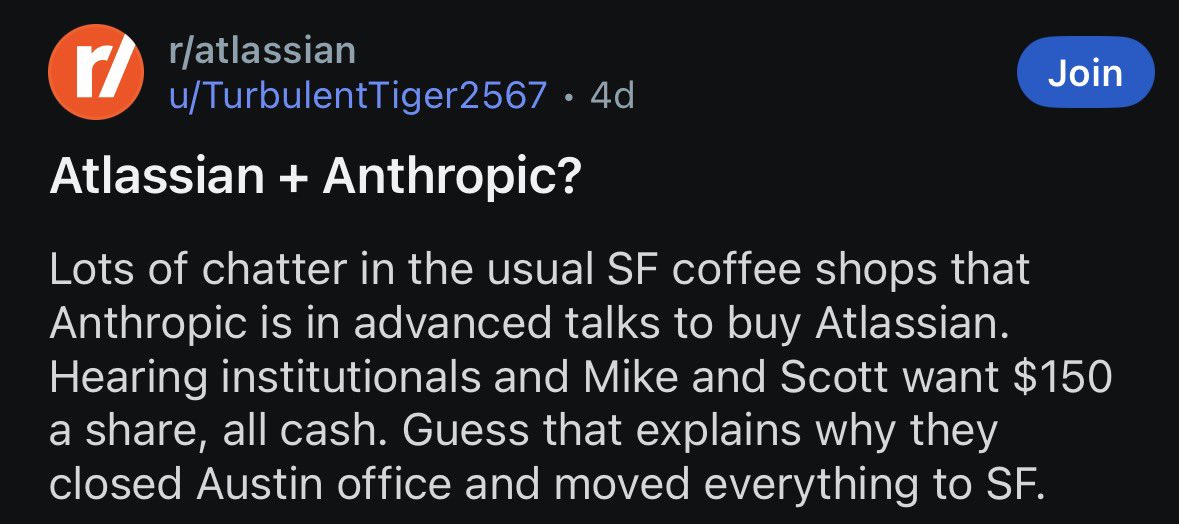
@naval This allows early investors to cash out at insane valuations without having to wait for ipo . Nice work.
English

Introducing USVC - a single basket of high-growth venture capital, for everyone.
No accreditation required, SEC-registered, and a very low $500 minimum.
Includes OpenAI, Anthropic, xAI, Sierra, Crusoe, Legora, and Vercel. As USVC adds more companies, investors will own a piece of that too.
Liquidity typically comes when companies exit, but we’re aiming to let investors redeem up to 5% of the fund every quarter. This isn’t guaranteed, but if we can make it work, you won’t be locked up like in a traditional venture fund.
It runs on AngelList, which already supports $125 billion of investor capital.
And I’ve joined USVC as the Chairman of its Investment Committee.
—
Go back to the 1500s, you set sail for the new world to find tons of gold - that was adventure capital.
Early-stage technology is the modern version. It says we are going to create something new, and it’s risky. It’s daring.
But ordinary people can’t invest until it’s old, until it’s no longer interesting, until everybody has access to it. By the time a stock IPOs, most of the alpha is gone. The adventure is gone. Public market investors are literally last in line.
This problem has become farcical in the last decade. Startups are reaching trillion dollar valuations in the private markets while ordinary investors have their noses up to the glass, wondering when they’ll be let in.
Investing in private markets isn’t easy. You need feet on the ground. You need judgment built over years. Most people don’t have the patience to wait ten or twenty years for an investment to come to fruition.
But there is no more productive, harder-working way to deploy a dollar than in true venture capital.
USVC enables you to invest in venture capital in a broad, accessible, professionally-managed way, through a single basket of innovation, focused on high-growth startups, at all stages.
It is how you bet on the future of tech: the smartest young people in the world, working insane hours, leveraged to the max, with code, hardware, capital, media, and community. Your dollar doesn’t work harder anywhere.
There is an old line - in the future, either you are telling a computer what to do, or a computer is telling you what to do. You don’t want to be on the wrong side of that transaction.
USVC lets you buy the future, but you buy it now. Then you wait, and if you are right, you get paid.
Get access here:
usvc.com
AngelList@AngelList
Announcing: USVC AngelList exists to power the innovation economy. To date, we have powered $125 billion in assets, 25,000+ funds, and 13,000+ startups. Today, we’re opening it for retail access. @usvc_ is a regulated fund that holds stakes in promising private companies. There are no accreditation requirements and anyone can get started with as little as $500. Early portfolio includes xAI, Anthropic, OpenAI, Sierra, Vercel, Crusoe, and Legora. Own a stake in the companies defining the future. Learn more: usvc.com
English


@Rothmus I'm from Argentina so, the rest of the world is irrelevant.
Enjoy your diversity idiots.
English


@karrisaarinen The challenge is cognitive load from UI impermanence. Workflow tools rely on stable interfaces that users internalize as muscle memory. Constantly shifting UIs add friction. This works for creative tasks, but for routine work, dynamism reduces speed and confidence.
English

My ideal AI design tool probably something like:
A canvas tool, where you can get any view of your app rendered to edit or use as the starting point for a new view. You can freely explore, duplicate, and make changes visually.
You could start these renders from other tools like @linear. User feedback -> render the screen to be edited.
It would have design language, system and product guidance files that help guide the overall design based on your product.
Each artboard carries metadata, like the origin of the view, who created it, what changes was made when, so you could query things across your whole team.
You could create areas that you want AI to fill or complete. Fill this list, complete the columns with this data or using this screenshot or something.
Edits in the artboard are tracked as a diff. You export those diffs as a plan for a coding agent to build against your actual codebase.
The design tool agents keep check-ins with the coding agent and try to communicate the nuances of the design so it gets built as a prototype.
English
@rsms If this is what Claude thinks UX/product designers do then designers have no reasons to worry.
English

This is really neat but it’s not a design tool as much as it’s a design _production_ tool.
The practice of design is mostly about what comes before production.
There’s no doubt in my mind that all parts of software production will become automated very soon. Writing code, making web pages, putting pieces of a design system together etc.
And that’s fine. I think few people actually enjoy this kind of production work. Wouldn’t it be better if we spent our precious time in life on what is more meaningful?!
At the core, the practice of design is methodical; like architecture, not like art. In a nutshell: We find constraints, form comprehension of the whole and propose solutions that honor those constraints. First after that do we enter some form of production phase, usually prototypes first, learn about some constraints that were hidden before, loop back, prototype and then build the production-grade “final” artifact.
These last few tasks are quickly losing value because AI tools can do it much faster (not yet better though) than humans. It’s simply just what has the best RoI for a business.
Some companies and individuals will continue to spend human time on certain parts of the “production line” as a market differentiator, but it will cost them a relatively high price compared to competitors.
Anyhow, I still haven’t seen a tool better than Figma that supports the actually-interesting part of the design process.
I wouldn’t be surprised if Figma focused their products on that, maybe separating “products for production” of “products for ideation & exploration.” The latter would obviously still leverage AI, but not to do the work for me but rather to support my efforts the way a therapist helps me live a better life (not living my life for me.)
Claude@claudeai
Introducing Claude Design by Anthropic Labs: make prototypes, slides, and one-pagers by talking to Claude. Powered by Claude Opus 4.7, our most capable vision model. Available in research preview on the Pro, Max, Team, and Enterprise plans, rolling out throughout the day.
English
@Zoink Big opportunity for figma:
AI era gap: design → prod. Seeing it at ServiceNow. Everyone wants to vibe code real features (not mocks), but no system supports sandbox → review → ship (no git, unsafe).
Figma could unlock org-wide creation + 10x experimentation. Next frontier after design systems.
English


Figma has helped a lot of designers start making money, even without paying to use it. It gave beginners a chance to learn properly, and I’m one of those people.
It’s also played a big role in shaping the kind of internet we see today.
AI is improving every day, but I still think Figma is here to stay. It’s been around, it’s reliable, and it continues to be an important tool for designers.
Dylan Field@zoink
English
@cryptopunk7213 That’s not what 90% of designers do. Designers don’t read codebases, they interpret requirements, synthesize research, and refine workflows. Systems evolve, not one-shot. Real product work needs constant context. Until tools like Claude AI handle that, we don't stop designing.
English

fucking ruthless lol. now we know why anthropic left the board of figma this week
they built a product that not only replaces them it’s just better
Figma stock is getting crushed on the news and already down 50% this year 💀
claude design
> reads your code base,
> creates a custom design system for it
> uses new opus 4.7 to create design assets
this is 90% of the work designers do.
Claude@claudeai
Introducing Claude Design by Anthropic Labs: make prototypes, slides, and one-pagers by talking to Claude. Powered by Claude Opus 4.7, our most capable vision model. Available in research preview on the Pro, Max, Team, and Enterprise plans, rolling out throughout the day.
English


@martinmrmar Problems in General Physics by IE Irodov, one most popular books for JEE exams in India .
First publication was 1968

English

@deedydas I wonder with all the prompting you can do, can it exactly recreate something iconic, like
GIF
English


@aakashgupta Golf and tennis have longevity because they're rich people's sport. Easy. Science and economics undefeated.
Dumb research.
English

Tennis players live 9.7 years longer than sedentary people.
Not 9.7 months. 9.7 years. Nearly a decade.
The Copenhagen City Heart Study tracked 8,577 people for 25 years and ranked every sport by how much life it adds.
Badminton: 6.2 years. Soccer: 4.7. Cycling: 3.7. Swimming: 3.4. Jogging: 3.2.
Tennis almost triples jogging.
A separate study of 80,000 adults found racket sports cut all-cause mortality by 47% and cardiovascular death by 56%. Swimming hit 41%. Aerobics hit 36%.
The question is why racket sports destroy everything else.
Three mechanisms stack on top of each other.
First, the physical demands. A tennis rally requires explosive sprints, lateral cuts, and sustained aerobic output. You're training fast-twitch and slow-twitch muscle fibers simultaneously. Most cardio only trains one system.
Second, the cognitive load. You're reading spin, predicting angles, adjusting position, and executing motor patterns in real-time. Your brain is solving spatial puzzles at 80+ mph. That hand-eye coordination and strategic processing builds neural connections that protect against cognitive decline.
Third, and this is the one researchers keep coming back to: you literally cannot play alone. Every racket sport requires another person on the other side of the net. That forced social interaction triggers neurochemical benefits that solitary exercise cannot replicate. Strong social connection alone increases your chance of longevity by 50%.
Jogging is you and your thoughts. Tennis is you, a strategic opponent, and a community.
Dr. Daniel Amen is right. The data is overwhelming. If you want the single highest-ROI activity for a longer life, pick up a racket.
English
@TheBakaArts instant follow!! I would love to see the process
English

My art is good, the algorithm just ignores me
My art is good, the algorithm just ignores me
My art is good, the algorithm just ignores me
My art is good, the algorithm just ignores me


Herheim@Commissions open!/リクエスト大歓迎@Herheim731
My art is good, the algorithm just ignores me My art is good, the algorithm just ignores me My art is good, the algorithm just ignores me My art is good, the algorithm just ignores me
English

Aggressive prediction: the CEOs like @jack and @tobi who are slinging code and open source and all the way at the edge are leading from the front. Their companies will make it
Others still in manager mode? Oof maybe less so
shirish@shiri_shh
bro was right. Atlassian down 75%. HubSpot down 69%. Figma down 86%. Almost all of them down 30–70% from their 52-week highs. AI is literally eating software alive and repricing every company in real time. SaaS is cooked fr 😭
English

My friend in Big Tech told me that a $600K job in SF actually isn't Big as it seems:
- $270K or 45% in taxes
- $100K on housing in rent
- $60K on groceries + transport
- $20K on travel++
You're left with $170K or ~30% of income just on basics, which is a low savings rate
English
@pritopian We drive to udipi in SF once in a while, that place is dope
English

@RoninZwartsteen @dotkrueger That is an easier challenge to solve than trying to fly close to the speed of light
English

@MaximumTwang @dotkrueger We have never build or tested something that will last 6000 years. We don't know what materials will do during a 6000 years space trip.
That spaceship must outlast longer than the pyramids have existed....
English

We're not going to travel beyond the solar system, according to Leonard Susskind. And neither are aliens, coming to visit us.
We may not be alone, but we are stuck here for, essentially forever.
1. The nearest star is 4.24 light years away. The fastest spacecraft ever built would require 6,600 years to get there.
2. Surely we can just build faster spacecraft. The problem is to get to anywhere close to the speed of light, we need exponentially more energy.
3. Chemical rockets will just not work. Even fusion rockets won't work. Even 10% of the speed of light is not achievable. The Tsiolkovsky Rocket Equation prevents it.
4. Interstellar dust becomes hand grenades when traveling anywhere close to the speed of light. Ships break.
5. Space radiation will kill us over the time need to travel interstellar distances. Impossible to protect without massive shields, which require massive energy to accelerate and de-accelerate.
English