Nalin Pithwa

6.7K posts

Nalin Pithwa

Nalin Pithwa

@NalinPithwa

Katılım Aralık 2014
157 Takip Edilen62 Takipçiler
Nalin Pithwa retweetledi
Probability and Statistics
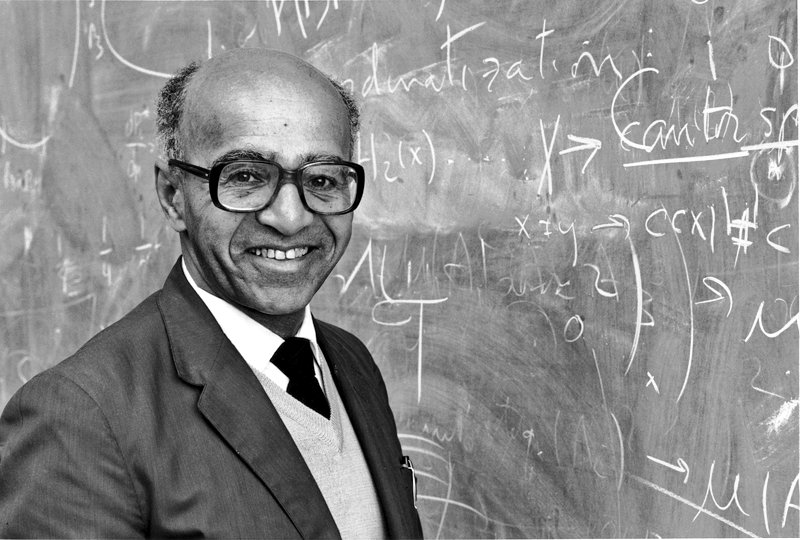
David Blackwell (1919–2010) was one of the greatest probabilists and statisticians of the 20th century. Born in Centralia, Illinois, he earned his PhD in mathematics from the University of Illinois at just 22 under Joseph L. Doob. Despite facing racial discrimination, he became the first Black tenured professor at University of California, Berkeley. Blackwell made foundational contributions to probability, statistics, game theory, and decision processes. He is best known for the Rao–Blackwell Theorem (with Calyampudi Radhakrishna Rao), which improves statistical estimators using sufficient statistics. His work on Markov decision processes, dynamic programming, and repeated games deeply influenced modern probability theory and later areas like reinforcement learning and machine learning. Known for both brilliance and humility, Blackwell inspired generations of mathematicians and became a historic figure in American mathematics.
Probability and Statistics tweet media
English
5
107
449
36.3K
Nalin Pithwa retweetledi
Captain Finity, Time Travel Police
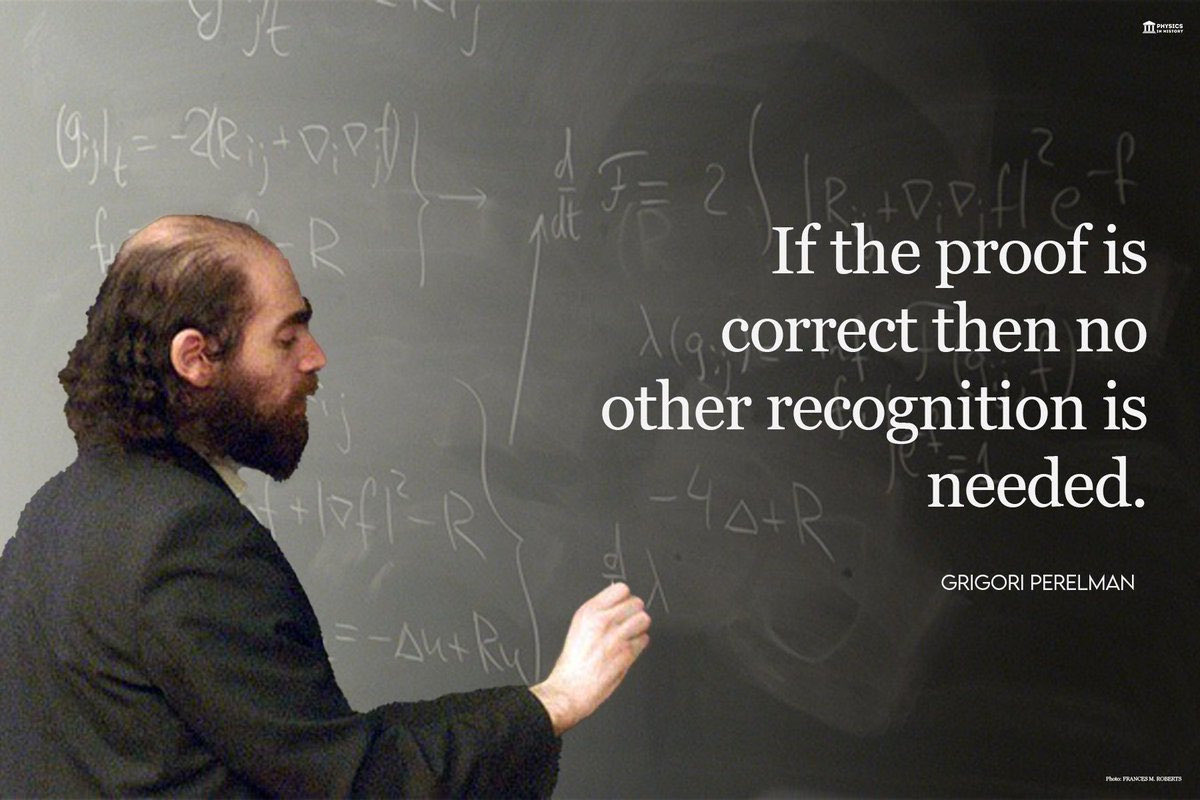
@PhysInHistory My hero for this quote Exactly why I don’t have to take any guff from pseudo intellectuals that don’t understand my correct solution to the so-called Grandfather Paradox
Captain Finity, Time Travel Police tweet media
English
0
2
16
843
Nalin Pithwa retweetledi
Physics In History
Physics In History@PhysInHistory·
7 interesting facts about Grigori Perelman ✍️ 1. Solved a 100-year-old problem: He proved the Poincaré Conjecture, one of the most famous unsolved problems in mathematics. 2. Turned down $1 million: He declined the Millennium Prize money, saying he didn’t want to be “on display like an animal in a zoo.” 3. Refused the Fields Medal: In 2006, he rejected the Fields Medal, the highest honor in mathematics, stating he wasn’t interested in recognition. 4. Walked away from mathematics: After proving the conjecture, he quit academia entirely, disappearing from public life. 5. Outperformed the best minds: His proof was so deep that it took the mathematical community four years to verify its correctness. 6. Rejected top universities: Institutions like Princeton and Stanford tried to recruit him, but he refused all offers. 7. Lives in near isolation: He reportedly lives in a small apartment in St. Petersburg with his mother, avoiding media and the spotlight.
Physics In History tweet media
English
37
111
721
54.7K
Nalin Pithwa
Nalin Pithwa@NalinPithwa·
Math is the music of reason
English
0
0
0
1
Nalin Pithwa retweetledi
Math Files
Math Files@Math_files·
One night, long after most people had gone to sleep, mathematician and writer Jacob Bronowski picked up the phone and called John von Neumann in the middle of the night. Bronowski had been thinking about an argument they had the previous day. After hours of reflection, he realized something unsettling: von Neumann had been right all along. Wanting to admit it immediately, he called to confess his mistake. Half-awake and clearly irritated at being disturbed so late, the legendary von Neumann listened for a moment before giving a wonderfully sharp reply: “Call me only when I am wrong.”
Math Files tweet media
English
19
126
1K
54.2K
Nalin Pithwa retweetledi
Mustafa
Mustafa@oprydai·
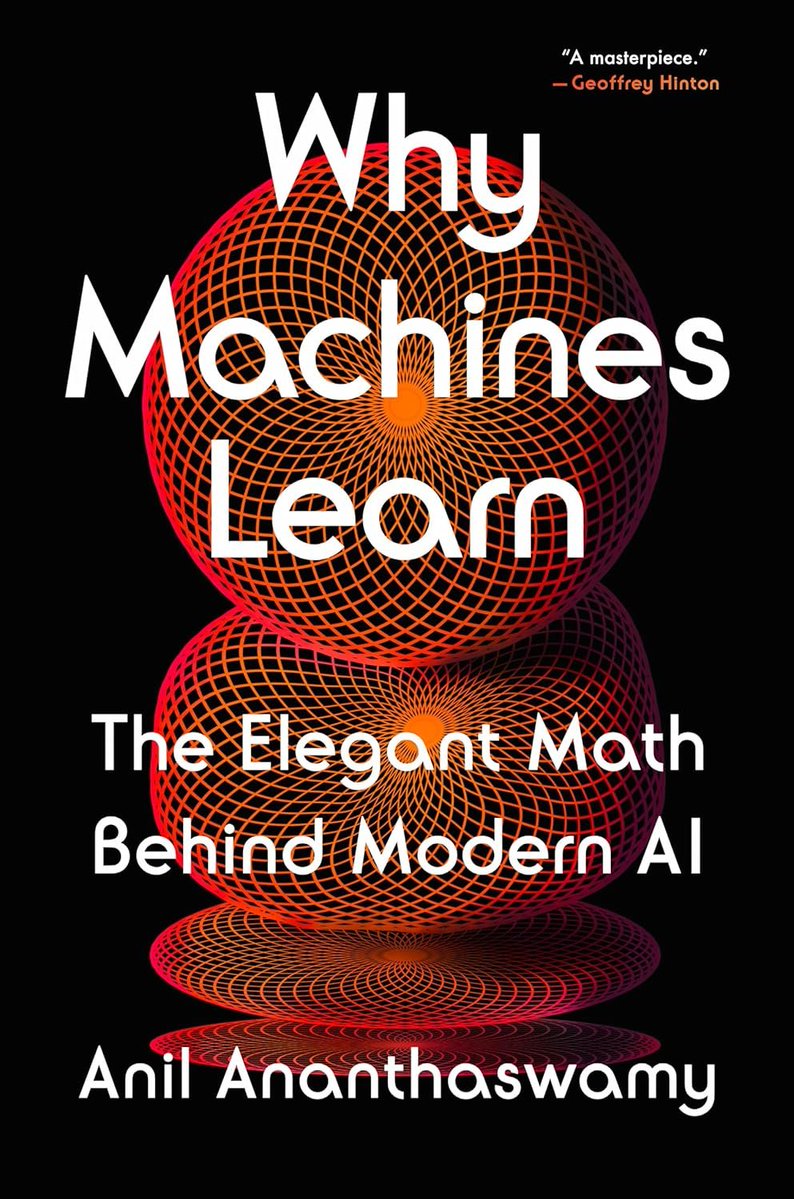
modern ai is not magic. underneath the hype is mostly: • linear algebra • calculus • probability • optimization models learn by adjusting parameters to reduce error. again. and again. across massive datasets. why machines learn explains the mathematics behind modern ai without turning it into unreadable theory. • gradient descent • neural networks • loss functions • high-dimensional spaces suddenly the black box starts looking mechanical. the important realization: ai is not intelligence appearing from nowhere. it is mathematics discovering structure inside data at scale.
Mustafa tweet media
English
13
83
436
12.2K
Nalin Pithwa retweetledi
AIM
AIM@Analyticsindiam·
Indian Institute of Technology, Guwahati (@IITGuwahati) has launched a new MTech programme in Robotics and Artificial Intelligence, open to both fresh graduates and working professionals, with no GATE score required for admission. The hybrid programme combines online lectures with on-campus lab sessions, covering robot kinematics, machine learning, and computer vision, with multiple exit options ranging from a postgraduate certificate to a full MTech over two to five years. "The programme addresses the growing demand for expertise in intelligent systems, offering cutting-edge, interdisciplinary learning in machine learning, computer vision and robotics through a flexible format," said Prof Hemant Kaushik, Dean of Outreach Education and Skilling at IIT Guwahati. Applications for the inaugural batch are open until 15 July 2026, with classes beginning on 10 August. Read the full story: analyticsindiamag.com/ai-news/in-a-f… #IITGuwahati #AIEducation #Robotics #MTech #IndiaAI
AIM tweet media
English
1
17
74
7.7K
Nalin Pithwa retweetledi
Sann
Sann@san_x_m·
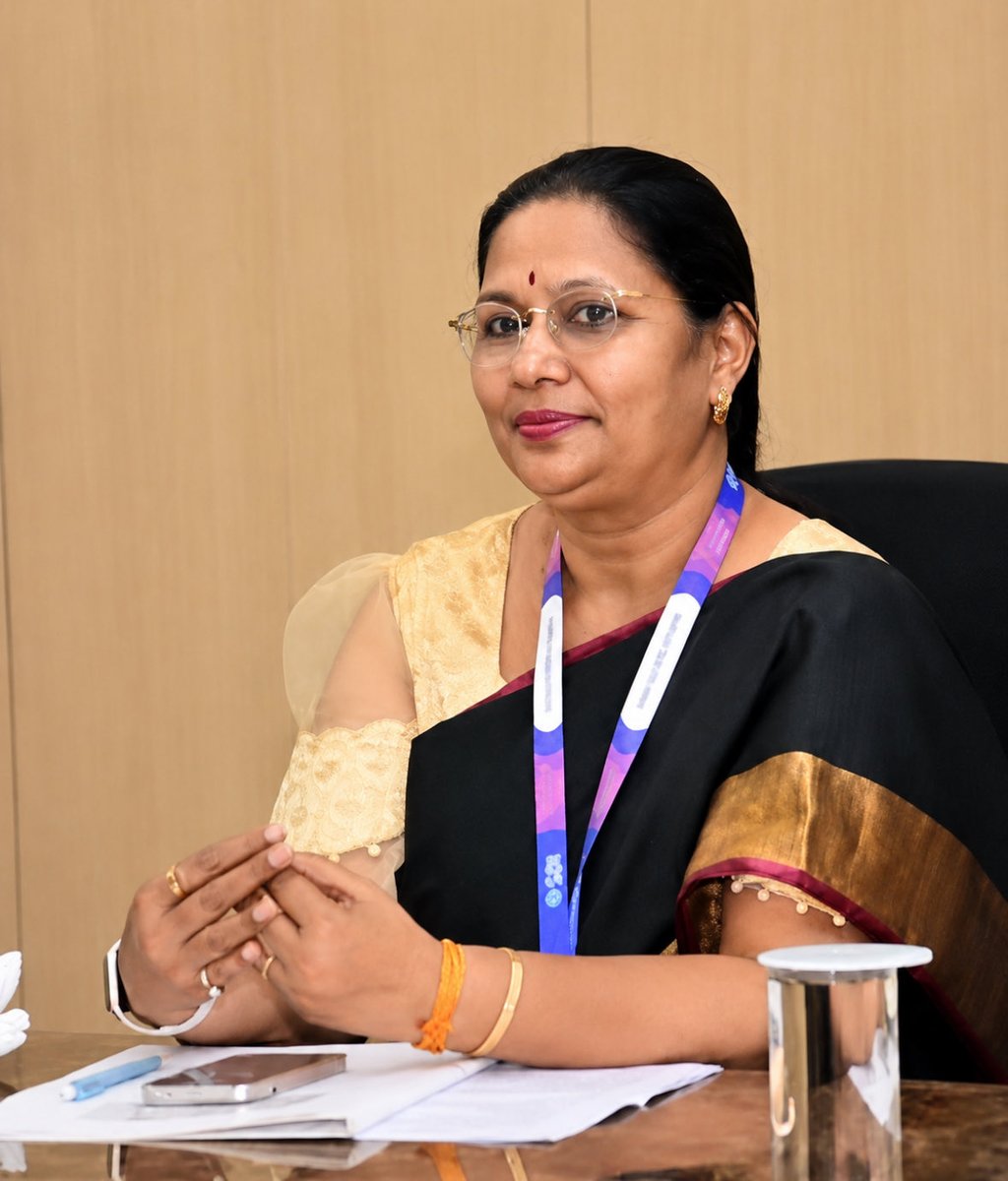
Her name is Pratiksha Tondwalkar. She was born in 1964 in Pune into a Scheduled Caste family. When she was in Class 7, her father decided to pull her out of school and get her married. Her teacher begged him to let her continue. She even offered to pay for Pratiksha’s education herself. Her father refused. She was married at 17. Her husband Sadashiv Kadu worked as a bookbinder at a Mumbai branch of the State Bank of India. When she was 20, he died in a road accident. She was left with a two year old son and no education. She walked into the same SBI branch to collect her late husband’s dues. She told the bank she needed any job they could give her. They gave her a broom. She swept floors. She dusted furniture. She cleaned restrooms. She earned Rs 65 a month. She said in an interview whenever my son asked for a packet of biscuits I would get off the bus one stop early just to save the fare money to buy them for him. After work, she enrolled in night college in Vikhroli. She completed Class 10 with first class marks. Then Class 12. Then a psychology degree. Bank colleagues helped her study whenever they could. Her parents pressured her to remarry immediately. She refused until she had graduated. She was promoted from sweeper to messenger to clerk. She remarried in 1993. Her husband Pramod Tondwalkar encouraged her to take the banking officer exams. She cleared them. She rose from trainee officer to Scale 4 to Chief General Manager. In 2022, she became Assistant General Manager of the State Bank of India. The same bank where she once cleaned restrooms for Rs 65 a month gave her its highest management honour 40 years later. Follow for stories India deserves to remember.
Sann tweet media
English
201
1.6K
6.6K
150.9K
Nalin Pithwa retweetledi
Math Files
Math Files@Math_files·
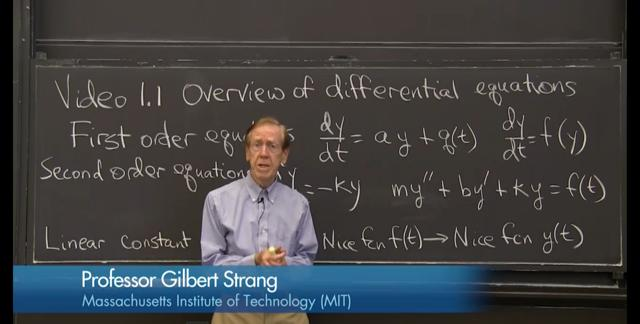
Gilbert Strang turned linear algebra into something more than a subject. He made it clear, engaging, and even joyful. Over 66 years at Massachusetts Institute of Technology as a student, teacher, and professor, he shaped generations of learners. He taught more than 15,000 students at MIT, wrote over 20 books including the widely loved Introduction to Linear Algebra, and reached more than 20 million people worldwide through OpenCourseWare. What was once a niche topic grew into one of the most popular courses at MIT because he showed how mathematics connects to the real world. With 17 major awards and global recognition, his teaching stood out for its clarity, warmth, and humanity. His influence goes far beyond numbers and classrooms. Reflecting on his journey, he simply said, “Teaching has been a wonderful life.”
Math Files tweet media
English
4
20
122
7.7K
Nalin Pithwa retweetledi
Mathematica
Mathematica@mathemetica·
Richard Feynman wrote approximately 37 research papers during his career. His most impactful work is widely considered to be his "Space-Time Approach to Quantum Electrodynamics", published in 1949. This paper, along with its companion, "The Theory of Positrons", formed the foundation for which he was awarded the 1965 Nobel Prize in Physics.
Mathematica tweet media
English
3
40
203
11.6K
Nalin Pithwa retweetledi
Philosophy Of Physics
Philosophy Of Physics@PhilosophyOfPhy·
Most people know calculus began with Newton and Leibniz in the 17th century. But long before that, in the 14th century, mathematicians in the Kerala school of astronomy and mathematics in India, led by Madhava of Sangamagrama, had already developed ideas that strongly resemble key parts of calculus. They discovered infinite series expansions for trigonometric functions like sine, cosine, and arctangent. They used early ideas of limits to approximate curves by breaking them into very small parts. They also computed arc lengths and areas with impressive accuracy for their time. These ideas were later recorded in a work called Yuktibhāṣā, written in the 16th century in Malayalam. However, because the work remained largely within the region, and due to language barriers and later disruptions during Portuguese colonial influence, it did not spread widely to Europe. Historical research shows no evidence that Isaac Newton or Gottfried Wilhelm Leibniz were aware of this work when developing calculus independently in Europe. What we see is not a single origin story, but parallel developments: different cultures, different problems, yet arriving at remarkably similar mathematical ideas.
Philosophy Of Physics tweet media
English
13
79
343
19.3K
Nalin Pithwa retweetledi
aramco
aramco@aramco·
As part of our biodiversity conservation efforts, Lake "Greiner" and Lake "Lanhardt" in Dhahran serve as sanctuaries for local wildlife and biodiversity
English
0
1.3K
13K
135.2M
Nalin Pithwa retweetledi
Ihtesham Ali
Ihtesham Ali@ihtesham2005·
A Harvard professor spent 24 hours preparing every single lecture, filmed all of them, gave them away for free, and quietly made himself the most influential CS teacher in history without charging a dollar for any of it. I watched the first lecture at 1am and immediately understood why every self-taught engineer I respect has mentioned this man's name. His name is David Malan. The course is CS50. Here is the part of the story almost nobody tells you. In 1996, a 19-year-old Harvard sophomore named David Malan walked into a lecture hall to shop a class called CS50. He was a Government concentrator with a vague interest in constitutional law. He had never written a line of code in his life. He took the course because a friend dared him to and because the instructor that semester happened to be Brian Kernighan, the man who co-wrote the original textbook on the C programming language. By the end of his sophomore year, Malan had switched his concentration to computer science. He has said in every interview since that the course did not just teach him to program. It rewired his entire understanding of what intellectual work could feel like. He used to walk back to his dorm in Mather House on Friday nights actually excited to start the weekly problem set. Eleven years later, in 2007, Harvard handed him the keys to the same course that had changed his life. Enrollment that semester was 132 students. The course had a reputation on campus for being difficult, dry, and only worth taking if you were already certain you wanted to be a computer scientist. Most students who had taken it for years described it the same way. They were impressed. They were exhausted. They were not transformed. Malan kept everything that was rigorous about it. Then he tore down everything that made it inaccessible. He rewrote every single problem set so that the assignments connected to actual things students cared about. Cryptography became a problem set about decoding real messages. Data structures became a problem set about reconstructing memory from a corrupted image file. Algorithms became a problem set about searching genealogical databases. Same content. Completely different relationship between the student and the work. He restructured the lecture experience so aggressively that journalists started writing about him as a performer. He shredded a phonebook on stage to demonstrate binary search. He hired a lighting director from the American Repertory Theater. He brought in guest speakers like Mark Zuckerberg. He opened every single lecture with the same three-word incantation: "This. Is. CS50." And he walked into Sanders Theatre for the first time wearing a black sweater and jeans, looked directly at the audience, and convinced 282 students that semester that they were about to be part of something none of them would ever forget. Enrollment doubled in his first year. By 2011, the course had over 600 students. By 2014, it was the largest course at Harvard, period. Female enrollment grew by 48% in a single year. Students who had never touched a computer were sitting next to lifelong programmers in the same lecture hall, working on different versions of the same problem set, both of them rewarded for the level they were actually at. Then Malan made the decision that turned a Harvard course into one of the most consequential education projects of the century. He made it free. In 2007, he started recording every lecture and putting them online. In 2012, he launched CS50x as one of the first major courses on the new edX platform. Then he uploaded everything to YouTube. Every lecture. Every problem set. Every walkthrough. Every section. Every short. The entire course that costs Harvard students roughly $80,000 a year to attend in person became available to anyone on Earth with a phone and a working internet connection. For zero dollars. Over 5.8 million people have now taken it through HarvardX alone. The YouTube lectures have been watched tens of millions of times beyond that. The course is now officially taught at Yale and at the University of Oxford, both of which built their own versions on top of Malan's recorded lectures. The thing he said in his recent interview that stayed with me the longest was about who actually takes the course now. He gets thank-you notes from prisoners who watch the lectures on smuggled smartphones. He gets emails from a Google employee who started in a non-technical role, took CS50 on the side, taught himself programming through the problem sets, and now builds AI systems that read medical scans for radiologists. He gets messages from teenagers in countries with no functional computer science education who finished the course and got hired as software engineers a year later. Susan Wojcicki, the late former CEO of YouTube, took CS50 her senior year as a humanities concentrator. She said for the rest of her life that the course changed everything about how she thought. The platform she eventually ran is the same platform that now hosts every lecture of the course she took, available for free, to a billion people who never had to be admitted to Harvard to learn from the same professor she did. The man teaching does not have tenure. He runs the course on a five-year renewable contract. He is technically a Professor of the Practice, which in academic terms is a slightly lower-status title than the research professorships that dominate the rest of the Harvard faculty. He does not publish papers in volume. He does not run a research lab. His entire job is to teach one introductory course, again and again, to anyone who shows up. He has been doing it for 19 years. The most useful thing I have ever heard him say, and the thing that explains why the course works so well, is that he refuses to assume any prior knowledge in the room. He treats the absolute beginner and the experienced programmer with the exact same respect, because his belief is that the only difference between the two of them is when they happened to start. The beginner is not behind. The beginner is simply earlier in the same sequence. The most expensive university in the world quietly produced the most accessible computer science course on the planet, and the professor running it was once a 19-year-old Government student who did not know what a variable was. Most people scrolling past CS50 on YouTube right now will never click on it. The ones who do will quietly join a community of millions of self-taught engineers who decided that the credential mattered less than the knowledge. The classroom door was opened twenty years ago. Almost nobody walks through it.
Ihtesham Ali tweet media
English
16
130
573
37.5K
Nalin Pithwa retweetledi
fardeen
fardeen@fardeentwt·
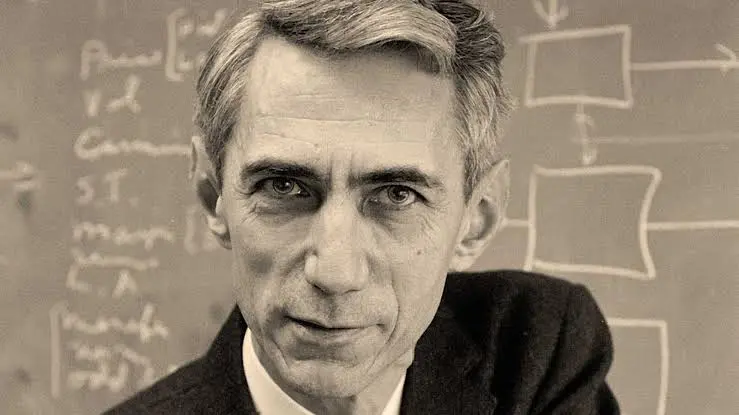
> be claude shannon > invent information theory in 1948 > literally define how data moves through machines > build the foundation for the internet, computers, and AI > die in 2001 never knowing any of this happens > anthropic names their AI after him in 2023 > that AI is now talking to a billion people > using the exact math he wrote on a chalkboard 75 years ago most people using claude daily have never heard of claude shannon which is kind of exactly what he would have wanted tbh, dude was famously unbothered
fardeen tweet media
English
9
36
351
10.4K
Nalin Pithwa retweetledi
Massimo
Massimo@Rainmaker1973·
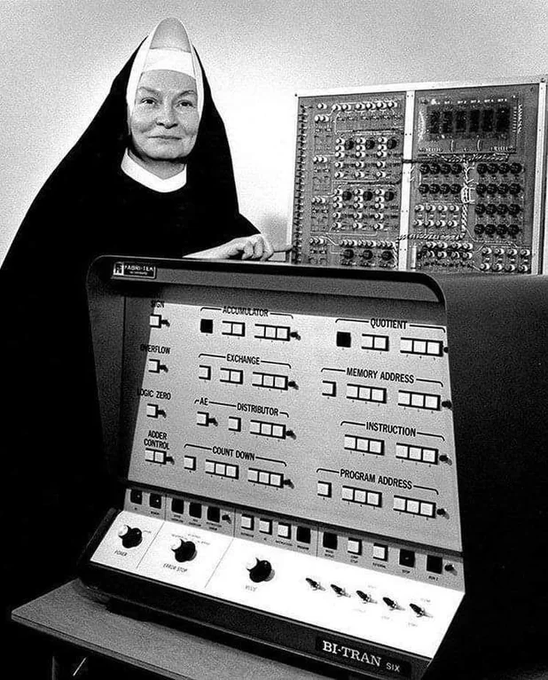
Sister Mary Kenneth Keller was told computers were “not for women”. She ignored it, earned a PhD, and became the first woman in the U.S. to receive a doctorate in computer science, helping shape modern programming languages.
Massimo tweet media
English
43
438
1.7K
47.7K
Nalin Pithwa retweetledi
Physics In History
Physics In History@PhysInHistory·
George Dantzig, known as the "father of linear programming," once solved two open problems in statistics by mistake, thinking they were homework assignments. His work during WWII on supply chain logistics led to the development of the simplex algorithm.
Physics In History tweet media
English
5
45
286
15.1K
Nalin Pithwa retweetledi
Shikhar
Shikhar@shekhu04·
Meet Supriyo Datta (Every chip that uses electron spin instead of electricity, he invented that) > Born in Dibrugarh, Assam, 1954 > B.Tech from IIT Kharagpur, 1975 > PhD from University of Illinois, 1979 > Joined Purdue University in 1981. Never left. > For over 40 years, one man, one university, one obsession > In 1990 proposed the Datta-Das Spin Transistor > The first ever concept for a spintronic switch Instead of using electric current to power devices, use the spin of electrons > A completely new way to think about computing It focused the entire world's attention on a field called spintronics > Which is now at the heart of quantum computing research worldwide > Called "one of the most original thinkers in nanoscale electronics" > Fellow of both IEEE and the American Physical Society > In 2012 elected to the National Academy of Engineering > In 2024 elected to the National Academy of Sciences > One of the very few people ever elected to both A boy from Assam spent 40 quiet years at one university and rewrote how the world thinks about electrons No Silicon Valley. No startup. No noise. Just a desk, a question and 40 years of obsession. "Science emphasizes conceptual advances. Engineering emphasizes practical impact. Nanoelectronics involves both." He lived both. Simultaneously. For four decades
Shikhar tweet media
English
29
85
474
34.4K