
Sabitlenmiş Tweet
Nate
2K posts


Nate
@NateRothstein
Writing “Zen of Business Operations." It covers topics like "Enlightened Laziness " and "Less data provides more Information." (also an excel memes reply guy)
Katılım Mart 2010
564 Takip Edilen218 Takipçiler
@mattyglesias I kinda like it…signals a back to basics mentality, which is what they need.
English

Star Wars: Starfighter is a hilariously bad title.
How did they not spend 30 minutes brainstorming a better idea for their trillion dollar IP?
English
It’s true in many ways. But OTOH it’s very hard to *make* people understand reasoning if they are not willing to spend the time or even just be open to the POV
And in many cases there can be legit, valid disagreements too; the reasoning can have flaws but you need take a decision regardless
English

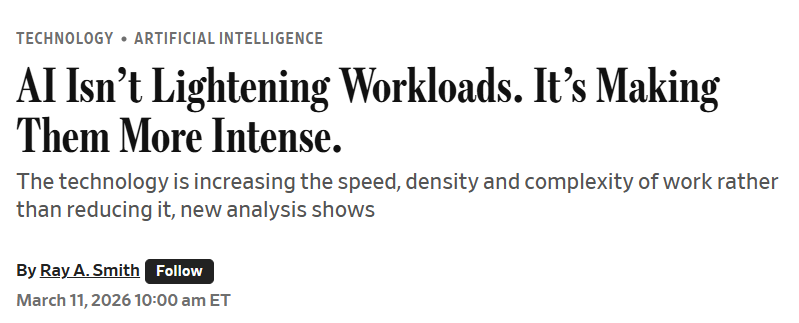
@Noahpinion Dunno…The headlines isn’t even talking about the amount of work or “people working more,” it seems to be about the nature of the work itself: it’s making things more complex, not less.
On the one hand it’s counterintuitive, OTOH kind of in line with past tech advancements
English

This isn't Jevons' Paradox. It's everyone thinking that 90% of the people at their company are about to get laid off, and working like crazy to try to make sure they're part of the 10% who don't.
English
Nate retweetledi

@politicalmath It took me about 5 minutes working a full-time, terrible corporate job and having kids to realize that Calvin's dad was the hero of Calvin and Hobbes.

English
@allgarbled I was hoping the model would interpret this as an act of trust from my part and therefore take my asks more seriously and with more attention to detail as a result of the increased responsibility!
English


Given what current-gen LLMs (say, in math, but whatever) can do, I think their apparent limitations are kind of mysterious. What is the blocker preventing, at present, high quality fully autonomous work?
English
Similar dynamic I see with LLM writing, in particular emails: they *increase* the number of sentences when they should be reducing. No one is reading more than 3 lines in an email, so use their powers to make those max effective.
(I assume why this is the case, but nevertheless)
English
@John_Attridge I saw the best tweeters of my generation destroyed by madness, scrolling hysterical
English

Personally I believe the greatest tweet of all time has not yet been tweeted
English
@robinhanson How do you explore inside other people without doing do so in relation to what’s inside oneself?
English

I’ve never been very interested in inside myself. Much more in the universe, and inside other people. How different could I be inside?
PsyPost.org@PsyPost
Analyzing your own thoughts might seem healthy, but a new review shows that deep introspection is actually associated with higher levels of depression and anxiety, rather than boosting life satisfaction or overall well-being. dlvr.it/TRb3RP
English
@staysaasy @awilkinson I think it was a combo of: 1) a lot of folks don't use "introspective" to mean "dwells on the past" or "excessive rumination" or "Therapy culture" instead it's 2) more like i.e examining oneself and motivations, which is not new, but has been written about since the Greeks
English

@awilkinson I was surprised that he got so much shit for this, because anecdotally it seems at least directionally correct to me. It's not that they're incapable of introspection, it's more that they aren't that anxious and focus on the future
English

Most insanely successful people I've met are not even remotely introspective.
To me this always seemed more indicative of a personality disorder than a strategy for living a happy life.
Extremes create great work outcomes, but not longterm personal or familial happiness.
More Perfect Union@MorePerfectUS
Billionaire Marc Andreessen says he has "zero" introspection, and that the idea itself is a modern invention.
English
@buccocapital They should just chop up the essays into shorter ~140 character sections that you can scroll through in a sort of threaded fashion. Then you could even share a specific section as its own post if it was a particularly good point.
English

1. Roll out articles so people can write really long tweets. These will mostly be written by AI
2. Then, use AI to summarize those articles back into tweets
Nikita Bier@nikitabier
We’re rolling out summaries for Articles now. Just tap the Summarize button if you want to know if it’s worth your time to read it (or if your attention span is 12 seconds).
English
@toddsaunders The SaaS boom produced enormous wealth for tons of people. Salaries alone at most of those companies are probably higher than average let alone the stock comp.
English

I heard an incredible analogy from a VC friend that I can’t stop thinking about.
“The moat in software was the cost of building software. And Claude Code just mass produced a bridge.”
It’s wild when you think about the impact of this.
The SaaS boom produced a few dozen billionaires and a bunch of zero sum winners.
But the AI SaaS era will mass produce millionaires.
There will be fewer ServiceTitans hitting $5B valuations, and instead there will be 50,000 companies doing $500K-$5M each, run by 1-3 people with deep expertise and huge margins.
To be clear, I believe that the total value of software goes up, and the number of companies created goes up exponentially.
But the number of people who capture the value also goes up 100x.
I don’t believe in the “SaaS is dying” headline, I think it’s missing the point.
It’s simply that the power of SaaS is changing hands.
English
@atelicinvest I would simply raise a lot of money to fund ventures that would destroy those moats. Who is building this?
English

@tszzl @roddreher They really should be using AI to make those types of essays shorter, not longer!
English


Read this. It's important. It's from a Silicon Valley guy talking about what AI is about to do to us, whether we want it or not.
sahajgarg.github.io/blog/cognitive…
English
@zachtratar Every generation needs to learn on their own that Excel is the pinnacle of software and nothing new will ever improve on it.
English
At some point we're going to have to admit to ourselves just how weird it is that everyone is building effectively the same product.
Sometimes a different niche, GTM, or brand. But the core puzzle pieces are all converging.
The mass centralization of software is among us.
Chris Hladczuk@chrishlad
We raised a $27M Series A to replace the spreadsheets and human duct tape behind $100 trillion in global assets. Fund administration is the invisible backbone of private equity and venture capital - and it’s broken. Why? Financial data is scattered, stale, and locked inside legacy providers. Books take forever to close. Basic questions about your own fund take days to answer. So we rebuilt the general ledger, waterfall engine, investor portal, and portfolio management from scratch. One single source of truth for your firm. Our AI agents read emails, propose journal entries, and extract portfolio updates in seconds. Our CPAs review every output. Today, we administer $15 billion in assets - and we’re just getting started. Every fund CFO keeps getting asked: how will you adopt AI? Now you have an answer. Run your firm in real-time with @hanoverpark. –- Excited to partner with Jake Saper at @emergencecap @peterjhebert at Lux, @chadbyers/@pratyushbuddiga at Susa and CFOs at the largest private equity firms to forge this future.
English
I am generally on the POV of “AI will *not* take all our jobs, etc.” However there is a real fundamental difference IMO between AI and past software and general tech innovations: AI represents the first time you can theoretically “automate” or offload actual decision-making, not just process / workflow.
All past tech requires some form of design or formalizing the expected output, but you need a human decision-maker in the loop; AI can actually replace decision-making in theory, which means the potential for something truly different than past tech trends is more way more plausible
English

One of the funnier things about the AGI/pilled folks is that people are extrapolating what happened with coding automation to the rest of the world, but I don’t think that extrapolation holds up.
Coding is, at its core, the generation of texts and numbers to tell a computer to do things. There is, obviously, a lot more to it then that. Like understanding how systems connect / should flow together matters as you can better think through what the complete code “should” look like.
But to build that system, the primitives are letters and numbers.
LLMs are trained on a gazillion examples of letters and numbers. Much of that is code (thank you Stack Overflow). They just take text inputs and make text outputs.
Now, there are derivatives to this. Like LLMs can now call tools, and the outputs of those tools can be used as inputs to trigger other things, but they’re just writing letters and numbers which a harness then knows to “trigger” to do a thing.
Which means the things that can be fully automated are things where the input and output are purely numbers and letters.
So, writing (marketing copy, emails, books?!, code, Excel functions, etc.)
But most other domains just have more nuance or friction or edge cases that, even if a lot of the flows can be automated, have something that they system can’t “get” or “do” that throws off the whole loop.
And basically any job that isn’t purely “read/write text” has a lot of those friction points.
So SWEs kind of built a thing that replaced their jobs, but I just don’t see that pattern matching to too many other fields.
Sam Altman@sama
I have so much gratitude to people who wrote extremely complex software character-by-character. It already feels difficult to remember how much effort it really took. Thank you for getting us to this point.
English
I am generally on the POV of “AI will *not* take all our jobs, etc.” However there is a real fundamental difference IMO between AI and past software and general tech innovations: AI represents the first time you can theoretically “automate” or offload actual decision-making, not just process / workflow.
All past tech requires some form of design or formalizing the expected output, but you need a human decision-maker in the loop; AI can actually replace decision-making in theory, which means the potential for something truly different than past tech trends is more way more plausible
English

This is a compelling argument from Tim. @pmarca ended up being wrong about software eating the world. I’ve previously said on the podcast that Andreesen was vindicated, and this made me change my mind.
Timothy B. Lee@binarybits
Marc Andreessen was wrong about software eating the world, and I see people making the same mistake about AI today. I wrote this almost three years ago and I wouldn't change a word if I were publishing it today.
English
IMO, from a functional standpoint the payments networks did (and still do) everything crypto/fintech wanted to do (ie real time transactions/ credit); plus you get the benefit of all the additional security/ risk / chargeback protections; the only “problem” that crypto identified was centralization.
There was a need for an middle layer like stripe or square, but those are not disruptive as much as enhancing the existing tech
English

@TheStalwart The inability of tech/fintech/crypto to make inroads into finance is the most surprising thing to me, when on paper it seems like a natural industry to impact.
English

why does a VC go on podcasts? marketing, dealflow, brand-building. the goal is to get the next founder of the next trillion dollar company to want a16z to invest in them. if you're thinking on a long enough timeline, you want to get them when they're still kids
English
ppl keep asking me about this. marc said he's against introspection– yet he also introspects. when confronted about it, he says he's against rumination, dwelling on the past, self-guilt, etc. so why didn't he say that to start with? it's not that he's stupid. it's that he's a VC
Visa is doing marketing consults (see pinned!)@visakanv
“I don’t introspect, but I have suspicions about my underlying motivations, I don’t think external impact is enough to keep going, and I have a story I tell myself about why I do what I do”
English