Coinflippers

35 posts

Coinflippers banner
Coinflippers

Coinflippers

@Nova_Intern

Extremely Lucky

Katılım Ekim 2022
143 Takip Edilen11 Takipçiler
Coinflippers
Coinflippers@Nova_Intern·
@_0xghost_ There’s a macro-specialised tradfi team launching their agentic desk this month. Currently being rolled out to family offices and insti funds with Bloomberg type pricing. I’ll share more in dm it hasn’t launched yet
English
0
0
0
1
𝔊𝔥𝔬𝔰𝔱
𝔊𝔥𝔬𝔰𝔱@_0xghost_·
Bearish on almost all of these AI projects. And I used to be so excited & interested in them. Now I just roll my eyes. Truth is almost none of them have a path towards revenue. And that’s the only thing which matters.
English
30
1
84
9.1K
Wall3 Labs
Wall3 Labs@Wall3_Labs·
Drawdowns decide everything. Why does crypto die every couple of years? TLDR: Retail equates volatility to return, linearly. The pattern seems to repeat constantly: starting from a quiet, grinding, boring market. Eventually, conditions improve, and small pockets within retail start to make incredible (unrealised) returns. This kicks off FOMO: word of mouth, social etc. The majority join after most of the move has been juiced. They start to run mental calculations, calculating their theoretical net-worth if Fartcoin hits $100. Eventually, the price targets get higher and higher, and so does the leverage, volatility, risk of ruin… The only thing that doesn’t go up is the bottom line. It’s time portfolio construction is given the same importance as single coins. Here to help, Wall3
Wall3 Labs tweet media
English
3
1
3
160
Coinflippers retweetledi
Wall3 Labs
Wall3 Labs@Wall3_Labs·
Tragic chart. A $100 grocery trip doesn't fill the cart, and $100k doesn’t buy you shelter anymore. Since 2020, cash purchasing power has collapsed by around -20%. In nations built on traditional saving, like the Netherlands, holding uninvested cash is a slow, silent drain on real wealth. While inflation erodes savings, ownership in real businesses and productive assets remains the hedge. Asset ownership is the only way out. Wall3
Wall3 Labs tweet media
English
0
2
3
230
Coinflippers retweetledi
Wall3 Labs
Wall3 Labs@Wall3_Labs·
Every company has a founding document. Ours is a private banks “financial plan”, and it's in a bin in Amsterdam. The origin of WALL3: two friends, four years, and a door that isn't coming back. x.com/i/article/2080…
English
2
2
11
1.1K
Coinflippers retweetledi
What Are the Odds
What Are the Odds@koreavaluehunt·
Investing in Korean equities in 2026 is the closest thing the modern investing world has to a time machine, because what you are looking at, when you open a screen of Korean small and mid caps, is structurally identical to what Japanese deep value looked like in 2018, which is structurally identical to what American small-cap value looked like in the late 1970s, which is to say, a developed market full of profitable, debt-free, asset-rich companies trading at fractions of liquidation value while a generational catalyst builds in the background that almost nobody outside the country has yet noticed. The catalyst is the Corporate Value Up Program, launched by the Korean government in February 2024, modeled explicitly on the Japanese reforms that produced one of the great equity bull markets of the last decade. The program is voluntary, but the pressure surrounding it is not. The Korea Exchange has launched a public Value Up Index that names and tracks compliant companies. The National Pension Service is voting against management at companies that fail to address valuation. The dividend tax was cut from a top rate of 45% to a range of 14 to 30% in December 2025, which is the kind of legislative change that fundamentally rewires the incentive structure for every founding family in the country. Activist funds, both domestic and foreign, are filing campaigns at a rate that has never been seen in the modern history of the Korean market. By the end of 2025, more than 170 companies had already disclosed Value Up plans. The Value Up Index itself has roughly doubled since its launch. This is not a screening artifact. This is not an emerging-markets discount. Korea is a developed economy with a sophisticated regulatory regime, a functioning court system, and a stock market that has operated continuously since 1956, and the stocks are cheap because of a specific cultural feature, the chaebol structure and the founding-family hoarding that produced it, that is now, for the first time in a generation, under coordinated political and regulatory pressure to change. The dam that held the discount in place for 30 years is cracking. The water has barely started to move. The American funds that will eventually allocate to Korea are still figuring out the operational mechanics. The American retail investor, who can now access the market directly through a standard brokerage account thanks to the FSC’s April 2025 rule changes, has not yet noticed. You do not need to pick winners. You build a basket of 30 to 50 names, sized small, hold for a decade, and let the math do what the math has always done. Some will go nowhere for years and then re-rate 4x in a quarter when the activist arrives or the founder retires or the next round of pressure lands. You cannot predict which one will be which. You do not need to. You need to be in the basket when the catalysts arrive, and the catalysts are arriving, in 2026, faster than they have at any point in the modern history of the Korean market. The window is open. The math is the math. The early movers will be rewarded the way early movers are always rewarded in trades like this one, which is generously, and the late ones will, as always, arrive in time to be the exit liquidity for the people who showed up while it was still uncomfortable. The trade is sitting there, in a market that has just become accessible, in a moment that almost nobody outside a small group of dedicated value investors has yet recognized, and the only thing standing between you and it is a brokerage account and the willingness to do the unglamorous work that almost no other investor will bother to do.
English
23
62
670
92.8K
Coinflippers retweetledi
SouthernValue
SouthernValue@SouthernValue95·
This podcast with @dylan522p is a terrific rebuttal to the Citrini doomer scenario by playing through the real world constraints of a fast-ish takeoff (I know it wasn’t intended as such). The constraints to producing enough AI tokens to be disruptive to society will slow it down and let the world adopt at a more digestible pace. But more importantly, we should not think of AIs impact on the world in a zero sum manner. As AI becomes more capable, the value of producing more tokens goes up, every corner of the energy and semis supply chain will need to ramp capacity, and in doing so, will invest / hire and grow GDP. This somewhat small example of a tech entrepreneur using AI to develop a cancer vaccine for his dog highlights that things that were not before possible or practical may now be. What if we suddenly find 300 new disease cures in the next 2-3 years? We will have a biotech boom that makes the COVID era look like a warmup, and a manufacturing boom to produce the drugs, more hiring and more GDP growth. It’s not crazy that we could be facing skilled labor shortages for many years. theaustralian.com.au/business/techn… (thanks @ElliotTurn ) The broader point is there will be lots of growth in new areas that didn’t exist before, and we will need people to do new jobs and to build those companies. If society can do everything we do today with fewer people, and reallocate some amount of people to new tasks, that’s a very good thing. That’s a productivity boom that potentially increases the quality of life for everyone on the planet.
Dwarkesh Patel@dwarkesh_sp

.@dylan522p gives a deep dive on the 3 big bottlenecks to scaling AI compute: logic, memory, and power. And walks through the economics of labs, hyperscalers, foundries, and fab equipment manufacturers. Learned a ton about every single level of the stack. 0:00:00 – Why an H100 is worth more today than 3 years ago 0:24:52 – Nvidia secured TSMC allocation early; Google is getting squeezed 0:34:34 – ASML will be the #1 constraint for AI compute scaling by 2030 0:56:06 – Can’t we just use TSMC’s older fabs? 1:05:56 – When will China outscale the West in semis? 1:16:20 – The enormous incoming memory crunch 1:42:53 – Scaling power in the US will not be a problem 1:55:03 – Space GPUs aren't happening this decade 2:14:26 – Why aren’t more hedge funds making the AGI trade? 2:18:49 – Will TSMC kick Apple out from N2? 2:24:35 – Robots and Taiwan risk Look up Dwarkesh Podcast on YouTube, Apple Podcasts, or Spotify. Enjoy!

English
11
23
186
54.2K
Coinflippers retweetledi
Object Zero
Object Zero@Object_Zero_·
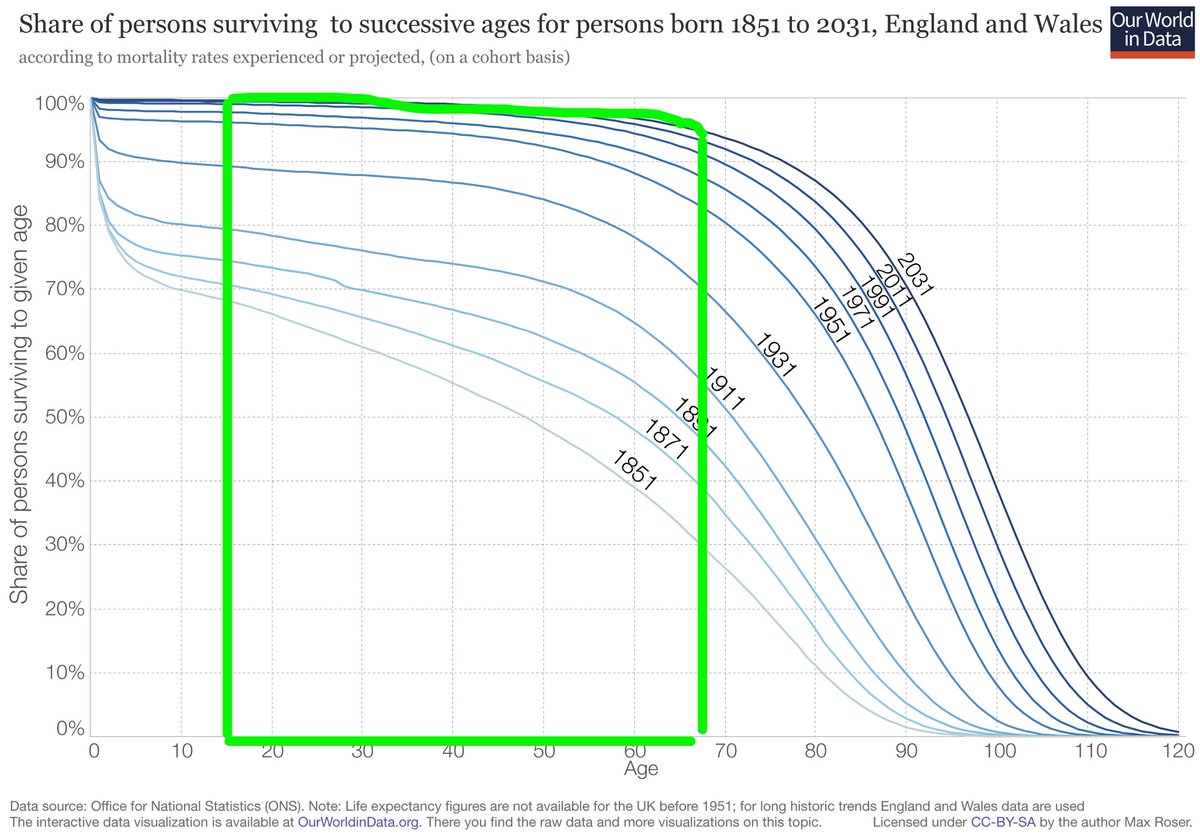
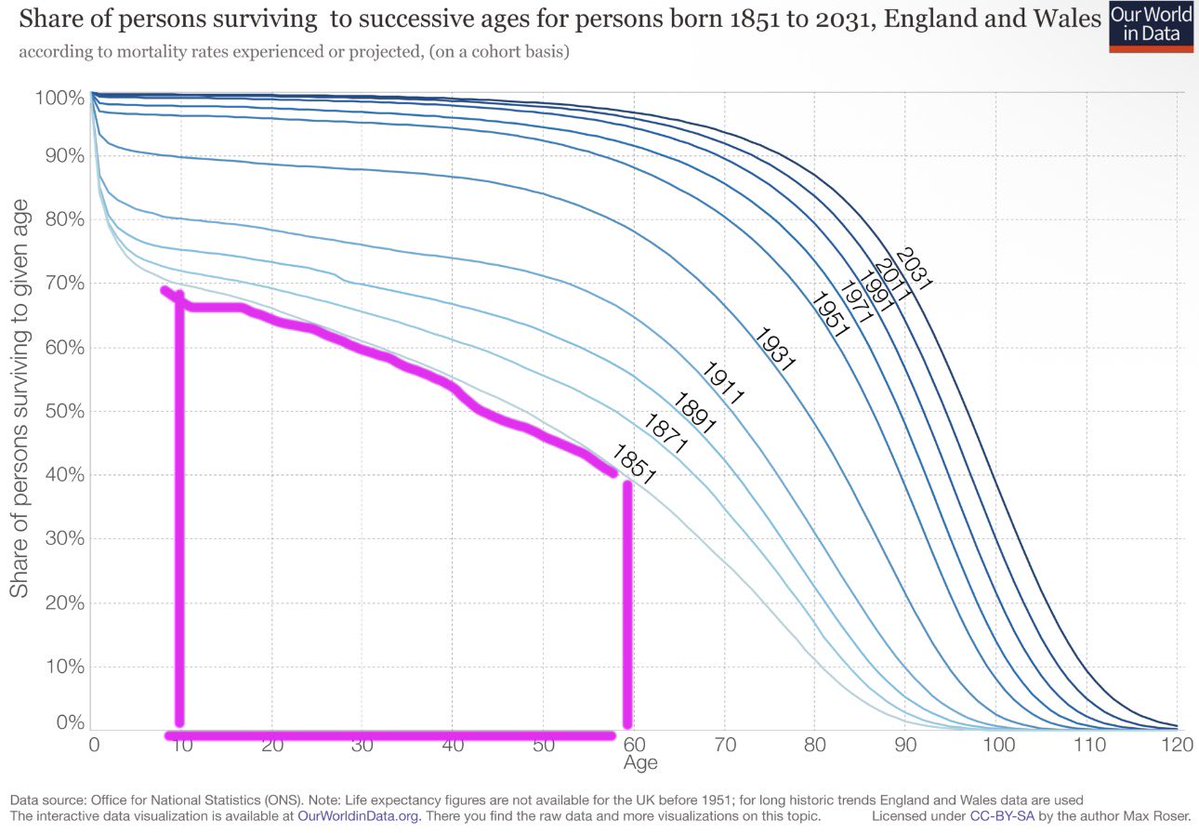
Birth Rate Collapse & Economic Utility of a Birth This is really weird, but I suspect it’s overlooked in socio-economic research literature. Below I present 2 zones on the same chart. The pink zone on the left chart shows the useful economic life of 1 human birth in the year 1851. The green zone on the right chart shows the useful economic life of 1 human birth in 2011. Now because of medical advances, sanitation, public health, etc, etc we have significantly improved life expectancy and reduced infant mortality. This means that a birth in 2011 has vastly more hours of economic output than a birth in 1851. Historic mortality rates really cut down the expected economic lifespan of a birth, but how much? The pink area on left = 40 years * 40% + ( 40 years * 30% )/2 = 22 years of economic work per birth (yikes!) The green area on the right = 51 years * 98% = 50 years of economic work per birth. These numbers are massively different. The expected working lifespan of a human at birth has increased by 127% over 160 years. Even though we work to approximately the same age. This means that in economic terms 1 birth in 2011 is worth 2.27 births in 1851. How does that gain in economic utility per birth compare to the collapse in volume of births? Today there are 2.31 births per woman worldwide. In 1850 there were 5.82 births per woman. 5.82/2.31=2.52 So we have 2.27x gain in utility per birth and a 2.52x fall in the volume of births? These ratios are within 10% of one another, they almost perfectly track inversely to give a fixed amount of ‘human economic utility birthed per woman’. I find this to be a staggering coincidence. Is the collapsing birth rate just supply and demand? Did longevity gains simply create a temporary oversupply of units of human utility? The population crisis might just be market forces. Or rather, it’s just macro-ecology.
Object Zero tweet mediaObject Zero tweet media
English
187
446
6.4K
949.2K
Coinflippers
Coinflippers@Nova_Intern·
My funds 20% exposure to gold earlier this year paid off. The entire thesis was - dollar devaluation and not sure where else to park it. Judging by the crazy run I think everyone else bought for similar reasons Too much talk about gold today. 2 months of range to come.
Coinflippers tweet media
English
0
0
0
7
Ahmed
Ahmed@CryptoBheem·
$ENJ Got me a cool swing long here
Ahmed tweet media
English
16
6
163
143.2K
WIZZ🥷 ( beware scammers )
WIZZ🥷 ( beware scammers )@CryptoWizardd·
I alrdy posted this before Top 6 My top main bags in size $DOGE $TAO $INJ $WOO $ZIG $NPC Will post top 10 soon Whats yours
English
1K
237
3.2K
296.4K
Coinflippers
Coinflippers@Nova_Intern·
Dip into HVN😮‍💨😮‍💨😮‍💨😮‍💨 Was even generous enough to give you another try. $sui $xrp $bitcoin $hype $moodeng $chillguy $avb

Coinflippers tweet media
English
0
0
0
81
Coinflippers
Coinflippers@Nova_Intern·
Here’s the Boomer chart of the day. No hints. Retweet and I’ll tell you $chillguy $xrp $sui $bitcoin $meme
Coinflippers tweet media
English
0
0
1
37
Coinflippers
Coinflippers@Nova_Intern·
They doubted us. Said bitcoin wasn’t going to 30k. Then 50 then 60…. No way 100k will hit 🤣 $btc $eth $sol $sui
English
0
0
1
24
Coinflippers retweetledi
Gold
Gold@Gold_Cryptoz·
One of the earliest precursors for a bullish market is when coinbase listings start pumping once again - @GiganticRebirth 2020
English
2
9
68
0
Steven
Steven@Dogetoshi·
Raising $5M at $50M for a new DEX. DM for more info.
Steven tweet media
English
12
24
422
0
Coinflippers retweetledi
Dan Go
Dan Go@CoachDanGo·
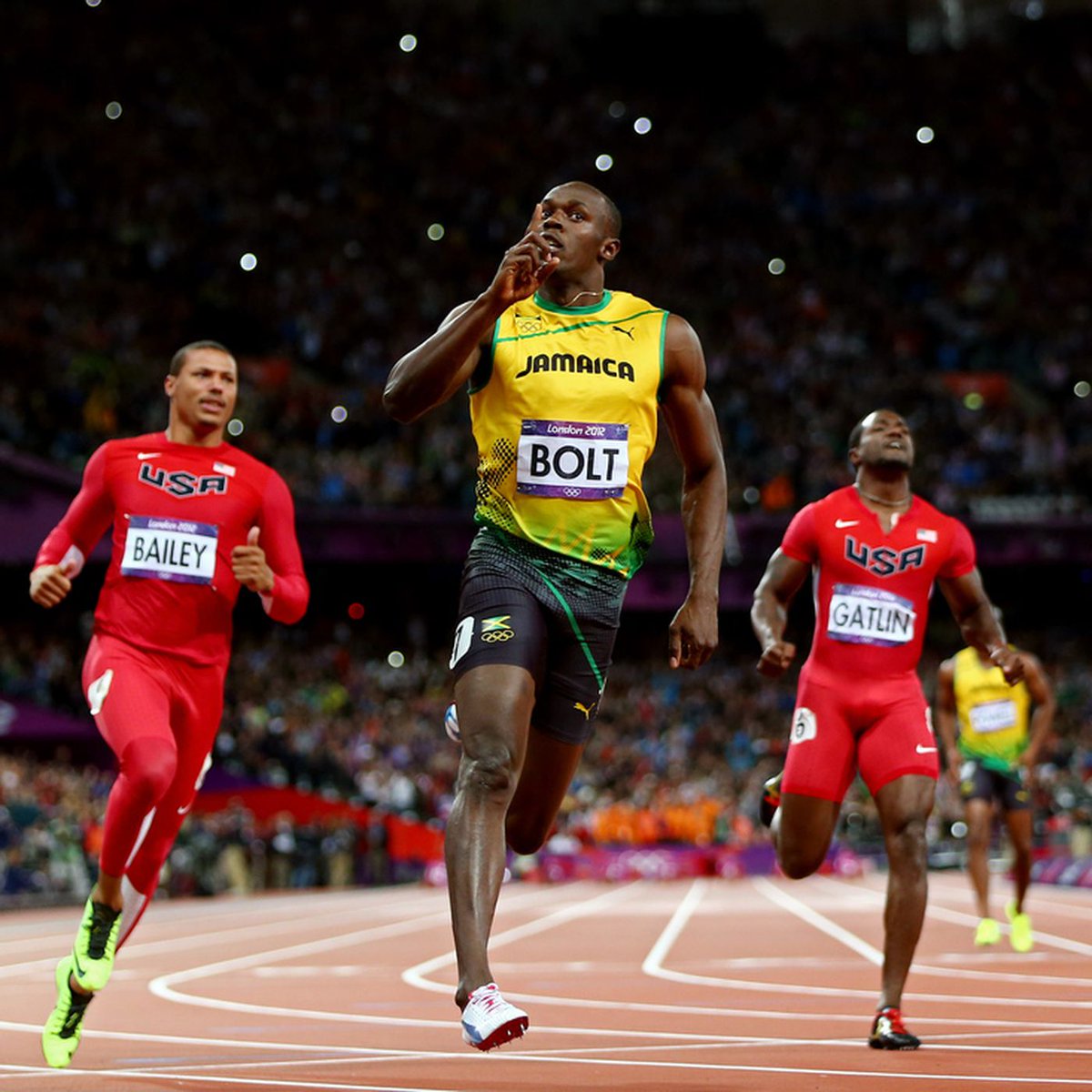
When an athlete is told to run at 85% they run faster than if they're told to run at 100%. It's called the 85% rule and here's why it works:
Dan Go tweet media
English
482
5.8K
41.8K
0
Coinflippers retweetledi
Synq
Synq@SynqXYZ·
🚨 Attention early adopters! 🚨 Our first quest is live on @Galxe now 🔱 Prove you're early to Synquote by completing the quest and minting your free NFT 👀 👉 quest here: galxe.com/synquote/campa… We’re giving 5 prizes of $50 USDC to 5 random people who complete the quest 💰
English
2.1K
38.7K
22.3K
0