David Mannion

75 posts

David Mannion banner
David Mannion

David Mannion

@Odyssey374

Katılım Mart 2026
744 Takip Edilen115 Takipçiler
David Mannion
David Mannion@Odyssey374·
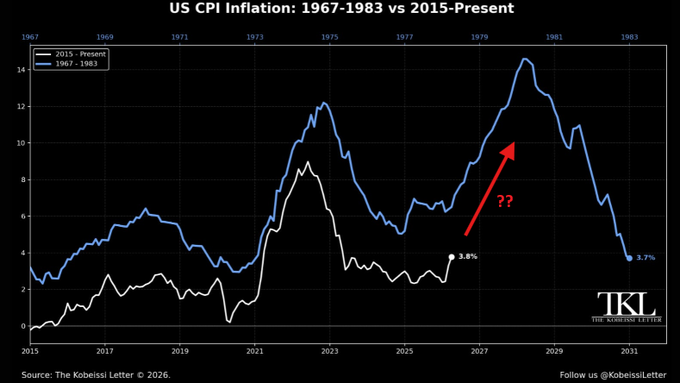
The fed won’t have to increase interest rates as much because population growth is much slower than in the 70’s and automation will help cap the cost of labor, if not decrease it outright. In other words, the price spikes are much more likely to create demand destruction today than in the 70’s.
English
1
0
0
3
Ewerton Costa
Ewerton Costa@ewertoncostapt·
7% mortgages, 4% inflation, 30% loss in dollar purchasing power since 2020, and that chart is tracking the 1970s second wave almost perfectly. The scariest part isn't where we are it's where the 1967-1983 overlay goes next. Volcker had to take rates to 20% to break it last time. Nobody is politically willing to do that today, which means the second half of 2026 isn't just "interesting." It's the moment we find out if history rhymes or repeats.
English
0
0
8
1.2K
Adam Kobeissi
Adam Kobeissi@TKL_Adam·
American consumers are now facing 7%+ mortgage rates, 4%+ inflation, and a 30% loss in the purchasing power of the US Dollar since 2020. The second half of 2026 is going to be interesting to say the least.
Adam Kobeissi tweet media
The Kobeissi Letter@KobeissiLetter

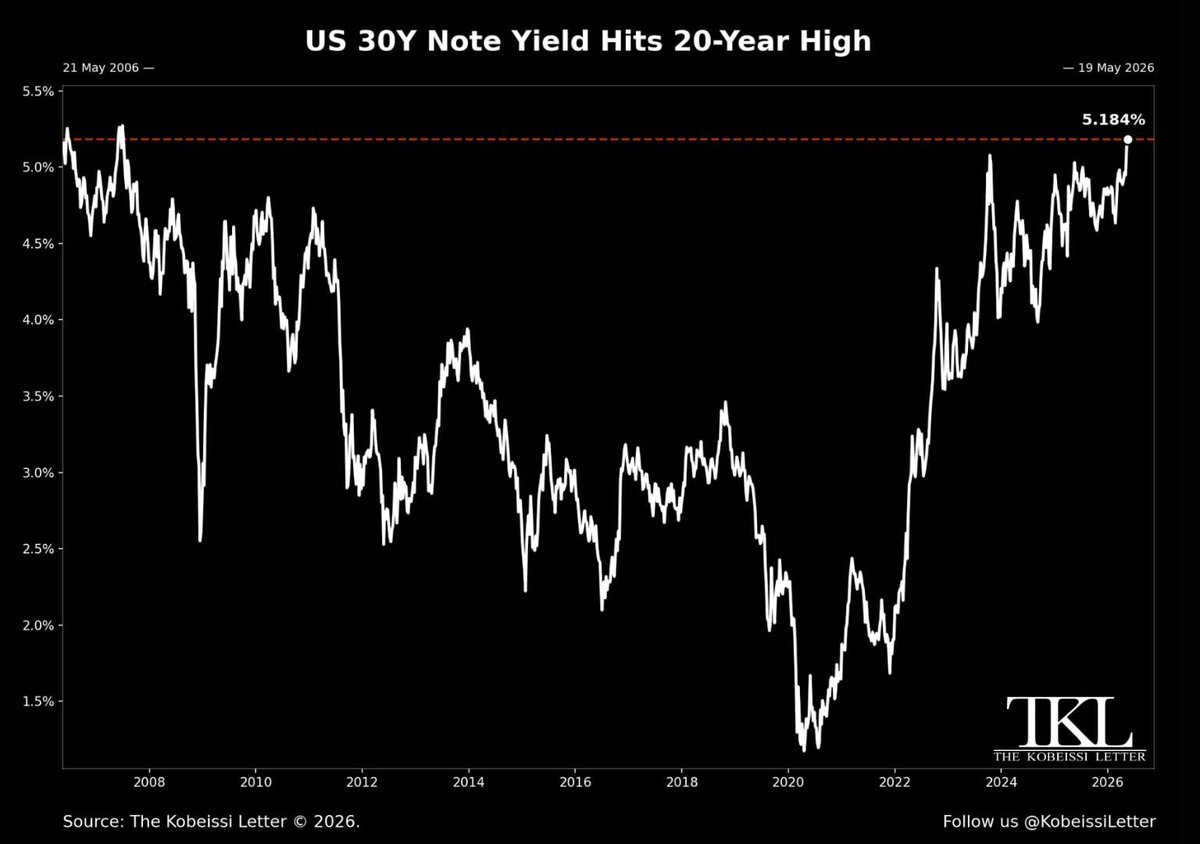
Bond markets are flashing red. Today, the US 30Y Note Yield officially hit its highest level since July 2007, at 5.19%. This will soon become Americans’ biggest problem, yet the vast majority do not even know it is happening. What is happening? Let us explain. (a thread)

English
164
812
3.8K
569.4K
Dachswerk
Dachswerk@dachswerk·
@TKL_Adam Only 30%? I feel like we lost 65% since 2020.
English
0
0
10
351
David Mannion
David Mannion@Odyssey374·
The population in the US is not growing at the same rate as the 70’s. A significant increase in food and energy costs today is much more likely to cause demand destruction than it did in the 70’s. Automation, slowing population, will cap if not reduce income for many Americans. That may cause the coming price spikes to be short lived as many people are forced to cut purchases.
English
0
0
1
3
Silent Fill
Silent Fill@Silent_fill0·
The chart overlay is striking but the mechanism is different. The 70s second wave was oil shock driven — Iran, OPEC. Today's setup is energy disruption + fiscal spending + supply chain restructuring simultaneously. If anything the 2015-present line could overshoot the 70s analog because the inputs are more entrenched. 3.8% CPI is not a plateau, it's a floor.
English
1
1
6
1.6K
Andy Mercer
Andy Mercer@wambameaglesman·
@TKL_Adam It’s time for Trump to honor his commitments with all of us that voted for him. We look like assholes right now…
English
4
0
9
791
Tim Koltek
Tim Koltek@TimKoltek·
@TKL_Adam 100% agree. AI and tech stocks are the only things proping up the market right now.
English
2
0
13
1.9K
S
S@NinBoss727·
@TKL_Adam @KobeissiLetter Yes, and we all gonna say thank you Biden and Democrats for printing more and more money OK
English
11
0
12
1.9K
David Mannion
David Mannion@Odyssey374·
The dollar will be devalued gradually, the energy crisis will cause other currencies and economies around the world to collapse during this time. It’s all relative. The dollar will be able to buy less oil, and products relative to what the dollar would have been able to purchase. But that will be somewhat offset by other currencies collapsing.
English
0
0
0
5
cansera ok
cansera ok@ManfroiRenato·
O colapso do dólar está iminente e mandando sinais de todos os lados. Mas cansera, oque isso significa? Significa que hoje,por exemplo, voce vai dormir com dolar a 5 reais amanhã, assim que abrir o mercado, dolar estará a 1 real e ninguem vai querer comprar. Economia americana colapsara instantaneamente e, em 5 anos, eua terá somente 1/3 do pib de hoje. Putin e Xi já devem ter a estratégia preparada pra quando isso acontecer e oque irão fazer na maior crise financeira da história. Anotem e guardem esse tweet.
Português
56
1
111
51.3K
David Mannion
David Mannion@Odyssey374·
Here at the end of the debt cycle the US (and most of the world) will be forced to lower the value of the USD. Although the Fed might raise interest rates in the short term, they are bound to keep the rate lower than the actual inflation rate. With the energy and food shock pending, demand destruction is more likely than it was in the late 1970’s.
English
0
0
1
21
Atlas
Atlas@theatlasvision·
This thread is two arguments that can't both be right. The 30Y at a 19-year high says money just got more expensive and inflation isn't finished. The "+$11T in 7 weeks, own assets or be left behind" tweet a few posts down says discount that and pay up anyway. Those aren't one story. They're bonds and equities pricing opposite outcomes. The bond market is rarely the one that turns out wrong about the cost of money.
English
3
0
8
9.5K
The Kobeissi Letter
The Kobeissi Letter@KobeissiLetter·
Bond markets are flashing red. Today, the US 30Y Note Yield officially hit its highest level since July 2007, at 5.19%. This will soon become Americans’ biggest problem, yet the vast majority do not even know it is happening. What is happening? Let us explain. (a thread)
The Kobeissi Letter tweet media
English
482
1.2K
6.6K
3M
David Mannion
David Mannion@Odyssey374·
@intlmandotcom Destroying what’s left of the current monetary system seems to be the point
English
0
0
0
345
Doug Casey's International Man
The 10-year Treasury yield is perhaps the most important financial benchmark in the global fiat system, as it drives valuations and market trends worldwide. It is widely—and erroneously—regarded as the risk-free rate of return. The 10-year Treasury yield can be thought of as a key barometer of the US dollar-based fiat system—a critical measure akin to its beating heart. Bond yields move inversely to bond prices. When bond prices fall, bond yields rise. A rising 10-year Treasury yield signals trouble for the US dollar because it means investors are selling Treasuries, which pushes up the US government’s borrowing costs. That is why the 10-year Treasury yield is a major pain point for the US government. The 10-year Treasury yield was 3.97% when the war started. Now it is around 4.60%, an increase of roughly 63 basis points. I expect the 10-year Treasury yield to keep climbing over the coming weeks and months—until it forces the Fed’s hand. At that point, the intervention will be sold as “stability,” but the mechanism will be familiar: suppress yields by debasing the currency. At today’s debt levels, every 1 basis point increase in the government’s average borrowing cost adds roughly $3.9 billion in annual interest expense. So a 63 bps rise is not trivial—it translates to nearly $250 billion in additional yearly interest costs, materially widening a 2025 budget deficit that was already around $1.8 trillion. Higher yields mean the US government must pay tens or even hundreds of billions more in interest on its debt. At the same time, the global economy faces even greater added costs because Treasury rates serve as the benchmark for borrowing worldwide. That is not an insignificant move. However, given all the headwinds I have discussed, I suspect the 10-year Treasury yield is headed much higher because investors will demand higher yields to compensate for rising inflation. Further, if Hormuz remains closed, drastically higher oil prices are all but certain. Higher energy prices mean higher prices across the economy and higher official inflation rates, which means investors will demand still higher yields to compensate. The problem is that interest on the federal debt is already over $1.2 trillion and is now the second-largest item in the budget. The US government cannot afford yields going much higher because the interest expense would push it toward bankruptcy. I am not sure how—or even if—the US government can manage this situation. Something has to give, and we will not have to wait long to find out what. The Iran war may prove to be more than another foreign policy disaster. It could be the trigger that exposes the fragility of the entire dollar-based financial system.
English
207
635
3.2K
1.5M
Matthew Hoh
Matthew Hoh@MatthewPHoh·
“The directive is not to move during daytime unless it's a matter of life and death.” For decades, the American military, and its allies and proxies, operated with the certainty that anything that can be seen could be killed. This was what the Revolution in Military Affairs (RMA) that began in the 1970s had promised and had delivered. American dominance on the battlefield was evident and US adversaries were only able to fight US forces asymmetrically, mostly through guerrilla or insurgent campaigns, emphasizing concealment from observation by operating at night, in forbidding terrain or dense urban areas, or among populations. US surveillance and firepower prevented enemies from massing and rarely were US forces in danger of being tactically defeated in combat. American bases were secure, and, while harried by indirect fire, US bases were, by and large, safe and never in any danger of being overrun (with some exceptions in Afghanistan). IED attacks did greatly hamper and hinder US force and logistics movements but US freedom of movement was never fully denied, and the US was always able to mass forces, set the tempo of operations and take initiative at the tactical and operational levels of war. Now that advantage is gone. The US, allied and proxy dominance of the enemy through surveillance and applied firepower has been equaled. Whether through Iranian drones and missiles damaging and forcing the evacuation of nearly all US Gulf bases, the inability of US carriers to get closer than 1,000km from the Iranian coast, or the IDF unable to move in daylight in Southern Lebanon, the great advantage US forces and their allies once had has been met. Now, with certainty, if US and allied forces can be seen, they too can be killed. I cannot overstate how dramatic this is for an American empire that depends upon the conquest and control of terrain to achieve, demonstrate and report success and victory. An American military unable to openly operate without challenge upends decades of American warfighting on all levels: tactically, doctrinally, industrially, psychologically, politically… The 1970s RMA brought about the high tech weaponry that provided American dominance at the tactical and operational levels of war. This dominance allowed the US to not suffer battlefield defeats while garrisoning terrain and cities. No enemy could fight the US symmetrically and US forces could not be forced to retreat or hunker in their bases (at least not at the tactical level of war, but certainly so at the strategic and political levels). Now nearly any American adversary enjoys that same “if we see it, we can kill it” guarantee. The Americans are incredibly inept at the strategic and political levels of warfare. Their technological dominance has allowed them to succeed tactically and operationally, at least measured in the sense of avoiding battlefield defeat and holding terrain. Now that dominance has been equaled. This doesn’t just offer the prospect of battlefield defeat and inability to hold terrain/bases, but seemingly ends the entire construct of American military success and victory as understood through such paradigms. Bad days ahead for the Empire and its armies.
Shaiel Ben-Ephraim@academic_la

As more and more IDF soldiers are killed and injured by Hezbollah drones, while demolishing buildings in Lebanon. The soldiers are complaining that they are being used irresponsibly and taking a great amount of damage as a result. An article in Haaretz today shed light on this: 1) Capt. Maoz Israel Rakanti was killed Friday by an explosive drone while securing a tour held at midday despite standing guidelines to minimize daytime movement due to the drone threat. A commander in the division who had argued against the tour put it bluntly: "For what? To secure a visit by the division commander who wanted to see the Litani and the Galilim Bridge. There was no operational benefit to this visit." He added that the timing made the decision especially indefensible, coming a day after Sgt. Negev Dagan of the same Golani battalion was killed by a mortar in the same area: "The directive is not to move during daytime unless it's a matter of life and death. This infuriates me to levels I can't even describe." 2) The army's defense of the decision concedes much of the criticism. A senior military source argued Norkin acted on operational judgment, but acknowledged the security arrangements were inadequate: "Maybe a tank instead of an open jeep. Maybe not staying there 20 minutes after a senior commander leaves." The justification ultimately fell back on command prerogative: "He's the commander, and if he thought he needed to see the bridge with his own eyes in daylight, then we execute." The IDF has not ruled out that Hezbollah identified Norkin's presence and targeted the location accordingly. 3) The incident reflects a broader erosion of operational discipline around the drone threat. Commanders and soldiers describe a pattern in which troops are exposed to serious risk for missions that are neither urgent nor essential, often demolition work that could be done at night. As an officer serving in the north described the dynamic: "Forces that are required to hide all day and avoid unnecessary exposure find themselves on missions that could be done at night, without endangering the troops beyond what's already dangerous." 4) The demolition mission itself structurally exposes troops to the drone threat. A central part of IDF activity in southern Lebanon is the systematic destruction of buildings, with commanders required to report daily tallies of structures demolished. This work demands sustained exposure in open terrain, precisely the conditions in which explosive drones are most effective. One soldier captured the contradiction directly: "We stand exposed securing house demolitions while there are drones in the air. There's no logic to it." An earlier account from a soldier in the sector framed the deeper problem: "The only mission is to keep destroying." What we are seeing is that the IDF mania to destroy every building in Lebanon is putting their soldiers at risk. But the IDF command would rather put the soldiers at risk in daytime to increase the speed of demolition, than secure the lives of soldiers. Life is cheap for Israel.


English
17
107
411
86.7K
AleXandra Merz 🇺🇲
AleXandra Merz 🇺🇲@TeslaBoomerMama·
If you are planning to buy SpaceX shares, how will you pay for it
English
106
51
301
77.2K
H4ND4L4
H4ND4L4@HPRRed·
🚨 Are you ready to release 639,000 confidential documents on the financing of Zionism?
English
35
360
1.9K
41.8K
Matt Ridley
Matt Ridley@mattwridley·
Global warming is doing less harm than predicted. Global greening is doing more good than predicted. Decarbonisation is costing more than predicted. Time to admit that we got this one wrong. We are amputating off our legs to prevent blisters on our toes.
Human Progress@HumanProgress

Climate science is now moving away from the most extreme scenarios. @RogerPielkeJr explains why on our podcast: "Our expectation for future emissions has come down dramatically, largely because there was an assumption everything was going to go towards coal... Another big factor—and it’s one that really hasn’t made its way into climate projections yet—are changing outlooks on global population. The leading climate scenarios still have 12, 13 billion people on the planet in 2100 and still growing. And demographers are now seriously talking about a global population peak soon after mid-century."

English
128
629
2.2K
135.8K
David Mannion
David Mannion@Odyssey374·
It’s true that better nutrition is equated with better health outcomes, it’s important to remember that even ‘ideal’ diets and lifestyles won’t eliminate the possibility of getting cancers and other life ending diseases. It is important when that as one gets older to screen for cancers even if you are doing the right things for your health. There was a study done in Europe recently that tested over 1000 Europeans from different countries for glyphosate and found 100% of them had it in their body. I suspect that all, or most animals in Europe and the US would test positive for glyphosate as well. That is just one of 1000’s of new chemical compounds created and used since the 1980’s.
English
1
0
2
20
💎JanCarlos | Clarity Coach | ₿
@young_cato__ @bryan_johnson are you aware that cancer isn’t a single disease but a type of disease? the cure for “cancer” lies in the biology of humans. at any rate, many documented cases of nutrition being the cure for cancer; almost as if not having proper nutrition = sickness. what a concept.
English
1
0
2
303
Bryan Johnson
Bryan Johnson@bryan_johnson·
If Hantavirus mutated into a global threat, it would unleash AI + biotech unlike anything we've ever seen. > genome sequenced and public in 4 hours > AlphaFold maps every protein target > AI screens 10,000 drugs in 24 hrs > 50 vaccine candidates designed simultaneously > AI designed antibodies in days > risk of death computed instantly > decentralized trials launch globally > enroll from home > 20 countries manufacturing at once > first doses in three weeks > real-time dose characterization > your genome + biomarkers determine your protocol > variant map updates every hour No one would wait for governments.
English
522
246
4.6K
547.6K
David Mannion
David Mannion@Odyssey374·
We don’t have ‘cures’ for viruses, we do have treatments and therapies, which is similar to cancer. The FDA was created for the 20th century. It can take years or decades to get pharmaceutical products approved. If a disease is deadly, but primarily infects poor people, the market won’t fund the development of treatments. Today AI can be used to look for relevant pharmaceuticals that have already been approved for something else. So it’s possible to find some pharmaceuticals even for the world’s poor. Even then, if the poor can’t afford even preexisting medicines, they are screwed.
English
0
0
0
261
David Humphreys
David Humphreys@young_cato__·
@bryan_johnson So where's the cancer cures then? We already have tons of global threats without cures, so why would this suddenly be different?
English
13
0
212
7.8K
Larry Cloetta
Larry Cloetta@not_insayne·
@ProudSocialist @ricwe123 Trump would not know what the hell Xi was talking about, Thucydides Trap. You can bet your life on that. Education vs. the lack thereof.
Larry Cloetta tweet media
English
16
81
447
12.3K
Power to the People ☭🕊
Power to the People ☭🕊@ProudSocialist·
Xi Jinping is putting on a clinic: “The whole world is watching our meeting. The International situation is turbulent. The world is at a new crossroads: Can China and the US overcome the Thucydides Trap and create a new paradigm to meet global challenges together.” The Thucydides Trap is the structural tension that occurs when a rapidly rising power (China) threatens to displace an established ruling power that is in decline (US). By mentioning the Thucydides trap, Xi Jinping is signaling that China is the new leader of the free world and what’s remarkable is, unlike the U.S., China achieved this without dropping bombs, waging endless wars, or spending $1 trillion a year on its military. Instead China became the leader of the free world by investing in its people with housing, education, health care, and the best modern infrastructure in the world, and investing in its neighbor countries through its Belt and Road Initiative, which has funded ports, railways, and energy networks across the Global South. The US became a “superpower” through endless wars, corruption, and selling out its own people to the billionaire class while China became a superpower and surpassed the US by building trade and relations with the world and investing in its people instead of wars. Americans would be wise to take note and then change our corrupt government.
English
902
6.5K
18.6K
886.6K
David Mannion
David Mannion@Odyssey374·
@CJ_Feher @jaydubs83 You overlook everything that has been accomplished (assuming you bother to look at all) for Elons lofty past projections. Like many TSLA investors I’m up over 1000x since 2019, wait and see where we will be in 2030. If consistency is your mantra, buy Coca-Cola.
English
0
0
0
12
George Noble
George Noble@gnoble79·
THIS SPACEX NONSENSE SHOULD BE REJECTED BY THE SEC: Only Elon Musk Can Fire Elon Musk” (The Ultimate Entrenchment Clause) • Musk can only be removed as CEO, Chairman, or from the board by a vote of Class B super-voting shareholders (10 votes per share). • He controls those shares post-IPO (holding majority voting power, e.g., ~79-84% voting control with ~42% equity). • This makes removal effectively require his own consent—far beyond typical dual-class structures at companies like Meta or Alphabet. reuters.com • Experts call it unusually extreme; it gives him perpetual veto power even if public shareholders are unhappy. This is the one most frequently labeled “stunning,” “shocking,” or unprecedented in coverage. 2. Massive Performance-Based Compensation Tied to Mars Colonization • A reported ~$1 trillion (or up to $1T+) stock-based pay package for Musk. • Tied to extreme milestones like reaching a $7.5 trillion valuation and establishing a one-million-person Mars colony, plus other targets (e.g., space-based data centers). wlockett.medium.com • Similar to (but even more ambitious than) his Tesla comp plan. Critics call it “bat-s**t crazy” given the speculative nature. 3. Dual-Class Share Structure with Perpetual Super-Voting Power • Class B shares (10x votes, held by Musk/insiders) vs. Class A (1 vote for public investors). • Musk retains dominant control (majority voting power) post-IPO. • Super-voting shares convert to Class A if sold, locking in insider power. reuters.com • SpaceX warns investors their influence will be “severely limited.” Other Notable (and Investor-Unfriendly) Terms • Mandatory arbitration for shareholder claims. • Texas-law barriers limiting derivative lawsuits. • “Controlled company” status (exemptions from some independent board rules). • Heavy concentration of roles in Musk (CEO + CTO + Chairman) while he runs multiple companies. comptroller.nyc.gov These reflect Musk’s philosophy of long-term vision (Mars, etc.) over short-term shareholder democracy. Valuation itself draws “ridiculous/ludicrous” labels (high multiples on current revenue, betting on unproven future businesses like orbital AI compute). fool.com Bottom line: The prospectus is a classic Musk-style document—bold, visionary, and heavily tilted toward founder autonomy. Investors are essentially buying into “Elon gets to do what he wants, including trying to colonize Mars.” Whether that’s genius or risky depends on your view of his track record. The full public S-1 (expected soon) will have more details in the governance and risk factors sections.
Baufinanciaphaster 👹@bauhiniacapital

@gnoble79 The prospectus is allowed to become effective by the SEC. But it’s a registration. The SEC doesn’t ‘approve’ or ‘disapprove’ of valuations or securities. It can ask for language changes til the cows come home. But there are lots of ways to sell the dream within the current rules.

English
27
38
119
19.3K
George Noble
George Noble@gnoble79·
Tell me about all the cash flow and earnings generated by @elonmusk companies. I will wait. I am not talking about the hopium and the stock price.
JDubs83@jaydubs83

@gnoble79 Nope. Generational less than once in a lifetime talent. Let him cook. I blindly will follow.

English
17
20
140
10.4K
David Mannion
David Mannion@Odyssey374·
🤣 if you want cash flow today try Johnson and Johnson, Coca-Cola etc. If you want to invest in some of the technologies that will shape the 21st century, Musks companies are in the top. I have also made great money on PLTR when value investors insisted that Palantir was just a consultant firm with easily replaceable tech. Clearly the scars of the dot com crash linger. You can believe that SpaceX and Tesla are Pets.com, that involves not looking what these companies are doing. If one is going to Wall Street for Technical analysis, good luck! You should look to Technology experts who are working in the space. Ultimately there are many ways to make money, if one in in their 80’s and in poor health, dividend stocks may serve your needs better than volatile growth stocks. Of course @DivesTech is a Wall Street analyst, but I’m sure you will dismiss him for violating your P/E technical belief system.
English
0
0
0
11