Outsider

4.3K posts

Outsider

Outsider

@OutsiderUye

Katılım Ağustos 2021
48 Takip Edilen101 Takipçiler
Outsider
Outsider@OutsiderUye·
@ChangaCC1980 @matinyarare Mr Lawman, the question is simple. What is the point of having democratic safeguards on term limit only i.e changing from 2 terms to 3 terms requires referendum but changing from two terms of 5yrs to two terms of 7yrs, 9yrs, ....n yrs requires no referendum? Where is the logic?
English
0
0
0
15
The Patriarchy
The Patriarchy@ChangaCC1980·
@OutsiderUye @matinyarare Term limit & term size are 2 different things. I want to give u an example. An academic year has 2 semesters with a duration of 4 months. We all know we cant change those semesters to 3 easily bt we cant change 4m 4mths to 6mths hence the duration has increased bt semester no.
English
1
0
0
19
Rutendo Matinyarare
Rutendo Matinyarare@matinyarare·
We hear that Ziyambi Ziyambi has said that senators will not have a secret ballot when they vote for CAB3 next week. Apparently they will follow the bereka mwana format where those opposed to the Bill will sit on one side and those who support it on the other. They want to see those who will not vote accordingly. Nevertheless, no matter what happens in Parliament, CAB3 will not survive the courts without referendum.
Rutendo Matinyarare tweet media
English
51
63
284
40.7K
Outsider
Outsider@OutsiderUye·
@ChangaCC1980 @matinyarare You don't get it. I didn't say CAB3 is of unlimited duration. Your submission characterises the term envisaged by s91(2) as indeterminate. So I asked what's the point of s91(2) term limit & s328(7) if term size can be changed without referendum e.g. 5-7yrs CAB3, 7-9yrs CAB4 etc?
English
1
0
0
34
The Patriarchy
The Patriarchy@ChangaCC1980·
@OutsiderUye @matinyarare CAB3 is not about an unlimited duration. The duration is specified which is 7 years. Secondly the same person said He is a constitutionalist and if the constitution says 7 years he will abide to it. He said 5 years coz currently thats what the constitution says.
English
1
0
0
34
Outsider
Outsider@OutsiderUye·
@ChangaCC1980 @matinyarare You have a warped understanding of the letter and spirit of the Constitution. What would be the point in limiting tenure to 2 terms of unlimited duration? Even the chief architect of CAB3 knows the correct position at law - presidential tenure is limited to 2 terms of 5 years 👇🏿
English
1
0
0
48
The Patriarchy
The Patriarchy@ChangaCC1980·
@matinyarare A term limit is 2 terms these 2 terms are the ones that require a referendum when wanting to extend to 3 terms or more. The duration of terms are not limited per say but the term is the one which is limited to 2 and needs a referendum. The terms will remain 2. Go to law school!
English
4
0
0
519
Outsider
Outsider@OutsiderUye·
@NehandaRadio @nelsonchamisa Cde, just present evidence to prove that Simba Chikanza is Chamisa's tool. Otherwise your drift is ridiculous. Did NC accuse you? Who should set the record straight here? Why is it not enough that you refute Chikanza's allegations? Has anyone doubted you? Make it make sense.
English
0
1
8
545
Nehanda Radio
Nehanda Radio@NehandaRadio·
Open Letter to @NelsonChamisa “If you do something once, it is a decision. If you do it twice, it becomes a habit. But when you do it more than three times, it becomes character.” Dear Nelson, I have known you for 31 years and have always — and still do — consider you a close friend and brother. Back then, there was no MDC opposition party to speak of, no @NehandaRadio, and none of the political prominence that surrounds us today. We were simply ordinary students at Harare Polytechnic trying to find our way in life. Over the years, you have done exceptionally well in rising through the ranks of leadership — from Youth Leader, to Spokesperson, Organising Secretary, ICT Minister during the GNU, Vice President, and eventually President of Zimbabwe’s main opposition movement. Throughout this journey, we developed a clear understanding of professional boundaries and mutual respect. I own and run a media platform that gives space to voices that may either criticise or praise you in equal measure. I have always appreciated the fact that you understood and respected this principle, and never sought to censor our work. In return, I have respected our friendship and never abused our proximity for personal or journalistic advantage. It is therefore deeply disheartening that, 48 hours after a defamatory article was published by Simba Chikanza on ZimEye falsely claiming that I recorded your conversation regarding Advocate Thabani Mpofu (@adv_fulcrum), you have chosen to remain silent and avoid setting the record straight. You are the only person who knows who was on the other side of that phone call. While you have every right to protect the identity of that individual, it is unfair to remain silent while false accusations are being levelled against a long-time friend and colleague. Unfortunately, your silence — as has happened in other matters which I will not get into here — creates a vacuum that people inevitably fill with assumptions and speculation. One cannot entirely blame those who may conclude that your silence suggests some level of complicity in the breeding of these claims. I have engaged you privately and encouraged you to do the right thing because, apart from the interviewer, you are the only other person capable of authenticating the recording and confirming that the person you were speaking to was clearly not me. Yet despite this, you have chosen not to correct the record. That is troubling — not just politically, but personally. Over the years, Simba Chikanza has made defamatory allegations against several people associated with your political space, including @advocatemahere, @PedzisaiRuhanya, Hopewell Chin'ono (@daddyhope), @JamesonTimba and many others. Allowing such falsehoods to continue unchecked has inevitably led many to question whether these attacks are random, or whether there is active encouragement behind the scenes regarding who should be targeted next. There are currently two separate audio controversies being discussed publicly. The first was the Daily News recording in which you were heard criticising your colleague Jameson Timba. The second recording (attached here for purposes of clarity) — the one now falsely linked to me — was not released by the Daily News. It was allegedly leaked by the very person whose identity you appear resolutely determined to protect. That naturally raises difficult questions about why you are prepared to protect that individual at the expense of long-standing friends and comrades. This situation mirrors closely that of another dear friend of mine, Luke Tamborinyoka @luke_tambo). He gave you years of dedication and service, often at great personal sacrifice, yet in 2023 you quietly imposed another candidate in Goromonzi West after Luke had emerged victorious in the much-criticised “Bereka Mwana” voting exercise. Luke narrated his painful experience in an open letter to Domboshava residents, circulated in polling-station-based WhatsApp groups in Domboshava, which we later published on the Nehanda Radio website in July 2023. One could conclude you have a perchant for sabotaging your own friends and comrades, even when they would not in any way have sought any benevolence from you. While your friends and comrades are left exposed, you appear comfortable briefing and confiding in a publisher whom many Zimbabweans consider deeply reckless and unstable. The day you eventually fall out with him, you may come to appreciate the importance of choosing and screening confidants carefully. Should he one day find himself before a court of law (given the many people he has defamed) he may be required to substantiate his allegations and there is every chance he will seek to protect himself by pointing in your direction. You have been warned repeatedly by many people about his conduct and disposition, yet it increasingly appears that you may have found utility in that recklessness because it can easily be weaponised politically against both friends and perceived opponents alike. I could easily have used this letter in anger to retaliate or reveal matters shared in confidence, but I have deliberately chosen not to do so because I still believe in conducting myself professionally and responsibly for the greater good. In 31 years, our phone calls must number in the thousands, and not a single one has ever been recorded by me — something you know better than anyone else. If you ultimately choose not to correct the record, so be it. I am more than capable of defending myself publicly and politically. I am not particularly concerned about what Simba Chikanza writes because, quite frankly, very few serious Zimbabweans consider him credible. My greater concern is your apparent unwillingness to tell the truth on a matter that should be straightforward. What irks me the most is that I never expected this from a friend, a comrade, and a Pastor. God is definitely not in this. Lance Guma Managing Editor Nehanda Radio
English
129
52
118
64K
Outsider
Outsider@OutsiderUye·
@Chofamba @BatsieKu A journalist is supposed to just present information as it is and let his audience make their own deductions. Once you go ad hominem and also start to prescribe how political actors should prosecute their programs/agendas it becomes legitimate to ask you to form your own party.
English
0
0
0
29
Chofamba
Chofamba@Chofamba·
@BatsieKu So you think in a democracy the only people allowed to talk about politics and governance are politicians? Maybe you should consider a head transplant!
English
4
1
17
504
Batsie K
Batsie K@BatsieKu·
Why is Hopewell not forming his party nhai veduwe? He knows he is mediocre and won't get a single vote! His family won't even vote for him!
Batsie K tweet media
English
29
5
37
3.8K
Outsider
Outsider@OutsiderUye·
@cdemlambo @BatsieKu The flip side is that criticising your daddy is allowed. He should understand that people have own agency & not everyone who disagrees with him is a Chamisa flunkey or sycophant. There is a world of difference between constructive criticism & character assassination.
English
0
0
1
37
Chofamba
Chofamba@Chofamba·
@Leokoni Are you prepared to believe that some people have more information than you? Or do you fight that possibility?
English
2
0
0
83
Leonard Koni🇿🇼
"Chamisa personally tells people in private that individuals like Fadzayi Mahere are ZANUPF plants. It is the same modus operandi he is now using against Jameson Timba through pathetic proxies like Simba Chikanza and the Baba Jukwa page" -Hopewell Chin'ono
Leonard Koni🇿🇼 tweet media
English
105
27
114
23.3K
Outsider
Outsider@OutsiderUye·
@Leokoni Hopewell blocked me but someone must tell him that this 👇🏿 coming from him is shocking & reeks of hypocrisy coz what he alleges is exactly what him & his circles do - each time there is a push back on Zanu/ED they launch a character assassination drive on NC to divert attention
Outsider tweet media
English
0
1
1
71
Outsider
Outsider@OutsiderUye·
@ProfJNMoyo @DougColtart @NewsHawksLive Facts & evidence point to e.g. the 10th Parly of Zim not being Democratic or Accountable with stooges like the unelected MPs in Mabvuku-Tafara, Cowdray Park, Binga North and pliant "opposition" MPs like Susan Matsunga. Such a parliament would be voting for Pres on behalf of who?
English
0
0
0
87
Prof Jonathan Moyo
Prof Jonathan Moyo@ProfJNMoyo·
Counsel Coltart, is this not one of your arguments? “My argument is not that an indirect system of election is inherently undemocratic, but rather that the specific system created by #CAB3 is inherently undemocratic because it takes away the people’s right to vote for the President and gives it to an UNDEMOCRATIC and UNACCOUNTABLE Parliament.”? If the is not one of your arguments, you deserve an apology. But if it is; then, with all respect Counsel, you are not only intellectually lazy; but you are also an intellectual coward with neither the courage nor capacity to defend your bare conclusions that you routinely make about the Bill without facts, law or logical reasoning to support them. Your stance or tactic is uninformed and misinforming!
English
7
39
31
1.1K
TheNewsHawks
TheNewsHawks@NewsHawksLive·
Long Road to One Man One Vote: The History and Realisation of Universal Adult Suffrage in Zimbabwe By Brian Goredema As the 90-day public parliamentary consultation process on Constitutional Amendment Bill N0.3 comes to an end today, a number of salient and contentious issues emerged, and one of them was the one man one vote or universal adult suffrage concept - the right to vote. Universal adult suffrage — the right of every adult citizen to vote in free and fair elections regardless of race, ethnicity, gender, or class — is the cornerstone of modern democracy in the world. In Zimbabwe, this right was not a gift of colonial transition, but the primary objective of a protracted armed struggle against settler rule. This, together with land and freedom, were the main causes of the liberation struggle. This featured strongly during the constitutional amendments debate. It became a point of serious contestation around the proposal to change the presidential electoral system to elect the President through parliament rather than by direct vote. Critics of the proposal claimed this removed the one man one vote or universal adult suffrage - the right to vote - from ordinary Zimbabweans. The factual and truthful position is that it changes how people exercise that right, but not remove it. Zimbabweans will obviously still be entitled to one man one one vote even if the presidential electoral system changes, but will now elect the President through their parliamentary representatives and not directly. People will vote for MPs and in the process reposit their trust and confidence in them to elect the President through parliament. This means their right to vote with equality remains, but when it comes to electing the President, they will now vote like they do in Botswana or South Africa. In Botswana, voters elect MPs through first-past-the-post and those MPs then elect the President. By contrast, in South Africa they for political parties through proportional representation and MPs emerge from party lists. This system ensures that the number of seats a political party gets in parliament is directly proportional to the percentage of votes it receives in an election. And then those MPs or parliament vote for the President. So a president can be elected by parliament whether the MPs are elected through first-past-the-post, Westminster system, or proportional representation. The argument that you can't elect a president through parliament unless there is proportional representation first is thus incorrect, uninformed and false, just like saying electing a president through parliament takes away one man one vote from the people. The history, development, and realisation of universal adult suffrage in Zimbabwe is a story of transition from a racially exclusionary system to a constitutional democracy, punctuated by intense political struggles to define the inclusivity of that vote. For nearly a century, Rhodesia (Zimbabwe) operated under a political system designed to perpetuate white minority rule. The qualified franchise was historically restricted through education, property ownership, and income qualifications. These qualifications were structured to systematically disenfranchise the indigenous African population. Even when some African voting was permitted, it was within a "two-roll" system designed to ensure that the small white population retained control over the vast majority. The struggle for universal suffrage gained momentum in the 1950s and 60s, driven by nationalist parties like the Southern Rhodesia African National Congress, National Democratic Party, Zapu and then Zanu, who adopted the slogan "one man, one vote", meaning universal adult suffrage or the right to vote. The concept and the attendant mantra was about the right to vote whether through electing a prime minister - as was the case in Zimbabwe from 1980 to 1987 - or president - from 1987-1990 - through parliament or direct elections, as happened from 1990 onwards.
TheNewsHawks tweet media
English
34
72
74
9.1K
Outsider
Outsider@OutsiderUye·
@ProfJNMoyo @mimmitwit Yet "in accordance with the Constitution" does not mean only the letter (which can be misinterpreted/manipulated for nefarious reasons as is the case with CAB3) but also the spirit and, more importantly, the desires & aspirations of the governed as agreed to (in 2013).
English
0
0
1
45
Prof Jonathan Moyo
Prof Jonathan Moyo@ProfJNMoyo·
Professor Lovemore Madhuku in his Own Words Making the Case for Parliament to Indirectly Elect the President as an Electoral College: “We must not put in the Constitution of the country a provision that is dependant on what happens in a political party. That’s the point I’m making. We must never say in our Constitution of Zimbabwe that if a sitting President dies or resigns, we will wait to hear what the political party of that President is saying. No. That is not the best way of running a country. Political parties remain the preserve of those people who are in those political parties. But the country is run on the basis of either an election by the people—direct election—or you have Parliament as an institution sitting as an electoral college. Where parties have influence, they must do the influence within Parliament, but never to allow the political party to sit there to say I’m giving you this President, and so forth. That’s the point I’m making. And on that point, I’m making it right across the world; that’s what they do.” - Professor Madhuku, addressing a “Heal Zimbabwe Trust” public meeting in Harare on 22 February 2020. COMMENT: Professor Lovemore Madhuku’s 2020 remarks make a clear, powerful and enduring case for Clause 3 of the Constitution of Zimbabwe (Amendment No. 3) H.B.I. Bill, 2026. This clause replaces the direct election of the President with an indirect election by Parliament sitting jointly as an electoral college; both after every general election and, when necessary, to fill any vacancy in the office of President. The current direct election of the President was first introduced in anticipation of a legislated one-party-one-man rule through Constitution Amendment No. 7, Act 1987 in the old Lancaster Constitution repealed in 2013. Professor Madhuku put it plainly: The Constitution should not—as it currently does— depend on the internal decisions of a political party to select a successor to the President of the country. When a sitting President dies, resigns or is removed, the nation should not have to wait and hear what that President’s political party “is saying.” That is not a constitutionally proper way to run a country. Political parties exist for their own members. The country, however, belongs to all Zimbabweans. The proper solution is straightforward: Parliament—the institution chosen by the people—should act as the electoral college. Inside that open forum, parties may exercise their influence transparently and accountably. No party should ever stand outside the Constitution and simply “give” the nation its next leader. This principle is not abstract. Worldwide, presidential by-elections to fill mid-term vacancies are extremely rare. Most stable presidential systems instead use automatic succession by a deputy or, increasingly, allow the legislature to elect a successor who serves out the remainder of the term. These arrangements place national continuity and stability above partisan interests. Clause 3 of the Bill follows exactly this proven path. By giving Parliament the clear duty to elect the President—whether at the start of a new term or in an unforeseen vacancy—Zimbabwe will secure stronger democratic stability, and keep the highest office firmly within the people’s constitutional framework rather than the private control of any single party. In short, Clause 3 is a mature, practical and principled reform that directly honours Professor Madhuku’s wise 2020 counsel. As such, it deserves the full support of every well-meaning Zimbabwean who values good governance, democratic constitutionalism, institutional integrity and the long-term strength of the country’s democracy in the national interest!
English
138
113
163
87.3K
Outsider
Outsider@OutsiderUye·
@Enimbi @SitholeGracious @matinyarare Delete this nonsense and keep it at Chitepo School of Idiocy. How does a provision stating who forms government translate to their private constitution supplanting the supreme law of the land? What does s2 of the same Constitution of Zimbabwe you're quoting say explicitly?
English
0
0
0
53
TheEnias
TheEnias@Enimbi·
@SitholeGracious @matinyarare The national constitution clearly states that the party which wins elections forms government. So how is this treasonous? The party is supreme to govt
English
1
0
0
142
Rutendo Matinyarare
Rutendo Matinyarare@matinyarare·
𝗗𝗜𝗗 𝗭𝗔𝗡𝗨 𝗣𝗙 𝗖𝗢𝗡𝗚𝗥𝗘𝗦𝗦 𝗥𝗔𝗧𝗜𝗙𝗬 𝗖𝗔𝗕𝟯 𝗥𝗘𝗦𝗢𝗟𝗨𝗧𝗜𝗢𝗡? 𝗗𝗜𝗗 𝗜𝗧 𝗘𝗟𝗘𝗖𝗧 𝟮𝟬𝟮𝟴-𝟯𝟮 𝗣𝗥𝗘𝗦𝗜𝗗𝗘𝗡𝗧? 𝗜𝗙 𝗡𝗢𝗧, 𝗛𝗢𝗪 𝗜𝗦 𝗖𝗔𝗕𝟯 𝗦𝗨𝗣𝗣𝗢𝗥𝗧𝗘𝗗 𝗕𝗬 𝗧𝗛𝗘 𝗣𝗔𝗥𝗧𝗬? How can a decision that came from a Conference and not a 𝗖𝗼𝗻𝗴𝗿𝗲𝘀𝘀 be said to be a party decision, when the party, through its Central Committee, is only entitled to execute policies or programs that are made by the 𝗣𝗲𝗼𝗽𝗹𝗲’𝘀 𝗖𝗼𝗻𝗴𝗿𝗲𝘀𝘀? Was CAB3 okayed by The People’s Congress for you to say that it enjoys the support of the party? No! Secondly, President ED has not been elected by Congress and should be serving his final term, which ends in 2028 according to the party constitution. So how can the current President be deemed to have succeeded to 2030 when he hasn’t won at Congress for him to be the ZANU PF leader from 2028-2032? You go on to say that Chiwenga has no support in the party. It’s too early to say that because at Congress next year, someone can nominate him and structures could vote for him as the new leader of ZANU PF, considering that the current President will have served his two terms is inallegeable to run again. Unless of course if ZANU PF has dumped its processes or it changes the constitution. Why wasn’t an extraordinary Congress held to allow Congress to pronounce itself on the CAB3 resolution and to select a new leader before CAB3 was pushed through? Because as it is, CAB3 is ultra vires. Finally, what made you feel that Chiwenga was taking aim at the President through his allegorical sermon which does not mention anyone’s name?
Sabhuku Temba P. Mliswa@TembaMliswa

This is as brazen an attack on the President as one can ever give and coming from his own Deputy its shocking. For one so close to the President to resort to this is diplomatically gross and strategically poor. The VP is now seriously endangering his standing by pandering to the whims of social media and the opposition by indulging in content creation. The subject matter which he poorly dresses in Biblical frocks instead of explicitly stating his opposition to CAB3, as any serious politician would do, shows his level of frustration. Politically the man has been outmanoeuvred and if he is sincere that he opposes what ZANU PF has come to represent then he should resign like any self-respecting leader. What he is contesting is a party decision and he can't continue within an entity whose thinking and direction he doesn't accept! Resigning, not metaphors, is the only redemptive path for him. He should resign and then canvass for the support of the opposition, which he is clearly pandering to, against his own party. CAB3 is not the product of any single individual but is a ZANU PF project, a party to which he belongs. He cannot reduce it to any single Hezekiah when he has been part of Cabinet that approved it. He failed to block the resolution from the Conference, Politburo, Central Committee, Cabinet, Public Hearings and we are now reaching the Parliament stage. For the ruling party he has become the main opposition, providing fodder for continued tension and instability through such veiled attacks. The biggest takeaway from all this is that he lacks the necessary political muscle and internal support for anything of significance. Thats a hard truth which the doomsday prophets should quickly recognise and stop putting pressure on him to become some action hero. Party members have accepted the party decisions and moved on. Only social media and the motley crowd of illusionists hanging in shadows amount to the "army" that are beckoning him into what will surely amount to self-immolation. Fuelled by this "virtual army" he has instigated multiple political infractions goading President Mnangagwa who has himself remained dignified and quiet. ED's patience and Long-Game tactics are clearly unsettling him. It's just that the political standards for the opposition, which has embraced him on social media, is very low such that they can't recognise the absurdity of the VP remaining part of the machinery which they deride and yet embrace him as a shining light. For the ruling party he is becoming a liability publicly questioning party resolutions and feeding the public mentality with treasonous thoughts.

English
36
96
266
48.1K
Outsider
Outsider@OutsiderUye·
@LindaDadisoM @Bete263 @ProfJNMoyo @DavidHofisi @FaraiMuvuti @TSatNewslive 1. Do you agree with ED here 👇🏾 that the spirit & intention of the 2013 Constitution was to limit presidential term to 2 terms of 5 years? 2. If you agree with ED you must also agree that CAB3 & Jonso's interpretation of s95 is misuse of law to circumvent s91 & s328(7) safeguards
English
0
0
0
83
Outsider
Outsider@OutsiderUye·
@AMutirikwa @ProfJNMoyo It may have flown over your head but my point is that even if Jonso's interpretation of s95 is correct, extending term length without a referendum is a MISUSE OF LAW to circumvent democratic safeguards & an affront to the spirit of 2013 Constitution as stated by ED in that clip.
English
0
0
0
74
Prof Jonathan Moyo
Prof Jonathan Moyo@ProfJNMoyo·
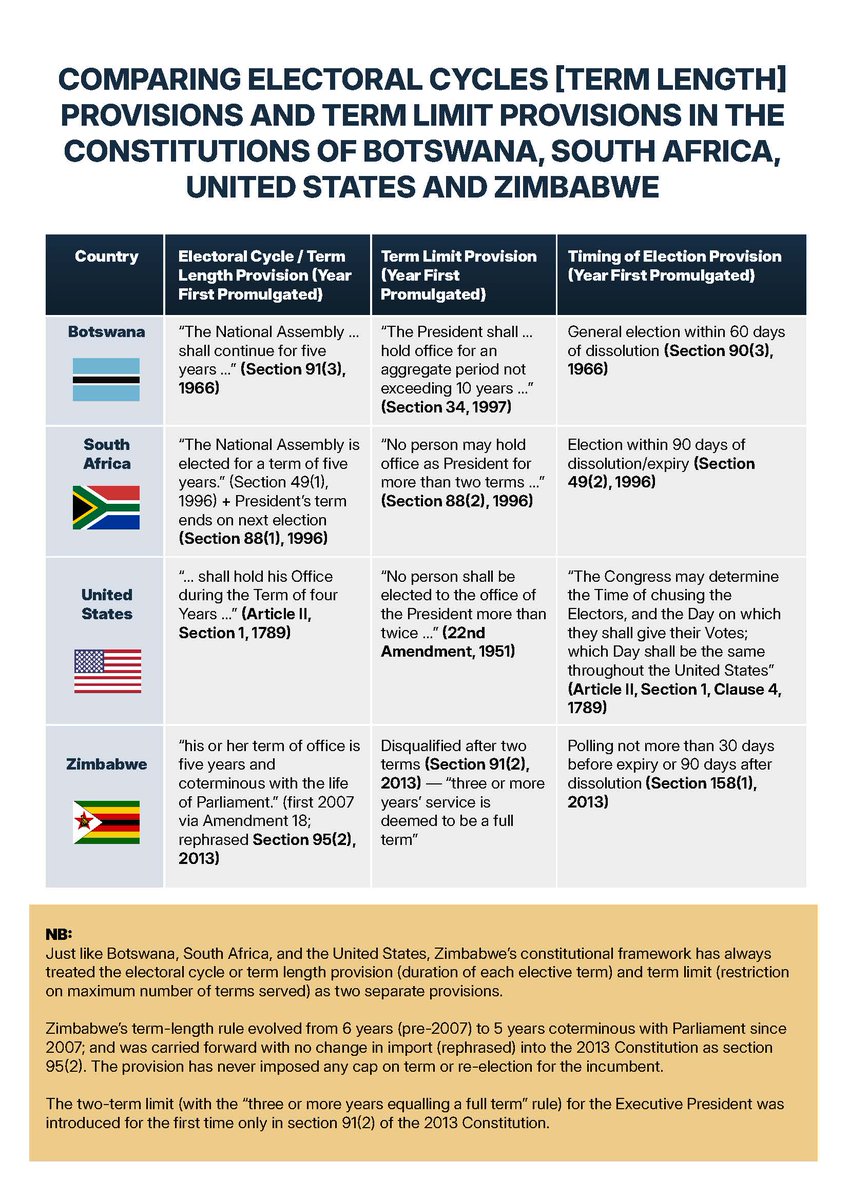
Debunking a Persistent and Dangerous Myth: Zimbabwe’s Constitution Contains Only One Presidential Term Limit Provision: In the intense public debate over the Constitution of Zimbabwe (Amendment No. 3) Bill, an utterly false claim is being repeated relentlessly and without a single shred of evidence: that the Constitution contains two separate presidential term limit provisions—sections 91(2) and 95(2)(b). This assertion is not merely incorrect; it is constitutionally impossible. No constitution anywhere in the world has ever created two distinct term limit provisions for the presidency. Section 95(2)(b) is not—and, according to the Constitution’s own crystal-clear definition in section 328(1), read with section 328(7), cannot possibly be—a term limit provision. A genuine presidential term limit provision restricts the total or maximum length of time any individual may hold or occupy the Office of President. Section 95(2)(b) does nothing of the sort. It simply defines the length of each presidential term as five years, running coterminous with the life of Parliament. In straightforward language, section 95(2)(b) regulates the office itself, not the person who holds it, and says absolutely nothing about how many terms or the length of time any one individual may serve. The Constitution of Zimbabwe (2013) contains only one term limit provision: Section 91(2). This clause is unequivocal and ironclad. It prohibits any person from serving more than two terms as President, with the vital safeguard that three or more years in office counts as a full term. It is only this single provision—and this provision alone—that actually limits the total time any individual can occupy the highest office in the land. Nothing illuminates this fundamental distinction more powerfully than comparative constitutional analysis—the gold standard for both public education and responsible policymaking. As the ancient wisdom has it, there is truly nothing new under the sun. A careful examination of proven global practice, vividly illustrated in the attached infographics, reveals three clear and time-tested approaches that nations around the world have taken when designing presidential term rules: Case 1 – Term length only (unlimited re-election permitted) Constitutions in this category have a single provision that simply defines the length of each presidential term, leaving the number of terms entirely open. This constitutional model operated successfully for decades—for example—in Botswana (31 years, 1966–1997), the United States (163 years, 1789–1951), and Zimbabwe itself (23 years, 1987–2013). Case 2 – Two separate provisions Here constitutions have two separate provisions: one that sets the length of each presidential term; and a second, entirely distinct clause that limits the total time any person may serve as President. This is precisely the framework that has—for example—operated in Botswana since 1997, South Africa since 1996, the United States since 1951, and Zimbabwe since 2013. The first infographic displays this clear separation of the two provisions across all the four countries. Case 3 – Combined in one elegant clause Constitutions in this category have a single constitutional provision that seamlessly merges both term limit concepts—defining term length while simultaneously imposing the limit. This approach has—for example— stood the test of time in Argentina (since 1994), Chile (since 1980), France (since 1958), Mexico (since 1917), the Philippines (since 1987), and South Korea (since 1987), as shown in the second infographic. The historical record is especially telling. Botswana introduced its separate term limit provision only after 31 years of independence, the United States after 163 years, and Zimbabwe after more than two decades of operating under a pure term-length provision. South Africa, by contrast, enshrined both provisions, separately, from the very first day of its democratic Constitution in 1996. These facts drive home an irrefutable truth: a provision that merely defines the length of a term has never been—and can never be—a term limit provision. The distinction is not a technicality; it is the bedrock of constitutional integrity. Recognising it clearly ensures that public discourse and debate on constitutional amendments is anchored in facts, logic, and proven international best practice, rather than convenient fiction to advance nefarious political agendas. Zimbabwe and Zimbabweans deserve nothing less!
Prof Jonathan Moyo tweet mediaProf Jonathan Moyo tweet media
English
177
112
118
61.4K
Outsider
Outsider@OutsiderUye·
@Bete263 @matinyarare @ProfJNMoyo Thanks, I will listen to it but fact remains that even if legal interpretations allow extending term length without a referendum, it is a blatant MISUSE OF LAW to circumvent democratic safeguards & an affront to the spirit of 2013 Constitution as stated by ED here 👇🏾 @ProfJNMoyo
English
0
0
0
57
Bete 𝕏 
Bete 𝕏 @Bete263·
It’s painful writing this because @matinyarare won’t read it. And if he does, he won’t understand it. But for everyone else, here are the laws: s95(2)(b) makes the presidential term coterminous with Parliament. It is not a fixed personal cap. s143 sets Parliament’s life at 5 years from first sitting. CA3 extends Parliament’s term under s143. s95(2)(b) simply follows, because that is what “coterminous” means. s328(1) defines what a “term-limit provision” actually is in law. s328(7), the incumbent-protection clause, only applies to genuine term-limit provisions as defined under s328(1). s95(2)(b) does not meet that definition. AG Mabiza compiled a list of 15 genuine term-limit provisions in the Constitution. s95(2)(b) is not among them. The Constitutional Court confirmed this exact reading in Mupungu (CCZ 7/21, paras 43–51). So when Rutendo asks “why extend from 5 to 7 years if 5 years is not a term limit?”, the answer is right there in s143. CA3 extends Parliament. The presidency follows. That’s it. No fiction. No propaganda. Just the law. The tragedy is he’ll read this and still miss it. Rutendo do you know X now has TTS. It might help you.
Rutendo Matinyarare@matinyarare

For a grown man to argue that he accepts that there is a two term limit in the Zimbabwean constitution but he pretends like he doesn’t know that the limit to the length of the term itself is limited to five years, is illogical. How can people know when the two terms are up if no one knows how many years are in term? How did the current President serve a first term if there was no limit to the numbers years in the first term? And why is his second term not bound by the years of the first term? Why is the ZANU PF Bill seeking to legally extend a term from five years in the constitution to seven years if five years is not a term limit? This argument that Professor Moyo keeps failing to is part of why CAB3 is being rejected because people realize that Moyo is trying to use propaganda to create a legal fiction to rape the constitution.

English
7
9
10
1.2K
Outsider
Outsider@OutsiderUye·
@Bete263 s95(2)(b) -  "term is 5 years AND coterminous with the life of parliament"
English
0
0
0
26
Bete 𝕏 
Bete 𝕏 @Bete263·
@OutsiderUye Read s95(2)(b) in full. It says the President's term of office runs from the date they assume office until the date the next President assumes office after a general election held under s143. That is the complete provision. The five years lives inside s143, not inside s95(2)(b). Section 95(2)(b) doesn't define five years — it borrows whatever s143 says. That's what coterminous means in law: the duration is set elsewhere, and this provision simply mirrors it. So when CA3 amends s143 from five to seven years, s95(2)(b) doesn't need to be touched. It already follows. Automatically. By design. Now ask the real question: does s95(2)(b) cap how many times a person can be President? No. That's s91(2). Two terms. Untouched. Does s95(2)(b) tell any President "your time is up"? No. It tells every President "your time ends when the next election ends." That's institutional rhythm, not a personal cap. AG Mabiza listed 15 genuine term-limit provisions. s95(2)(b) is not one of them. The Constitutional Court confirmed the distinction in Mupungu (CCZ 7/21). The "addition" you're describing doesn't exist in the text. Go back and read it again, slowly.
Outsider@OutsiderUye

@Bete263 @matinyarare You & @ProfJNMoyo are tying yourselves in knots. Yes s95(2)(b) makes presidential term corteminous with parliament but it doesn't start/stop there it actually says what that presidential term is. Coterminosity with life of parliament is in addition to the term being 5 years!!!

English
1
0
1
120
Outsider
Outsider@OutsiderUye·
@shumbakadzi_zim ED knows 👇🏾 that the Constitution limits time in office for president to 2 terms of 5,5. So one of @ProfJNMoyo and ED does not know what they are talking about. Who is it?
English
0
0
0
44
Shumbakadzi👑
Shumbakadzi👑@shumbakadzi_zim·
When people say the amendment is violating “two term limits,” they’re building an argument on something that doesn’t even exist. It’s not a legal point but rather a political and emotional talking point. At the end of the day, if we’re going to debate constitutional changes, let’s at least be honest about what the Constitution actually says. Otherwise, we’re arguing fiction, not facts.
Prof Jonathan Moyo@ProfJNMoyo

Debunking a Persistent and Dangerous Myth: Zimbabwe’s Constitution Contains Only One Presidential Term Limit Provision: In the intense public debate over the Constitution of Zimbabwe (Amendment No. 3) Bill, an utterly false claim is being repeated relentlessly and without a single shred of evidence: that the Constitution contains two separate presidential term limit provisions—sections 91(2) and 95(2)(b). This assertion is not merely incorrect; it is constitutionally impossible. No constitution anywhere in the world has ever created two distinct term limit provisions for the presidency. Section 95(2)(b) is not—and, according to the Constitution’s own crystal-clear definition in section 328(1), read with section 328(7), cannot possibly be—a term limit provision. A genuine presidential term limit provision restricts the total or maximum length of time any individual may hold or occupy the Office of President. Section 95(2)(b) does nothing of the sort. It simply defines the length of each presidential term as five years, running coterminous with the life of Parliament. In straightforward language, section 95(2)(b) regulates the office itself, not the person who holds it, and says absolutely nothing about how many terms or the length of time any one individual may serve. The Constitution of Zimbabwe (2013) contains only one term limit provision: Section 91(2). This clause is unequivocal and ironclad. It prohibits any person from serving more than two terms as President, with the vital safeguard that three or more years in office counts as a full term. It is only this single provision—and this provision alone—that actually limits the total time any individual can occupy the highest office in the land. Nothing illuminates this fundamental distinction more powerfully than comparative constitutional analysis—the gold standard for both public education and responsible policymaking. As the ancient wisdom has it, there is truly nothing new under the sun. A careful examination of proven global practice, vividly illustrated in the attached infographics, reveals three clear and time-tested approaches that nations around the world have taken when designing presidential term rules: Case 1 – Term length only (unlimited re-election permitted) Constitutions in this category have a single provision that simply defines the length of each presidential term, leaving the number of terms entirely open. This constitutional model operated successfully for decades—for example—in Botswana (31 years, 1966–1997), the United States (163 years, 1789–1951), and Zimbabwe itself (23 years, 1987–2013). Case 2 – Two separate provisions Here constitutions have two separate provisions: one that sets the length of each presidential term; and a second, entirely distinct clause that limits the total time any person may serve as President. This is precisely the framework that has—for example—operated in Botswana since 1997, South Africa since 1996, the United States since 1951, and Zimbabwe since 2013. The first infographic displays this clear separation of the two provisions across all the four countries. Case 3 – Combined in one elegant clause Constitutions in this category have a single constitutional provision that seamlessly merges both term limit concepts—defining term length while simultaneously imposing the limit. This approach has—for example— stood the test of time in Argentina (since 1994), Chile (since 1980), France (since 1958), Mexico (since 1917), the Philippines (since 1987), and South Korea (since 1987), as shown in the second infographic. The historical record is especially telling. Botswana introduced its separate term limit provision only after 31 years of independence, the United States after 163 years, and Zimbabwe after more than two decades of operating under a pure term-length provision. South Africa, by contrast, enshrined both provisions, separately, from the very first day of its democratic Constitution in 1996. These facts drive home an irrefutable truth: a provision that merely defines the length of a term has never been—and can never be—a term limit provision. The distinction is not a technicality; it is the bedrock of constitutional integrity. Recognising it clearly ensures that public discourse and debate on constitutional amendments is anchored in facts, logic, and proven international best practice, rather than convenient fiction to advance nefarious political agendas. Zimbabwe and Zimbabweans deserve nothing less!


English
4
3
5
427
Outsider
Outsider@OutsiderUye·
@AMutirikwa @ProfJNMoyo Hot air. Listen to legal guru ED saying it as it is, the 2013 Constitution limits president's time in office to 2 terms of 5 years
English
1
0
0
71
Anesu Mutirikwa
Anesu Mutirikwa@AMutirikwa·
I agree with you, Prof. Comparative constitutional analysis makes it plain: term length ≠ term limits. Across Botswana, the United States, Zimbabwe, and South Africa, limits are always explicit—either separate or combined. Clarity here protects constitutional integrity and honest public debate.
English
1
0
2
567