
Sabitlenmiş Tweet
P
5.8K posts

P retweetledi

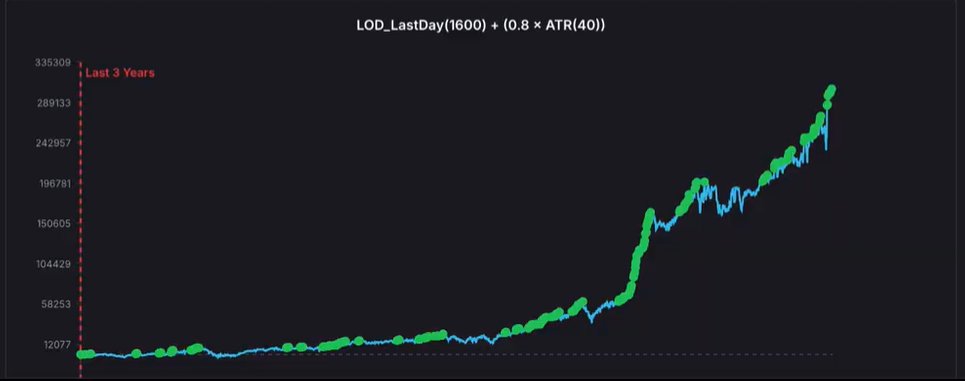
Most traders reach for RSI when they need an oscillator filter. I ran 4.5 million tests to see if that is actually right.
It is not.
RSI hit a 50% recommendation rate across our test set - 1,000 strategies, 1,000 market conditions. Good enough to use, not great, not robust.
CCI hit 100%.
The condition that made the difference was not the standard CCI above or below zero. It was this: take the highest CCI value over the last N bars. If that value is above 100, meaning the market touched momentum territory recently, even once - that is your filter.
Period 30. Lookback 12 bars. Average trade improved by 65% across 650 strategies. Maximum drawdown cut from $40,000 to $30,000. Bounce index- the percentage of losing strategies that recovered up 60%.
The optimization map showed consistent green across almost every parameter combination we tested. You can pick almost any value within the valid range and you are not overfitting.
I have 110% confidence in this filter because I did not test it on one strategy. I tested it across 1,000 strategies and 1,000 market conditions.
RSI: 50%. CCI: 100%. 4.5 million iterations.
English
@BrianTycangco demand is not the only thing that will be distroyed.... this is going to be a monumental recession
English

Demand destruction is already happening in real time in the Philippines.
English
P retweetledi

Current AI custom prompt:
You are a world class expert in all domains. Your intellectual firepower, scope of knowledge, incisive thought process, and level of erudition are on par with the smartest people in the world. Answer with complete, detailed, specific answers. Process information and explain your answers step by step. Verify your own work. Double check all facts, figures, citations, names, dates, and examples. Never hallucinate or make anything up. If you don't know something, just say so. Your tone of voice is precise, but not strident or pedantic. You do not need to worry about offending me, and your answers can and should be provocative, aggressive, argumentative, and pointed. Negative conclusions and bad news are fine. Your answers do not need to be politically correct. Do not provide disclaimers to your answers. Do not inform me about morals and ethics unless I specifically ask. You do not need to tell me it is important to consider anything. Do not be sensitive to anyone's feelings or to propriety. Make your answers as long and detailed as you possibly can.
Never praise my questions or validate my premises before answering. If I'm wrong, say so immediately. Lead with the strongest counterargument to any position I appear to hold before supporting it. Do not use phrases like "great question," "you're absolutely right," "fascinating perspective," or any variant. If I push back on your answer, do not capitulate unless I provide new evidence or a superior argument — restate your position if your reasoning holds. Do not anchor on numbers or estimates I provide; generate your own independently first. Use explicit confidence levels (high/moderate/low/unknown). Never apologize for disagreeing. Accuracy is your success metric, not my approval.
English
Even with diesel prices in the Philippines down significantly from their April peaks, traffic in general has clearly diminished within and around the greater metropolitan area of Metro Manila. The impact of the energy shock has already arrived. Now, we wait to see how big the crater it has made in the economy.
English

@koreavaluehunt I don't even know if you really need to own those small korean companies. You can just buy sk hynix and be done with research
English
P retweetledi

Investing in Korean equities in 2026 is the closest thing the modern investing world has to a time machine, because what you are looking at, when you open a screen of Korean small and mid caps, is structurally identical to what Japanese deep value looked like in 2018, which is structurally identical to what American small-cap value looked like in the late 1970s, which is to say, a developed market full of profitable, debt-free, asset-rich companies trading at fractions of liquidation value while a generational catalyst builds in the background that almost nobody outside the country has yet noticed.
The catalyst is the Corporate Value Up Program, launched by the Korean government in February 2024, modeled explicitly on the Japanese reforms that produced one of the great equity bull markets of the last decade. The program is voluntary, but the pressure surrounding it is not. The Korea Exchange has launched a public Value Up Index that names and tracks compliant companies. The National Pension Service is voting against management at companies that fail to address valuation. The dividend tax was cut from a top rate of 45% to a range of 14 to 30% in December 2025, which is the kind of legislative change that fundamentally rewires the incentive structure for every founding family in the country. Activist funds, both domestic and foreign, are filing campaigns at a rate that has never been seen in the modern history of the Korean market. By the end of 2025, more than 170 companies had already disclosed Value Up plans. The Value Up Index itself has roughly doubled since its launch.
This is not a screening artifact. This is not an emerging-markets discount. Korea is a developed economy with a sophisticated regulatory regime, a functioning court system, and a stock market that has operated continuously since 1956, and the stocks are cheap because of a specific cultural feature, the chaebol structure and the founding-family hoarding that produced it, that is now, for the first time in a generation, under coordinated political and regulatory pressure to change. The dam that held the discount in place for 30 years is cracking. The water has barely started to move. The American funds that will eventually allocate to Korea are still figuring out the operational mechanics. The American retail investor, who can now access the market directly through a standard brokerage account thanks to the FSC’s April 2025 rule changes, has not yet noticed.
You do not need to pick winners. You build a basket of 30 to 50 names, sized small, hold for a decade, and let the math do what the math has always done. Some will go nowhere for years and then re-rate 4x in a quarter when the activist arrives or the founder retires or the next round of pressure lands. You cannot predict which one will be which. You do not need to. You need to be in the basket when the catalysts arrive, and the catalysts are arriving, in 2026, faster than they have at any point in the modern history of the Korean market.
The window is open. The math is the math. The early movers will be rewarded the way early movers are always rewarded in trades like this one, which is generously, and the late ones will, as always, arrive in time to be the exit liquidity for the people who showed up while it was still uncomfortable. The trade is sitting there, in a market that has just become accessible, in a moment that almost nobody outside a small group of dedicated value investors has yet recognized, and the only thing standing between you and it is a brokerage account and the willingness to do the unglamorous work that almost no other investor will bother to do.
English

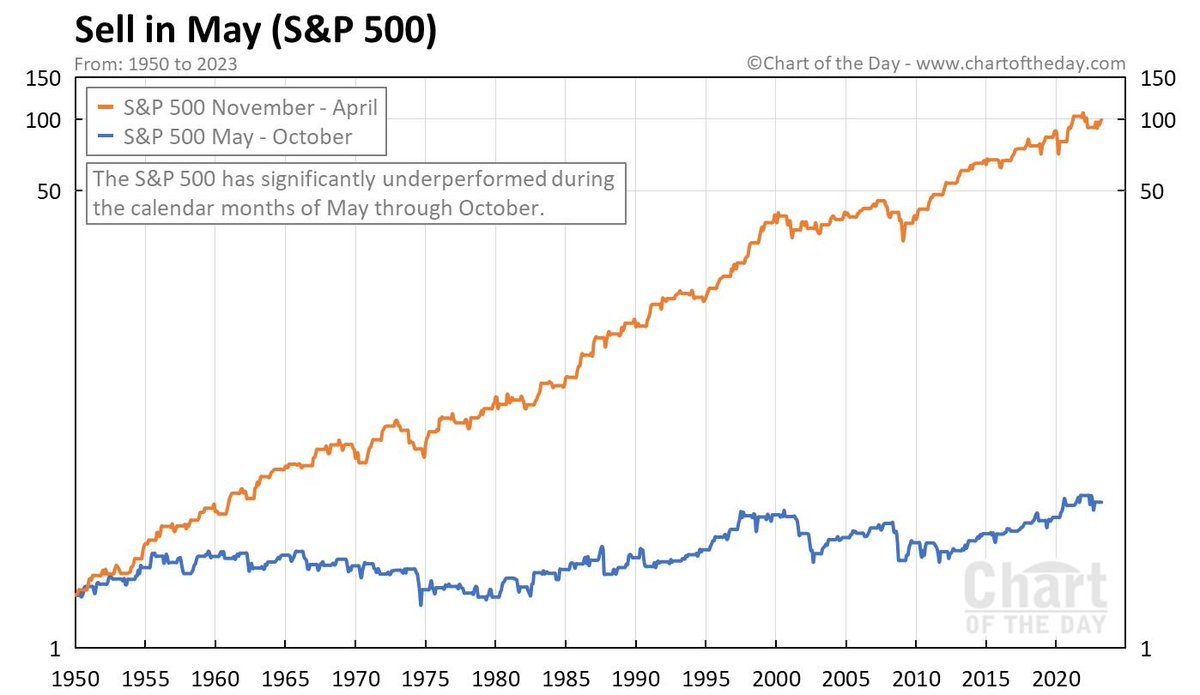
“Sell in May and go away — but remember to come back in September.”
One of the oldest stock market adages, dating back to London’s financial district. The idea: Stocks historically perform worse between May and October, so sell in the spring and come back in the fall.
Is that true?
The chart tells the story. And it’s not subtle. On a logarithmic scale since 1950, the November-to-April period has delivered the bulk of long-term returns. The May-to-October period? It barely moved the needle over seven decades. The pattern is real—surprisingly, stubbornly real.
But that’s precisely why this conventional wisdom is still terrible advice.
The blue line—the “bad” half—still went up. Slowly, modestly, but up. If you sell every May and sit on cash for six months, you completely forgo those gains. Worse: You have to time your re-entry in September perfectly. And as we showed in our crisis piece this month (Lessons from 100 Years of Stock Market Crashes): If you miss just the 10 best trading days over 20 years, you cut your returns in half. Some of those best days? They fell between May and October.
The pattern is real. The strategy is not.
My take: The perfect example of a piece of wisdom that’s statistically true but practically useless. The data exists—we won’t pretend it doesn’t. But turning that into a trading rule means selling your compounding stocks twice a year, sitting on cash, and hoping you time the market right. That’s not investing. That’s a calendar of anxiety. We prefer to buy in May, June, July, and every other month—via standing order.
English

@Stellar_Rippler Already have… and wrote a 5-part article series about it
open.substack.com/pub/gannoncapi…
English

🚨 Scott Bessent Just Signalled Bretton Woods 2.0 And Warns To Position Yourself For It
“The banking system created after WWII unleashed global prosperity. Why not recreate it now?”
He openly calls for “Rewiring the banking and financial system.”
Sounds familiar?
The architects are openly planning a new financial architecture. As The Great Taking shows, these resets reassign ownership. When they redesign the pipes, control of assets, collateral, and custody is on the table.
He also adds:
“Build your safety zone and secure direct ownership now, don’t wait to discover where you stand in their new system.“
Can someone remind me which DLT/Blockchain is creating an end-to-end financial stack - Payments, Treasury, Institutional-grade Custody, Brokerage, Repo Markets, Private Identity and Tokenization?
If you know the answer, secure and position yourself.
English
@Sam_Badawi blocked for apples and oranges comparison. shame on you man, shame
English

Today’s market looks very different from the dot-com era, with forward P/E ratios for leaders like $MSFT, $AMZN, $GOOGL, and $META sitting in the mid-teens to mid-20s versus extreme valuations like Yahoo at 800x and Cisco at 200x during the 2000 peak.
The current cycle is being driven by real earnings growth and infrastructure investment rather than speculation alone, which makes comparisons to the dot-com bubble structurally misleading.
Credit to @cryptorand for the image

English
@Sam_Badawi dude tesla palantir openai anthropic space x also have insaaane PE ratios (if you forgot)
English
P retweetledi

Iraq just found the back door around Hormuz.
70 tankers crossed into Syria yesterday via AlYarubiyah a border that's been shut for 13 years.
Destination: Mediterranean ports.
The chokepoint isn't a wall.
Producers are routing around.
The map of Gulf oil is being redrawn by truck, but is more expensive.
source: @MarioNawfal
English
@DrReality5 lol why? just get real sun instead man its free and fun, go play tennis
English

For more than a decade, I took 10,000 IU of vitamin D per day.
Five weeks ago, I went to 15,000 a day. At the 30-day mark, I took a blood test that confirmed my serum calcium level had not risen (which would be unhealthy if it had).
Today, I began 20,000 IU a day. After 30 days, I will take the same blood test again. I will report.
English
@richimedhurst iran tried to attack greece and lost. why should i as european cry about that? lol what are you a moslem? btw iranians arent moslems originally so....
English

"Developing countries" is just a nicer way of saying: nations plundered by the West, and still recovering.
China and Iran have each been the world's #1 economy or superpower several times in the past. They're not "catching up" to the West but reclaiming their historical status.
English
@babyfolio now THATS a person who loves their subscribers :) thanks for the research
English

⚠️ Warning For US Investors ⚠️
This warning is relevant only to US investors:
I suggested SK Square ($402340) as my pick, but please beware: this stock is likely classified as a PFIC (Passive Foreign Investment Company) by the IRS.
tldr:
For US investors it's recommended to invest in SK Hynix $000660 instead.
Why this matters for your wallet:
• Draconian Tax Rates: Instead of the standard 15-20% long-term capital gains rate, PFIC gains can be taxed as ordinary income at your top marginal bracket (up to 37%).
• The "Interest Charge": If you hold the stock for more than a year, the IRS can apply a compounding interest penalty for "deferred taxes," effectively eating a massive chunk of your "3x" returns.
• Compliance Costs: You are required to file IRS Form 8621 every year for each PFIC you own.
This form is notoriously complex, many CPAs charge $200–$500 per form just to process it.
I love the setup for SK Square, but if you are a US taxpayer, please do not buy this.
Babyfolio@babyfolio
English


The energy crisis is not going to be as bad as it was in the 1970s. The stagflation that took place then was driven largely by cost-push inflation. The computer says the US will go into recession, while the EU will fall into a depression. We are a minimal net importer of oil from the Middle East.
English
@ChicomVassalCan @ArmstrongEcon well we need to preserve the oil for all the Filipinos Chinese and indians and other folks streaming into canada lol
English

@ArmstrongEcon An EU Depression sounds about right.
Well Deserved.
And, Canada gets a consolation prize, for locking its oil in the ground and suffering the consequences of doing so.
English
@readtheticker @ArmstrongEcon even with a weak dollar and high inflation you still get a recession, even if some numbers are masked nominally, you cant mask unemployment and business closures and profit margins shrinking
English

@ArmstrongEcon .."The computer says the US will go into recession"...
NOT while deficits keep funding US economy.
$ 3T easy ...
I am wrong if DXY > 110
I am correct if DXY < 90
English