PARMINDER SINGH

129 posts

PARMINDER SINGH banner
PARMINDER SINGH

PARMINDER SINGH

@Parminder_S94

Living my small infinity ☺️

California, USA Katılım Kasım 2016
231 Takip Edilen101 Takipçiler
Peter Lidsky
Peter Lidsky@LidskyPeter·
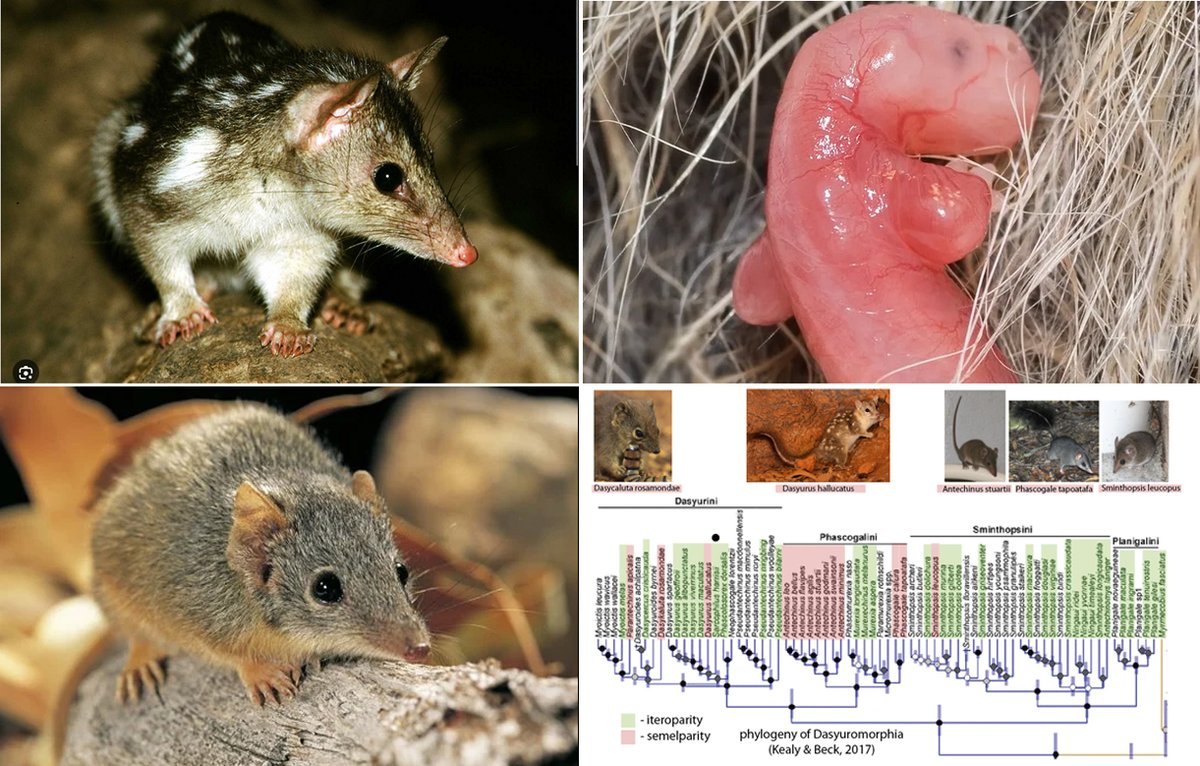
This Friday Aging Puzzle is on air! Today, it is not about aging specifically. It is about death, which is close but not the same thing. The topic is the evolution of semelparity and what drives its repeated evolution in carnivorous marsupials. As you may know, semelparity is a type of death that happens rapidly after reproduction. The classic example is Pacific salmons that go up the rivers to lay eggs and die soon after this. The exact evolutionary reason for this is unknown (we discussed it last week x.com/LidskyPeter/st…). Semelparity can also be found in lampreys, octopuses, some insects, and ticks. Some people say it is because of the tremendous effort these animals put into reproduction, but this take is likely wrong. For example, the mechanistic reason for death in the Pacific salmons is a hormonal spike. If the glands are removed, salmons can survive spawning. Phenotypically, muscle and neural system degeneration, as well as immune and kidney decline in fish, looks like a programmed suicide and not as a consequence of exhaust. Strange, right? And what about mammals? Is semelparity found in mammals? Surprisingly, it evolved only in two groups of carnivorous marsupials, Dasyuridae and Didelphidae, from Australia and South America. The North American opossums belong to Didelphidae, but is not semelparous, so today’s puzzle does not inspect garbage in your garden right now. North American opossums reproduce several times, while some of their relatives die very soon after replication. Paradoxically, in most semelparous species, only males die after breeding. It would be quite strange to believe they exhaust more than females. Surprisingly, semelparity evolved in marsupials at least five times independently! So, something is not random about these species! Why is it never found in placental insectivores or carnivores that occupy similar ecological niches? Initially, when semelparity was discovered in marsupial mice, people also hypothesized that this was about exhaust. However, when it was found in Northern quolls (aka northern native cats), this model was challenged: quolls are quite big animals; they eat during the breeding season, so there are no good reasons to believe they get exhausted (doi.org/10.1098/rspb.2…). Currently, I am finishing a book about my aging theory, and this theory, among many others, can also explain this puzzle. I believe that the key evolutionary determinant that dictates why marsupials, but not placental animals, evolve semelparity is embryonic development. Placental animals nurture their embryos via the placenta and evolved mechanisms. This placenta (which is partially made by embryonic cells) is not attacked by the immune system. Marsupials also nurture their embryos while they are in the uterus. However, attachment of the embryo is accompanied by activation of the immune system that attacks the embryo as an alien tissue (similar to transplant rejection). Embryo tissue also activates immune response. All together, it is called “cooperative inflammation” (see doi.org/10.1016/j.jri.…). However, marsupial embryos are not attached for a long time, they come out as tiny pink beans, attach to the nipples, and are nurtured further with the mothers' milk. Finally, the question: my theory states that cooperative inflammation can be an initial but indirect reason for the repetitive evolution of semelparity in marsupials. It determines some important ecological factor that in turn, makes semelparity a good evolutionary strategy. Try to guess what this mysterious selective factor may be! The correct answer must be only two words long! As before, the first person providing a correct answer will get my signed paperback!
Peter Lidsky tweet media
Peter Lidsky@LidskyPeter

Attention! An Aging Puzzle! Precious prize for the winner!!! Here are five animals you can meet in many aging presentations. Why? They all have something unusual with aging, mortality, and lifespan. However, we do not know why they evolved these bizarre aging styles! Let's unfold: 1) Flying birds 🦜and many species of bats 🦇 evolved incredibly long lifespans for their body sizes. Sparrows can live 20 years in captivity, and Brandt's bats can survive up to 40 years in the wild. Some scientists connect it to protection from predators, but many small birds still have very high annual mortality! So, why flight is associated with longevity is not clear! 2) Naked mole rats basically do not age! These mouse-sized rodents can live up to 40 years and their mortality does not increase with age! Again, some scientists say naked mole rats are protected from hazards, but they are not: annual mortality of naked mole rats can be about 40%. 3) Eusocial insects (bees🐝, termites, ants🐜) and mole rats (Fukomys mole rats) have queens that reproduce and workers that don't. Their genomes encode two different programs for aging, a slow and a fast one. No answer is found so far for this. 4) Pacific salmon 🐟lives in the ocean but goes up the freshwater rivers to spawn. After spawning, all the fish die due to programmed death. The ecological reason for this is unknown. Some researchers claim that with this, fish feed their brood with their own dead bodies. However, calculations showed that the contribution of dead fish bodies to the nutrition of the next generation is minimal. While all these animals are entirely different, and their aging is bizarre in a very different way, they have something in common—something that you can describe in three to four words. I believe that this reason is key for the evolution of aging and for our understanding of aging in humans. Can you guess what it is? 😉 Oh, yes, I have promised a prize. I need to make a coming out: I am writing a book describing my theory and ideas! The first person who answers the question correctly will get a signed paperback! The winner, as well as the most inquisitive readers, will be invited for beta reading!!!

English
13
3
39
2.3K
PARMINDER SINGH
PARMINDER SINGH@Parminder_S94·
Practice the pause!! “Self-protection is learning how to take a pause between what you feel and how you react. When there is no awareness between what you perceive and the way that you respond, anything can control you.” @AcademicChatter
English
0
0
2
57
PARMINDER SINGH retweetledi
Pankaj kapahi
Pankaj kapahi@kapahi_pankaj·
Here is another obituary we wrote which covers Judy’s contributions in the field of cancer and the role she played in getting people in aging and cancer fields to talk. Judy was one of the most unifying forces in our field and will be missed by so many.
Nature Reviews Cancer@NatureRevCancer

Dr Judith Campisi passed away earlier this year. Pierre-Yves Desprez and @kapahi_pankaj honor her personal and scientific contributions in this Obituary. go.nature.com/441JKUE pic.x.com/CaxGk1wV4V

English
1
2
13
1.7K
PARMINDER SINGH
PARMINDER SINGH@Parminder_S94·
3/3 When individuals prioritize their own brilliance over collective intelligence, the entire team suffers, and opportunities for innovation and collaboration are lost.
English
0
0
0
41
PARMINDER SINGH
PARMINDER SINGH@Parminder_S94·
2/3 confidence with competence. However, true leadership isn't about being the smartest in the room but about including and learning from diverse voices.
English
1
0
0
42
PARMINDER SINGH
PARMINDER SINGH@Parminder_S94·
1/3 In academia, one of the most undervalued roles is that of nurturing and fostering the growth of team members. Unfortunately, there aren't enough incentives for this vital task. Instead, we often reward individuals who dominate conversations, mistakenly equating their
English
1
0
3
70
PARMINDER SINGH retweetledi
Pankaj kapahi
Pankaj kapahi@kapahi_pankaj·
We had a fun lab outing and team building day. Making it out of the Escape room and Chinatown visit was fun with this great group of talented and fun peeps.
Pankaj kapahi tweet media
English
1
2
26
1.3K
Priya Makhijani, Ph.D.
Priya Makhijani, Ph.D.@PMakhijani16·
It is my pleasure to share my 1st independently led primary research pub w/ @Winer_Imm_Lab With many pointing out the leaky gut + dysbiosis that come with Alzheimer’s disease,we set out to investigate changes in the gut immune system in a mouse model of AD biorxiv.org/content/10.110…
English
4
11
46
7.6K
PARMINDER SINGH retweetledi
KarsentyLab
KarsentyLab@KarsentyLab·
Have you ever thought about to what extent gestation influence organismal homeostasis during adulthood? In our most recent publication, we addressed this question through the hormone Osteocalcin. embopress.org/doi/full/10.10…
English
5
3
31
4K
PARMINDER SINGH retweetledi
VitaDAO 💛
VitaDAO 💛@vitadao·
💛 VitaDAO Fellowship Updates! Our latest fellowship batch has been selected and funded! 🎉 Here's a 🔍 closer look at the incredible minds in longevity research and why we chose to back their promising ventures. 💡 Parminder Singh, Cassy Le, and Marton Meszaros: 😍We're thrilled to have sponsored their attendance at ARDD 2023 - one of the top aging conferences. Their representation of diverse 🧬aging-related domains made this decision a no-brainer
VitaDAO 💛 tweet media
English
1
11
42
6.9K
PARMINDER SINGH
PARMINDER SINGH@Parminder_S94·
@TrumanLab @DrDDOM In ideal world may be yes, but in practical world its almost inevitable. Postdocs writes grant claim in CVs to show their demonstrative skill set. A Win-win solution that any grant agencies can do is to have a small contribution section in the grant for people other than PIs.
English
1
0
10
1.1K
Andy Truman PhD
Andy Truman PhD@TrumanLab·
@DrDDOM If a grant is not awarded to you, you can’t lost it as your grant on your CV, plain and simple. Should PIs make a postdoc write a whole grant and then claim it as their own-absolutely not
English
1
0
11
7.8K
Andy Truman PhD
Andy Truman PhD@TrumanLab·
Re: discussion of switching co-first authors on CVs for faculty positions. Another thing that I see commonly are postdocs listing themselves as having grants when they are not the PI of the grant. Don’t do this-it’s easy to look up and check…
English
36
11
213
225.1K