
Penny Van Bergen

1.1K posts

Penny Van Bergen banner
Penny Van Bergen

Penny Van Bergen

@Penny_VB

Associate Professor in Educational Psychology | Views my own

Sydney, New South Wales Katılım Temmuz 2015
409 Takip Edilen671 Takipçiler
Penny Van Bergen
Penny Van Bergen@Penny_VB·
@learnwithmrlee Great blog Brendan. I don’t know if you’ve read much of Martin’s load reduction instruction, but it includes similar balance of “what when and why”, drawing on the different needs of novices and experts. Then it’s a question of “what do we want to achieve?”
English

0
0
0
36
Brendan Lee
Brendan Lee@learnwithmrlee·
Does anyone else feel torn when people pit explicit instruction against discovery learning? 🙋‍♂️ On one hand, I know the research: novices need guidance. "Minimal guidance" usually leads to frustration. On the other hand... as a teacher, there is nothing better than seeing a student have a genuine "Aha!" moment where they connect the dots themselves. For years, I've felt frustrated at feeling like I had to pick a side. Learning about the Instructional Hierarchy has been great at explaining how it's all about when and how. But recently, I’ve been diving into the world of Contingency Adduction and it has really started to provide some precise answers for me. It’s a framework that shows how we can engineer discovery. We don't leave it to chance. We build the tool skills to such a high level of fluency that the "discovery" becomes inevitable. It’s about designing for the "Aha!", not the "Huh?". I wrote a piece explaining how this works (and why most discovery lessons fail because they skip the fluency step). Check it out here: open.substack.com/pub/knowledgef… You might find this interesting @brian_poncy @msrebeccabirch @jettybe3 @StamStam193 @nsachdeva2019 @teacherhead @Emma_Turner75
Brendan Lee tweet media
English
10
8
24
3K
Penny Van Bergen
Penny Van Bergen@Penny_VB·
@mathillustrated How do you draw the difference Ralph? (I’d treat knowledge as true justified belief, which would require understanding to ensure justification)
English
1
0
0
29
Ralph Pantozzi
Ralph Pantozzi@mathillustrated·
We don't want our students just to know things, we want them to understand. #iTeachMath
English
2
2
7
364
Penny Van Bergen
Penny Van Bergen@Penny_VB·
@TPLTD @C_Hendrick In cog sci there’s even a retrieval-induced forgetting phenomena where non cued info is more likely to be forgotten than if there was never retrieval The benefit with retrieval practice, though, is the chance to go back during different activities and cover more of that content
English
1
1
1
546
Terry Pearson
Terry Pearson@TPLTD·
@C_Hendrick Somewhat like retrieval practice. Research mainly reports that it has frequently enhanced recall of the specific content it targeted but provided no benefit whatsoever for recalling other information from the same learning resource.
English
1
0
1
64
Carl Hendrick
Carl Hendrick@C_Hendrick·
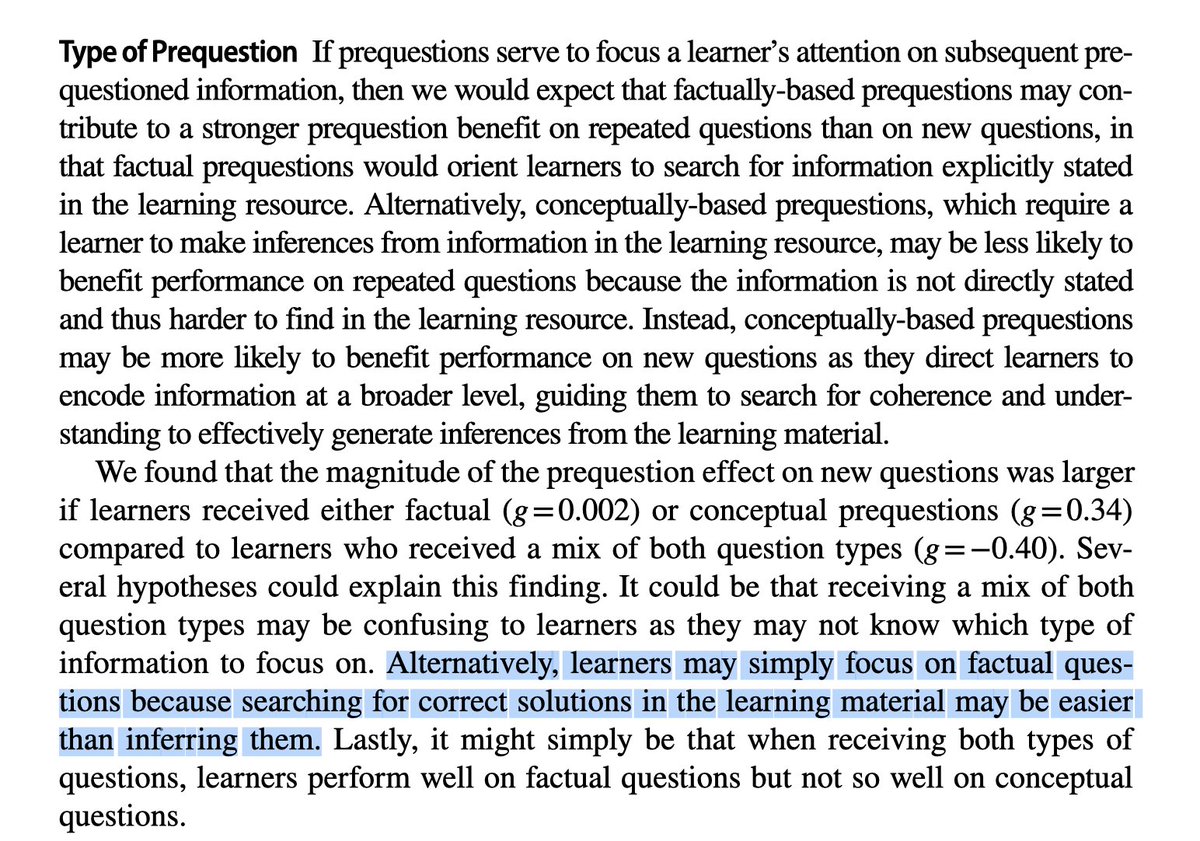
Sixty years of research on prequestions: they work, but only for the content they directly target. They reliably enhance learning of the specific content they target, but provide no benefit whatsoever for learning other information from the same learning resource. Educators should therefore use prequestions strategically: if you want students to learn specific facts or concepts, prequestion those exact items. But do not expect prequestions alone to generate broader curiosity or deeper engagement with adjacent material. link.springer.com/article/10.100…
Carl Hendrick tweet media
English
1
7
36
3.8K
Penny Van Bergen
Penny Van Bergen@Penny_VB·
@PamelaSnow2 @C_Hendrick I think there are disciplinary nuances too - autobiographical memory research in devt psych sometimes invokes Vygotsky when considering parent-child scaffolding of memory but there’s a heavy focus on adult talk quality
English
0
0
0
25
Penny Van Bergen
Penny Van Bergen@Penny_VB·
@TPLTD @C_Hendrick Coming from devt psychology into education, they’re almost two different versions of the one theorist. The discipline seems to matter here (in my anecdotal experience at least)
English
0
0
0
12
Terry Pearson
Terry Pearson@TPLTD·
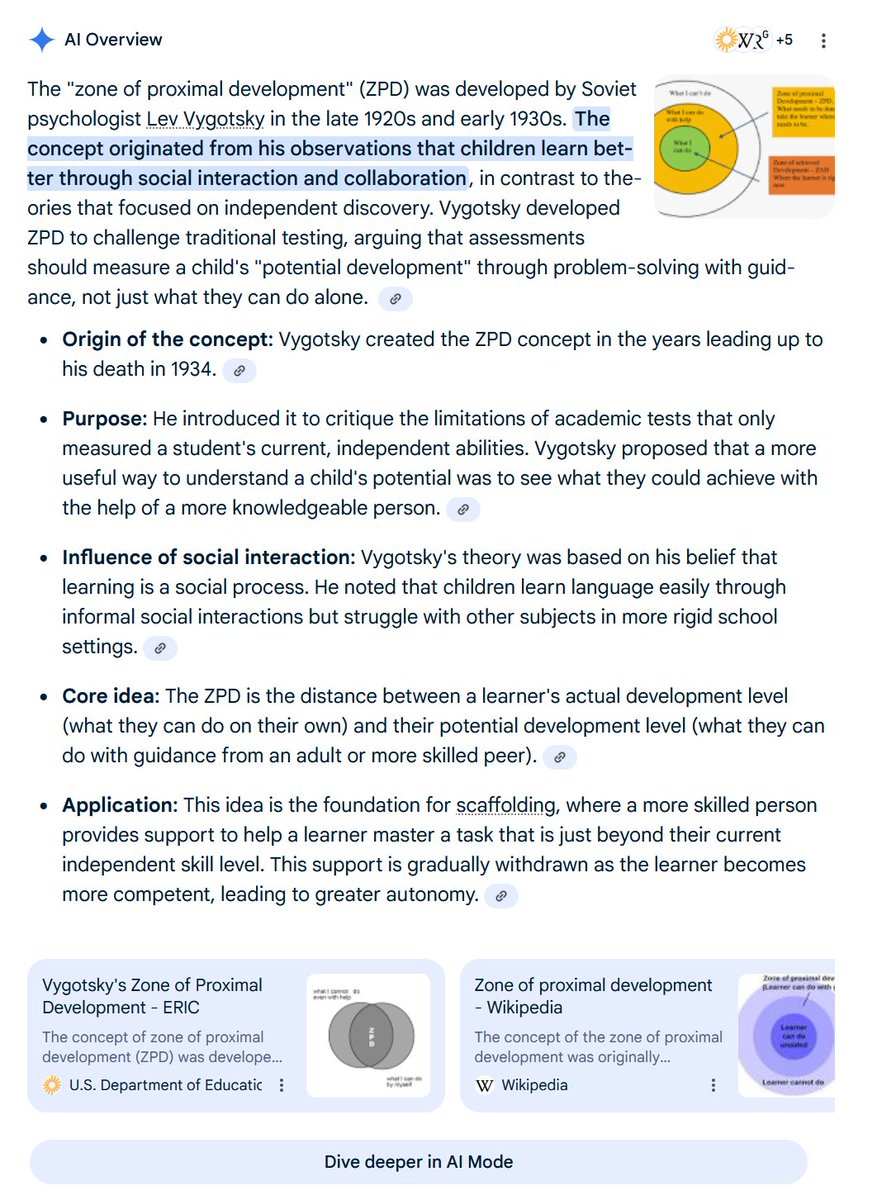
@C_Hendrick Not sure that the general Western view of Vygotsky is one of a person who favours discovery learning over support from a more knowledgeable person. See this short AI perspective for example:
Terry Pearson tweet media
English
3
0
2
213
Carl Hendrick
Carl Hendrick@C_Hendrick·
Vygotsky's 'Zone of Proximal Development' is perhaps the most misunderstood idea in education. It was never a teaching method but a metaphor for how teaching can pull thinking upward, from the everyday to the scientific. ⬇️ 🧵
Carl Hendrick tweet media
English
11
100
334
63.5K
Kevin Fulton
Kevin Fulton@Teacher_Fulton·
Do I want an app that combines two of my least favorite things?
Kevin Fulton tweet media
English
2
0
1
379
James Dobson
James Dobson@jdtdobson·
@Penny_VB Thanks! Stress injuries are frustrating- I hope it's healing well
English
1
0
1
35
James Dobson
James Dobson@jdtdobson·
Had a blast at the Sydney Marathon in its 1st year as a World Major. Loved the views & vibes! Sydney turned on the weather for us 🙌 Even spotted Kipchoge on course. He was close to finishing, I was still at the 15k mark.
James Dobson tweet mediaJames Dobson tweet mediaJames Dobson tweet mediaJames Dobson tweet media
English
1
0
10
1.3K
Chalkytalky
Chalkytalky@theawfulMrD·
@SciInTheMaking Walking is not running, but still - it's difficult to imagine academics assigning the same low regard for walking as they seem to do for memorisation.
English
1
0
0
69
Ms. Sam
Ms. Sam@SciInTheMaking·
I think experts carry knowledge in their long-term memory for so long that recalling it feels automatic. Because of this automaticity, they don't recognize it as something they’ve memorized. And then they tell people that memorization is not important for learning.
Prof. Feynman@ProfFeynman

Memorization is not learning.

English
37
55
636
42.8K
treehousekeeper
treehousekeeper@treehousekeeper·
@Penny_VB What Feynman said about memorization is true. Remembering is critical to learning. Memorization is not.
English
2
0
2
68
Penny Van Bergen
Penny Van Bergen@Penny_VB·
@warmMagnet @SciInTheMaking Sure; I’m all for careful articulation. I don’t know any researchers in memory or cognition who would say that it’s true or unhelpful to see LTM as the place we keep knowledge and skills though? Most using/building on Tulving-type understandings of LTM
English
0
0
0
35
Dylan Smith
Dylan Smith@warmMagnet·
@Penny_VB @SciInTheMaking These matters need to be carefully articulated because there are many kinds of learning and many kinds of memory. It's not helpful for a scientist or a teacher to say that everything we learn and take forward has found its way into "long term memory." We know better.
English
1
0
0
95
Trish 🐻
Trish 🐻@themetresgained·
From the Productivity Commission's Skilled and Adaptable Workforce interim report. Look at the last line 🙄
Trish 🐻 tweet media
English
7
1
17
3K
Penny Van Bergen
Penny Van Bergen@Penny_VB·
@warmMagnet @SciInTheMaking But aren’t those experiences held in memory still - and the activity which generates them part of the encoding process? Memory shouldn’t be taken to mean passive or rote; although it’s sometimes characterized that way
English
1
0
0
48
Dylan Smith
Dylan Smith@warmMagnet·
Memorizing is indeed a proper kind of learning, and it can be quite sophisticated. But it’s limited, too. Memorized info can only support abstract kinds of planning between our ears. More active learning builds experience that directly supports real-world action planning. Experience helps our entire being enact behaviour competently.
English
2
0
1
195
Penny Van Bergen
Penny Van Bergen@Penny_VB·
@Teacher_Fulton I asked my daughter what makes a good teacher recently and she said “strict and kind”. Anecdotal of course, but kids really do thrive when they have both structure and care ☺️
English
0
0
1
43