Shantanu Pradhan

559 posts

Shantanu Pradhan

Shantanu Pradhan

@PradhanLab

Assistant Professor, Department of Biotechnology, IIT Madras
Chennai, India Katılım Mayıs 2019
697 Takip Edilen478 Takipçiler
Shantanu Pradhan
Shantanu Pradhan@PradhanLab·
Congratulations to Srashti Birla from Dept. of Biotechnology, IIT Madras for getting selected for the Bangalore Microscopy Course 2026! Wish her the best!
English
0
0
3
104
Shantanu Pradhan
Shantanu Pradhan@PradhanLab·
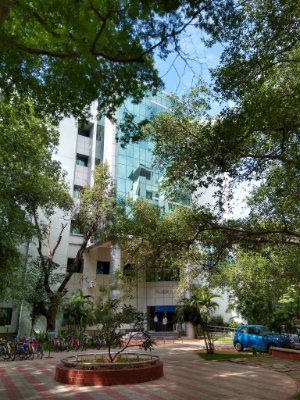
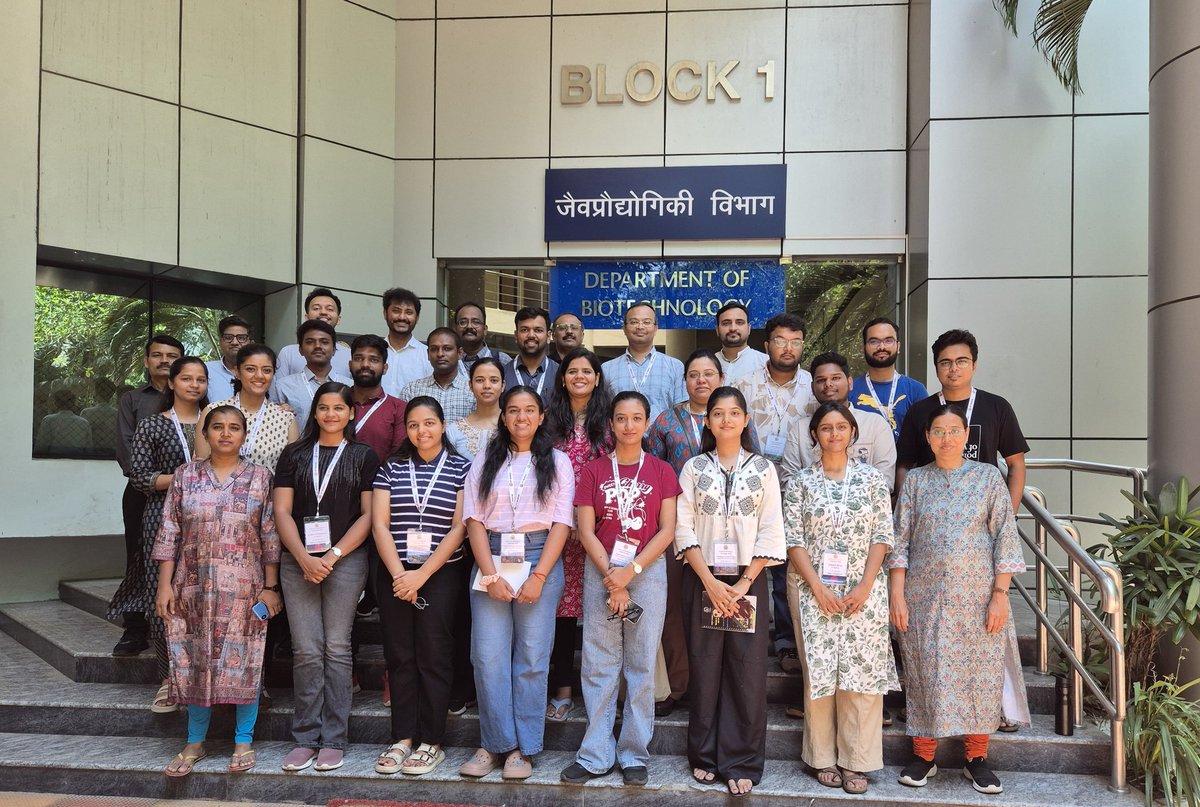
We conducted the Advanced Bioimaging Workshop 2026, May 18-20, in Dept. of Biotechnology, IIT Madras. Thank you to all the participants, speakers, trainers, sponsors and volunteers for making this a successful and educative event. @iitmbt
Shantanu Pradhan tweet mediaShantanu Pradhan tweet mediaShantanu Pradhan tweet mediaShantanu Pradhan tweet media
English
2
2
12
791
Shantanu Pradhan retweetledi
Department of Biotechnology IIT Madras
Dept. of Biotechnology, IIT Madras is organizing Workshop on Rheology and Soft Matter Mechanics in collaboration with Anton Paar. Register soon for this exciting hands-on-training opportunity!
Department of Biotechnology IIT Madras tweet media
English
0
3
6
327
Shantanu Pradhan
Shantanu Pradhan@PradhanLab·
@ganitlabs Yes, because for many people, tone of the message is more important than the content of the message.
English
1
0
0
26
binay panda
binay panda@ganitlabs·
science community in #India is v polite & well-behaved! language like shit/fuck/rubbish in mtgs are heavily criticized & civility in lang use is enforced. #plagiarism, #misconduct, #corrupt practices, however, are well tolerated b'cas one uses parliamentary lang while doing so.
English
1
0
4
167
Shantanu Pradhan retweetledi
Sanjeev Sanyal
Sanjeev Sanyal@sanjeevsanyal·
This is why "skin in the game" is such an important filter.
Marissa Streit@marissastreit

.@GadSaad agrees with Orwell: it takes an intellectual to come up with truly stupid ideas. When academics are disconnected from reality or accountability, bad ideas spread like parasites. While STEM professionals have to answer for their mistakes, humanities professors build theories that no one ever has to test. That lack of accountability is exactly how toxic ideas take over a university and eventually a culture. If these professors can't survive the scrutiny of their own ideas, should they be teaching our children? Watch here 👉l.prageru.com/49RBlY7

English
23
208
1.1K
53.7K
Shantanu Pradhan retweetledi
kshitij vaze
kshitij vaze@VazeKshitij·
I got so, so much to say about this man. This is going to be long, so buckle up. There is a mental block in Indians that stems from the British rule. Someone who sits in a cabin, surrounded by papers and constantly looking busy has historically been associated with power, intelligence, and importance. During the colonial era, this perception made perfect sense. The people occupying those offices were not merely employees - they were extensions of the administrative machinery that governed the country. The clerk, the officer, the babu, the man behind the desk with stamps, files, and authority, represented access to power itself. Entire lives could be altered based on what happened inside those rooms. Naturally, generations grew up internalizing the idea that proximity to paperwork and administration equated to status. The British left decades ago, but cultural conditioning does not disappear with a flag change. The structure survives long after the rulers are gone. Even today, Indians subconsciously associate office environments with success and dignity in a way they rarely do with industrial or technical labor. A BPO employee wearing a formal shirt, sitting in an air-conditioned office and speaking English into a headset often commands more social respect than a CNC machinist capable of manufacturing components with tolerances tighter than a human hair. One is perceived as “corporate,” the other as “factory labor,” despite the latter possessing an extraordinarily specialized and economically valuable skillset. And that disconnect says something deeply uncomfortable about how we value work. A skilled machinist can take a raw block of metal and convert it into high-precision components that may end up in automobiles, aircraft, industrial robots, medical devices, or defense systems. That requires mathematical understanding, spatial reasoning, knowledge of materials, tooling strategy, machine behaviour, thermal expansion, tolerance stack-ups, feeds, speeds, vibration control, and process discipline. Mistakes are expensive. Precision is unforgiving. The work has tangible consequences in the real world. Yet socially, this individual is often viewed as somehow “below” someone doing process documentation for a foreign client in an outsourcing firm. India developed an economy where appearing professional became more important than producing something real. Entire generations were taught that escaping physical or industrial work was the ultimate marker of upward mobility. Parents wanted their children in offices because offices symbolized safety, cleanliness, English-speaking environments, and social elevation. Factories, workshops, shop floors, and machine environments became associated with struggle rather than expertise. The tragedy is that this mindset emerged precisely in a country that desperately needed strong manufacturing capability to become economically self-sufficient. You can see the consequences everywhere. We celebrate startup founders making apps that optimize food delivery by 3%, but rarely admire the people who understand tooling, fabrication, embedded systems, production engineering, process automation, or manufacturing reliability. We romanticize “corporate culture” while ignoring the fact that nations become powerful through industrial competence, not PowerPoint presentations. A society that cannot respect the people capable of building and maintaining physical systems eventually becomes dependent on those who can. The irony is almost absurd. The CNC machinist, the welder, the industrial technician, the maintenance engineer, the assembly line specialist - these are the people who convert engineering from theory into reality. Without them, designs remain drawings and simulations remain fantasies. They are the interface between ideas and existence itself. Yet because their expertise exists on a shop floor instead of inside a glass office cabin, society often treats them as lesser. And honestly, it makes me sick to witness.
Sanskar Modi@sanskarmodi22

India doesn't have a manufacturing problem. India has a respect problem. We respect the guy who cracked CAT more than the guy who can build an engine from scratch. And that concludes the whole story.

English
24
67
432
26.8K
Shantanu Pradhan retweetledi
Alushin_Lab
Alushin_Lab@Alushin_Lab·
Very pleased that after a rigorous (and lengthy) review process, our paper visualizing how myosin generated forces modulate actin filament structure for mechanosensitive recogntion by α-catenin has appeared in @Nature nature.com/articles/s4158…
English
4
24
91
7.2K
Shantanu Pradhan retweetledi
Swapnil Srivastav
Swapnil Srivastav@theswapnilsri·
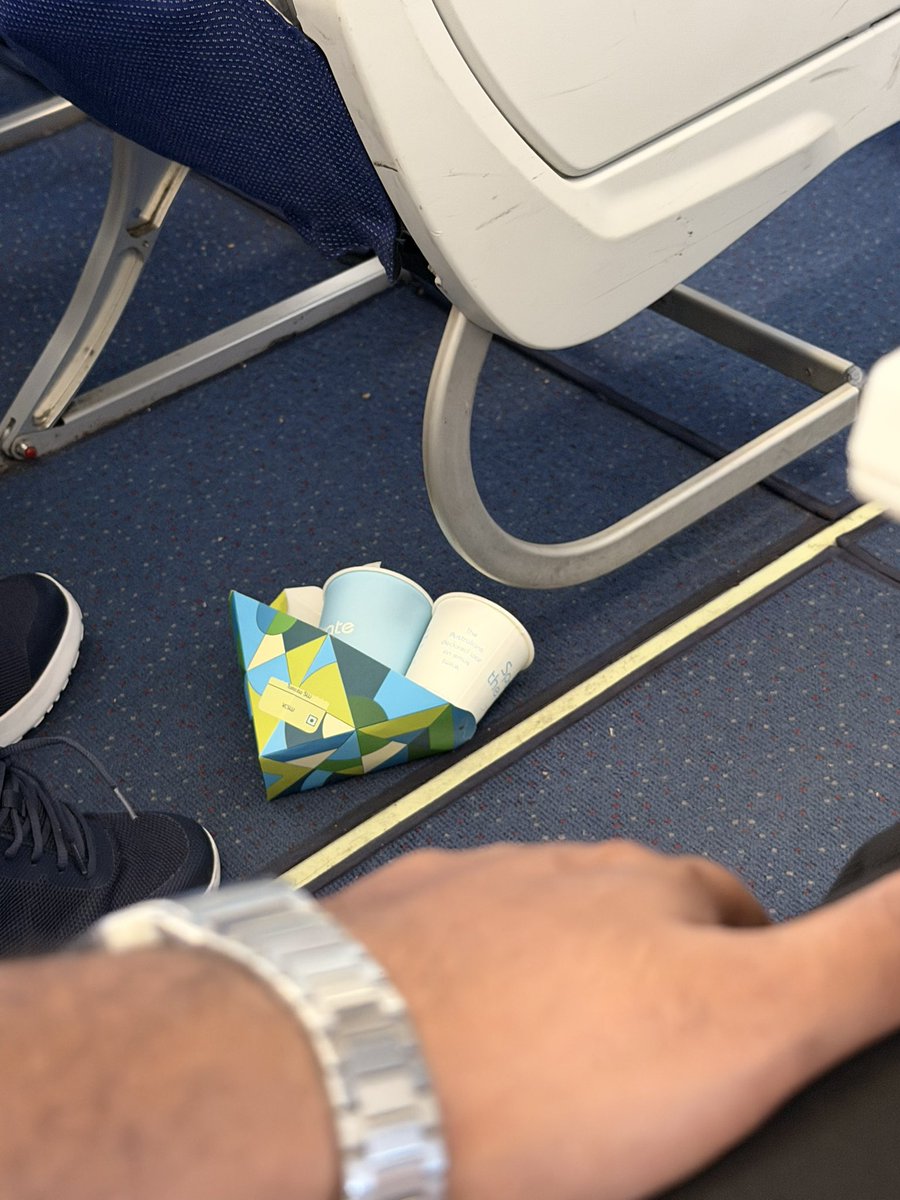
Something small happened on my flight yesterday. IndiGo flight. Sitting next to a guy, well put together, well dressed. The kind of person you’d point to and say “educated, aware.” He finishes his snack. Looks at the trash in his hand. And places it on the floor under the seat in front. Not accidentally. Deliberately. The cabin crew came through for trash collection. Did their job perfectly. Collected from everyone’s hands, every tray table. The stuff on the floor, easy to miss from that angle, stayed. We landed. His cups and food box were still sitting there on the aircraft floor. And I just sat with this feeling I couldn’t quite name. It wasn’t anger. It was something closer to disappointment. Or maybe exhaustion. Because we’ve been having this conversation about civic sense in India for decades now. And nothing moves. Here’s what I’ve come to believe. It’s not an awareness problem. It’s not an education problem. It’s not even an income problem. It’s a “whose problem is it” problem. Most people in India have unconsciously decided that shared spaces, flights, roads, parks, footpaths, are not their responsibility. Someone is paid to clean it. Someone will handle it. Me? I’m just passing through. And that mindset is exactly where the problem begins. Because civic sense isn’t just about what you do. It’s about what you normalize. Every time someone litters and nobody reacts, the bar drops a little lower. Every time someone cleans up after themselves in a space nobody’s watching, the bar rises. We are all, quietly, setting the standard for each other. Choose the standard you want to live in.
Swapnil Srivastav tweet media
English
247
374
1.6K
180.2K
Shantanu Pradhan retweetledi
Inna Vishik
Inna Vishik@InnaVishik·
Academics are not known for their EQ, but there are some scenarios where they put in all their effort to make it seem otherwise. 1) Responses to referee reports, which by decree, must be sufficiently obsequious, lest someone change their opinion for the worse. You cannot LLM your way out of this, the obsequiousness must come from your own heart. 2) Trying to gauge the emotional state of your dean (akin to an abusive relationship). Did we put in enough tit to receive that tat? Are we responding to all whims with sufficient joyful deference?
English
3
2
37
9.5K
Shantanu Pradhan retweetledi
Oded Rechavi
Oded Rechavi@OdedRechavi·
Every PI
English
11
103
813
155.5K
Shantanu Pradhan retweetledi
Fermat's Library
Fermat's Library@fermatslibrary·
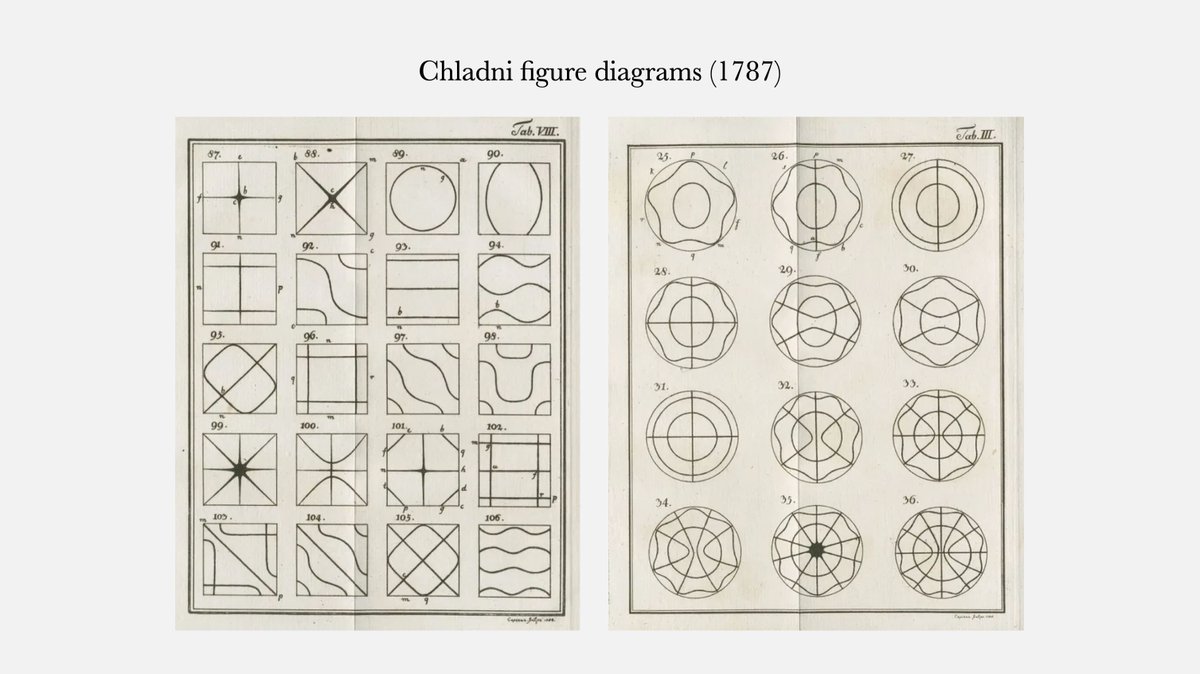
Ernst Chladni was a German physicist and musician, often called "the father of acoustics." In the late 18th century, he developed a technique that made sound visible: he sprinkled sand on metal plates and bowed them with a violin bow. The sand migrated to the nodal lines revealing geometric patterns now known as Chladni figures. In 1808 when Napoleon saw the demonstration and was so impressed he offered a prize for the best mathematical explanation. Sophie Germain, a self-taught French mathematician was the only entrant who got the approach right - though her solution had some flaws. She became the first woman to win a prize from the Paris Academy of Sciences for her work on elasticity theory. The math describing Chladni figures later showed up in quantum mechanics when Schrödinger used similar mathematics to describe electron orbitals.
Fermat's Library tweet media
English
6
104
472
28.9K
Shantanu Pradhan retweetledi
Jasveer Singh
Jasveer Singh@jasveer10·
India isn’t dirty because people can’t clean, or lack civic sense. India is dirty because people genuinely believe it’s not their job. That belief comes from caste. And that belief is not accidental. It comes straight from caste conditioning drilled into people for generations. Caste in India was never just about hierarchy. It was about assigning work. And cleaning got pushed to the bottom. So now even today, people carry that same mindset without even realizing it. I am not the one who cleans. You go to a park, people will eat, throw garbage, walk away. Not because they’re unaware. Their brain literally doesn’t even register that they should pick it up. Why. Because somewhere deep inside, they think cleaning is a ‘lower’ person’s job. Same everywhere - Hill stations, rivers, tourist spots. Trash it and leave. Not laziness. Conditioning. Compare this with somewhere like Singapore - You eat at a place, people clean their own table. They carry tissues, wipe it, and throw garbage properly. Why? Because they don’t think it’s someone else’s job. Even Sri Lanka feels cleaner than India! And then we pretend it’s a Swachh Bharat problem. You can run a hundred Swachh Bharat campaigns. Put dustbins every ten steps. Nothing changes. Because the problem is not infrastructure. It’s identity.
English
451
827
3.3K
271.5K
Shantanu Pradhan retweetledi
Denis Wirtz
Denis Wirtz@deniswirtz·
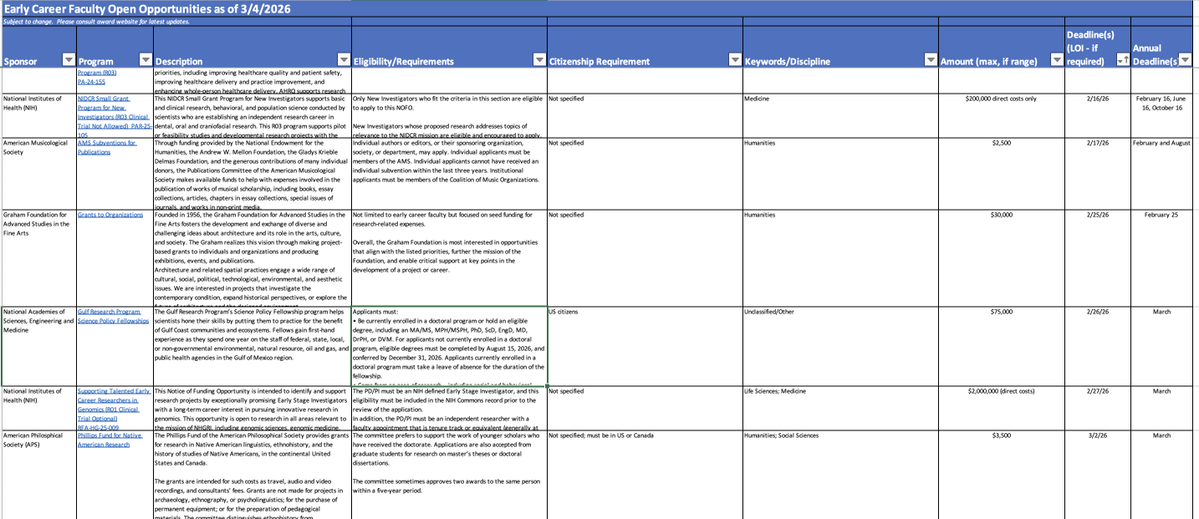
Here is our updated database of grants for early careers researchers in all fields. It goes way beyond traditional NIH and NSF funding opportunities. We list 428 types of grants. Download it here: research.jhu.edu/rdt/funding-op…
Denis Wirtz tweet media
English
15
379
1.2K
149.8K
Shantanu Pradhan retweetledi
Michael Samuel
Michael Samuel@TMEM_Samuel·
I am delighted to be able to share that our latest paper arising from a project co-led by @DrSarahBoyle and me is now out in the world, published in AAAS Science Advances: science.org/doi/10.1126/sc….
English
2
6
15
2.2K