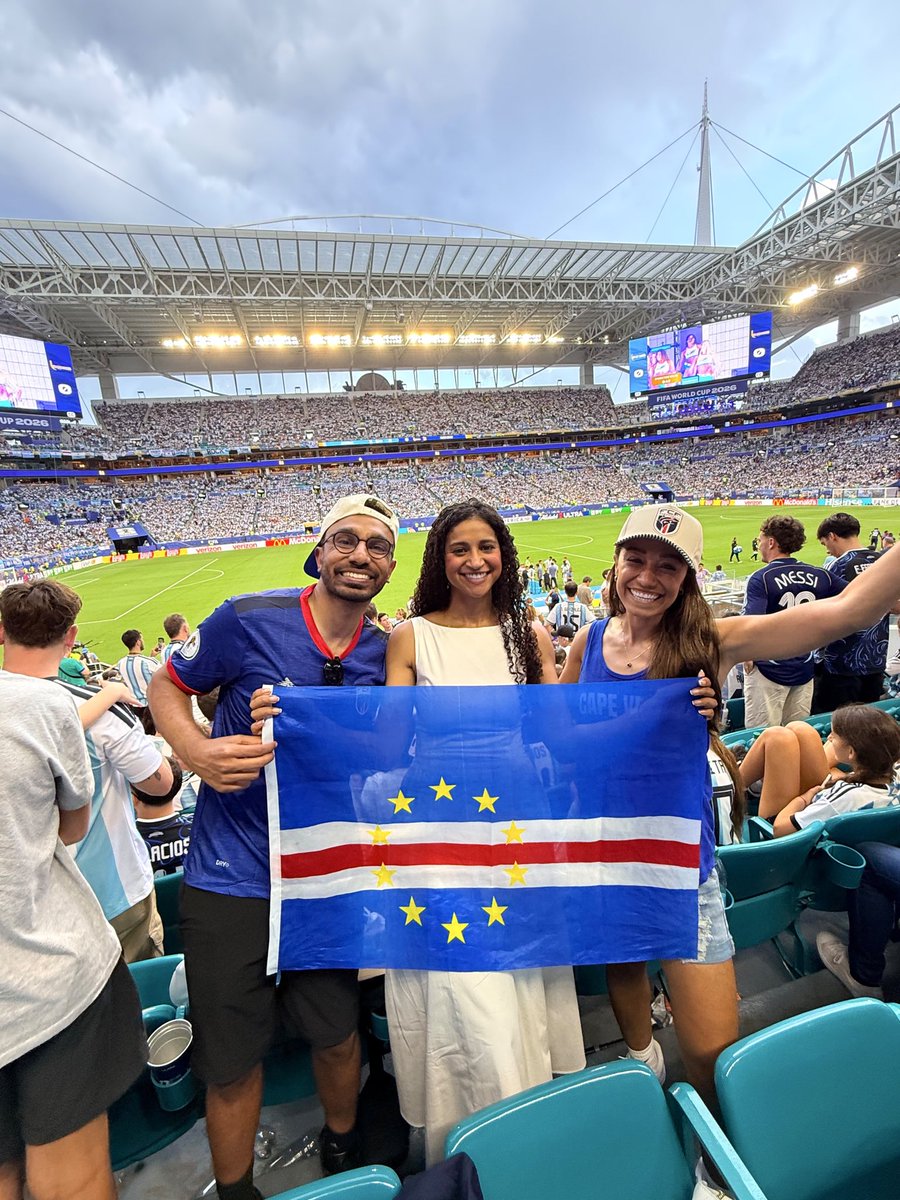
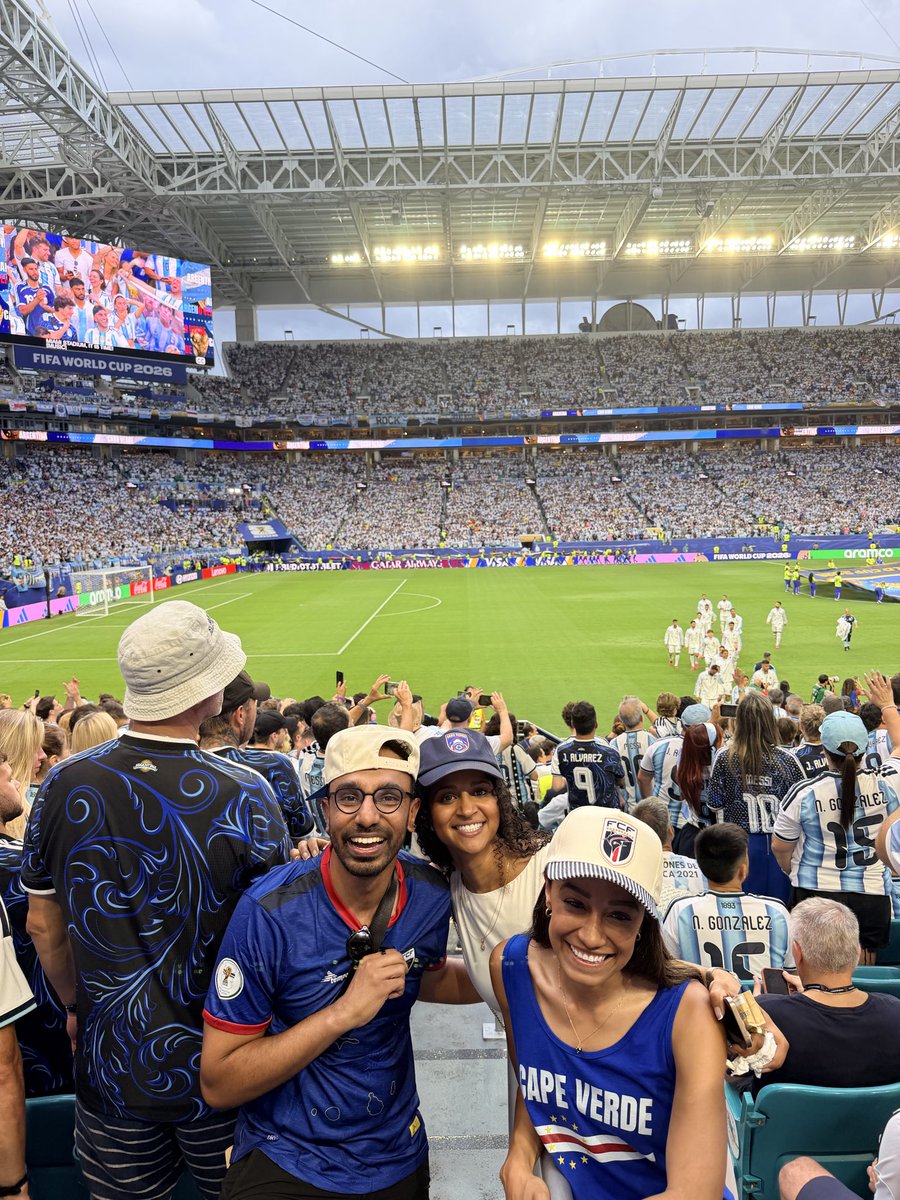
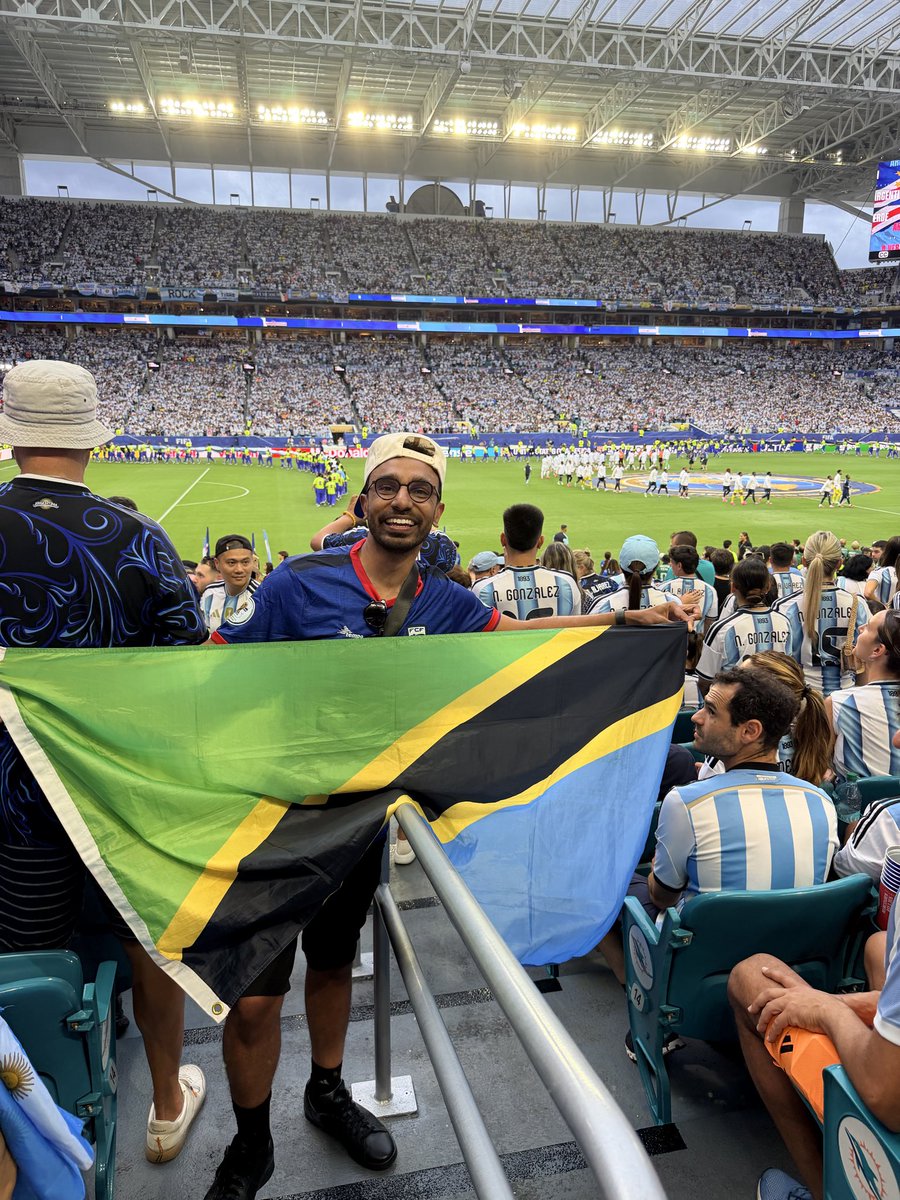
39 year old Messi was carrying this classless group of cheats and cavemen thugs that we call footballers.
I hope they don’t win anything else in my lifetime when Messi eventually retires.
Yesterday 4 flights cancelled.
Booked last minute to Baltimore at 7am.
Need to land and drive 4 hours to the final. I hope I make it.
Por la ultima de Leo.
🙏
Why do we still buy stadium tickets without ever seeing what the view from the seat actually looks like? ☠️
So I prototyped an idea.
A 3D seat view experience for a football stadium built with Fable 5 + @threejs, where you can preview exactly what you'll see from your seat before buying.
The entire 3D experience was working after the first prompt, and the whole prototype came together in just five prompts.
This is the kind of 3D experience I'd love to see more of, tbh. Feels so good.
Right now, buying a ticket gives you almost no sense of what the experience will actually feel like. We're still relying on static seat maps, charts, and boring UI layouts, when interactive 3D experiences could make that decision so much easier.
If you think, 3D development has the potential to create genuinely useful experiences. This feels like the direction we should be heading. 3D is the future.
I can already imagine this for cinemas, cricket stadiums, Wimbledon, concerts, and so many other venues.
I'm planning to take this further. What should I build next? More stadium features, or should I try another venue? Let me know :D
Code: github.com/thebuggeddev/f…
Live: football-stadium-ruddy.vercel.app
🚨 𝗗𝗜𝗗 𝗬𝗢𝗨 𝗞𝗡𝗢𝗪: Lionel Messi will become just the second player in football history to play in three World Cup finals.
• 🇧🇷 Cafu: 1994, 1998, 2002.
• 🇦🇷 Messi: 2014, 2022, 2026.
derek thompsons recent article inspired me to read more about alcohol
im shocked by the est impact vs current narrative
for instance, 7-14 drinks per wk reduces life expectancy by only 6 mos (!!)
moreover, the negative effect is possibly offset by gains from deeper friendships
My conversation off late
It was a clear foul
Me: Have you ever fouled during the game
No
Have you ever played football
No
Have you seen many WC football games
Yes, a lot!
Nice, when did you start seeing football World Cup
This is my first one
I give up!
Incredible Egyptian goal is disallowed because of a foul far away, then same situation a few minutes later and goal for Argentina not disallowed! No VAR, nothing? FIFA again looks like a corrupt joke, playing favorites for stars.
The biggest misconception about stablecoins is that the winner will be determined by the token.
It won’t.
It will be determined by the ecosystem.
Great ecosystems aren’t built overnight. They’re built through years of investment in infrastructure, liquidity, regulatory engagement, interoperability, and developer adoption.
@circle deserves enormous credit for laying that foundation. Building USDC into one of the world’s most trusted digital dollar networks wasn’t the result of one product launch.
That’s why I actually see announcements like OUSD as a positive for the industry.
Every credible participant that enters the ecosystem helps:
More enterprises become comfortable adopting stablecoins.
More developers build real-world applications.
More banks integrate digital dollars.
More regulators engage constructively.
More payment companies invest in infrastructure.
The network gets stronger. The market gets bigger.
At Nium, we’ve always believed the opportunity isn’t to replace one payments network with another. It’s to build the financial infrastructure that enables money to move as seamlessly as information does on the internet.
The stablecoin market is still in its infancy. The next decade won’t be won by a single company, it will be won by the ecosystem that creates the most trust, the deepest liquidity, and the greatest utility.
That’s good for Circle.
That’s good for the industry.
And, most importantly, that’s good for customers.
MEMORY IS THE MOAT
@nikesharora, Chairman & CEO of @PaloAltoNtwks , interviewed by @HarryStebbings (@20vcFund )
Summary: Nikesh Arora took Palo Alto Networks from an $18 billion company to one worth $225 billion, and his read on enterprise AI is blunt: most companies are doing it wrong, and most of the products are not ready. His core claim is that consumers forgive AI's mistakes while enterprises cannot, so the money will flow to whoever builds the depth (the context, the memory, and the edge-case training) that lets an agent act without a human catching its errors. The companies that win will redesign themselves around AI instead of adding it to yesterday's workflow, and the lasting advantage will be the memory a system builds up about you. He expects token prices to fall 90%, half of G&A roles to disappear in 3 years, and more engineers and salespeople, not fewer.
1. Context Stickiness. The lasting advantage in AI is the context a system holds about you, not the model itself. Arora says the frontier labs are racing to remember what you asked over the last 30, 60, 90 days so each new answer gets easier and you stop wanting to leave. The more a model knows about a user, the higher the cost of switching, and that stickiness is the moat. For enterprises the same logic holds: the company that owns its context wins, not the one renting the smartest model.
2. Breadth Versus Depth. The frontier model problem is a breadth versus depth problem. Consumers tolerate false positives and enterprises have none to spare. Arora had Gemini write a passable investment memo in 4 minutes, and a wrong line or two did not matter because a person was sitting in the middle to catch it. An agent acting on its own has no person in the middle, so a false positive becomes a live failure. Consumer AI wins on breadth and brand, while real enterprise revenue comes from depth.
3. The Waymo Standard. Waymo is the biggest agentic product in the world, and it shows what depth actually costs. Replacing one human, the driver, took tens of billions of dollars of edge-case training and data that exists nowhere on the internet. You cannot drop the next Anthropic model into your Mercedes and tell it to drive you home. Every enterprise agent that truly replaces a person needs that same depth, which is why most agentic enterprise products are not ready.
4. Rethink The Workflow. Most enterprises are losing because they add a little AI to an old workflow instead of redesigning the workflow around AI. Arora's example: scanning an invoice 20% faster is the trap, while the real win is letting AI do 80% of the thinking, like reading every CV and telling you which 20 people to interview and what to ask each one. That means giving up human control, which is exactly what companies resist. The winners over the next 3 years rethink the company with AI, not the task.
5. Software With Opinions. The next wave of enterprise software will have opinions, and that is the real change Arora is pointing at. Coded SaaS gives you the output you defined for the input you fed it. An AI marketing assistant reads your copy, tells you it is off-brand, and says how to fix it. That opinion makes an average employee smarter, which is why Arora expects half the people in G&A functions like marketing, finance, and HR to be gone within 3 years.
6. More Engineers, Not Fewer. The fear that AI shrinks headcount is half wrong. Process-heavy G&A roles compress, but Arora wants more technical and more sales people. His teams keep asking for resources to rework marketing and HR, and for people who can prompt frontier models, build harnesses, and bring in data nobody else has. A good product also needs more sellers: he met 20 customers in Europe last week and half did not know what his 20-year-old company already ships.
7. Tokens At One-Tenth. Long-term token pricing should be a tenth of what it is today. Compute costs 2 to 4 times what it did 2 years ago because more than half of it feeds loss-making consumer AI, which forces the pricing pressure onto enterprise and coding workloads that have to pay. As compute gets more efficient and consumer usage gets capped, prices fall hard over the next 3 to 5 years. The model from 2 years ago was already good enough for 90% of tasks; the problem was it cost too much to run.
8. The Token Allocation Trap. Capping token spend punishes your best people. Arora runs a "use judiciously" model, not a free-for-all, because the smartest AI-savvy employee can burn 20 times the tokens of an average one. Playing whack-a-mole with cost hurts the high performers most and slows the learning you need. The better move is to track usage, leave the power users alone, and cap only the genuine outliers.
9. The Attacker's New Edge. Powerful coding models cut both ways. Trained to write good code, they are just as good at finding bad code. Pointed at his own systems, a model found in 6 weeks what would have taken his team 5 to 6 years. It cannot safely auto-patch, because it would "fix" 30% of things that are not broken, so it arms attackers faster than defenders. The result is urgency: every enterprise has to fix its systems faster, which is good for security companies.
10. The FTE Tell. If a startup needs forward-deployed engineers to sell into the enterprise, the product is not finished. Arora's read: enterprise AI is barely 12 months old, agents keep changing what the product even is, so vendors send engineers to build the product inside the customer while the technology keeps moving. A real forward-deployed engineer brings code back and folds it into the product; many are just adoption consultants. Expect customers to churn from one tool to the next, the way coding went from Windsurf and Devin to Codex, Claude, and Factory.
11. Three Missed Tricks. Miss one trick and you survive, miss two and you are partly impaled, miss three and you could be obsolete. This is why Arora spends more time than ever learning, pinging founders building things he does not yet understand. He buys early and cheap on conviction, treating an acquisition as a 10x or 100x bet where paying 1 or 2 times more does not matter, rather than waiting to buy the proven winner for a billion. He runs a twice-weekly "AI EIO" meeting so his top 15 leaders compete to show what they shipped.
12. The Sunk Cost Walk. A board member taught Arora to separate effort from wanting the outcome. After months grinding through a near-billion-dollar acquisition, he was told to take a long walk and ask one question: if this deal walked in the door right now with zero effort, would I still write the check? You have not spent a dollar yet, so the only thing that counts is whether it stands on its own merits. The same trap catches investors who confuse beating 8 VCs to a term sheet with the deal being good.
Have they ever tried removing the offsides penalty in soccer? I'm prob gonna get skewered but it seems like that rule holds back the game from being more exciting w more shots on goal, actual goals and creative strategy vs this war of attrition type play. They should try it IMO.
Today, we're announcing a $60M Series B led by @BatteryVentures, bringing our total funding to $85M in just under a year.
Also joining the round are founders and operators who’ve built generational companies of the last two decades – @tobi (CEO, Shopify), @arashf (Dropbox), @chughesjohnson (Stripe), and more.
The round came together in 6 days. Here's why.
Every major category in enterprise software is seeing multiple AI-native challengers. CRM, ERP, ITSM – all being rebuilt from scratch by a new generation of companies applying AI to solve persistent problems we couldn’t before.
Employee Management (also known as HCM) is the exception. It’s the last frontier, and we believe the most important one. The operating layer to manage people, run payroll, benefits, compliance, and IT, for every company in the world, is still built on architecture that predates AI by decades.
This fundraise is the story of how Warp is changing that. The average Warp customer is growing 5x faster than their peers, with 1/10th of the HR and admin overhead.
We’re seeing a massive shift happening in how the best companies run their people operations. From the fastest-growing AI-startups to massive public companies, the winning teams are running lean: HR, finance, and ops generalists who automate as much as possible, and use their time instead for strategic work that AI can’t automate.
Warp is the platform of choice for ambitious companies operating at this new pace. Legacy HCMs help humans track the work. Warp uses AI to proactively complete the work.
Workday was built for the last era. We're building for the next one.
And it’s working. We've –
- Doubled ARR in Q1
- On track to $2B+ payroll volume this year
- Signed enterprise customers with thousands of employees
- Launched entire product lines back-to-back: Warp benefits brokerage and Warp Fabric (our AI-native IT automation suite built in-house).
A few thank-yous:
1. Our customers, the fastest-growing companies in the world, who trust us with their most critical systems. We wouldn't be here without you.
2. Our team - 50+ people in NYC who've built this platform, taken on the hardest problems in business-critical software. We're just getting started.
3. Our investors doubling down in this round, and some of our earliest believers – @sound_ventures_ (@aplusk, @epsteineffie), @PeakXV, (@arnavsahu341), @harjtaggar at @ycombinator, @balajis, @kevinhartz, @kvogt, @amasad, @HOFCapital (@myfady), @colinevans (@OpenAI)
We're here to arm ambitious American companies with Workday-grade power, but with the usability and delight of an Apple product.
With this new funding, we plan to fund deeper AI agents, tax and compliance infrastructure, expand our product suite, and support even closely our fast-growing customers.
Come join us.
Why don’t all hotels just use keypads instead of keycards?
Day of check in I got a text message telling me to verify ID and then they gave me the room number and code directly. Such a better experience than waiting in line to check in.
@Muneeb_08 Let's see 2022 WC, Arg would have played Brazil if it didnt lose to Croatia. They would have played England if France didnt beat England and they would have made it to the finals and would have played Spain if it didnt lose to Morocco. Italy didn't qualify for 3 of the 6 cups.
If Portugal wins the World Cup with Ronaldo as the leading scorer, the GOAT debate will become the most heated in sports history.
But if Argentina wins another World Cup with Messi as the leading scorer, the debate may be over for good.
One reignites the argument, the other etches it in stone.