Sarah Price Hancock, MS, CRC ♿ Vent #LDSx

30.3K posts

Sarah Price Hancock, MS, CRC ♿ Vent #LDSx banner
Sarah Price Hancock, MS, CRC ♿ Vent #LDSx

Sarah Price Hancock, MS, CRC ♿ Vent #LDSx

@PsychRecovery

Rehab counselor + ECT survivor (116 Tx) + co-author 8 peer-reviewed ECT experience articles | Enforce FDA 2018 ECT order + mandate post-ECT rehab | #AuditECT

San Diego, CA, USA Katılım Şubat 2013
3.8K Takip Edilen4.3K Takipçiler
Sabitlenmiş Tweet
Sarah Price Hancock, MS, CRC ♿ Vent #LDSx
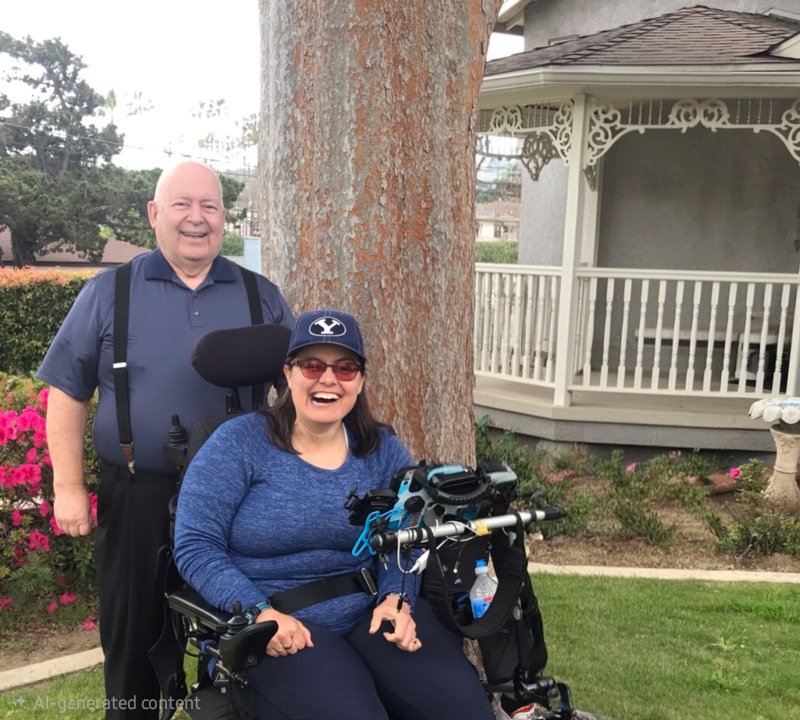
Family is the basic unit of society. But what happens when a promised "safe and effective" medical procedure acts like a hardrive wipe of all experiences? Relationships rooted in shared experiences are destroyed. 275+ family members shared their experiences with #ECT and how it impacted their loved ones. This peer-reviewed article (published today) in Psychology and Psychotherapy: Theory, Research and Practice. My dad, a gentle, soft-spoken, hero-of-a-man, had never previously been candid with me about his thoughts witnessing my ECT experience. When I asked him if he'd be willing to share a statement for the media about the article giving family members a voice, he sent me the following: “The immediate effects of my daughter’s ECT were startling: memory loss. We are, after all, the sum of our memories. She knew I was her father, but she did not remember anything about our relationship. I was told this would be short-term. They lied. Even worse was the long-term effect on her physical health. It was a prescribed massive electrical injury, again, and again, and again. Typical long-term results of multiple electrical injuries include neurological damage, depression, anxiety, PTSD, migraines, hearing loss, reduced cognitive abilities, and/or attention difficulties, along with chronic pain. She got most of those, plus some extra.” I wish our ECT experience was an anomaly. I wish that raw pain had been isolated to a single family to protect the others. Sadly, these survey results indicate more families were harmed in ways far worse than I was. This is why the @FDA must enforce their 2018 ruling adulterating ECT devices and @CMSGov must cut off funding until doctors have training in how to chose an electrical dose that can reliably replicate research findings on their individual patient with a unique head size and shape. The last survey response highlighted in the article is a devastating example of what can happen when a doctor isn't trained in how to choose a correct dose, the clinic isn't prepared for manufacturer identified treatment consequences, and the hospital's lawyers bury it. My dad's heartbreaking explanation of his witnessing my ECT experience could have been so much worse in this medically sanctioned Russian Roulette. #AuditECT @Chris_E_Harrop @LisaTMSA @ReadReadj @BasedMikeLee @MakeAmericaHA bpspsychub.onlinelibrary.wiley.com/doi/full/10.11…
Sarah Price Hancock, MS, CRC ♿ Vent #LDSx tweet media
English
7
17
39
2.4K
Sarah Price Hancock, MS, CRC ♿ Vent #LDSx
I'm so grateful the California Supreme Court saw through the claim that somehow psychiatric patients had less right to bodily autonomy than other fellow humans. A case precedent now establishing a patient's right to decline a recommended treatment if a reasonable human would. Himes v. Somatics 2024 Ruling The Case: Michelle Himes alleged that Somatics, LLC did not adequately warn that their ECT device could cause permanent brain damage and memory loss. The Ruling: The California Supreme Court rejected the defense that only a physician's decision to prescribe matters, holding that patient autonomy is crucial. New Causation Standard: A plaintiff can establish liability if: A stronger warning would have changed the physician's decision to prescribe (traditional rule). OR the physician would have passed the warning to the patient, and an "objectively prudent patient" would have declined the treatment. Given the historical patriarchy of coercion (if you don't consent, we will deem you incompetent and give it to you anyway), this was a very welcome and necessary ruling that can be used to ensure bodily autonomy in a wide variety of contexts.
English
0
0
0
17
Cooper Davis
Cooper Davis@Cooperdavis·
In “fairness”, psychiatric prescribing is seen to be different than other medical interventions by nature of the fact the patients are often understood to lack insight and be less able to make clear-eyed judgements in their own interest
BASED PSYCHIATRIST@BasedPsychMD

Imagine any other industry applying this logic. "If you knew how the investment was going to go, you'd never give us your money." "If you knew what was in the contract, you'd never sign it." "If you knew the risks of the surgery, you'd refuse it." Everywhere else this is called fraud. In psychiatry it's called standard of care.

English
5
2
20
3.4K
Sarah Price Hancock, MS, CRC ♿ Vent #LDSx
It's always concerning when an ECT provider states "not sure what 'life memories' means" while simultaneously discussing autobiographical memory-- literally defined as memories of one's life. But since ECT providers don't routinely assess or track patients' autobiographical memories: erasing education experiences, work experiences, marriage, children's births, dates, family vacations... LIFE MEMORIES... proving they believe doing so is outside their scope of practice. Imagine permanently erasing the life experiences in 22% of your own patients without realizing it because you never chose to measure it. For the sake of accuracy, this unethical statement is a demonstration of gross negligence because if 22.2% of ECT recipients experienced this type of injury without a referred to TBI rehabilitation, it's patient abandonment. #PatientSafety #AuditECT @MAHA_Action
Sarah Price Hancock, MS, CRC ♿ Vent #LDSx tweet media
English
0
0
0
10
Dr John Read
Dr John Read@ReadReadj·
22% of ECT patients suffer loss of life memories. (No other adverse effects measured) Clinical and Cognitive Outcomes Comparing Right Unilateral Ultrabrief Electroconvulsive Therapy ….. American Journal of Psychiatry psychiatryonline.org/doi/abs/10.117…
English
3
10
27
829
Sarah Price Hancock, MS, CRC ♿ Vent #LDSx
@melia_re701 The irony of criticizing a movement for not having standardized language whilst simultaneously calling out the solicitation of research funding to identify and standardize language isn't lost.
English
1
0
0
41
Amelia
Amelia@melia_re701·
@PsychRecovery I’m sure you understand given my first interaction with you was being solicited by you on this platform for donations.
English
2
0
0
31
Amelia
Amelia@melia_re701·
The language used across psych harmed marketing & branding is inconsistent. They jump from withdrawal to brain injury as if those terms are interchangeable. They aren’t. If it were truly about advocacy, there’d be distinct language and collaboration with qualified professionals.
English
5
1
5
2.7K
Sarah Price Hancock, MS, CRC ♿ Vent #LDSx
Donations? Are you referring to my birthday invitation to donate to a non-profit which researches electrical injury and develops rehabilitation interventions for the injured? Research into harms doesn't happen without funding. We have none, so I am not sure to what you're referring. Funding research is of no personal benefit to me. Unless of course someday the research leads to a cure for my continuing and progressive injuries caused by prescribed treatments. But at the rate I'm deteriorating (my abysmal inability to fundraise), you can be confident a cure won't happen in my lifetime. Hopefully it will benefit others who live with such injuries. For the record, I've never invoiced anyone or received any payment for legal consulting, research, presentations, interviews, or publications on prescribed harm in any form. My incentive to share my story isn't monetary, it's preventing what happened to me from happening to others.
English
1
0
1
64
Sarah Price Hancock, MS, CRC ♿ Vent #LDSx
I agree it's important to creating standards, only medical doctors can create medical standards. 😉 This grassroots movement will produce standardized verbage once medical doctors conduct the research to identify what that might be. Protecting against medical harm is bipartisan. Anyone who says differently is more focused on the administration who's willing to talk about it than the egregious epidemic of prescribed harm. It's a public health crisis no one's been opening talking about for decades. My "network" isn't whomever happens to experience acute serious adverse events from prescribed psychiatric treatment, RT me, or reply to something I've posted any more than I'm in Taylor Swift's network because I heard her music while shopping for groceries. My credibility is a product of my professional credentials, work experience, work ethic character, and acting in accordance with my personal values. Something I strive for hourly. I know who I am. Civil discussions about adverse consequences of medical treatments with inadequate safety profiles prescribed without legally informed consent are required to improve medical care for everyone, not just one side of the aisle. The only incentive I have to share my story is a genuine desire to prevent what's happened/happening to me from happening to any other human.
English
1
0
3
100
Amelia
Amelia@melia_re701·
@PsychRecovery Once a movement is public facing, monetized, political, and aimed at vulnerable people, grassroots is an excuse. If you want to hold MDs and institutions to higher standards, then becoming that standard should be the priority. Your network is a part of your credibility.
English
1
1
2
108
MillyMolly
MillyMolly@MissMillMoll123·
@Antidepressed1 She was mentally ill and probably had puerperal psychosis. THAT'S the most likely cause.
English
1
0
1
52
Beverley Thomson
Beverley Thomson@Antidepressed1·
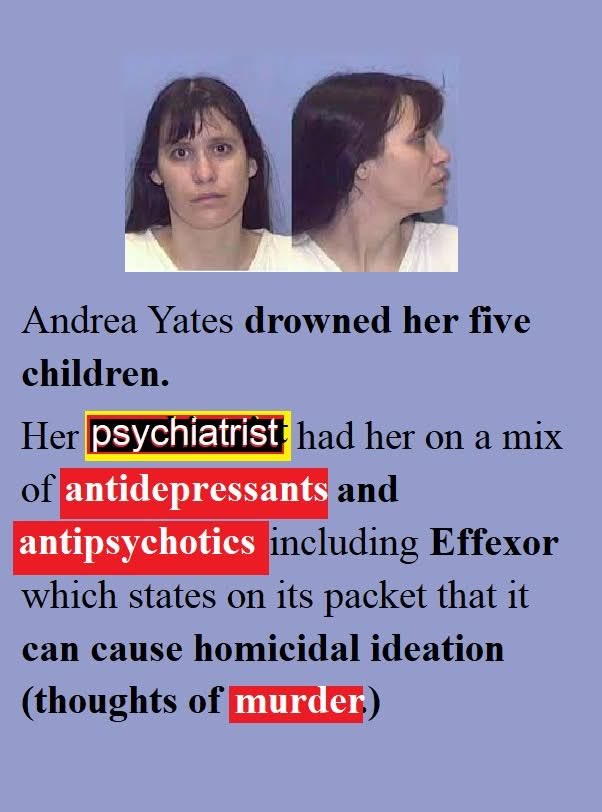
Andrea Yates waited for her husband Russell to leave for work at their home in Clear Lake, Texas. Then she drowned her five children, one by one, in the family bathtub. Noah was seven. John was five. Paul was three. Luke was two. Mary was six months old. Andrea Yates had been on a cocktail of psychiatric drugs. Sixteen days before the murders, her psychiatrist discontinued one of them and added another. The drug timeline in this case is the story. Andrea had been under psychiatric care for years. She had attempted suicide twice. She had been hospitalised multiple times. Each time the psychiatric system's answer was more drugs. By spring 2001 she had been admitted to the Devereux Texas Treatment Network twice and was on a combination of Haldol, Wellbutrin, and Effexor. On June 4 — sixteen days before the murders — her psychiatrist Dr Mohammed Saeed discontinued the Haldol and added Remeron on top of the Effexor she was already taking. The Effexor dose was at nearly the maximum allowed level. Sixteen days later, all five children were dead. Each drug in that cocktail carries its own documented profile of harm. But the combination — and the abrupt switching of one powerful drug for another — is where the pharmacological picture becomes most damning. Effexor — venlafaxine — is an SNRI antidepressant. In 2005, four years after the murders, Wyeth Pharmaceuticals added homicidal ideation to Effexor's label as a documented side effect. The warning had not been there when it was prescribed to Andrea. Andrea had told doctors she was experiencing intense homicidal hallucinations while on it. Nobody stopped the prescription. Nobody acted on it. Remeron — mirtazapine — is an antidepressant whose documented side effects include agitation, aggression, mania, hallucinations, and psychosis. It was added to Andrea's already dangerous drug load on top of near-maximum Effexor. Wellbutrin — bupropion — is an antidepressant documented to cause agitation, aggression, hostility, anxiety, and psychosis. Haldol — haloperidol — is a powerful antipsychotic. Stopping it abruptly is documented to cause severe psychiatric destabilisation — the brain suddenly deprived of the chemical suppression it has adapted to, firing back into psychosis harder than before. A woman already on a dangerous combination of antidepressants. One powerful drug abruptly stopped. A new antidepressant added simultaneously. And a history of telling doctors she was having homicidal hallucinations on these drugs. Nobody stopped the prescriptions. Nobody was held accountable. Andrea Yates was convicted of capital murder in 2002 and sentenced to life in prison. That conviction was thrown out on appeal after it emerged that the prosecution's expert witness had fabricated testimony — claiming she got the idea from a Law & Order episode that never existed. At retrial in 2006 she was found not guilty by reason of insanity. She was sent to a state psychiatric hospital where she remains to this day. The defence attorney's opening statement at the retrial made the drug argument directly: if Andrea had not been taken off the antipsychotic and placed on the new drug combination, her children would still be alive. The psychiatrist who changed the drug cocktail sixteen days before the murders faced no criminal charges. No regulatory action. Nothing. Five children were drowned in a bathtub. Homicidal ideation was added to the Effexor label four years later. The drug that warned about causing exactly what happened — after it happened. Noah. John. Paul. Luke. Mary.
Beverley Thomson tweet media
English
13
68
154
4.9K
Sarah Price Hancock, MS, CRC ♿ Vent #LDSx retweetledi
BASED PSYCHIATRIST
BASED PSYCHIATRIST@BasedPsychMD·
Every week I hear from people who’ve been on SSRIs for 15 years and were never told getting off would be hard. Informed consent isn’t optional.
English
20
17
207
7.9K
Bert
Bert@HenryRunamucker·
BTW, the reason that the efficacy of psychiatric treatment is disputed is that: 1) they all use short-term symptoms to evaluate efficacy 2) They don't evaluate the effect of the drug on health 3) Long term health outcomes are terrible
Bert@HenryRunamucker

@tylerblack32 is a complete and total non-entity in the research arena, but it's noteworthy that his highly-cited colleagues become so emotionally unhinged at criticism of psychiatric drugs that they endorse this juvenile insult piece against Dr. Moncrieff. "Antipsych Bingo" 🤔

English
4
9
31
1.1K
Another Sarah
Another Sarah@I_am_sarah_also·
I embroidered the Bern Switzerland temple on a necklace for my mom
Another Sarah tweet media
English
8
2
120
839
Sarah Price Hancock, MS, CRC ♿ Vent #LDSx retweetledi
Mikhaila Peterson
Mikhaila Peterson@MikhailaFuller·
This isn’t political.
Adam Urato, MD@AdamUrato1

NEW Study: Fetuses with prenatal SSRI exposure have brain & placental alterations seen on in utero MRI. This is now the 13th consecutive MRI study showing that prenatal SSRIs are associated with altered fetal brain development. #MOESM1" target="_blank" rel="nofollow noopener">nature.com/articles/s4138… "Importantly, we observed decreased left & right hippocampal volumes, as well as reduced cortical gyrification index, curvedness, & surface area in fetuses exposed to SRIs compared to unexposed controls after adjusting for maternal depression scales." "SRIs cross the placenta & potentially influence fetal brain development by altering levels of critical neurotransmitters. Indeed, changes in serotonin levels during critical periods of brain development could alter the formation of neural circuits & potentially lead to brain structural alterations & subsequent neuropsychiatric outcomes."

English
36
120
755
31.1K
Andrew Streeter
Andrew Streeter@andrewstreeter_·
My dad passed away a couple days ago. I really cannot recommend having both of your parents die within an 11-month span of each other. It is a decidedly bad time.
English
10
1
45
1.7K
Sarah Price Hancock, MS, CRC ♿ Vent #LDSx retweetledi
Dr. Josef
Dr. Josef@DrJosefWD·
A 12 year old girl named London died three weeks after being prescribed Prozac at an inpatient facility. Her mom said no four times. The psychiatrist told her it was "the safest drug out there" and that he would put his own kids on it. He never mentioned the FDA black box warning that Prozac doubles the risk of suicide in children and adolescents. Her name was documented as "verbal consent" without her knowledge. The dose was doubled to an adult starter dose three days in without anyone calling her. Read your informed consent forms. Black box warnings exist for a reason.
Dr. Josef tweet media
English
14
79
213
5.7K
Sarah Price Hancock, MS, CRC ♿ Vent #LDSx
The irony is that psychiatrists must identify a diagnosis to get paid for seeing the patient in the present insurance model and the psychiatrist must follow a "standard of care" for the diagnoses billed to insurance. @awaisaftab likes to pose theoretical ideas, but they fall short in application in clinical settings and don't reflect realities in community settings where a psychiatrist sees a Patient for 10-15 minutes, identifies a diagnosis for billing purposes and writes a prescription based on the standard of care for the diagnoses identified so as not to get written up for not following standard practices. x.com/i/status/20537…
English
0
0
0
43
Rachael Bedard
Rachael Bedard@RBMD1982·
“The problem is that when categories are the only language we have for talking about mental health difficulties, and when public discourse treats them as definitive explanations, patients and the public are left with a picture of the mind that is far too simple.” @awaisaftab with a wonderful, practical, clear discussion of the vagaries of psychiatric diagnosis in @nytopinion nytimes.com/2026/05/11/opi…
English
4
13
36
3.3K
Sandeep Palakodeti, MD MPH
But what do I know? I’m just a stupid internist and an internet grifter, because that’s a convincing argument to the contrary of how physiology actually plays out in our bodies
Sandeep Palakodeti, MD MPH tweet mediaSandeep Palakodeti, MD MPH tweet mediaSandeep Palakodeti, MD MPH tweet mediaSandeep Palakodeti, MD MPH tweet media
English
4
1
17
477
Sarah Price Hancock, MS, CRC ♿ Vent #LDSx retweetledi
Sandeep Palakodeti, MD MPH
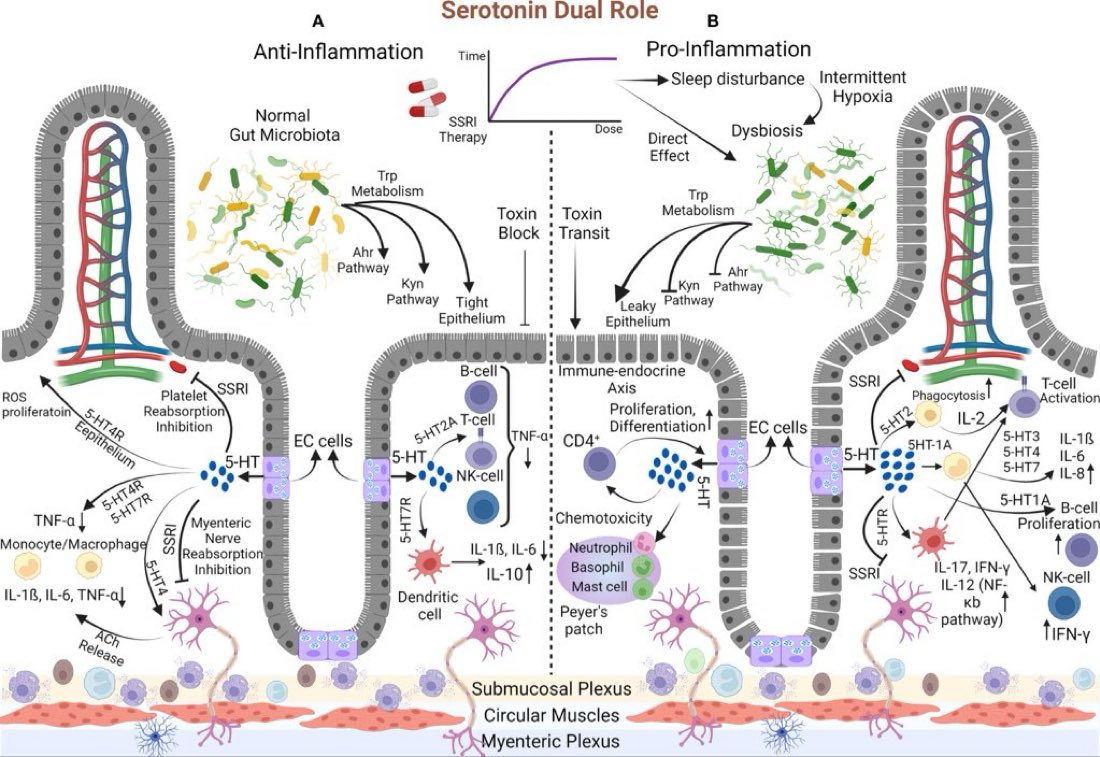
Have seen a lot of psychiatrists flapping and telling me to “stay in my lane” I’m an internist, everything is “my lane” because the entire body is connected SSRIs can initially have very mild anti inflammatory effects, but quickly become PRO inflammatory Patients w IBD know…
Sandeep Palakodeti, MD MPH tweet media
Sandeep Palakodeti, MD MPH@DrDeepMD

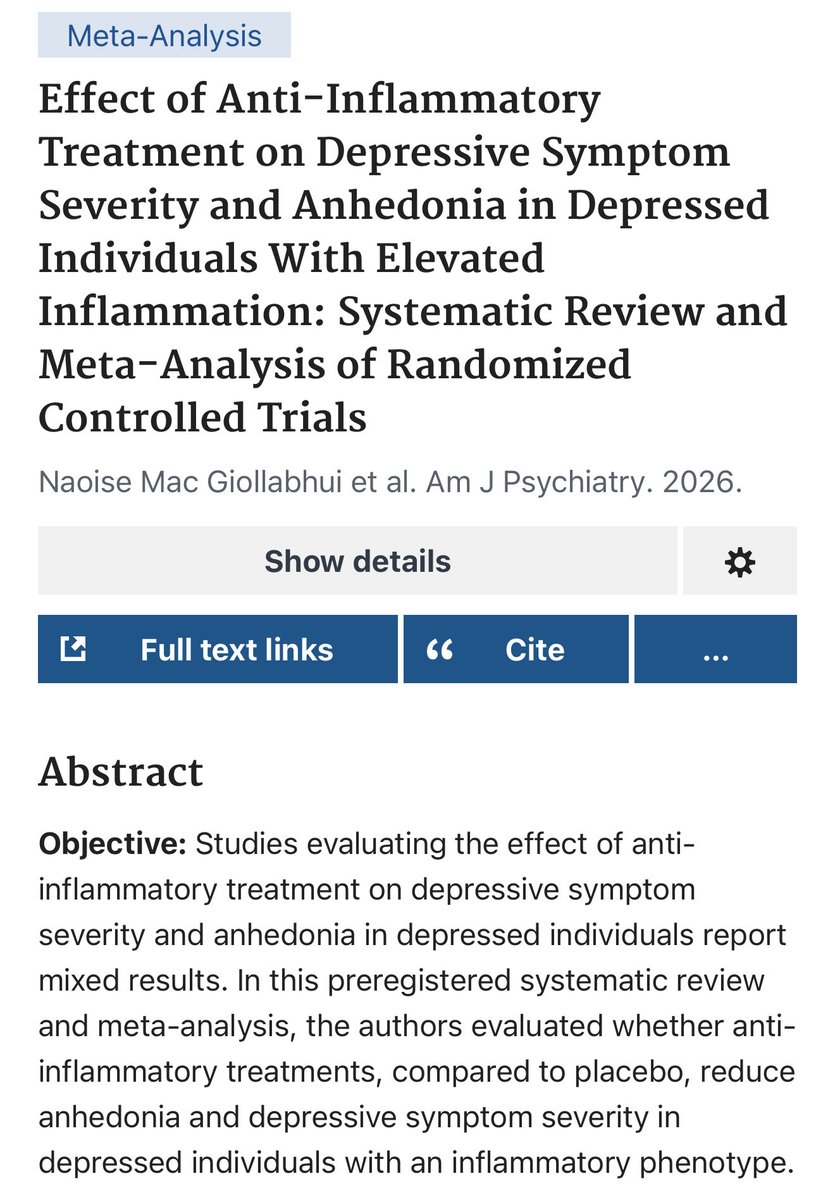
Depression is fundamentally a neuroinflammatory disease The problem with SSRIs is that we’re treating the wrong underlying pathology We’re forcing the disproven serotonin theory And ignoring the true mechanism: neuroinflammation Treat inflammation —> improve symptoms

English
27
59
292
30.3K
Sarah Price Hancock, MS, CRC ♿ Vent #LDSx
Given the long-term symptoms of SSRI use can involve sensory processing problems, emotional connectivity dysruption, concentration challenges, restlessness, asexuality, and sleep disturbances in adults and children, and withdrawal can include all kinds of coordination and tetany-like seizure issues it really makes one consider the trending exponential growth of Developmental and sensory processing disorders diagnosed in children over the last 35 years. With 1 in 4 people on SSRIs, I suspect this MRI study peels back another layer to the explosive number of individuals living with non-speaking or episodic speaking forms of Developmental diagnoses. When I was a kid (75-93) before SSRIs were introduced widely we didn't have the epidemic diagnoses of all these sensory integration issues like Autism and others. x.com/i/status/20534…
English
0
0
2
157
Adam Urato, MD
Adam Urato, MD@AdamUrato1·
This new study is the first in utero MRI study on this topic (fetal MRI) & it shows what the prior 12 post-natal MRI studies showed: SSRI exposure alters the developing fetal brain. The FDA must warn the public about this.
Adam Urato, MD@AdamUrato1

NEW Study: Fetuses with prenatal SSRI exposure have brain & placental alterations seen on in utero MRI. This is now the 13th consecutive MRI study showing that prenatal SSRIs are associated with altered fetal brain development. #MOESM1" target="_blank" rel="nofollow noopener">nature.com/articles/s4138… "Importantly, we observed decreased left & right hippocampal volumes, as well as reduced cortical gyrification index, curvedness, & surface area in fetuses exposed to SRIs compared to unexposed controls after adjusting for maternal depression scales." "SRIs cross the placenta & potentially influence fetal brain development by altering levels of critical neurotransmitters. Indeed, changes in serotonin levels during critical periods of brain development could alter the formation of neural circuits & potentially lead to brain structural alterations & subsequent neuropsychiatric outcomes."

English
3
36
88
6K
Wendy Burn CBE
Wendy Burn CBE@wendyburn·
Some of you on here will have known Dr Tony Zigmond who sadly died yesterday. He worked for many years as a psychiatrist in Leeds and was an Hon Fellow and former Vice President of @rcpsych. He will be greatly missed. RIP Tony.
English
19
11
74
5.6K