Ron Vara
1.7K posts


@dgflipped @Ken_Campbell27 @Tablesalt13 Okay, you missed the whole explanation. My nationality is Canadian. My ethnicity is European. My people created this country. But for arguments sake, which European country am I going back to after being in Canada for over 200 years and America over 200 years before that?
English

@Terakotarako @SenateForeign @UN @antonioguterres Japanese sovereignty shall be limited to the islands of Honshu, Hokkaido, Kyushu, Shikoku and such minor islands as we determine.
--Potsdam Declaration
English

@SenateForeign @UN @antonioguterres 日本と中国と台湾の位置関係を理解していない人が多い。中国は日本の沖縄をも中国の領土だと言い出している。台湾の次は日本を侵略すると宣戦布告にも近いことを言っているのだ。今後も日本は自衛のために対応していくだけ。それに中国高官が高市総理の首を切ると言ってきたことに対して謝罪も無い
日本語

Prime Minister Takaichi’s comments are in line with Japan’s longstanding policy on Taiwan. China is spreading a false narrative and weaponizing the @UN to bully another country. Secretary General @antonioguterres should not circulate this propaganda to UN members. reuters.com/world/china/ch…
English

@Rolyat7299 @rshereme all will be futile against armies of Chinese robots.
English

It would never happen because we are America and have 40% of the planets weapons. That's around 400 million individual arms. Plus 12 trillion rounds of ammo. This is all held privately it does not include our military, which is the baddest on the planet because we don't have free healthcare. Our Founding Fathers knew exactly what they were doing. Ukraine needs to make a deal or Europe should go it alone.
English

Imagine China occupying California, Nevada, Arizona, and Oregon and then the EU telling America: “Make a deal with the occupier or we won’t support you.”
Absurd, right? No country would accept that.
Yet this is exactly what Ukraine is being told today.
And let’s not forget: Ukraine gave up the world’s third largest nuclear arsenal under U.S. security guarantees. They trusted America.
Now Ukraine being pushed to surrender their land to the same aggressor that invaded them.
This isn’t “peacemaking.” This is betrayal.
Author: David Imedo

English

Cheng Li-wun, the new chair of the KMT party, said to @dwnews: "Putin is not a dictator. He is a democratically elected leader... Russia has democratised for many years... It's unreasonable and unfair to say Putin is a dictator."
Cheng went on to blame NATO for the Ukraine war.
English

@GichuhoMungai @WhiteHouse Joe Biden did not visit China during his entire time in the white house. Now Trump has a state visit scheduled for next year, so you could say it is historic.
English

One can’t help but wonder whether the current @WhiteHouse is staffed with morons! There is nothing historic about Trump-Xi meeting.
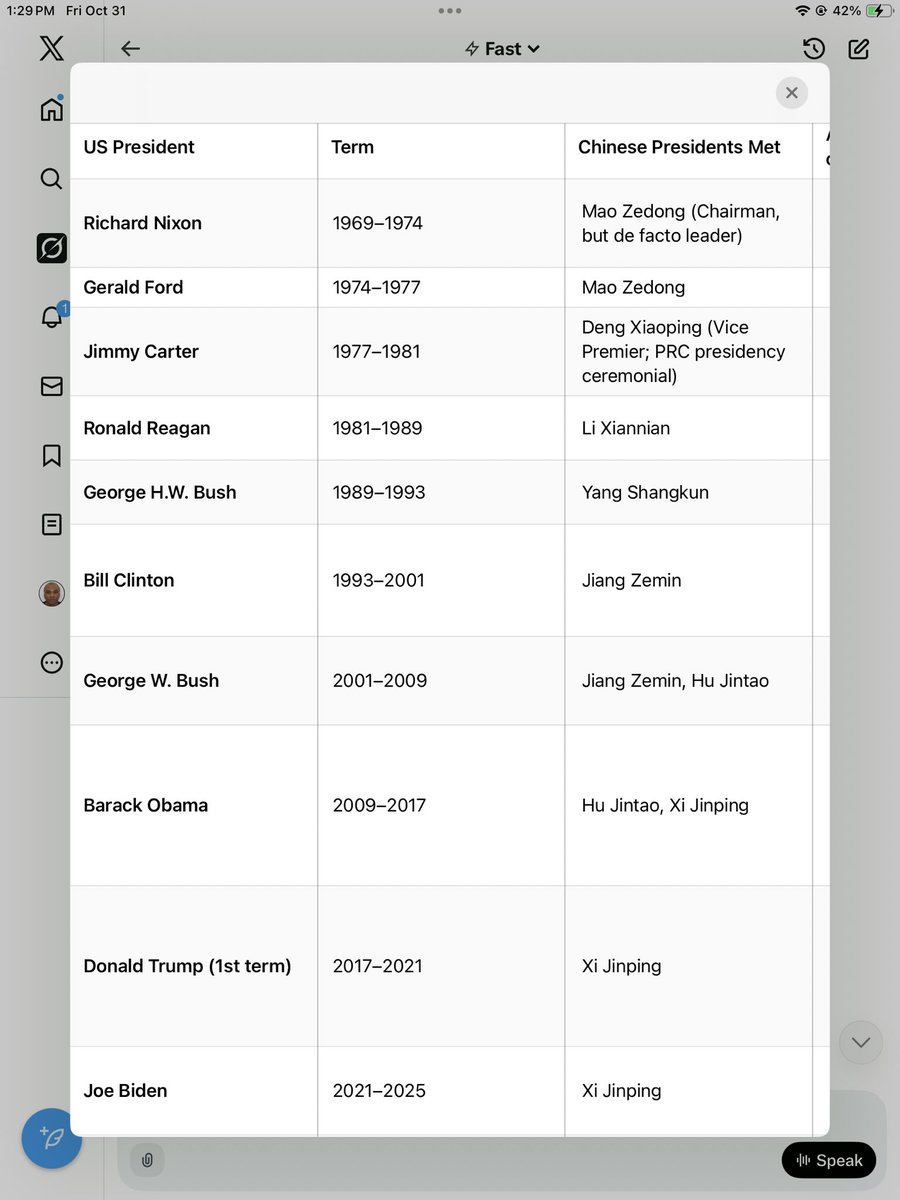
The total number of formal bilateral meetings (in-person summits, not including phone calls or virtual talks) is approximately 45–50, based on historical records of state visits, summits, and multilateral sidelines meetings.
US Presidential administration, highlighting major meetings:
| Richard Nixon | 1969–1974 | Mao Zedong (Chairman, but de facto leader) | 1 | 1972 Beijing summit (historic visit, multiple sessions). |
| Gerald Ford | 1974–1977 | Mao Zedong | 1 | 1975 Beijing meeting. |
| Jimmy Carter | 1977–1981 | Deng Xiaoping (Vice Premier; PRC presidency ceremonial) | 1 | 1979 Washington state visit (normalization of relations). |
| Ronald Reagan | 1981–1989 | Li Xiannian | 2 | 1984 Beijing summit; 1985 Washington visit. |
| George H.W. Bush | 1989–1993 | Yang Shangkun | 2 | 1989 Beijing visit; 1992 multilateral sidelines. |
| Bill Clinton | 1993–2001 | Jiang Zemin | 5–6 | 1998 China tour (multi-city); annual G8/G20 sidelines; 2000 Washington summit. |
| George W. Bush | 2001–2009 | Jiang Zemin, Hu Jintao | 6–7 | 2002 Beijing state visit; 2005, 2006, 2008 G8 summits. |
| Barack Obama | 2009–2017 | Hu Jintao, Xi Jinping | 10–12 | 2009 Beijing/China visits (3 meetings in one year); 2013 Sunnylands; 2014 Beijing APEC; 2015 Washington; 2016 Hangzhou G20. |
| Joe Biden | 2021–2025 | Xi Jinping | 3 | 2022 Bali G20; 2023 San Francisco APEC; 2024 Lima APEC. |

English

@BalasorOK @WhiteHouse You know why? Because the US fulfilled 0% of their obligations.
English

@WhiteHouse Trump's 2020 Phase One trade deal
a 2023 Peterson Institute study showing China fulfilled only 58% of Phase One obligations
Barely 50% honor of that deal.
English

@EuromaidanPR Well they just cut off the drone components supply from China to Ukraine
English

@Darth_Gollum @shell_zipi @Megatron_ron They could just drop the bomb on inhabited islands to show the force, but no, they chose to drop it on the center of a densely populated city. It was indeed a field test.
English

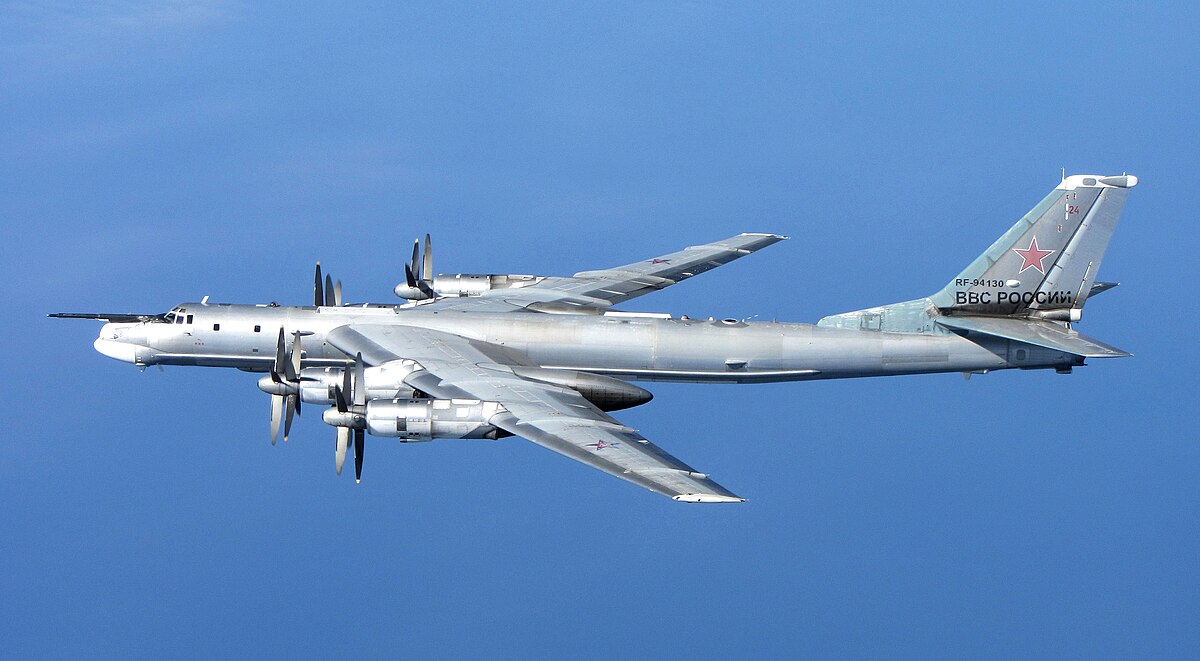
JUST IN:
🇷🇺🇺🇦 The first comment from an official from Moscow after the attacks on the nuclear bombers, Medvedev:
"To everyone who is worried and waiting for retribution.
It's right to worry, that's what normal people do. Retribution is inevitable.
But keep in mind, our Army is pushing forward and will continue to advance.
Everything that needs to be blown up will be blown up, and those who must be eliminated will be.
The Istanbul talks are not for striking a compromise peace on someone else's delusional terms but for ensuring our swift victory and the complete destruction of the neo-Nazi regime.
That's what the Russian Memorandum published yesterday is about.


English

@BonnieGlaser Who is the largest supplier to Ukraine's war industry, including their drone factories?
Hint: their largest trade partner
English

Ukraine confirmed Chinese supplies to 20 Russian military plants, intelligence chief says.
Do the US and Europe still draw the line at “no lethal aid? “ we need a response to restore our credibility. reuters.com/world/china/uk…
English

US lawmakers introduce bill to make Taiwan 'NATO Plus' country taiwannews.com.tw/news/6117180
English

@RosnySpanngen @thinking_panda LOL, Japan lost the war in mainland China, that was exactly the reason they attacked pearl harbor so they could move to southeast asia(US colony).
And good you mentioned the nukes, which killed half million civilians, the greatest war crime in human history
English

@thinking_panda Let’s be fair… US saved China with the nukes and neutering Japan, they had no obligation to. They coulda let Japan keep Korea and Manchuria, but forced them out.
English

I hope all Chinese remember the following historical facts - during the Japanese invasion of China:
54.4% of Japan's weapons and supplies were provided by USA.
76% of Japanese planes came from USA in 1938.
All lubricating oil, machine tools, special steel, high-test aircraft petrol came from USA.
59.7% of Japan's scrap iron and 60.5% of Japan's petrol came from USA in 1937.
Japan freely bought weapons from USA companies, even as USA Govt barred the sale of weapons to Republican Spain.
From 1937 to 1940, Japanese bombers were fueled with USA oil and Japanese weapons were made out of American scrap iron.
USA indirectly massacred millions of Chinese.

English

82% of Americans view Taiwan as independent country taiwannews.com.tw/news/6098317
English

@chim10_ @macastel3 They locked down Shanghai for 2months, everyone basically locked inside their home for whole 2 months.
Still have doubt about their ability to outlast the US?
This is a war Trump has no hope of winning.
English

@macastel3 You obviously have a good deal of experience here, as do I.
I’m curious as to how ur thinking about China’s ability to outlast the US?
English

@ConservaWonk @BonnieGlaser No body believes Taiwan can be protected, just like no body believes Ukraine will win.
They, however, need an alliance to sanction China after it takes Taiwan.
English

@briangobosox @BillAckman US is the only market that bans Chinese EV, is it "pervasive state intervention"?
English

@BillAckman One cannot credibly argue that there is a deal to be had that changes the fundamental behavior at the root of the problem, which is China’s pervasive state intervention in its economy.
You can never have global trade at equilibrium with a non-market actor as the biggest player.
English

Some have suggested that because China takes a very long-term view, China can ‘win’ a trade war with the U.S. which, according to the conventional view, is a much shorter-term player than China.
The problem with this assessment is that the longer the tariffs persist, the more rapidly every company that has a supply chain based in China relocates it to India, Vietnam, Mexico, the U.S. or some other country.
China has to understand this dynamic, which is why it should be highly incentivized to make a trade deal as quickly as possible. Unless it is clear that a company can continue to source from China on economically viable terms, it must leave the country.
The longer high tariffs persist, the greater the likelihood that no company can be confident it can rely on China for sourcing or production over the long term. This is true for US and non-US companies. As a long-term player, China must understand this dynamic.
The China tariffs are very damaging in the short term to companies that rely on China for a large percentage of their goods or for parts to make their products. This is particularly true for small companies who don’t have the wherewithal to weather the storm. If the tariffs were to persist, our government could provide loans to help companies manage their transitions out of China, but I don’t think this will be necessary.
The tariffs are similarly damaging for medium-size and large businesses, but their greater financial resources allow them to better manage the tariff burden until they can relocate production outside of China.
In light of the above, both China and the U.S. are highly incentivized to take the tariffs down to more reasonable levels — say 10% to 20% — as quickly as possible. The only thing stopping the reduction in tariffs to a more sensible level is the fear on the part of both countries’ leadership of looking weak.
A pause, however, would not be a sign of weakness because it requires both countries to take down their tariffs. It is just common sense.
Both countries know that the 145% tariffs have to come down now. They are just trying to manage the diplomacy in such a manner to make clear that it is a mutual decision as opposed to one country ‘going first’.
So let’s imagine the U.S. and China agree to a 180-day pause to allow for negotiations to take place.
Once the pause is announced, China would be highly incentivized to make a deal as quickly as possible, whereas we have time on our side. This is true because the longer the tariffs persist, the greater the reputational damage to China as a reliable country in which to do business, and therefore the higher the probability that US and non-US companies will leave.
A lower level of tariffs in the short term will enable companies to better manage the transition out of China. It is a near certainty they will leave unless and until a new and highly favorable deal is made with China. Even then, no company will be confident it can rely on China for a major portion of its supply chain. That cake is already baked.
There is no board of directors or management team who will ever again feel comfortable relying on China for a major portion of their supply chain. The damage has been done.
The only hope for China as a place to do business is for China to immediately come to the table and make a deal which provides permanent commitments addressing IP theft, forced technology transfer, market access restrictions, tariffs, and other barriers to doing business in China.
If instead China stubbornly decides to hold out and not negotiate due to pride or other emotional issues, China will suffer that much more severe and permanent economic consequences. In China holds out, I expect we will launch a loan program to enable US companies to better manage the exit from China.
Time is the friend of the US and the enemy of China’s in this negotiation.
A pause and negotiations should therefore begin soon.
Tell me why I am wrong.
US Homeland Security News@defense_civil25
🚨Update: Apple plans to shift all US-bound iPhone production to India by next year, reports FT—accelerating pivot from China amid supply chain diversification. Major win for 'Make in India,' potential blow to Beijing.
English

@JJS36038159 @GlennLuk @BillAckman You forgot the most important factor: The chines(willingly or not willingly) can endure far more hardship compared to the americans. They locked down cities with millions of people for months during Covid. this is a war Trump has no hope of winning.
English

Interesting. But the analysis misses five critical points.
First, it ignores multiplier effects.
The $6 billion figure only counts direct output, but manufacturing dollars ripple through the economy at 2.5x.
Every $1 spent in manufacturing generates about $2.50 in total economic activity when you account for suppliers, logistics, services, and consumer spending triggered by wages.
The true impact is closer to $15 billion.
Second, it overlooks ecosystem damage.
iPhone production anchors 200 suppliers and 1.5 million workers across China’s industries.
Third, it assumes a seamless transition.
Moving to high-value production takes 5–7 years. Japan tried it in the 1990s; only 40% of displaced workers successfully moved up.
Fourth, it disregards regional concentration.
In Zhengzhou, iPhone production drives nearly 8% of local GDP — not 0.033%.
Fifth, it misunderstands competitive positioning.
China holds just under 10% of global memory production, far from its 40% dominance in assembly.
It also fails to account for China's growing economic fragility:
Deflation is deepening in January 2025.
The property sector is collapsing, with prices down ~30% and housing tied to ~70% of household wealth.
Youth unemployment is rising.
Local governments are drowning in debt, with ratios exceeding 150% of GDP.
Manufacturing disruption doesn’t just hit GDP.
It tears at the foundation of an already brittle economy.
English

@alfonsomj @lililixxx6789 @jenzhuscott How many chinese branded cars, phones, clothes, shoes, etc, you see in the US? close to zero. US banned chinese EV and phones while apple and tesla are allowed to sell in China.
English

@lililixxx6789 @jenzhuscott USA does not want a tariff war, but it does want fairness. China makes it difficult for USA companies to import into China, but USA makes has made it easy for China to import into the USA. That’s not fair trade.
English


@DocLanceP @macastel3 During Covid 30million people of Shanghai were forced to be locked inside their home for 2 months.
Chinese people can endure far more hardship compared to the Americans, and this time, it will be the US/Trump to be blamed.
This is a war Trump has no hope of winning.
English

@macastel3 Wrong, China will be in recession (IN REALITY, REGARDLESS OF THE STATE NUMBERS) far before the US. Some short term-pain is worth the cost of significant de-coupling.
English

@BonnieGlaser @bpolitics Did Zelenskiy know most of his drone components are from Ukraine's largest trading partner?
English

Ukrainian President Volodymyr Zelenskiy accused China of supplying weapons to Russia in its war against his country. Xi "gave me his word that weapons would not be sold and sent to Russia,” Zelenskiy said. “But we see other information.” bloomberg.com/news/articles/… via @bpolitics
English