AJ Ghergich

17.6K posts

AJ Ghergich banner
AJ Ghergich

AJ Ghergich

@SEO

AI & Marketing Technology Executive | 4x Founder, 3 Exits | Services Transformation | PE, Bootstrap & VC

Saint Louis, Missouri Katılım Kasım 2008
705 Takip Edilen128.7K Takipçiler
AJ Ghergich
AJ Ghergich@SEO·
My productivity during the Claude global outage.....
GIF
English
0
0
5
1.6K
AJ Ghergich
AJ Ghergich@SEO·
@taycaldwell I want to! I try to login and get routed to business.x, does that mean I don't have access yet?
English
0
0
1
100
Kimi.ai
Kimi.ai@Kimi_Moonshot·
Kimi K3 (open weights, coming soon)
English
432
1K
13.8K
1.1M
AJ Ghergich retweetledi
Ben Wills
Ben Wills@benwills·
I do NOT expect ChatGPT to leave this open. It disclosed far more about its internal search process and ranking than I ever expected. These close routinely, without an announcement. I am publishing this a week early, unfinished, so you can use it ASAP. I would rather people had a couple weeks with it than a tidier document later. I found it by accident. Yesterday, I asked ChatGPT about fanout queries. It mentioned that some "result cards" had been screened out before their URLs were kept. I had never heard the term, so I asked. Eleven turns later I had the request format it sends its search tools, the text that comes back, a catalogue of 16 result types, the criteria it uses to pick which pages to open, and the pipeline it runs for commercial recommendations. -- "Result Cards" and the Internal Search Process A "result card" is one internal search result as the model receives it from an internal search tool. A title, a URL, a publisher, an extract capped by a marker like [wordlim: 200], a reference ID, etc. This is what the model knows about your page before it decides whether to look closer. The model sees that a result came back third, then judges the source on provenance, methodology and freshness, because that is what it has. Your structured markup gets consumed upstream. The search provider uses it to build the title, the date and the extract, and the finished card is what arrives, so schema work still does its job and you still cannot audit it from where the model sits. Then I stopped asking it to describe the process, logging the calls and thinking along the way. It ran 20 and showed me (almost) everything. Requests go out as JSON. Responses come back as plain text in custom formats depending on the internal tool. But it's not perfect. One finance result printed -17.66000 (-0.03272%) when the actual change was -3.272%, so something put a percent sign on a decimal fraction. Structured values get flattened into prose before the model reads them, and precision goes missing on the way. There's a whole lot more here, but you can read the blog post on OppAlerts, which walks through it in more detail. Or head straight to the new guide I'm working on. That link is in the first comment below. In the guide, I include 5 example commercial prompts, with the full, verbatim responses where ChatGPT details every step of its internal tool use and reasoning. -- How To Do Your Own Reflection Prompts The last thing in the guide is what I'm calling a "Reflection Prompt". Reflection is a programming term for the ability of a running program to inspect itself and report what it contains. Paste this one as the first message in a new chat, put your own question at the bottom, and it walks the same process for your category. Run it while it still answers. Every ChatGPT response is published verbatim, with code blocks showing if it came from a real call or not. What is a Result Card? oppalerts.com/How-AI-Search-… Template for writing your own Reflection Prompt: oppalerts.com/How-AI-Search-…
Ben Wills tweet media
English
3
10
30
3.3K
AJ Ghergich retweetledi
Aleyda Solis 🕊️
What a useful and free ChatGPT Query Fan-Out Chrome Extension that allows to easily track them over time by @Netanel 👇 Showing: * Queries: The actual search strings ChatGPT ran behind each prompt — the fan-out itself. * Sources: Every page it retrieved, grouped by domain, with cited vs. not-cited marked. * Citations: The sources that made it into the answer, and which domains keep winning. Everything is shown from your Chrome side-panel and allows you to export the data! Take a look: en.natielimelech.com/tools/chatgpt-…
Aleyda Solis 🕊️ tweet media
English
9
33
111
8.6K
AJ Ghergich
AJ Ghergich@SEO·
@emollick Awesome guide! I'm seeing a lot of chatter that opus 5 is best at high, are you seeing it differently it seems?
English
0
0
0
670
Ethan Mollick
Ethan Mollick@emollick·
I've already had to update the guide to which AI models to use that I wrote on Thursday to include Opus 5 and Codex's voice mode, both of which are significant & launched on Friday. Keeping up is challenging, even if you are following this stuff closely. oneusefulthing.org/p/an-opinionat…
English
36
43
476
37.2K
AJ Ghergich retweetledi
Marie Haynes
Marie Haynes@Marie_Haynes·
The Open Knowledge format has been improved. Google just announced OKF v0.2. which introduces a Trust Layer to solve the problem of accountability in agent-generated knowledge. OKF v0.2 aims to answer these 5 questions in the YAML frontmatter: ▪What was this created from? ▪How much should I trust it? ▪Is it still true? ▪Is it the current version? ▪Was this number produced the way we said it must be? Type is still the only required filed in the YAML frontmatter, but you are encouraged to add these new fields. (You don't need to though - your current OKF structure is still going to work.) The new fields are: ▪generated: (Supersedes timestamp) ▪verified: (List of human/machine confirmations) ▪status: (draft, stable, deprecated) ▪stale_after: (Absolute expiration date) ▪sources: (Structured provenance data) I want to share something else as well. I think if you're following how I'm building with OKF, we may be using OKF in a different way than it was intended to be used for. They say they created OKF so agents can have the context they need to understand table schemas, metric definitions and runbooks. Yet, we are using it to help agents understand knowledge. I think what we are doing is more akin to Karpathy's LLM-Wiki (which was the inspiration for OKF). I also think what we are doing is amazing - so continue on! cloud.google.com/blog/products/… Marie
English
4
4
23
3.5K
AJ Ghergich retweetledi
Chetaslua
Chetaslua@chetaslua·
🚨 Claude Opus 5 spotted in API
Chetaslua tweet media
English
18
5
323
82.6K
Jan Stevens
Jan Stevens@janstevens·
@SEO Life sucks for the permanent underclass. Thanks for the reminder.
English
1
0
2
35
AJ Ghergich
AJ Ghergich@SEO·
If you don't already have Opus 5, you're ngmi
English
1
0
3
2K
AJ Ghergich retweetledi
Aleyda Solis 🕊️
Aleyda Solis 🕊️@aleyda·
.@Similarweb new 2026 Generative AI Landscape Report is out, and I was delighted to contribute with a quote on one of its most actionable findings: the disconnect between the pages ChatGPT cites and those that actually receive referral traffic. Here are the highlights that stood out to me 👇 📈 Gen AI usage continues to scale: Between June 2025 and May 2026, these platforms averaged 9.5 billion monthly web visits (up 70% YoY) while monthly unique visitors grew 57% to 655 million. 🔀 AI Search is complementary and fragmented: 95% of ChatGPT users also use Google, and multiple AI platforms rather than committing to a single assistant. 🎯 AI visibility influences what users do next: People were two to four times more likely to visit an AI-recommended brand than a competitor that wasn't recommended. AI can shape the shortlist even when the journey doesn't produce an immediate referral click. 🔗 Citations are growing, but they're highly category dependent: The share of ChatGPT answers featuring citations increased more than fivefold to 6.8%, reaching 22.6% in travel, 13.5% in retail and 10.7% in sports, and the sources cited vary just as much: beauty conversations reference retail and ecommerce sites 54.7% of the time, while travel leans on reviews and UGC at 54.1%. 🏠 Cited and clicked pages serve different purposes: 65% of cited URLs sit two or three folders deep, while 58.8% of ChatGPT referral traffic lands on homepages. As I shared in the report: "Cited pages feature the content AI systems use as evidence, while traffic pages show where users enter the site. They serve different purposes and should be assessed separately." 💸 AI advertising is already becoming part of the journey: 26% of US desktop ChatGPT chats contained ads in June, and nearly 2/3 of those ads appeared after the second prompt or later. My main takeaway? AI Search can't be measured or optimized with one KPI, one platform or one type of page: You need to analyze brand visibility, citations, referral traffic and downstream impact separately, strengthen the deeper pages that influence AI answers, while ensuring the top level pages receiving clicks are relevant, persuasive and conversion ready. It's not SEO being replaced. It's discovery becoming distributed and our measurement and optimization need to catch up. Download the full report here: similarweb.com/corp/reports/2…
Aleyda Solis 🕊️ tweet media
English
8
17
72
7.4K
Will Stern
Will Stern@Will__Stern·
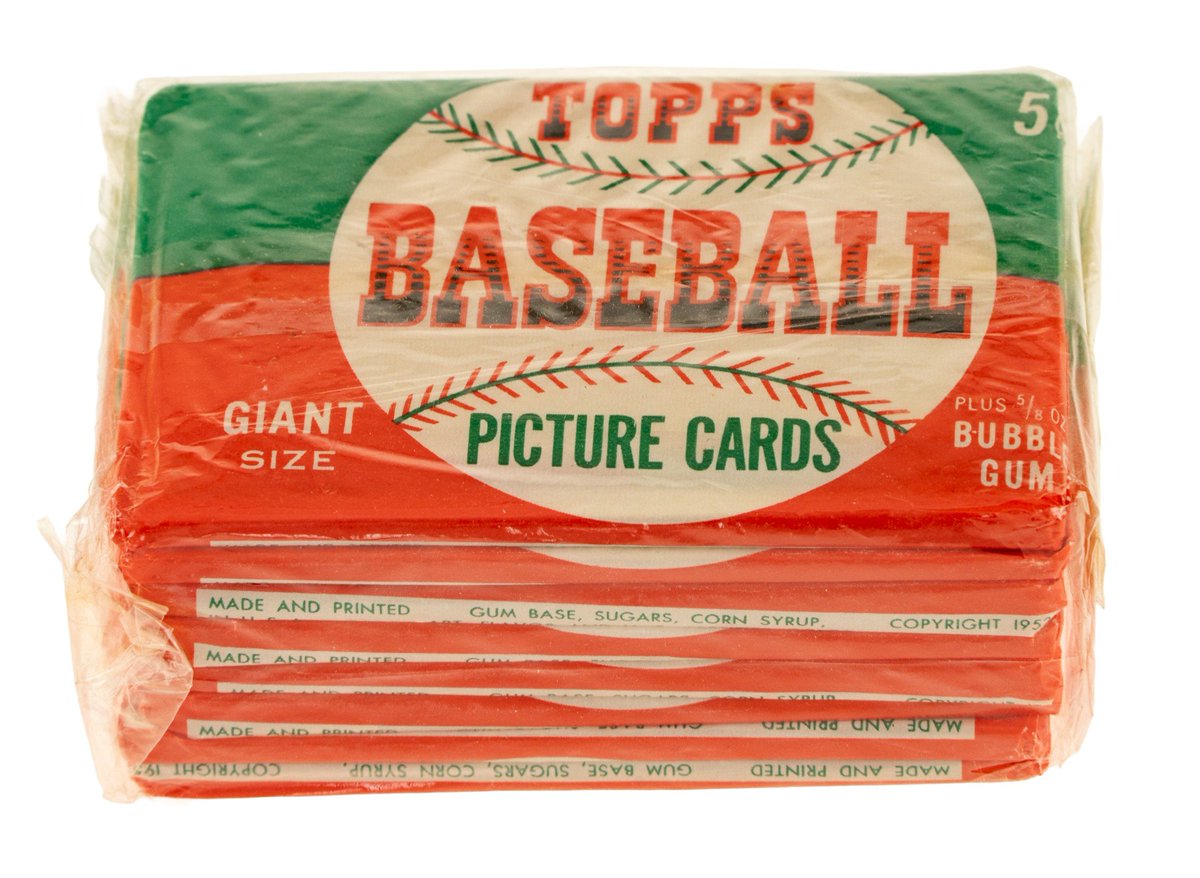
Amazing piece of history coming to auction at @collect_rea: An unopened wax pack "brick" of 8 five-cent packs. Only three are known to exist, with the only public sale fetching $852k in 2023.
Will Stern tweet media
English
13
9
80
12.2K
AJ Ghergich retweetledi
Katherine Argent
Katherine Argent@effthealgorithm·
Hahahaha. Google’s claims against SerpAI for scraping search results have been dismissed because…wait for it…Google can’t demonstrate it’s acting on behalf of the copyright holders. In other words, if Google wants to refile the suit within the allowed 21 days, it has to admit that site owners have copyright protection of their work and THAT would open the door to them suing Google for scraping their content for AI Overviews. Which reminds me: I’ve been meaning to reread Heller’s Catch-22. Now seems like a good time. seroundtable.com/google-lawsuit…
English
19
201
707
27.4K
AJ Ghergich
AJ Ghergich@SEO·
Thinking Codex hits 11M weekly active users by tomorrow afternoon... sounds about right @thsottiaux? I'm over here resetmaxxing
English
0
0
3
1.9K
AJ Ghergich retweetledi
Barry Schwartz
Barry Schwartz@rustybrick·
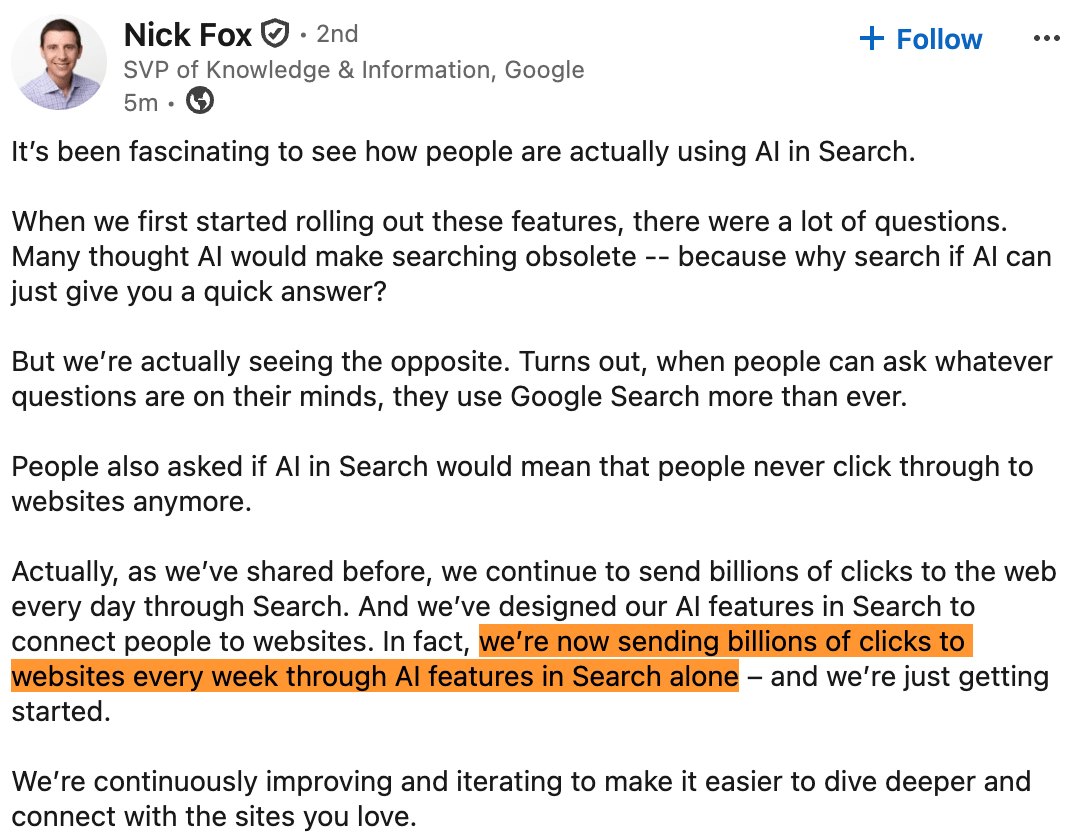
So this is why Google came out with that billions of clicks from AI features - the NY Times was working on a piece named "Google Is Building an A.I. Fence Around the Internet It Once Championed" nytimes.com/2026/07/20/tec…
Barry Schwartz tweet media
Barry Schwartz@rustybrick

Google's @thefox says Google's AI Mode and AI Overviews send billions of clicks to websites weekly and has a "personal gripe" when he can't find links in AI responses seroundtable.com/google-ai-sear…

English
8
15
55
16.4K
Brian Dean
Brian Dean@BrianEDean·
I'm officially coming out of content retirement. (Is content retirement even a thing 🤔) Full context: When I ran Backlinko, I was kind of a reluctant "marketing guru". Making videos and constantly publishing content was a big reason the brand grew and eventually sold to Semrush. But I never loved being in front of the camera. So when I started Exploding Topics, I did the complete OPPOSITE. No videos. No personal brand stuff. I was the ghost in the machine. And I LOVED it. Then I sold that company too. The first thing I thought of when the deal went through was: "I never have to make another YouTube video again!" Flash forward to today... I'm getting the itch to share my ideas again. After all, I built and sold two companies. That's not super common. I'm also enjoying making videos for Semrush's YouTube channel. Turns out video is actually fun when you're covering topics you find interesting. And I'm learning A TON from a side project. So I want to share all the cool stuff I'm figuring out. So yeah: I'm back. Under my own terms this time. 👍🏻
Brian Dean tweet media
English
71
6
253
14K