SemiSweetTweet

10.5K posts

SemiSweetTweet banner
SemiSweetTweet

SemiSweetTweet

@SemiSweetTweet

Former NYer. Sleuth. Talent Agent. Photographer. Tenacious. Problem Solver. Occasionally, Temporarily Out of Order.


Katılım Mayıs 2009
518 Takip Edilen1.3K Takipçiler
SemiSweetTweet
SemiSweetTweet@SemiSweetTweet·
@LOWES SOMEONE NEEDS TO ANSWER. THE PHONE AT THE OCEANSIDE STORE. W T F? The phone has run for over 11 minutes. : (760) 966-7140. Going to @HomeDepot to rent my equipment. So much for being a PRO customer.
English
5
0
1
111
SemiSweetTweet
SemiSweetTweet@SemiSweetTweet·
@VerizonSupport Can't send a DM for some reason. I need a phone number to a human being in the USA or I'll be emailing the CEO.
English
2
1
1
44
Verizon Support
Verizon Support@VerizonSupport·
@SemiSweetTweet We definitely want to keep you with us and get your wireless internet bill sorted out. Let's get you connected to the right team, send us a DM. -Jaquetta
English
1
0
0
51
SemiSweetTweet
SemiSweetTweet@SemiSweetTweet·
@Verizon @VerizonSupport Your off-shore reps are useless. I need a phone call about my wireless internet bill from someone in the UNITED STATES OF AMERICA, in the INTERNET RETENTION dept. or I'll be going back to @ATT.
English
2
1
2
135
CBS News
CBS News@CBSNews·
Victoria, a pet parrot, survived for seven days beneath the rubble after Venezuela's devastating earthquakes. When volunteers found her, she was clinging to the body of her owner, who died with Victoria on his chest. They told @camiloreports she refused to leave his side. Victoria, the only survivor from the apartment, was rushed to an emergency veterinary hospital but died days later from her injuries.
English
219
1.1K
10.3K
471.9K
SemiSweetTweet retweetledi
Gabriele Corno
Gabriele Corno@Gabriele_Corno·
This was filmed yesterday morning at Westside Animal Rescue in Phoenix. The man is Carlos. 39 years old. Came to the shelter to look at dogs. Told the front desk he was "just browsing." Not sure if he was ready for the commitment. Staff brought him to meet a brown mixed-breed named Rocky. Shepherd and Lab mix. Four years old. Carlos sat on the floor with Rocky for about thirty minutes. Rocky was calm. Sat beside Carlos. Let Carlos pet him. Normal meet-and-greet. Then Carlos stood up. Told staff he wanted to "think about it overnight." That's when Rocky moved. Didn't bark. Didn't jump. Just rushed forward and wrapped both front paws around Carlos's leg. Held on tight. Carlos tried to take a step. Rocky slid across the floor still gripping Carlos's leg. Wouldn't let go. Shaking. Tail tucked all the way down. Body trembling. Making this quiet whining sound. Volunteer Jessica was in the room. She said: "Rocky wasn't being aggressive. He was terrified. You could see it in his whole body. He thought Carlos leaving meant being abandoned again." Carlos stood there frozen. Rocky still holding his leg. After a long moment, Carlos knelt back down. Rocky immediately climbed into Carlos's lap. Still shaking……. And at the end they go away together
English
287
1.1K
15.7K
1.1M
SemiSweetTweet
SemiSweetTweet@SemiSweetTweet·
If you are considering @freshbooks, your 2FA will take 5 minutes to arrive via email. Hope you're not in a rush. Time is $, @Freshbooks, you need to allow the option to opt out of 2FA which currently SUCKS. IMPROVE it, ALLOW OPT OUT, or I'm going to the competition.
English
0
0
0
22
SemiSweetTweet
SemiSweetTweet@SemiSweetTweet·
@WordsWFriends FIX YOUR BROKEN USELESS DESKTOP VERSION. You can't log on with an email and support is clueless. Enter email - "We couldn't seem to reach you" is the message. NO OPTION to enter PASSWORD. Web version is absolute 💩for paying cusomters. @zynga
English
0
0
0
16
SemiSweetTweet
SemiSweetTweet@SemiSweetTweet·
@FortuneMMXM Tenacity. He deserves the payoff and success he's earned. Visionary. Futurist. Universe Changer. @elonmusk is a pioneer; I wish I had a quarter of his brain in my head.....the ideas are endless.
English
0
0
2
517
SemiSweetTweet retweetledi
Fortune MMXM
Fortune MMXM@FortuneMMXM·
For over 4days now, I haven't sleep. I've been studying this video over and over again. Bookmark and learn from it
English
173
2.8K
12K
488.3K
SemiSweetTweet retweetledi
Gabriele Corno
Gabriele Corno@Gabriele_Corno·
Shelter security footage from kennel 4. They call him Ghost he's been waiting for a home for 7 months. Honey arrived three days ago, too weak to stand, too scared to eat. The volunteers put them together that night. The camera caught what happened next.
English
668
5K
52.8K
2.7M
SemiSweetTweet retweetledi
Interesting things
Interesting things@awkwardgoogle·
A Taiwanese couple wears clothes that were left behind at their laundromat.
English
334
4.1K
44.3K
1.1M
CoinDesk
CoinDesk@CoinDesk·
🎥 Michael Saylor reveals he used AI to design $STRC as the preferred stock trades near $87, roughly 13% below its intended $100 value.
English
191
145
755
876.1K
SemiSweetTweet
SemiSweetTweet@SemiSweetTweet·
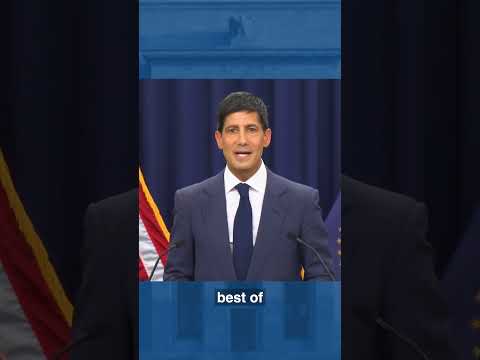
@federalreserve Kevin Warsh speaks and the stock market plunges and I'm now down $1,600.00 today. That's even after making some $ with the SPCX IPO. WTH???!!!
English
0
0
0
151
SemiSweetTweet retweetledi
Ihtesham Ali
Ihtesham Ali@ihtesham2005·
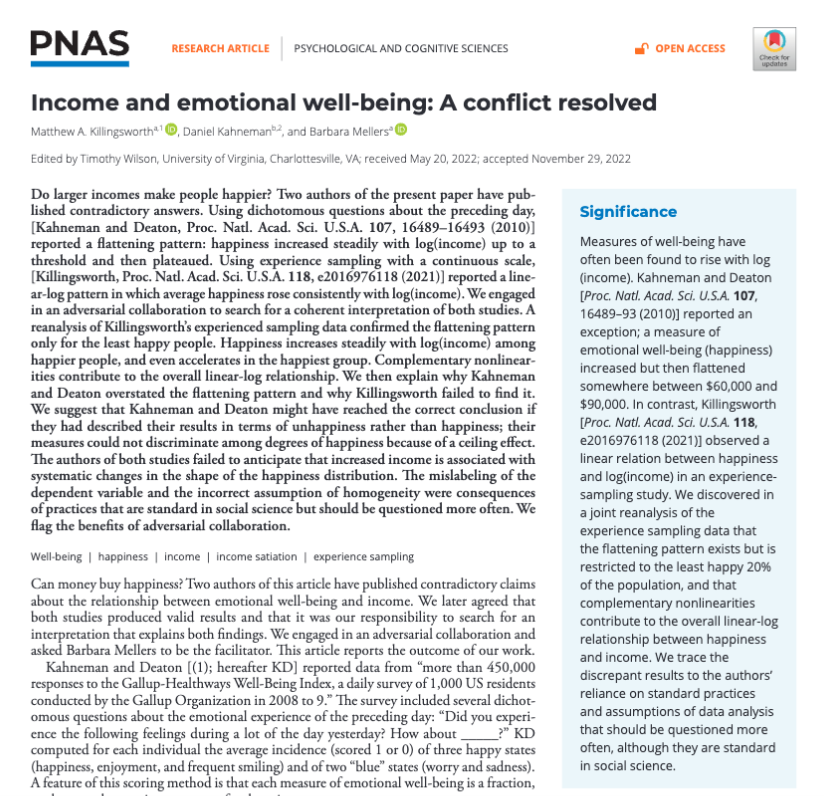
Does money buy happiness? A Princeton Nobel laureate said no above $75,000. A Penn researcher with 1.7 million data points said yes. The day they sat down together to settle the fight, the answer they reached should change how you think about your own life. The Nobel laureate is Daniel Kahneman. The Penn researcher is Matthew Killingsworth. The fight between them lasted 13 years, and the way it ended is one of the cleanest examples in modern science of two smart people being wrong in opposite directions about the same question. In 2010 Kahneman and his Princeton colleague Angus Deaton published a paper that became one of the most quoted findings in the history of social science. They analyzed 450,000 responses to the Gallup-Healthways Well-Being Index and concluded that emotional well-being rose steadily with income up to about $75,000 a year, and then flattened out completely. Above that line, the extra money was not buying any more daily happiness. The headline traveled around the world. Every news outlet ran the number. A CEO in Seattle famously cut his own salary to raise his employees to that exact threshold. The 75,000 dollar figure became cultural shorthand for the idea that the rich are not actually any happier than the rest of us once basic needs are met. For 11 years almost nobody seriously challenged it. Kahneman had a Nobel Prize in Economics, the sample size was massive, and the conclusion was emotionally satisfying in a way that made everyone feel a little better about not being wealthy. Then in 2021 a 33 year old researcher at the University of Pennsylvania published a paper that quietly destroyed the entire finding. His name is Matthew Killingsworth. He had spent the previous decade building a smartphone app called Track Your Happiness that pinged users at random moments during their day and asked them a simple question. How do you feel right now, on a scale from very bad to very good. The app was designed to catch happiness in the act, not to ask people to recall it later. By 2021 he had collected over 1.7 million real-time happiness reports from 33,000 adults. When he plotted income against in-the-moment well-being, there was no plateau anywhere. The line just kept rising. People earning $200,000 were happier on average than people earning $100,000. People earning $400,000 were happier than people earning $200,000. The curve flattened slightly but never stopped climbing. The famous $75,000 ceiling that the world had been quoting for 11 years simply did not exist in his data. Now there were two Nobel-quality findings sitting in direct contradiction with each other. One of them had to be wrong, and neither researcher was willing to walk away. What happened next is the part of the story almost nobody knows. Kahneman called Killingsworth and proposed something rare in academic science. He called it an adversarial collaboration. The two of them, joined by Penn psychologist Barbara Mellers as a neutral referee, would sit down together and reanalyze the raw data from both studies, line by line, until they figured out which one of them was wrong. The paper they co-authored was published in March 2023 in the Proceedings of the National Academy of Sciences. And the answer they reached was not what either of them had expected. Both of them had been right at the same time. They had been measuring two different populations without realizing it. When the team broke Killingsworth's 1.7 million data points apart by baseline happiness, the picture clarified completely. For the happiest 70 percent of people, more money kept buying more happiness all the way up to $500,000 a year, with no sign of slowing down. For people in the middle, the same pattern held. But for the bottom 20 percent of the sample, the ones who were already unhappy before the question of money even came up, the curve flattened almost exactly where Kahneman's original paper had said it would. Above roughly $100,000 a year, adjusted for inflation, more money did nothing for them. This is the finding that changes how the question should be asked. If you are not already unhappy, money keeps buying happiness for a much longer stretch than Kahneman's original paper suggested. The runway is wider than the world has been telling itself for a decade. If you are already unhappy, money does almost nothing past a certain point. There is a ceiling, but the ceiling is not about income. It is about the underlying state of the person collecting it. The deeper insight in Killingsworth's original research, the one almost nobody talks about, is the part that should sit with you longer than the income numbers. The Track Your Happiness app had been telling him for years that the single biggest predictor of in-the-moment well-being is not money at all. It is whether your mind is on the thing you are doing. His most cited paper, written with Daniel Gilbert at Harvard, is titled A Wandering Mind Is an Unhappy Mind. The data from the app showed that people are mentally absent from what they are doing 47 percent of the time, and that mental absence is one of the strongest predictors of unhappiness in the entire dataset. More predictive than income. More predictive than the activity itself. More predictive than almost any demographic variable you could measure. Which means the unhappy 20 percent that Kahneman's plateau actually described were probably not unhappy because they did not have enough money. They were unhappy for reasons that more money could not reach. The reason the curve flattened for them at $100,000 a year is the same reason it would have flattened at $300,000 or $700,000. The thing they were missing was not buyable. The most uncomfortable line in the entire 2023 paper is the one that nobody on the internet quotes. The authors note that the relationship between income and happiness, while real, is much weaker than the relationship between attention and happiness. A person earning $40,000 who is fully present in their own life will, on average, report higher in-the-moment well-being than a person earning $400,000 whose mind is somewhere else. The fight about money was the wrong fight the entire time. The two researchers spent 13 years arguing over whether the dollar ceiling was at $75,000 or $500,000, and the data from Killingsworth's own app was sitting there the whole time saying the ceiling was not about dollars at all. The ceiling is whether you can hold your attention on the life you actually have. You can run the experiment yourself the next time you catch your mind drifting. Stop. Put your phone down. Look at the room you are in, the person across from you, the food in front of you, the work you are actually doing. That is the part the apps cannot sell you and the salary cannot buy you. The data has been clear for over a decade. The plateau is not in your bank account. It is in your attention.
Ihtesham Ali tweet media
English
58
468
1.7K
313K
SemiSweetTweet
SemiSweetTweet@SemiSweetTweet·
@DIRECTVhelp It works for me. I hop to whomever gives me ALL my programming ALL the time, espcially when you just billed me $79.99. 🖕
English
0
0
0
3
DIRECTV Help
DIRECTV Help@DIRECTVhelp·
This doesn't only happen to DIRECTV, it affects the entire industry. Companies like Xfinity, DISH, and Spectrum all go through programming negotiations too. That's why switching service providers isn't the answer. Visit spr.ly/6014BDG4Oi to learn more and to find out if you're eligible for any credits.
English
1
0
0
113
SemiSweetTweet
SemiSweetTweet@SemiSweetTweet·
@DIRECTV you better immediately figure out why I don’t have @ABC in my channel lineup that I am paying for. “Our contract with this channel’s owner has expired.” Get me my programming or a refund. I’m about to jump to the competition. This is absolute bait and switch 🐄💩! #ABC
English
2
0
2
597
SemiSweetTweet
SemiSweetTweet@SemiSweetTweet·
- @pulte Can you get the USDA to remove and forgive their subsidy on mortgages? The reason for rural development and affordable housing is to make it affordable, but it's not when less than 5 years later you owe 20K. Same with EIDL loans, should be forgivable like PPP loans.
English
0
0
0
21
DIRECTV Help
DIRECTV Help@DIRECTVhelp·
We know it’s frustrating to lose Scripps stations. They chose to remove their channels while seeking a significant fee increase, even though much of their content is available free over the air or online. While we work toward a resolution, you can find other ways to watch and check potential bill credit eligibility at spr.ly/6018B8cGPp ^KharlS
English
2
0
0
78
SemiSweetTweet retweetledi
jardelito
jardelito@jardelito·
isso é o tipo de coisa que eu compraria se eu tivesse dinheiro e um cachorro
Português
315
3.2K
27K
3.3M