Sheff C (𝔦, 𝔦)

2.8K posts

Sheff C (𝔦, 𝔦) banner
Sheff C (𝔦, 𝔦)

Sheff C (𝔦, 𝔦)

@SheffC_eth

Trench Scientist

Tokyo-to, Japan Katılım Temmuz 2010
729 Takip Edilen1.2K Takipçiler
Sabitlenmiş Tweet
Sheff C (𝔦, 𝔦)
Sheff C (𝔦, 𝔦)@SheffC_eth·
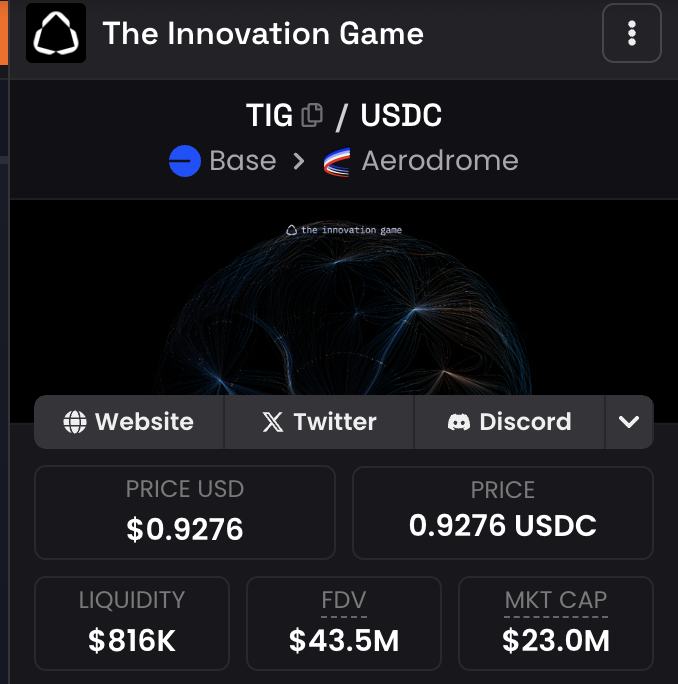
I believed when it was math, not marketing. When $TIG was misunderstood, not valued. It’s not just the backbone of AI, it’s the infrastructure of intelligence itself. I will pin this and look back at it, not if, but when it reaches billions.
Sheff C (𝔦, 𝔦) tweet media
English
2
6
65
4K
Sheff C (𝔦, 𝔦) retweetledi
John Fletcher (𝔦, 𝔦)
John Fletcher (𝔦, 𝔦)@Dr_JohnFletcher·
(reposting as I included wrong link!) Thanks. Yes, it’s encouraging that open weights models seem to be gaining on private ones (at least the private ones they let the public use!) My main concern is that SOTA in AI-assisted algorithm discovery (AlphaEvolve, or whatever google have now) is more elaborate than just an LLM, and Google may have a significant lead in this capability. If this is made available over API, it could become indispensable to researchers working in this area, whereupon they expose their know-how to capture; knowhow being, in this context, strategies that researchers try when they get stuck (knowhow is largely uncodified, so not in current training data). A “data flywheel” effect may not be out of the question. I wrote about this here if you are interested! x.com/dr_johnfletche…
English
1
2
15
402
Marc Andreessen 🇺🇸
Interesting.
John Ennis@johnennis

In the middle of my longest Codex run ever, coming up on 3 straight days I've adapated @elves_skill with a workflow for pure math research, and I've been working with my former PhD advisor on some open problems in differential geometry Looks like I'll get my first pure math paper in a while, and I've learned a ton about what is actually possible when it comes to AI for math The short of it is that AI is amazingly useful, and any mathematician who doesn't use these tools is at a big disadvantage, but the idea that there will be nothing left for human mathematicians to do is just wrong I'll write up more about this experience when done if people are interested, and I'm thinking about adding a math module to Elves

English
20
6
150
52.2K
Sheff C (𝔦, 𝔦)
Sheff C (𝔦, 𝔦)@SheffC_eth·
worth reiterating this because the market still hasn't processed it. GV, NVIDIA, AMD, Greycroft just paid $4.65 billion for one closed-source bet on AI-generated algorithms. no product. no revenue. 25 employees. one team, one country, one cap table. that is not retail. those are the most informed allocators on the planet. they don't write checks that size on a thesis they think is wrong. the thesis is settled. AI-generated algorithms are the path. the only open question is which structure captures the upside. TIG runs the same thesis with three things Recursive structurally cannot have: anyone can contribute. not 25 employees in two cities anyone with a laptop, a tacit-knowledge file, and a reason. the talent pool is the planet, not a payroll. contributors keep their edge and get paid. tacit knowledge never leaves your machine. royalties route on-chain to whoever discovered the algorithm, every time it ships commercially, forever. that contract does not exist anywhere else on earth. the algorithms stay open. Recursive must keep its outputs proprietary or the moat dies. TIG must keep them open or the market dies. opposite constraints, opposite outcomes. only one of those scales without a ceiling. this is not a token bet. this is the structural alternative to one company owning the math underneath modern civilization. that question gets decided once. you either positioned for it or you didn't. generational doesn't mean a 10x. generational means the answer to a question this size only gets priced once. and the priced once happens before the public catches on, not after. $TIG
The Innovation Game (𝔦, 𝔦)@tigfoundation

Another day, another (closed) startup. Recursive Superintelligence came out of stealth today, is valued at 4.65 billion and investors include Nvidia and Google (ofc) Their bet: We get to superintelligence by using AI to generate algorithms. One of their founders, Jeff Clune, published the AI Scientist paper in Nature this March. AI that runs the whole scientific method on its own. His announcement tweet says Recursive will "scale up" exactly that work. Universities and labs do the foundational, citable research, get the credit, and then the for-profit scales it up into something proprietary. Algorithms are how we get to superintelligence, and if a closed company gets there first, everyone else is locked out of the most important technology ever built. The algorithms HAVE to stay open.

English
2
13
47
2.2K
Sheff C (𝔦, 𝔦) retweetledi
Gilded Hiero
Gilded Hiero@Fox_Beholder·
Testosterone increases action under uncertainty. The ticker is $TIG Fuck you
English
5
15
94
3.8K
Sheff C (𝔦, 𝔦) retweetledi
Ⓣrillion
Ⓣrillion@Trillion_Tao·
Something big just dropped in the $TIG Discord. The Prometheus private beta just posted results — and nobody saw this coming. Their own expectations: don't beat any leading $TIG algorithms. One maths researcher gave it "close to 0% chance." The Energy challenge swarm generated an algorithm 6% better than the current winner. First swarm ever run. Half the features still missing. Every participant was brand new to Prometheus. It worked anyway. For context on what this means: When an algorithm is submitted to $TIG it takes four weeks to go live — two weeks private, then admitted into the game and made public. They've already tested against every public algorithm. It beats them all. Private submissions are still unknown. How the rewards work: The Prometheus team, as host of the swarm, will submit the algorithm. If it wins, rewards get distributed to every participant who got at least one agent running during the beta. Next swarm date gets announced Monday. GPUs potentially incoming. This is what decentralised algorithmic discovery actually looks like in practice. $TIG #Algorithms
English
12
26
125
6K
Tomás Bjartur
Tomás Bjartur@BjarturTomas·
Mathematician reacts to OpenAI's recent proof:
Tomás Bjartur tweet media
English
325
308
4.8K
820.6K
Algod
Algod@AlgodTrading·
@VitalikButerin @MsMelChen Issue is with opensource its much more difficult to monetise meaning you wont have the max benefits from capitalism to have tens/hundreds if billions flowing into companies to innovate
English
13
0
16
3.9K
Melissa Chen
Melissa Chen@MsMelChen·
Wake up, Europe. You have exactly two choices: America’s tech stack or China’s. You cannot build your own. You cannot complete anything at scale. All you do is pass legislation, issue fines, write stern letters of concern, and hold press conferences about “digital sovereignty” while your cloud infrastructure, AI models, semiconductors, and platforms remain overwhelmingly dependent on foreign technology. Pretending you’ll magically “build European champions” by taxing, fining, and hamstringing the only people who actually ship product at global scale is delusional. Decades of evidence prove it. Brain drain continues. Investment gaps widen. We know what the data says: Europe lags behind in AI, cloud, semiconductors, and consumer platforms because of the regulatory moat you build and maintain around mediocrity. So you can push for sovereignty but it will not materialize because you’re unwilling to do what it takes to get there.
Polymarket@Polymarket

NEW: The EU is pushing for “tech sovereignty” to reduce its reliance on the U.S.

English
352
406
2.8K
280K
Sheff C (𝔦, 𝔦) retweetledi
Nico⚡(𝔦, 𝔦)
Nico⚡(𝔦, 𝔦)@Simulacra333·
@base could be incredible and life could be so easy if the entire community actually rallied behind the few projects that will still matter in 5 years. @tigfoundation is one of them. An academic team with 45+ crypto patents between them. One of them is the researcher behind OP_PUSHTX, the technique that proved Bitcoin's smart contract capability. Their IP and licensing lead has 30+ years in the field. The thread below shows the researchers actively launching algorithm challenges on $TIG. The signal there is hard to miss. What they're building is the missing piece of the AI stack. Every industry on earth runs on algorithms, logistics, drug discovery, energy grids, AI training itself, and right now there's no neutral place to price, validate, and monetize them. The value sits trapped inside corporate R&D, unrewarded for anyone outside the walls. $TIG opens that market. The economics are designed for the long run, not the next emission cycle. Post-emission, rewards come from real licensing fees on actual algorithm usage. The token is wired into the protocol's revenue, it's one of the few projects in crypto that actually needs a token for more than bag holding and speculation. This one captures 100% of the licensing revenue and creates a market for algorithms. The Prometheus update is about to bring coordinated AI agent swarms into the system. Algorithmic discovery is becoming compute-bound, and $TIG is the layer where that work gets graded, ranked, and paid for. Submissions are climbing and the swarm isn't even live yet.📈
Nico⚡(𝔦, 𝔦)@Simulacra333

Imagine when $TIG has 100+ algorithmic challenges and the economic flywheel is in full effect. These are just 5 of the challenges, alongside the decorated researchers behind each one. It's one thing to pay CT KOLs to shill your project. It's another thing entirely to build infrastructure that attracts top academics from every field, all around the world, to put their reputations on the line working through @tigfoundation. Read the receipts. Run the numbers.👇

English
1
2
25
566
Sheff C (𝔦, 𝔦) retweetledi
FhtAbd
FhtAbd@fhtabd·
TIG is a swarm of economies. Here are five: 1. AGENTIC ECONOMY An agent gets stuck. It pays another agent for a code mutation. Strategy stays private. Problem solved. Autonomously. 2. CONSENSUS ECONOMY (OPoW) Not static like Bitcoin. Multiple Hot-Swappable algorithms run at the same time. Benchmarkers choose which to run. The network adopts the best. Benchmarkers get rewarded. Consensus is a market. 3. COMMERCIAL IP ECONOMY Companies pay $TIG tokens to licence algorithms. They keep data private. Revenue flows in. 4. TOKEN ECONOMY Licence fees fund new challenges. More challenges attract more Benchmarkers. More discoveries. A flywheel. 5. OPEN SCIENCE ECONOMY Researchers use algorithms free. They share improvements back. The IP grows. Science pays for science. That's not a crypto project. Thats a self-funding intelligence engine.
FhtAbd tweet media
English
0
5
40
1.6K
Sheff C (𝔦, 𝔦) retweetledi
Nico⚡(𝔦, 𝔦)
Nico⚡(𝔦, 𝔦)@Simulacra333·
Fun fact: If $TIG added what $NEAR just gained THIS WEEK alone, it would be valued at roughly $70 per token. Award winning scientists are launching algorithmic challenges here and @tigfoundation already has 2 SOTA algorithms under it's belt (one that NASA is using to clear space debris). Massive upgrade that will bring coordinated AI Agent swarms online to improve and speed up innovation even more is around the corner. Currently trading at $1.6 per token
Gilded Hiero@Fox_Beholder

x.com/i/article/2059…

English
4
10
83
2.5K
Sheff C (𝔦, 𝔦) retweetledi
Ⓣrillion
Ⓣrillion@Trillion_Tao·
The man behind $TIG isn't a just any founder. He's been building this for a decade. Most people posting about $TIG haven't read past the token price. Here's who actually built it — verified, sourced, no speculation. Academic record — Oxford, Imperial, Cambridge. In sequence. 🥇2004 University of Oxford Undergraduate degree — Physics Oxford 🥇2006 Imperial College London MSc — Theoretical Physics Imperial 🥇2011 University of Cambridge PhD — Mathematics and Theoretical Physics Cambridge His PhD wasn't in blockchain or crypto. It was in Foundations of Computer Science — specifically AI and Commonsense Reasoning — which he arrived at from general relativity and tensor calculations. He came to AI through physics, not the other way around. What he did before anyone was paying attention: 30+ Patents in cryptography and distributed systems 7yrs Researching distributed incentives before TIG launched 2016 Year he started — same year AlphaGo beat Lee Sedol March 2016 AlphaGo beats Lee Sedol. The world wakes up to AI in complex optimisation. Fletcher starts researching distributed incentive frameworks full time. 2016–2022 7 years of research. 30+ patents filed. No token. No launch. Just building the intellectual foundation. Nov 2023 TIG network goes live. 9 months of zero-liquidity mining before any market opens. June 2025 Called as expert witness before the UK Parliament on open-source AI and IP. Presents alongside Meta and OpenUK. Joined by TIG's IP counsel — former General Counsel at ARM. May 2026 Returns from San Francisco. Reports the entire city has caught up to the thesis. Stephen Diamond — who built CVXPY, the standard optimisation tool across finance and logistics — gives a talk at AGI House titled "An AlphaGo Moment for Numerical Methods." What makes this different: ✅Oxford undergraduate. Imperial MSc. Cambridge PhD. All three elite UK science institutions in sequence. ✅7 years of private research before any token, any launch, any community. ✅30+ patents in cryptography and distributed systems — built before TIG existed. ✅Called before the UK Parliament as an expert on AI and open-source IP. ✅No VC round. No presale. Team tokens earned through mining, then locked in Sablier. ✅The thesis he started building in 2016 is now the dominant conversation in San Francisco in 2026. The $TIG founder @Dr_JohnFletcher isn't a founder who read a whitepaper and decided to launch a token. It's someone who spent a decade building the intellectual and legal foundation for exactly this problem — before most of the people now buying the token had heard of Bittensor. That's not a marketing claim. Every line above is sourced from his LinkedIn, the $TIG team page, IQ.wiki, the UK Parliament evidence session transcript, and his own public interviews.
Ⓣrillion tweet media
English
2
12
63
2.1K