Simeng Zhu

82 posts

Simeng Zhu

Simeng Zhu

@SimengZhuMD

Radiation oncologist @OSUCCC_James. Medical AI reseacher.

Katılım Aralık 2016
637 Takip Edilen261 Takipçiler
Simeng Zhu retweetledi
Nathan Lambert
Nathan Lambert@natolambert·
I spent a bunch of time this week getting my Nvidia DGX Spark working in Ai2's post-training repo (open-instruct) for a local RL debugging machine. It was quite hard due to cuda 13 requirement and not many VLLM wheels. github.com/natolambert/dg…
English
15
13
138
22.4K
Jeff Ryckman
Jeff Ryckman@jryckman3·
So, who is going to develop free software to overlay RT DICOM onto follow-up CT imaging after radiotherapy, thereby decreasing patient scanxiety by correlating prior radiotherapy fields w/ diagnostic imaging? Because this paper shows why it matters.🧵👇 @uwradonc @UWRadiology
Jeff Ryckman tweet media
English
8
16
45
4.9K
Simeng Zhu retweetledi
David Sher
David Sher@DavidSherMD·
The linked paper is a nice document and summary product, but let's emphasize a few highlights: 1. Statement 16, strong consensus: ctHPVDNA should supplement conventional surveillance tools, rather than reducing or replacing them. Natural corollary: if it is not reducing or replacing surveillance, what is the point? 2. Statement 9, strong consensus: Detectable ctHPVDNA without clinical or radiographic evidence of disease often increases patient distress. 3. Statement 5, strong consensus: Large-scale, prospective randomized controlled trials are necessary to validate ctHPVDNA's role in HPV+ oropharyngeal cancer management. I would change that statement from validate to determine. Validate assumes it has a role today, but as the document states, it doesn't reduce or replace any currently established surveillance tools. There are so many exciting ways that ctHPVDNA may influence care (screening/diagnosis, de-escalation, non-imaging-based surveillance) but these strategies need to be established in prospective randomized trials.
Naveris, Inc.@Naveris_inc

The California Head & Neck Consortium released the first multidisciplinary consensus recommendations on the use of circulating tumor HPV DNA in HPV+ oropharyngeal carcinoma. The panel of 33 experts representing 15 institutions reached strong consensus that a tool like the NavDx® test should be incorporated into routine surveillance. The consensus recommendations also included: Using an option like the NavDx test improves time to recurrence detection vs. conventional surveillance tools, but should supplement these methods, not reduce or replace them. The recommended time for a patient’s first post-treatment test is 3 months. Serial testing should be performed in conjunction with conventional surveillance every 3 months in the first 2 years post-treatment and every 6 months in years 3-5. For patients with a single positive post-treatment test where no clinical or radiographic evidence of disease is present, the best time to repeat the test is in one month. Earlier molecular detection of locoregional or oligometastatic disease should improve outcomes. These recommendations reinforce real-world clinical validation and value of new technologies like the NavDx test in earlier detection of molecular residual disease and recurrence of HPV+ oropharyngeal cancer. Access the full publication here: bit.ly/3MrPgeG  #ctHPVDNA #HeadAndNeckCancer #Oncology #MRD #NavDx #CancerSurveillance #hncancer

English
5
5
18
4.7K
Simeng Zhu retweetledi
Andrej Karpathy
Andrej Karpathy@karpathy·
Test time compute cat 🐈‍⬛
English
102
221
2.5K
250.3K
Simeng Zhu retweetledi
Raj Singh, MD
Raj Singh, MD@Raj_Singh_MD·
Great to see our CNS/Peds director @joshuapalmermd! Making a huge difference for our patients in the state of Ohio and elsewhere through his prolific work @OhioStateRadOnc
Christian Rolfo@ChristianRolfo

Honored to participate at The James Ambassadors Foundation Fall Celebration. Thanks to our @OSUCCC_James Ambassadors for supporting research. “Precision, Collaboration, innovation, translational research personalization and hope are in the future of cancer care” (@David_Cohn_MD)

English
1
5
15
1.2K
Simeng Zhu retweetledi
The Nobel Prize
The Nobel Prize@NobelPrize·
BREAKING NEWS The Royal Swedish Academy of Sciences has decided to award the 2024 #NobelPrize in Physics to John J. Hopfield and Geoffrey E. Hinton “for foundational discoveries and inventions that enable machine learning with artificial neural networks.”
The Nobel Prize tweet media
English
991
13.1K
32.4K
12.7M
Simeng Zhu retweetledi
Raj Singh, MD
Raj Singh, MD@Raj_Singh_MD·
Great time at brain mets PRO ⁦⁦⁦@ASTRO_org⁩ w/ ⁦@stuxrt⁩ and ⁦@wgbreen⁩, reviewing prevention/diagnosis/management of radionecrosis and ⁦⁦@OhioStateRadOnc experience w/ Boswellia! Thanks to⁩ ⁦@BeantGill118⁩ and Avani Rao for organizing!
Raj Singh, MD tweet media
English
3
4
34
1.1K
Simeng Zhu retweetledi
Hamel Husain
Hamel Husain@HamelHusain·
LLM bullshit knife, to cut through bs RAG -> Provide relevant context Agentic -> Function calls that work CoT -> Prompt model to think/plan FewShot -> Add examples PromptEng -> Someone w/good written comm skills. Prompt Optimizer -> For loop to find best examples.
English
97
529
3.3K
289.9K
Simeng Zhu retweetledi
TimDarcet
TimDarcet@TimDarcet·
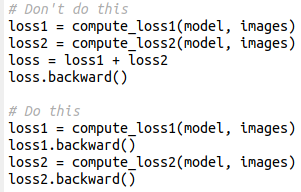
Bonus trick: you can remove the gradient reduction of the first backward (which is useless) by wrapping in no_sync() Remember to also include the forward pass in the no_sync context, else it does not work
TimDarcet tweet media
Gabriele Berton@gabriberton

This simple pytorch trick will cut in half your GPU memory use / double your batch size (for real). Instead of adding losses and then computing backward, it's better to compute the backward on each loss (which frees the computational graph). Results will be exactly identical

English
1
17
234
33.5K
Simeng Zhu retweetledi
Gabriele Berton
Gabriele Berton@gabriberton·
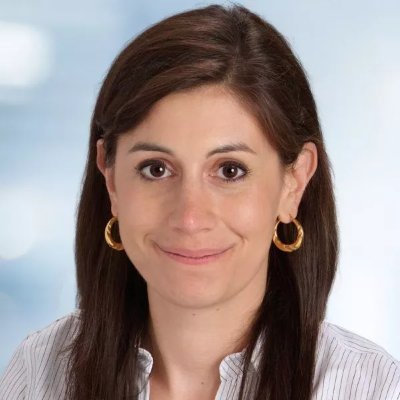
This simple pytorch trick will cut in half your GPU memory use / double your batch size (for real). Instead of adding losses and then computing backward, it's better to compute the backward on each loss (which frees the computational graph). Results will be exactly identical
Gabriele Berton tweet media
English
48
337
3K
803.1K
Simeng Zhu retweetledi
darren
darren@darrenangle·
why would I use a 200MB classifier when I can use a 40GB LLM named psiball-orpo-qdora-the-xplora-70B-int4-swiffer-sweeper-slerp-v0.02-(Taylor's version)
English
16
76
763
65.5K
Simeng Zhu retweetledi
Lea Alhilali, MD
Lea Alhilali, MD@teachplaygrub·
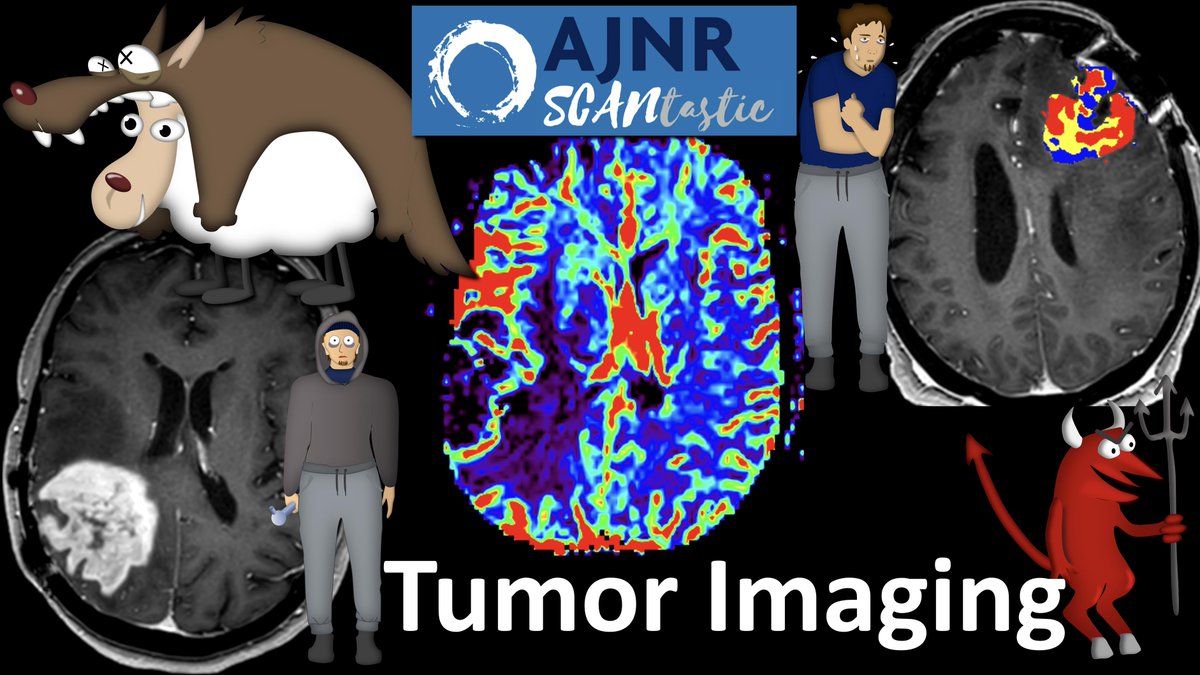
1/Have some confusion about tumor perfusion? Do you go into a coma looking at scans for glioma? Never fear! Read on for this month's @theAJNR SCANtastic for what you need to know on the latest in brain tumor imaging! ajnr.org/content/45/4/4…
Lea Alhilali, MD tweet media
English
12
119
360
41.5K
Simeng Zhu retweetledi
Lea Alhilali, MD
Lea Alhilali, MD@teachplaygrub·
Tired of stressing whether a brain tumor is progressing? Wish you had some insurance about calling tumor recurrence? Here’s the cheat sheet you NEED for the best signs of tumor progression! Read on for the newest @theAJNR SCANtastic on tumor imaging: ajnr.org/content/45/4/4… ▶️Tumor progression is like tumor escaping treatment. 🔷Just when treatment thinks it’s got tumor trapped at cliff, tumor is able to get away 🔶Think how you would get away if you were chased to a cliff’s edge---these are same signs of tumor progression: ➡️Jump off into the water: 🔸Tumor heads to the water—the ventricular surface 🔸Subependymal enhancement is very specific (93% sensitivity), but it isn’t commonly seen (38% sensitive). ➡️Cross over the rickety bridge: 🔸Tumor crosses over the brain’s main bridge: the corpus callosum 🔸Callosal involvement is only significant if combined w/multiple foci or crossing midline. ➡️Slide down the rocks: 🔸Spectroscopy looks like a slide down: Increased choline is seen w/recurrence—when combined w/low NAA, it looks like a reverse Hunter’s angle 🔸Increased Cho/NAA or Cho/Cre ratios can suggest recurrence ➡️Run fast & get your red blood hot: 🔸Blood volume is hot on perfusion: high rCBV on perfusion 🔸rCBV hotter than the normal contralateral white matter can be used as a gestalt 🔸Quantitatively, rCBV >1.75 is high suggestive of tumor & rCBV > 1.0 is concerning ➡️Try to sneak away when it’s dark: 🔸Tumor looks dark: Low ADC value (dark on T2) is concerning for tumor 🔸Quantitatively ADC value ≤ 1220 × 10-6 mm2/s is 74% sensitive & 89% specific 🔸I joke, “If the ADC is less than 1000 x 10-6, I am 1000% sure it’s tumor!” Now you know the best signs of tumor recurrence on imaging! Hopefully now you know when tumor progression should make your impression!
Lea Alhilali, MD tweet media
English
10
79
303
33.8K