

Don Smith
1K posts

Don Smith
@TanagerDon
Cat-Herder-in-Chief for several companies, including Covixyl, a virus-blocking nasal spray (@gocovixyl), a novel sensor, and an AI-based security company.
Jacksonville, FL Katılım Kasım 2022
207 Takip Edilen152 Takipçiler

@TanagerDon Hi Don, thanks for contacting Handshake Support. Please open the chatbot at the bottom right of support.joinhandshake.com/hc/en-us and ask it to create a new support ticket. From there, we can review your account status. We look forward to hearing from you.
English
@joinHandshake - it's been ten days and three support emails with NO human response. I'm trying to post internships but can't. Who do I call? Someone please help me. Two students are going to miss out because of this.
English
@DougKinnison - looks like a project for us.
Ruben Hassid@rubenhassid
Most people want AI to sound like them. But no one does this first (and it takes 47 mins): Step 1. Download Claude (claude. com/ download) Open 'Cowork'. Create a folder for your voice. Step 2. Select Opus 4.7 + Extended Thinking Set as default model. Turn ON Extended Thinking. Step 3. Copy-paste the interview prompt From this guide: ruben.substack.com/p/youre-just-a… It asks you 100 questions about how you think. Step 4. Answer every question out loud Use the Wispr. ai. Talk to yourself. Don't type. Typing makes you edit. Talking makes you honest. Step 5. Don't tell what you like. Tell what you reject. Be extremely precise and specific in your answers. 80% of your file should be what you'd never say. Step 6. Paste Prompt 2 - The Voice Compiler 20K-word raw file → 2-4K compressed tokens. Cuts generic. Keeps signal. Most people stop at the raw dump. That's the mistake. Step 7. Save + test [yourname] .md Open a blank Claude session. Paste the file. Ask it to write something. If it sounds like you → ship it. If not → re-interview. Step 8. Deploy with Obsidian Drop the .md in your Cowork folder. It auto-read on every prompt. Edit it like a Google Doc. It syncs automatically, without downloading uploading loop. The Don'ts: ✦ Skip the 100-question interview ✦ Answer vaguely ("I like clarity" → clarity HOW?) ✦ Stop at the 20K-word raw dump ✦ Use blank chats instead of Cowork folders ✦ Treat the file as static (you change daily) ✦ Think your voice is too "magical" to capture ✦ Forget to document what you'd NEVER write ✦ Blame AI for sounding generic The Do's: ✦ Always use Cowork - not blank chats ✦ Always turn on Extended Thinking ✦ Always compress with Prompt 2 ✦ Always test in a blank session first ✦ Always document refusals, not just preferences ✦ Always edit your .md as your taste shifts ✦ Always push through the full 100 questions ✦ Always start prompts pointing to your folder You think you're complex to fit in a file. You're not. 47 mins & one .md file to duplicate your brain. Most people won't sit for 2 hours. You're not most people. Full process + prompts: ruben.substack.com/p/youre-just-a…
English
@DougKinnison is 💯💯💯correct here. Build your audience.
Doug Kinnison ⚡@DougKinnison
You've got an idea for an app? Yeah I know. But here are my thoughts on your barriers to entry.
English

I mean in some ways it's a good thing, but the labor rates in Miami are nuts.
- Person to use chainsaw for 2 hours- $300-800
- General garden laboring - $60+ per hour
- Cleaning $50+ per hour
-HVAC repair $150 per hour
Meanwhile
- Brand manager- $20 per hour
- Qualified Architect - $30 per hour
- Office manager - $22 per hour
English

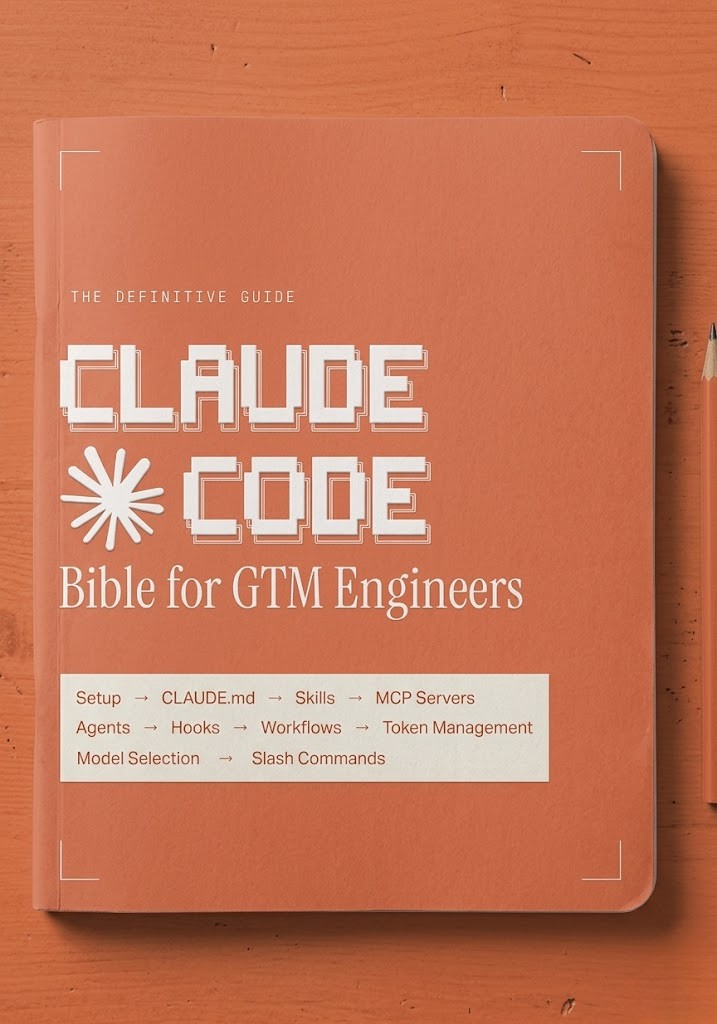
I put my entire Claude Code setup for GTM engineering into ONE Notion doc
10 modules. No fluff.
- How to install Claude Code and run your first GTM session in under 10 minutes
- How to build a CLAUDE. md that acts as your project brain and never loses context
- How to install GTM skills that chain together and run autonomously
- How to connect your full stack via MCP servers without writing custom wrappers
- How to run parallel agents and subagents across GTM workflows simultaneously
- How to manage context and token usage across long research sessions
- How to choose between Sonnet, Opus, and Haiku based on the task
- How to hook Claude Code into external triggers so workflows run without you
- The exact GTM workflows to build first: signal detection, lead scoring, outreach sequencing
- Full slash command reference for every repeatable GTM task
This is the setup I would have KILLED for before spending months piecing it together from documentation, YouTube tutorials, and scattered GitHub threads.
Like + comment "BIBLE" and I'll send it over
(must be connected for priority access)
English

Fork it
Drop your landing page URL
I'll give 1 piece of advice to as many of you as I can
English

@TanagerDon @TS_Secrets I think this is healthy, I use these moments to work out. Go for a walk change pace. Take care of life...
GIF
English

Quick question for founders:
How many hours do you really work per day?
Not being “on”…
not checking Slack…
Actual work.
I’ll go first:
Most days, 5–6 hours of real output.
What about you?
English
Oh, and @DougKinnison ... Strange things are afoot at the Circle K.
Sukh Sroay@sukh_saroy
🚨Shocking: A 25,000-task experiment just proved that the entire multi-agent AI framework industry is built on the wrong assumption. Every major framework - CrewAI, AutoGen, MetaGPT, ChatDev - starts from the same premise: assign roles, define hierarchies, let a coordinator distribute work. Researchers tested 8 coordination protocols across 8 models and up to 256 agents. The protocol where agents were given NO assigned roles, NO hierarchy, and NO coordinator outperformed centralized coordination by 14%. The gap between the best and worst protocol was 44%. That's not noise. That's a completely different outcome depending on how you organize the agents - not which model you use. Here's what makes this uncomfortable: When agents were simply given a fixed turn order and told "figure it out," they spontaneously invented 5,006 unique specialized roles from just 8 agents. They voluntarily sat out tasks they weren't good at. They formed their own shallow hierarchies - without anyone designing them. The researchers call it the "endogeneity paradox." The best coordination isn't maximum control or maximum freedom. It's minimal scaffolding - just enough structure for self-organization to emerge. But there's a catch nobody building agents wants to hear: below a certain model capability threshold, the effect reverses. Weaker models actually need rigid structure. Autonomy only works when the model is smart enough to use it. Which means every agent framework shipping with one-size-fits-all hierarchies is wrong twice - over-constraining strong models and under-constraining weak ones. The $2B+ invested in agent orchestration tooling may be solving a problem that capable models solve better on their own.
English
Oh @DougKinnison ...
Srishti@srishticodes
The 26 prompts running inside 𝗖𝗹𝗮𝘂𝗱𝗲 𝗖𝗼𝗱𝗲 just got open-sourced. This is literally the entire brain of a $200/month AI coding tool. Someone reverse-engineered every prompt from the accidentally published npm source and you can now study all of them for free. Claude Code uses 26 distinct prompts to function: 1 system prompt (identity, safety, tool routing) 11 tool prompts (shell, file ops, search, planning) 5 agent prompts (explorer, architect, verifier, docs) 4 memory prompts (summarization, session notes) 1 coordinator prompt (multi-agent orchestration) 4 utility prompts (titles, recaps, suggestions) The patterns inside are wild: A dedicated agent whose only job is to TRY TO BREAK the code before it ships Anti-over-engineering rules baked in: "don't add features beyond what was asked" 9-section memory compression that preserves every user message Tiered risk system: freely edits your files but asks permission before force-pushing Every prompt has been rewritten from scratch for legal compliance. Same behavioral intent, no verbatim copying. Even if you never build an agent, reading these teaches you how the best AI coding tool actually thinks. When it edits, when it asks, when it verifies, when it stops. This is a free masterclass in prompt architecture. MIT licensed. Fork it, copy it, learn from it. github.com/swati510/claud…
Don Smith retweetledi
6 steps to a 6-figure career…
No degree. No debt.
Most people have never heard of this path:
NDT (Non-Destructive Testing)
Here’s exactly how it works:
Skip the 4-year degree
Get trained in NDT (weeks/months, not years)
Learn to inspect welds, pipelines, and aircraft
Get your Level I certification
Move to Level II within 12–18 months
Hit $80k–$100k+ with experience
Check out my friends at @graycollarusa for a free webinar.
We’re still telling kids:
“Go take on $100k in debt.”
If I were starting over at 18, I’d look here first:
bit.ly/TSS-NDT
English
@ionleu Man, where to start.
visioncoreai.com
chew-doo.com (launch in 90 days)
tanager.holdings (our venture studio)
English

I am so excited to see this launch. I'm a huge fan of open-source protocols, and OpenAI partnering with Shopify to build a closed-source version is all the proof I need to know that this is needed in the world.
Go, @Pelagora !
Pelagora@Pelagora
OpenAI + Stripe just launched ACP — "open" commerce where one company decides what gets surfaced and one processor takes the cut. Pelagora is the actual open alternative. Peer-to-peer. No gatekeeper. Your node is your store. pim-protocol@0.3.0 is live.
English
Don Smith retweetledi


Come and get it! New careers: no degree, no problem. #ndt #graycollar
Gray Collar@graycollarusa
We're hosting a FREE live webinar April 8: "6 Steps to a 6-Figure Career in Non-Destructive Testing" Certifications, salaries, hiring landscape, and live Q&A with a Level III tech. Free. Recording available. 🔗 #ndt" target="_blank" rel="nofollow noopener">academy.graycollar.com/#ndt
#NDT #SkilledTrades #CareerChange #TradesNotCollege English
@TanagerDon I got your DM and responded there. I'll take a closer look at the issue with your bank transactions so you can take care of your taxes. ^Kailyn
x.com/messages/compo…
English
@QuickBooks I'm trying to get taxes done on several businesses, and my bank transactions page is jacked. I talked to support 10 days ago and then again last week and said there was a known issue they were working on with visibility to transactions, but have had no updates. Help!
English
@skyetrainx @sukh_saroy Bwahahahah! That's awesome. And true. That book scared the shit out of me several years ago.
English

@sukh_saroy Paperclip is an ominous name. Nick Bostrom warned about this.
English

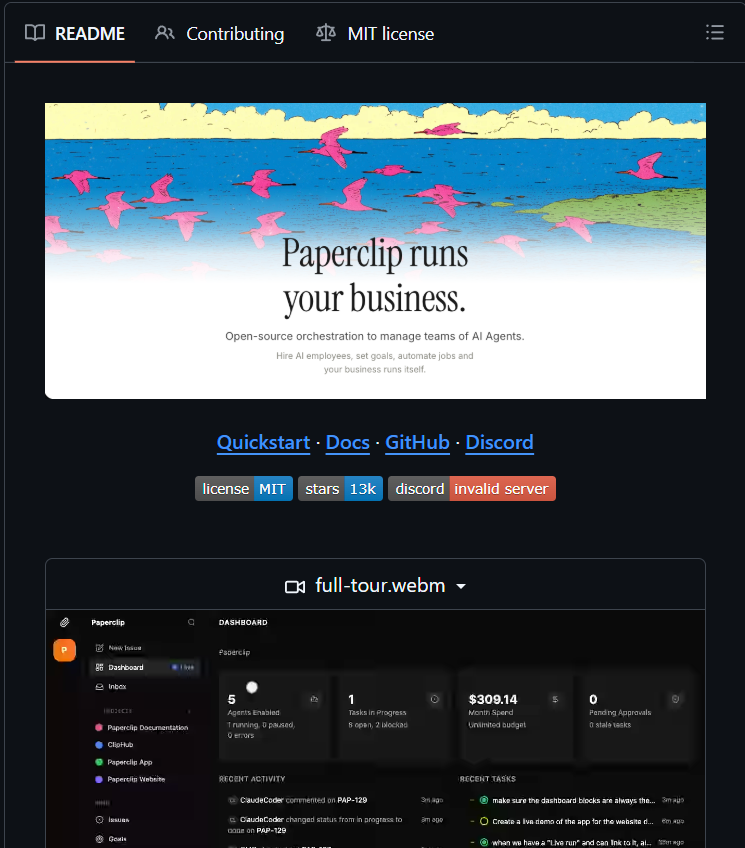
🚨 Someone just open sourced the operating system for running a company with zero employees.
It's called Paperclip.
You define a business goal. You hire AI agents as your team. CEO, CTO, engineers, designers, marketers. Then you hit go and watch them run your company.
Not a chatbot. Not a workflow builder. Not another agent framework.
A full company. With org charts, budgets, governance, job titles, reporting lines, and accountability. Run entirely by AI agents.
If OpenClaw is an employee, Paperclip is the company.
Here's how it works:
Step 1. Define the goal. "Build the #1 AI note-taking app to $1M MRR."
Step 2. Hire the team. Assign agents to roles. CEO, CTO, engineers, marketers.
Step 3. Approve and run. Review strategy. Set budgets. Hit go. Monitor from the dashboard.
That's it. Your AI company is running.
Here's what makes this different from everything else:
→ Full org charts. Your agents have a boss, a title, and a job description.
→ Budget enforcement. Set monthly limits per agent. When they hit the cap, they stop. No runaway costs.
→ Goal alignment. Every task traces back to the company mission. Agents know what to do AND why.
→ Governance. You're the board of directors. Approve hires, override strategy, pause or terminate any agent at any time.
→ Ticket system. Every conversation traced. Every decision explained. Full audit log.
→ Heartbeats. Agents wake on a schedule, check their work, and act. Delegation flows up and down the org chart.
→ Multi-company support. One deployment, unlimited companies. Complete data isolation.
→ Mobile ready. Manage your autonomous businesses from your phone.
Here's the problem this solves:
You have 20 Claude Code terminals open and you've lost track of which one does what. On reboot, you lose everything. You're manually gathering context. You're re-inventing task management between agents. You're spending hundreds on runaway token loops.
Paperclip replaces all of that with a real company structure.
Here's the wildest part:
Coming soon: Clipmart. A marketplace where you download and run entire pre-built companies with one click. Full org structures, agent configs, and skills. Import into Paperclip in seconds.
Download a SaaS company. Download a marketing agency. Download an e-commerce operation. Click run.
Works with OpenClaw, Claude Code, Codex, Cursor, or any agent that can receive a heartbeat. If it can receive a ping, it's hired.
One command to start:
npx paperclipai onboard --yes
1.4K GitHub stars and exploding. #1 on Trendshift.
100% Open Source. MIT License.
Built for people who want to run companies, not babysit agents.
English