Trading Bear

2K posts

Trading Bear banner
Trading Bear

Trading Bear

@TradeWithABear

🐂📈 Not a market bear. Finding inefficiencies in all markets. Discretionary Trading, Systematic Trading, Crypto, Prediction Markets.

Katılım Ağustos 2020
328 Takip Edilen394 Takipçiler
Sabitlenmiş Tweet
Trading Bear
Trading Bear@TradeWithABear·
On my journey to build a portfolio of systematic strategies, I will start by backtesting the following ideas. I will use Codex and Python. Breakout: - Donchian Channel with trailing stops (on Daily and H4) - Intraday breakouts based on ATR (volatility) and key high/low levels (yesterday, ATH, 52‑week high/low, and pivots) Exit criteria are crucial here: I will test both time‑based exits and trailing exits using MA/VWAP. Momentum: - Daily timeframe: trend continuation after a pause - TDI - and MA‑based momentum strategies (expected to fail) - VWAP momentum (expected to fail) Mean Reversion: - Standard deviation bands around VWAP I plan to backtest these strategies in a raw form (without pre‑filtering) as well as with regime filtering, distinguishing between low‑ and high‑volatility periods. Instruments Stocks and crypto in the beginning. I would really appreciate further insights and tips on what to pay particular attention to. I have no experience trading mean‑reversion strategies, as I have always traded breakouts and momentum/trend strategies.
English
5
1
22
1.8K
Trading Bear
Trading Bear@TradeWithABear·
@AtcoTrader @ConcretumR Wow! Then this really surprises me - as I would assume a lot of noise, but will test myself and check out the distribution
English
1
0
1
55
ATCOTrader
ATCOTrader@AtcoTrader·
Here's a very simple system that I trade - opening range breakout on nasdaq. Rules: Entry in the direction of the break of the first 5min bar. Exit either at end of day or at stoploss that is a % of ATR14. CAGR 41,51% Max DD 21,1% 650 trades Idea from @ConcretumR
ATCOTrader tweet media
English
9
7
92
10.2K
Trading Bear
Trading Bear@TradeWithABear·
@PKycek Thanks - I already got the book on my list. I was just curious if you are still trading inside bar/pinbar setups though?
English
1
0
1
15
Pavel | Robuxio
Pavel | Robuxio@PKycek·
1/ When does it make sense to go MR long after a large selloff? In Top40 Binance perps by volume (2020–2026), the answer is fairly clear: For 5-day drops, the sweet spot is -30% to -50%. That is where mean reversion still works Beyond -50%, these are usually not attractive MR longs anymore.
Pavel | Robuxio tweet media
English
4
1
12
1.3K
Peter - Cracking Markets
Peter - Cracking Markets@SystematicPeter·
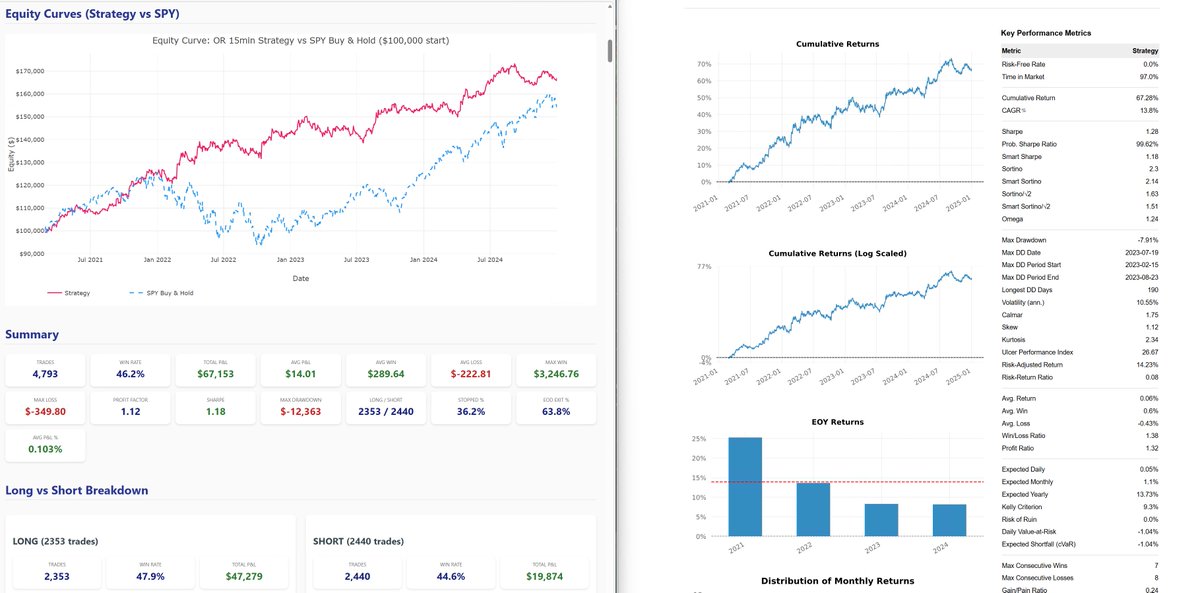
LLMs can backtest trading ideas surprisingly well - if you feed them clean data. It’s insanely convenient: the model writes a “just enough” backtester for the exact hypothesis you’re testing. But here’s the trap: LLMs sometimes make tiny implementation mistakes. And one small bug can turn a solid idea into total garbage - or total garbage into a “holy grail”. My current workflow that keeps me honest: Step 1: Let the LLM prototype + backtest in its own script (I use Claude Code) Step 2: If results look real, my workflow forces it to re-implement the same logic in a proper framework (I use NautilusTrader). Step 3: Compare outputs - equity curve + trade list must match (or be very close). Step 4: If it matches in Nautilus, odds are the backtest is actually correct. Best part: LLMs can port even complex strategy logic into NautilusTrader without hesitation. Screenshot context: Left = LLM “quick backtester” report Right = same strategy re-coded by the LLM inside NautilusTrader Do you have a validation step like this - or do you trust the first backtest that looks good?
Peter - Cracking Markets tweet media
English
10
7
126
9.4K
Trading Bear
Trading Bear@TradeWithABear·
@macrocephalopod Well tbf, couple years back you could do this with Bitcoin…manually…crazy days
English
0
0
0
1K
Trading Bear
Trading Bear@TradeWithABear·
@TraderOrion Are you using Tradingview Backtesting? I‘m pretty sure that there is some sort of bias or error in this backtests
English
1
0
1
30
Trading Bear
Trading Bear@TradeWithABear·
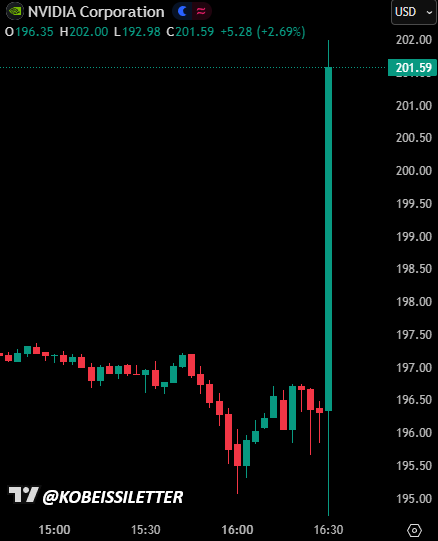
@KobeissiLetter Stock is up 3% now. If Bulls are lucky this ignites another leg up for the whole market.
English
2
0
6
1.6K
The Kobeissi Letter
The Kobeissi Letter@KobeissiLetter·
BREAKING: Nvidia stock, $NVDA, surges above $200/share after reporting record quarterly revenue of $68.1 billion.
The Kobeissi Letter tweet media
English
283
626
5.4K
653.7K
Ripster
Ripster@ripster47·
$NVDA Earnings 🚨 What happened? Where are you Jensen?
GIF
English
18
2
77
29.6K
Trading Bear
Trading Bear@TradeWithABear·
What is extremely noticeable in the last couple years. Gap between Institutions and Retail got smaller. And somehow retail traders are even at advantage. While Instis have to deal with more and more regulatory overhead, the costs of implementing technology + data etc. got so small that almost everyone can run a decent setup at home. It will not stop, just get different I guess. Core principles will always work.
English
0
0
1
239
Peter - Cracking Markets
Peter - Cracking Markets@SystematicPeter·
I get asked a lot: “Aren’t you afraid AI will destroy trading? That you’ll have to shut down your systematic vehicle because markets will become too efficient?” Honestly - I don’t know what the world looks like in 10+ years. It will change. A lot. But for small professionals and retail systematic traders, I see AI as a blessing for the next couple of years, not a threat. Here’s why: - Yes, markets may get a bit more efficient. - But inefficiencies won’t disappear - they evolve. - AI won’t magically create alpha. - But it does compress the research cycle - more tests, faster fixes, less grunt work. “But how is it possible that markets won’t become much more efficient if others use the same tools?” Because AI by itself doesn’t generate alpha - it multiplies execution and experience. And I think the majority of retail traders will still try to fight the market “by hand”. So no - I’m not afraid systematic trading will “stop working” because of AI in the coming years. On the contrary: I’m convinced these are the years that can bring substantial profits to smaller systematic traders who are open to using new tools.
English
3
5
38
6.1K
Trading Bear
Trading Bear@TradeWithABear·
@yuriymatso @SystematicPeter Trying to become the textbook example of selection bias? I have another strategy you could backtest: 100% long Bitcoin in 2010 - hold until October 2025. ...what you should do: Get Quality data. Backtest it on HISTORICAL index constituents (eg. S&P500)
English
0
0
1
20
Yuriy Matso
Yuriy Matso@yuriymatso·
@SystematicPeter No look ahead bias. All trades are executed the next day open. So, the returns are absolutely what they are. The strategy is expanding its universe -- it started with 70 stocks initially but I've been adding more and more as they hit my momentum radar.
English
4
0
3
819
Peter - Cracking Markets
Peter - Cracking Markets@SystematicPeter·
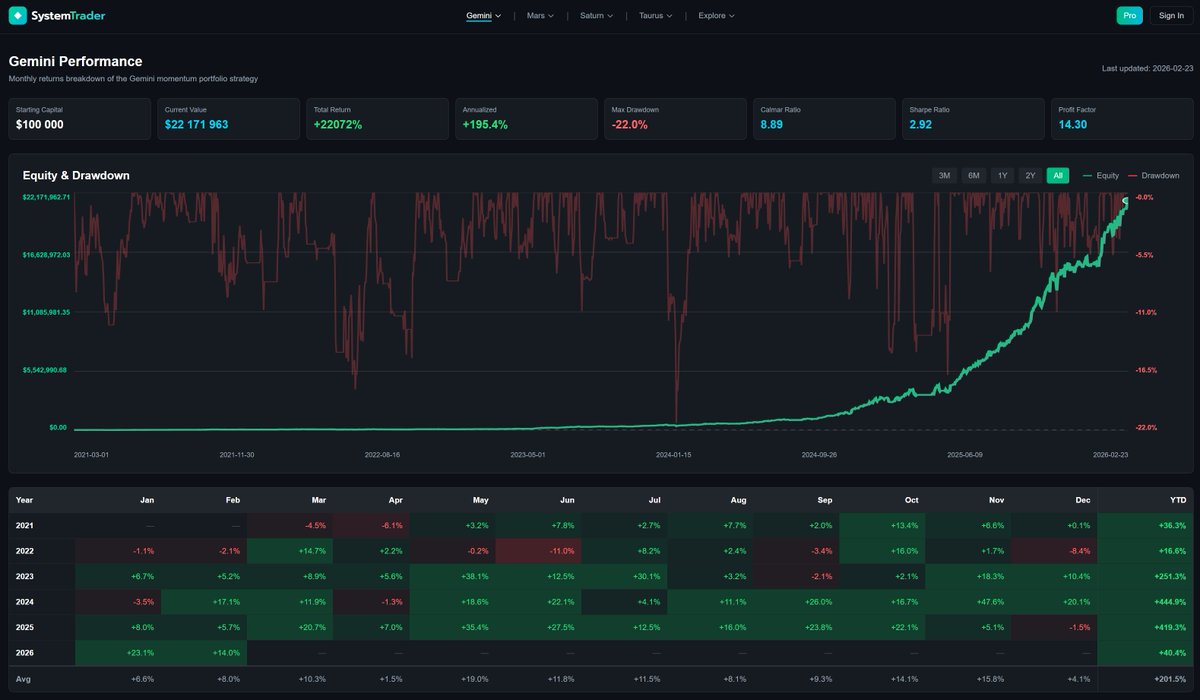
Seeing a US stock rotational strategy claim +195% annualized with Sharpe 2.92 made me stop and double-check what I was looking at. Published methodology sounds totally “normal”: - composite momentum / multi-factor score - QQQ trend filter - buy top-ranked stocks - rebalance daily So if the edge isn’t exotic… how can the results be this good? First thing I suspect: survivorship bias. Survivorship bias (plain English): - Backtest using today’s universe (current constituents/symbols). - That’s like backtesting 2015 while “knowing” which AI-related stocks would end up being the big winners. - But historically, that universe was messy: losers got delisted, acquired, or went bankrupt - and often vanish from common datasets. - Result: you’re effectively testing only the survivors, and performance can look unreal. Of course it could also be other errors: lookahead / non-point-in-time factor data etc. I just don’t believe performance like this is real without a catch. What’s your base-rate expectation for a clean US momentum rotation like this? Would you trust numbers this high? Stats: systemtrader.co/gemini/perform…
Peter - Cracking Markets tweet media
English
6
2
55
7.2K
Trading Bear
Trading Bear@TradeWithABear·
I did some backtests on Crypto and from my experience with them the CME futures make trading them easier (at least for my backtests). My explanation is that the 24/7 market creates a lot of time where there is just „noice“ so signals vanish and edge erases. What is your thought on this?
English
0
0
0
96
Trading Bear
Trading Bear@TradeWithABear·
@Valckrie I use Codex via CLI and on a VPS via Openclaw every day. Mainly for researching/backtesting systematic strategies. And it improved my productivity/speed a lot
English
0
0
1
90
Valckrie
Valckrie@Valckrie·
Interested in people's experiences with agentic coding tools - have you tried vibe coding and how regular do you use those tools? (Claude/Codex/Cursor)
English
5
0
12
2.7K
Trading Bear
Trading Bear@TradeWithABear·
@TraderOrion Thank you for your feedback. Yes - I'm still looking for ways to improve the profitablity of the strategy. A good way should be not to trade when the environment is not there. But did not find meaningful filters, that are no overfit, so far.
English
0
0
0
12
Trader Orion
Trader Orion@TraderOrion·
Good work sir. Sharpe is solid. Drawdown is excellent. Anything under 20% allows for leverage. Pf is right on the edge. Any kind of slippage or funding fees when your stuck in a trade could degrade that to 1.0 quickly. I think you would feel better if you could get that to 1.6+. The strategy actually did well in 2023. That year was kind of a reversal low volatility year which is interesting. Positive every year is solid. A monte Carlo simulation would prob turn these results negative. So keep working to give yourself more margin for error/deviation from the avg.
English
1
0
1
21
Trading Bear
Trading Bear@TradeWithABear·
I finetuned the strategy. Due to the fact that gross results are positive, there seems to be at least some raw edge. I sliced the data to US trading hours only. (Including weekend) And using a rolling t-1 filter (range of the t-1 day based) I could improve results. However I am not very happy with the robustness. Can some systematic traders here help me with ideas for (ex-ante) volatility expectation filters that could improve results? For further research pruposes to look into 🙂
Trading Bear tweet media
Trading Bear@TradeWithABear

Spent today stress-testing an ATR volatility breakout model (inspried by @SystematicPeter ) on BTCUSDT (5m, 2024–2025) with strict ex-ante logic only (no lookahead). I run it using 100% equity sizing (fixed_fraction=1.0), while also testing 1% risk-to-SL/no-cap variant Cost assumptions: 5bps fees + 2bps slippage What was tested: • ATR7 baseline with EMA10 trailing • ATR7 baseline without EMA trailing • Inside-day filter only • Inside-day + rising-volume + US session window • Separate reference: inside 09–22 with risk-per-trade 1% to SL (no practical leverage cap) Key results (NET / GROSS): • Baseline ATR7 + EMA10 (ff100): -42.08% / +25.30% • Baseline ATR7 no EMA trail (ff100): -0.54% / +115.10% • Inside Day only (ff100): -13.02% / -0.07% • Inside+Vol US hours (ff100): +4.17% / +5.49% • Inside 09–22 risk1% nocap (reference): -6.36% / +2.90% Main takeaways: • Gross edge can exist, but cost drag still dominates many variants. • Removing EMA trailing improved the ATR7 baseline materially in this sample. • Ex-ante filters help select better days, but too much filtering crushes sample size. • US-hour filtered setup remains one of the cleaner net performers here. Bottom line: ATR breakout can work in specific contexts, but it’s highly cost-sensitive and regime-dependent. Robust trade selection + realistic execution assumptions matter more than cosmetic optimization Baseline gross looks promising but cost implications are too high. Mining for additional filters also seems like not worth it / edge then comes from the market context filter and not the ATR breakout? Would really appreciate some insights and tips what to look for etc. It's my first "deeper" run on a strategy.

English
1
0
4
188
Trading Bear
Trading Bear@TradeWithABear·
@TraderOrion Do you run this live? And did you test it on other assets?
English
1
0
1
10
Trading Bear
Trading Bear@TradeWithABear·
@m218714 Did you consider survivorship? Also did you check difference to monthly rebalance? How did you construct the universe?
English
0
0
1
101
m218714
m218714@m218714·
Been researching systematic weekly (rebalancing) strategies on European single stocks for a while Turns out a simple approach works well: vol-adjusted 12-month cross-sectional momentum on a restricted universe, with trend filter to step aside in drawdowns A good "diversifier"
m218714 tweet media
English
10
3
171
14.6K
Peter - Cracking Markets
Peter - Cracking Markets@SystematicPeter·
What a great environment for short-term long mean reversion lately. Green line = export of my real long MR trades from IBKR (since I modified my portfolio). Gray = SPY buy-and-hold benchmark. Result so far: clear outperformance with Sharpe 3.9. But the part I care about even more - capital efficiency: - average capital used: 16% - max used: 62% This is the underrated edge of systematic MR: you’re not forced to be 100% invested to compound. You deploy when the signal is there, and keep capital for other edges (or just lower overall risk). Too bad these regimes don’t last forever 🙂
Peter - Cracking Markets tweet media
English
1
1
29
2.8K