
Trisha L. Roy MD PhD FACS
2.7K posts

@trisharoymd
🇨🇦 Engineer, Vasc Surgeon-Imaging Scientist I Katz Investigator, Associate Professor @debakeyCVedu |Periph Vasc MRI + Device Design|@UofTVascular Alum


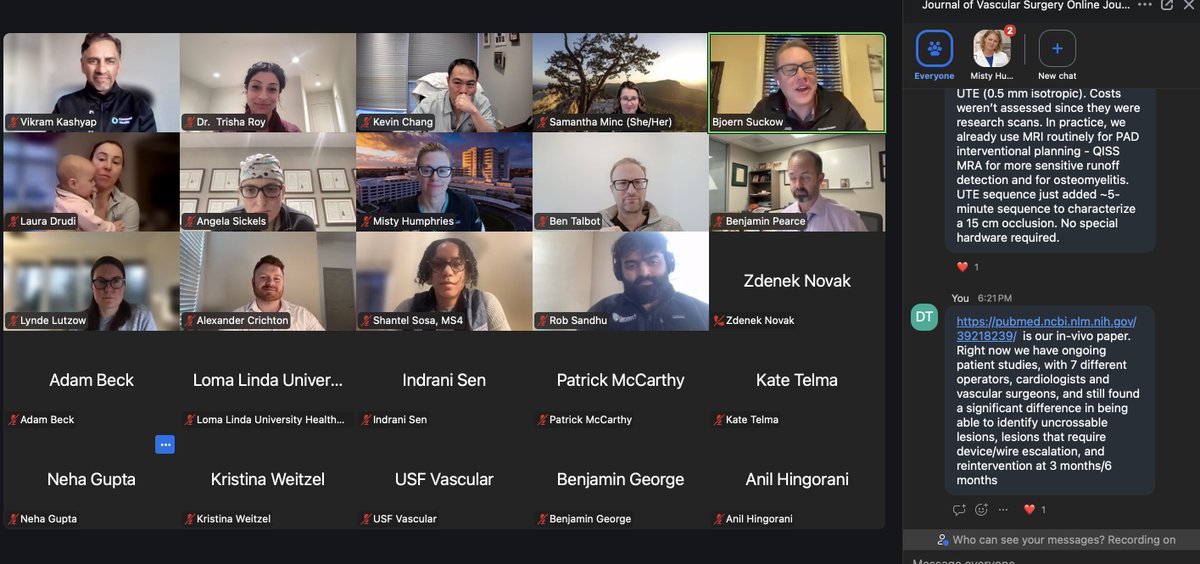
Thank you @JVascSurg for highlighting our paper this evening for the JVS journal club! Great discussion and looking forward to more collaborations in the future! @mhumphriesmd @VikKashyapMD @AeroMD @VascularABC @AlanLumsdenMD @DeBakeyCVedu


🌟 AUTHOR SPOTLIGHT: Dr. Trisha Roy 🌟 Visualizing the invisible: How drugs interact with complex plaque. In a recent #EJVESForum study, @TrishaRoyMD and her team at Houston Methodist and Weill Cornell Medical College developed a groundbreaking Scanning Electron Microscopy (SEM) approach to evaluate how paclitaxel is deposited from Drug-Coated Balloons (DCBs). 🔍 MEET THE AUTHOR: Affiliations: Houston Methodist Hospital & Weill Cornell Medical College, Houston, TX, USA 🇺🇸. Expertise: A pioneer in using advanced imaging and human cadaveric models to study peripheral artery disease (PAD) and endovascular outcomes. The Vision: Moving beyond animal models to understand how vessel preparation—like cutting balloons—changes drug transfer in real human calcified lesions. 💡 WHY THIS RESEARCH MATTERS: Current DCB data often comes from healthy animal vessels, which don't mimic the "rock-hard" calcium surgeons face daily. Dr. Roy’s work uses a human cadaveric PAD model to show that vessel preparation significantly impacts how much drug actually stays on the vessel wall. 🚀 THE CLINICAL IMPACT: By using SEM to map drug distribution at a microscopic level, we can finally see why some lesions respond to DCBs while others don't. It’s about optimizing every millimeter of the artery for the best long-term patency. Read the full study and join the discussion 👇 ejvesvascularforum.com/article/S2666-… #EJVESforum #VascTwitter #VascularSurgery #PAD #DCB #ScanningElectronMicroscopy #MedEd #ESVScommunity #VasculaRes #SurgicalInnovation #MeetTheAuthor @vascularis @bazinger_z @FLareyre @MariaKatsarou14 @NicLeoneMD @ESVSmembership @EVST_ESVS @WeillCornell @HMethodistCV @HMethodistMD @MethodistHosp


How we evaluate the final angiogram may be the missing link in PAD outcomes. Live on Dr Tummala’s Vascular Channel, @trisharoymd presents: “Beyond the Angiogram: Making Better Decisions in Complex PAD” ▶️ Watch here: youtu.be/KcaFCHo577M @Vascular_India @SIRspecialists @SIR_ECS @SIRRFS @CAIRweb @ACCinTouch @hmpVDM @ISETNews @NCVHonline @TraineesBSIR @VIVAPhysicians @BSIR_News @TraineesBSIR

When using DCBs, how much drug actually gets to the vessel wall? Plaque morphology matters and SEM can show us. Time to personalize our treatment strategies to the patients lesions and not rely on “one size fits all” for PAD! @AlanLumsdenMD @DeBakeyCVedu

🌟 AUTHOR SPOTLIGHT: Dr. Trisha Roy 🌟 Visualizing the invisible: How drugs interact with complex plaque. In a recent #EJVESForum study, @TrishaRoyMD and her team at Houston Methodist and Weill Cornell Medical College developed a groundbreaking Scanning Electron Microscopy (SEM) approach to evaluate how paclitaxel is deposited from Drug-Coated Balloons (DCBs). 🔍 MEET THE AUTHOR: Affiliations: Houston Methodist Hospital & Weill Cornell Medical College, Houston, TX, USA 🇺🇸. Expertise: A pioneer in using advanced imaging and human cadaveric models to study peripheral artery disease (PAD) and endovascular outcomes. The Vision: Moving beyond animal models to understand how vessel preparation—like cutting balloons—changes drug transfer in real human calcified lesions. 💡 WHY THIS RESEARCH MATTERS: Current DCB data often comes from healthy animal vessels, which don't mimic the "rock-hard" calcium surgeons face daily. Dr. Roy’s work uses a human cadaveric PAD model to show that vessel preparation significantly impacts how much drug actually stays on the vessel wall. 🚀 THE CLINICAL IMPACT: By using SEM to map drug distribution at a microscopic level, we can finally see why some lesions respond to DCBs while others don't. It’s about optimizing every millimeter of the artery for the best long-term patency. Read the full study and join the discussion 👇 ejvesvascularforum.com/article/S2666-… #EJVESforum #VascTwitter #VascularSurgery #PAD #DCB #ScanningElectronMicroscopy #MedEd #ESVScommunity #VasculaRes #SurgicalInnovation #MeetTheAuthor @vascularis @bazinger_z @FLareyre @MariaKatsarou14 @NicLeoneMD @ESVSmembership @EVST_ESVS @WeillCornell @HMethodistCV @HMethodistMD @MethodistHosp

🌟 AUTHOR SPOTLIGHT: Dr. Trisha Roy 🌟 Visualizing the invisible: How drugs interact with complex plaque. In a recent #EJVESForum study, @TrishaRoyMD and her team at Houston Methodist and Weill Cornell Medical College developed a groundbreaking Scanning Electron Microscopy (SEM) approach to evaluate how paclitaxel is deposited from Drug-Coated Balloons (DCBs). 🔍 MEET THE AUTHOR: Affiliations: Houston Methodist Hospital & Weill Cornell Medical College, Houston, TX, USA 🇺🇸. Expertise: A pioneer in using advanced imaging and human cadaveric models to study peripheral artery disease (PAD) and endovascular outcomes. The Vision: Moving beyond animal models to understand how vessel preparation—like cutting balloons—changes drug transfer in real human calcified lesions. 💡 WHY THIS RESEARCH MATTERS: Current DCB data often comes from healthy animal vessels, which don't mimic the "rock-hard" calcium surgeons face daily. Dr. Roy’s work uses a human cadaveric PAD model to show that vessel preparation significantly impacts how much drug actually stays on the vessel wall. 🚀 THE CLINICAL IMPACT: By using SEM to map drug distribution at a microscopic level, we can finally see why some lesions respond to DCBs while others don't. It’s about optimizing every millimeter of the artery for the best long-term patency. Read the full study and join the discussion 👇 ejvesvascularforum.com/article/S2666-… #EJVESforum #VascTwitter #VascularSurgery #PAD #DCB #ScanningElectronMicroscopy #MedEd #ESVScommunity #VasculaRes #SurgicalInnovation #MeetTheAuthor @vascularis @bazinger_z @FLareyre @MariaKatsarou14 @NicLeoneMD @ESVSmembership @EVST_ESVS @WeillCornell @HMethodistCV @HMethodistMD @MethodistHosp