TrustLogic

285 posts

TrustLogic banner
TrustLogic

TrustLogic

@TrustLogicRWA

IP attorney | applying trust law to digital assets TrustLogic - enabling smart contracts to function as enforceable contracts https://t.co/O01oidz5Q8


Chicago, IL Katılım Aralık 2025
478 Takip Edilen83 Takipçiler
Sabitlenmiş Tweet
TrustLogic
TrustLogic@TrustLogicRWA·
A single token can represent ownership. TrustLogic separates ownership from control. That separation unlocks everything below. 👇
English
1
0
12
332
TrustLogic
TrustLogic@TrustLogicRWA·
The new category isn’t another product. It’s enforcement. Crypto can verify and transfer anything - but rules disappear after transfer. That’s why RWAs, payments, licensing all break. Assets that enforce their own rules is the next wave (what we’re building at trustlogic.global)
English
0
0
0
265
Richard Chen
Richard Chen@richardchen39·
Hot take: There isn’t lack of VC money in crypto. In fact I’d argue there’s still oversupply of capital. What’s lacking is courage. Courage to build something that defines a new unproven category. Right now I’m mostly seeing copycats chasing what’s already working. But no one cares about the 69th prediction market, 69th yield vault, 69th stablecoin neobank, etc. Polymarket, Morpho, Redotpay, etc. won because they were early to new categories before they became obvious.
English
126
28
474
70.8K
TrustLogic
TrustLogic@TrustLogicRWA·
Crypto didn’t run out of ideas. It just never solved enforcement. We can verify and transfer anything. But the rules disappear after transfer. That’s why RWAs, payments, licensing, AI data all break. This problem is obvious if you’ve worked in IP/contracts. The next wave is assets that enforce their own rules.
English
0
0
2
16
fiskantes ⭐️🩸
fiskantes ⭐️🩸@Fiskantes·
Somoene asked me a million dollar qusestion: "What products should be built in crypto?" Imo the easy low hanging fruit is no longer available. What could be built within crypto was largely already done Would say its definitely not another perp dex, prediction market, generic money market or L1 I imagine the next big crypto business will be built by a founder with non crypto domain expertise (e-commerce, energy, farming - whatever) using crypto to solve some of the real problems their niche is facing e.g. I don't think the next big win comes from a crypto native founder who only knows crypto, trenches, DeFi etc...but from someone who comes from the outside
fiskantes ⭐️🩸@Fiskantes

Next wave of crypto founders will build meaningful products that leverage crypto as a base technology for businesses with lasting value Gone are the days of catering to the same 10k CT degens, bribing them with cheap incentives to generate non-organic activity to boost fake KPIs Reach out if you and your project vibe with this take

English
14
2
49
5.6K
TrustLogic
TrustLogic@TrustLogicRWA·
Well in that case… We’re building infrastructure for assets that enforce their own rules after transfer (patent pending). Not another L1 - a missing primitive for RWAs, payments, and agentic capital. If you’re investing in onchain finance, this unlocks things current systems can’t do. DMs open.
English
0
0
1
6
Ali
Ali@analyticalali·
Tom Dunleavy@dunleavy89

The shift in the crypto fundraising landscape the past 6 months has been insane. Crypto VCs used to have to constantly be networking/writing/podcasting/going on spaces/promoting your thesis/getting on 10 deal flow calls a week, to get into good deals...now it's literally enough to just have capital to write checks. Deals are being pushed rather than dug out. Inbound if people know you have money is at an all-time high. Most firms are either 1) Out of money 2) Moved to Series A and beyond or 3) Fundraising (with no success). Deals that used to close in 2-3 weeks now close in 2-3 months. Firms with questionable business models or copy pasta of the latest trend are getting zero primary or follow-on funding (Good news!). There are now realistically <20 firms writing checks in pre-seed/seed. VCs basically have the pick of any deal they want, with more time to do DD. IMHO 25/26 are going to be historic vintages for those who stick around.

English
43
21
326
51.6K
TrustLogic
TrustLogic@TrustLogicRWA·
@AlexLWitt @VerdaVentures Agentic payments without constraints is just giving AI a blank check. We’re building assets that enforce their own rules after transfer - so capital can only be used as intended. Missing layer in stablecoin infra.
English
0
0
1
48
TrustLogic
TrustLogic@TrustLogicRWA·
I’ve generated ~$100M in value over 5 years (5.5x–30x MOIC). One thing I didn’t expect: early-stage investing isn’t primarily idea-driven. It’s pattern-matched — prior exits, elite schools, network proximity. Which means a lot of important things get built outside that filter. The next generation of crypto won’t be single tokens. It will be systems where assets enforce their own rules — before, during, and after transfer. That’s what I’m building at trustlogic.global.
English
0
0
2
134
Tom Dunleavy
Tom Dunleavy@dunleavy89·
The shift in the crypto fundraising landscape the past 6 months has been insane. Crypto VCs used to have to constantly be networking/writing/podcasting/going on spaces/promoting your thesis/getting on 10 deal flow calls a week, to get into good deals...now it's literally enough to just have capital to write checks. Deals are being pushed rather than dug out. Inbound if people know you have money is at an all-time high. Most firms are either 1) Out of money 2) Moved to Series A and beyond or 3) Fundraising (with no success). Deals that used to close in 2-3 weeks now close in 2-3 months. Firms with questionable business models or copy pasta of the latest trend are getting zero primary or follow-on funding (Good news!). There are now realistically <20 firms writing checks in pre-seed/seed. VCs basically have the pick of any deal they want, with more time to do DD. IMHO 25/26 are going to be historic vintages for those who stick around.

English
140
33
789
924.2K
TrustLogic
TrustLogic@TrustLogicRWA·
@cmdlabs_ATX @jbrukh @coinfund That makes sense - you’re anchoring value externally. I’m focused on a different constraint: ensuring assets (not just money) can only be used within their intended rules.
English
1
0
1
19
cmdlabs
cmdlabs@cmdlabs_ATX·
Fair point — separation of concerns is a solid pattern. But CMD’s exogeneity isn’t really a token design choice. The Comcart lives completely outside the protocol. Nothing inside the system can touch it. The separation is already there, just at a different layer than most dual-token designs
English
1
0
0
13
TrustLogic
TrustLogic@TrustLogicRWA·
@cmdlabs_ATX @jbrukh @coinfund Not saying CMDV isn’t exogenous. Just pointing at the pattern - separating concerns unlocks capabilities single-token designs can’t.
English
1
0
1
16
TrustLogic
TrustLogic@TrustLogicRWA·
@etherfi_VC @ether_fi The next generation of crypto won’t be single tokens. It will be systems of tokens - each responsible for one thing, and impossible to break together. TrustLogic is the enforcement layer.
English
0
0
1
30
TrustLogic
TrustLogic@TrustLogicRWA·
@UnboundScience @dunleavy89 Justice on-chain shouldn’t start after something goes wrong. It should be built into the asset itself - before, during, and after every transfer. Many use cases emerge when you separate control from value. See whitepaper @ trustlogic.global
English
0
0
1
10
Unbound Science
Unbound Science@UnboundScience·
@dunleavy89 We're still waiting for narratives to mature in VC-land. Decentralized Science, History, and even Justice are coming on-chain. Who will put their money where their mouth is and truly back some crazy founders with massively disruptive ideas?
English
1
0
1
463
TrustLogic
TrustLogic@TrustLogicRWA·
A new design pattern is emerging in crypto: split the asset. Most tokens try to do everything at once: value, control, liquidity, behavior. That’s the problem. We’re starting to see systems break assets into layers: • CMDV separates reference value from market liquidity • TrustLogic separates control from economic rights Different use cases — same shift. Unbundle the asset. Constrain each layer. Why this matters: Monolithic tokens fail under stress: • price = truth → instability • ownership = control → rules break • liquidity = entitlement → misuse Layered tokens fix this by design: • value can be stable even if markets move • control can persist even if ownership changes • behavior can be enforced, not assumed This is how you get: • capital that doesn’t collapse • assets that don’t break their rules • systems that don’t rely on trust at the edges It’s not a new token standard. It’s a new way to design financial systems.
English
1
0
3
53
TrustLogic
TrustLogic@TrustLogicRWA·
@cmdlabs_ATX @jbrukh @coinfund The next generation of crypto won’t be single tokens. It will be systems of tokens - each responsible for one thing, and impossible to break together.
English
0
0
1
20
TrustLogic
TrustLogic@TrustLogicRWA·
@cmdlabs_ATX @jbrukh @coinfund Dual tokens are the real unlock. FTX showed what happens when value, control, and liquidity are mixed. CMDV splits value from liquidity. TrustLogic splits control from usage. Unbundle the asset. Constrain the system.
English
2
0
0
30
TrustLogic
TrustLogic@TrustLogicRWA·
Rules that don’t travel with the asset aren’t really rules. That’s where most systems break.
English
0
0
1
23
TrustLogic
TrustLogic@TrustLogicRWA·
Where do you see the biggest opportunity for assets that enforce their own rules?
English
1
0
3
40
TrustLogic
TrustLogic@TrustLogicRWA·
OpenSea vs Blur showed something simple: royalties weren’t real — just platform policy if rules don’t travel with the asset they aren’t really rules we built a way for them to smart assets → asset trusts • capital can’t be misused • assets enforce their own terms • compliance persists across platforms @garrytan @nikitabier @Jason @rleshner
English
1
0
2
30
TrustLogic
TrustLogic@TrustLogicRWA·
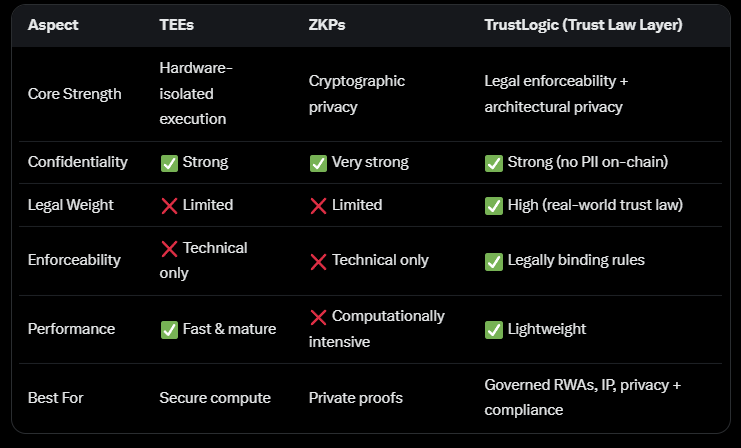
Great article on why blockchains need confidential compute for real adoption beyond speculation! Here's a practical proposal: While TEEs and ZKPs deliver strong technical privacy, TrustLogic adds the missing legal enforceability layer using trust law. It provides confidentiality by design — no PII on-chain, off-chain verification only — making it ideal for finance, RWAs, and enterprise use cases. Quick comparison:
English
2
0
0
26
CoinMarketCap
CoinMarketCap@CoinMarketCap·
OPINION: 🗣️ Blockchains must incorporate confidentiality if they are to move beyond speculative markets into core financial, enterprise, and AI systems, argues Horizen Labs CEO Rob Viglione. coinmarketcap.com/academy/articl…
English
32
30
113
19.6K
TrustLogic
TrustLogic@TrustLogicRWA·
Totally fair take - we can't fix a blockchain's base-layer reliability or outage history. That's on the L1 teams. But we can solve a massive pain point in crypto lending markets that institutions keep hitting: smart contracts execute, but they don't enforce. Defaults, compliance, rehypothecation, and remedies still rely on off-chain legal cleanup or hope. TrustLogic adds an enforceable trust-law layer (trustee authority token + revocable beneficiary rights) so rules and remedies travel with the asset. In lending, collateral automatically transfers on default with no court order needed. Stablecoins can be purpose-bound and compliant by design. Whitepaper here: trustlogic.global/whitepaper/Tru… Do you think this kind of innovation (enforceable on-chain obligations) could help override chain tribalism for stablecoin capital looking for decent yields on Solana - or is base-layer battle-testing still the unbreakable gatekeeper? Curious on your take. @andyyy
English
0
0
0
51
Andy
Andy@andyyy·
I question this take (and welcome criticism from the Solana crowd here), here's why: If I'm a stablecoin holder onchain what I want to have access to is a very safe, secure, resilient onchain ledger that is extremely battle tested in terms of DeFi protocols. In this regard, for me at least, it's Aave > Solana lending markets. That's a very basic, and perhaps reductionary take, but as a stablecoin holder onchain I want to be in the safest spot with decent yields. No chance of Thanksgiving Day turkey chart, essentially. Now... That isn't the thinking behind the *entirety* of stablecoin holders onchain. If the yields are just damn better onchain somewhere else, they may end up going over there regardless of where they sit on the chain tribalism spectrum. Seraphim is working on some very interesting custodial BTC lending products that may unlock another wave of new demand for borrowing onchain (and get the flywheel spinning), so maybe this is where Solana starts to pick up the pace on the stablecoin side of things. To be determined....
Seraphim@MacroMate8

why would stablecoin holders on ethereum move to solana? imo it’s upcoming borrowing demand from BTC sitting in custodians lending protocols like kamino and juplend will allow USD lenders to earn high scaleable yield collateralised by BTC in tier 1 custodians billions

English
8
1
36
10.9K
TrustLogic
TrustLogic@TrustLogicRWA·
@a16zcrypto @PaulFrambot @Morpho Everyone says banks don’t trust each other. That’s not the real problem. The real problem is the asset itself can’t be trusted. Fix that — and you don’t need to trust anyone.
English
0
0
1
28
a16z crypto
a16z crypto@a16zcrypto·
Open markets can make finance more transparent, competitive, and efficient. @PaulFrambot, cofounder and CEO of @Morpho, on what it means to build lending and borrowing onchain. 0:00 Intro 0:36 What Morpho actually does 5:26 Why Wall Street is paying attention now 6:46 Who’s adopting onchain finance first: Banks or asset managers? 9:57 The race for a Euro stablecoin 10:49 The future of finance, 5–10 years out 11:16 Why finance is still broken 13:30 What open mortgage and credit markets could become on open blockchains 15:14 The worst advice Paul's received as a founder 17:17 What's wrong with an $8 croissant
English
6
5
73
12K
TrustLogic
TrustLogic@TrustLogicRWA·
@ZeusRWA You’re thinking about it the right way. But tokenization doesn’t really change anything unless the rules travel with the asset. That’s where it actually becomes powerful.
English
0
0
0
33
Zeus 🇬🇧
Zeus 🇬🇧@ZeusRWA·
I think my interest in Tokenization is different to most. People in this space jump from trend to trend, whatever’s hot at the time. You see it happen fin now and with any other hot topic. But tokenization doesn’t feel like that to me. It feels a whole lot bigger. It’s not just another narrative, it’s a shift in how things actually work. Ownership, access, how money moves - all of it changes. That’s why I pay attention to it. I want to be part of the first few who saw the potential for this to be revolutionary.
English
23
1
113
2.7K