
Max Shaw
910 posts

Max Shaw
@_maxdshaw
Building @trywindmill. Built @GifJifApp. Formerly Product @Yext,
New York, NY Katılım Şubat 2010
818 Takip Edilen477 Takipçiler


it only took a year or so but it's finally here
cloudflare.com/drop
brandon@burcs
i dream of a simpler web...
English

THE PRODUCT SPEC: THE NEW UNIT OF PRODUCT WORK
Last week, I wrote that the classic PRD needs to be retired (link in comments).
The natural follow-up: what replaces it?
My answer (and I believe the right answer): the Product Spec.
A Product Spec performs two jobs: on one hand, make the product legible to humans, and on the other, make it executable by AI agents.
Humans need judgment: why this matters, who it is for, what trade-offs are being made. AI agents need precision: what to build, what to skip, what behavior must pass inspection, and what quality bar must be met before the work is done.
The classic PRD was written for alignment meetings. The Product Spec is written for a world where the next reader might be a designer, an engineer, a founder, or an agent running in a goal loop.
The default Product Spec has 6 sections: (a link to a sample Product Spec is in the comments)
1. PROBLEM
Who has the pain, and what is the pain? A good problem statement names a user group and a real struggle.
2. HYPOTHESIS
The causal bet. If we ship X for Y, user behavior will change because Z. Keep the numbers out of the hypothesis. The hypothesis explains the mechanism. The metrics section carries the numbers.
3. SCOPE
The launch boundary. What is IN, what is OUT, and what was deliberately CUT? This is where the team refuses tempting work and records judgment.
4. USER EXPERIENCE
A URL to the working prototype, mockup, or design. Show the thing. A human should be able to click it and understand what the user will experience.
5. ACCEPTANCE CRITERIA
The build contract. These are pass/fail checks before launch. They tell the agent and the team what must work.
For AI products, this is also where Evals belong. Evals answer: is the AI (model) judgment good enough to ship? A good Eval contains:
• Behavior contract
• Golden set
• Rubric
• Ship threshold
• Failure handling
Acceptance Criteria and Evals are both pre-launch gates. They tell the team whether the product is ready to ship.
6. SUCCESS METRICS
The market contract. These are measured after launch. They tell the team whether the product worked in the world.
It's important to understand the difference between Acceptance Criteria, Evals and Success Metrics.
-- Acceptance Criteria answer: did we build this product correctly? These are mostly deterministic (outside of AI Evals). A QA person or agent can inspect them before launch.
-- Evals answer: is the AI behavior good enough to trust? They are a subset of Acceptance Criteria, valid for AI products and applied specifically to model behavior. They are NOT deterministic, but are behavioral tests for judgment, not just software functionality.
-- Success Metrics answer: do users care enough for this to matter?
Founders: if your product doc cannot be reviewed by a strong PM and executed by an AI agent, it is under-specified.
The Product Spec is the new unit of product work. It crisply encodes the PMs' taste and judgment, and is interpretable both by humans and AI.
Coach's mission is to ensure every builder in the world writes excellent Product Specs (and stops writing traditional PRDs :)).
English
@wadefoster @zapier What about private channels. How are those factored in.
English

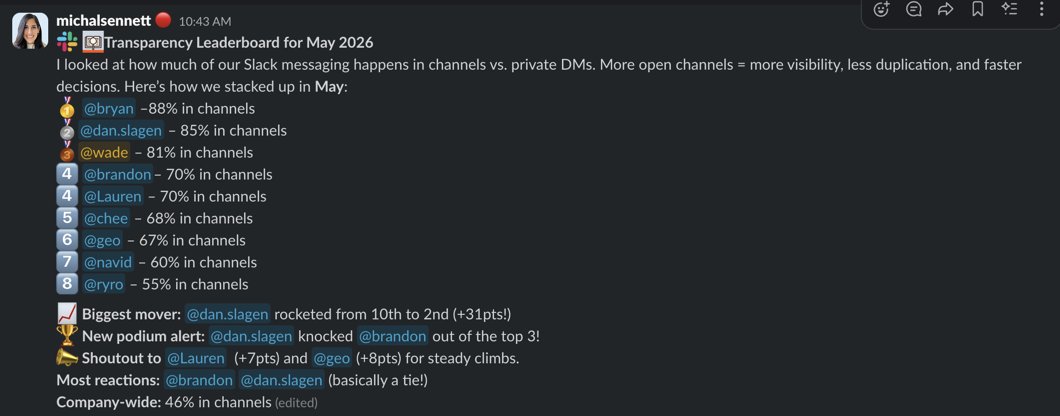
We're killing the DM at @Zapier. Starting with the executive team.
We've long held Default to Transparency as a value. That value has largely encouraged communication in public channels. But as the company grew, DMs are a hard habit to resist and break.
But every DM is a gap in our Shared Brain. It's context that is lost for humans and AIs. As a result the cost of DMs keeps going up.
So earlier this year I posted about our exec transparency leaderboard. The leaderboard has become quite the competition internally…
I'm 3rd today. My co-founder @BryanHelmig has held the top spot as long as I can remember…
It sets a standard for the rest of the company. In fact, since last year we’ve seen the % of Slack messages in public channels go from 33% to 46%.
What the leaderboard measures
Transparency is a team sport, and a disinfectant. Every month we track what percentage of our execs' Slack messages happen in public channels versus private DMs.
When your CEO debates strategy in a DM, that decision is invisible to every agent and every team that needs to know what was decided and why. The decision happens but the reasoning vanishes.
When that conversation happens in a channel, it stays. New hires can search it, agents can read and verify it, etc. Your Shared Brain knows what's true now: ask it a question and the answer reflects the latest reality.
Taking It to the Next Level
Reducing DMs are one way to increase transparency and open up context for humans and AI, but there are other mechanisms that help too. Three things beyond the leaderboard:
1. Meetings get recorded, transcribed, and become queryable
2. We run a shared skills library. Anyone on the team can encode a workflow they've figured out into a skill and share with the team
3. And we keep score. It's a silly scoreboard, but it subtly drives positive behaviors
Raising Your Ambition
In order to get the most of AI in your company, the AIs need context. So making your context queryable is one of the most practical moves you can make to improve the effectiveness of your AI agents.
P.S. I’m coming for #1, Bryan...
English
@matt_slotnick Claude in every channel has different permissions. You set it up on the backend. Super confusing.
Here is my pitch to slack to fix it app.notion.com/p/gowindmill/S…
English

claude tag access model is confusing... you auth claude once to your systems via global api key, and then any person can tag claude, which now has global system access with no permission or scope enforcement? and i don't see any placeholder for that to exist. what am i missing?
English
@NWischoff Parkish in Brooklyn is what you are looking for parkish.nyc
English

Personally interested in a fun play space for little kids that has a co-working space to drop in for an hour or two while the kids are being looked after to work. I believe this exists but would love to know of locations/brands that people really enjoy that think have a great offering (and ideally a cafe).
English

So @Adobe Marketo:
- Down for 1.5 days
- Deprecating API functionality (so AI Agent won't work)
- Didn't send newsletter to 450k+ yesterday because down
- Couldn't fix broken unsubscribe link
AND
- Want to raise prices +20% next year
This is why pre-AI SaaS is dying
English

Why don’t all hotels just use keypads instead of keycards?
Day of check in I got a text message telling me to verify ID and then they gave me the room number and code directly. Such a better experience than waiting in line to check in.

English

This is a Friday night where the Hanover Park team stays for pizza and demos.
No slides. No status updates. You built something, you stand up and show it live in front of everyone.
Here's why it matters more than it looks:
When you know you're demoing Friday, you build differently. You cut the thing that doesn't work. You finish the thing that does. And you get fast at explaining why it matters, not just what it does.
It's the best forcing function we've found for velocity.
Pizza, demos, the whole team in one room focused on delivering magic for our customers.

English

I’m seeing interesting fights between product owners and UX.
Product owners are vibe coding high quality mockups.
UX doesn’t like this - they want to go first, not merely chime in on existing vibe coded mockups.
Others seeing this? How are you handling?
English
WHITEBOARD INTERVIEWS ARE BACK
In the ancient era of the late nineties / early aughts, Eng interviews were all conducted in person f2f with an interviewer in a room. The interviewer asked you a question, you thought about it, and you sketched out the answer (the algorithm or pseudo code, most likely) on a whiteboard. It wasn’t perfect due to the setting and time constraint being unrealistic but it worked reasonably well.
In the 2010s, the technical interview changed to actually writing working code in person on a computer, typically supplied by the company. Companies set up banks of computers in their office, just for interview candidates to write code on.
COVID changed all this. Candidates started doing coding interviews remotely on their own computers.
AI is now bringing things full circle to where they were 25 years ago. More and more companies are instituting in person interviews, where the candidate has to sketch out the algorithm on a whiteboard. This is the only way to see if the candidate understands the core principles of computer science, vs using AI to quickly solve the problem.
English
@staysaasy No one should be spending a lot of time waiting self reviews. Focus on doing good work and the system should have it written for you
English

@fredsoda @staysaasy Or just let windy automatically capture these for you
English

the interesting thought experiment for Claude Tag-like UX: when your agents in slack are doing significantly more proactive and autonomous work than your people are, will inviting agents to your people-centric spaces make sense, or should people join agent-centric spaces?
English

@_maxdshaw @karpathy Slack is pretty limiting in what you can do. One lil hack we did is create empty slack user groups which allows you to “tag” different agents, which is a lot easier to wrap your head around
English

This is a new paradigm for interacting with Claude that is significantly more "inline" with all the other human activity org-wide. Once you do all of the under the hood engineering work to make this "just work" (e.g. across tools, integrations, compute environments, memory, security, etc.), Claude basically joins the team in a seamless way - you can talk to it as you would talk to a person and it can help with a very large variety of workloads.
Imo this is the 3rd major redesign of LLM UIUX. The first paradigm was that the LLM is a website you go to, the second was that it is an app you download to your computer. This third one is that it is a self-contained, persistent, asynchronous entity with org-wide tools and context, working alongside teams of humans. It really takes a while to wrap your head around it, but it works and it is awesome.
Claude@claudeai
Introducing Claude Tag, a new way for teams to work with Claude. In Slack, Claude joins as a team member with access to the channels and tools you choose. Tag Claude in and delegate tasks to it while you focus on other work.
English
Slack really needs a new primitive for agents. @claudeai tag really highlights this. The permissioning model is extremely confusing and every channel having a different version of Claude will cause mass confusion.
I wrote the product spec to solve this so hopefully they can have their agents fix this.

English

@fletchrichman @karpathy Yeah I saw openai do the same thing. A decent hack but still a mess. Man Slack needs some new primitives for agents.
English
@daniel_mac8 @trq212 Imagine telling someone 5 years ago this is the future of user interfaces
English

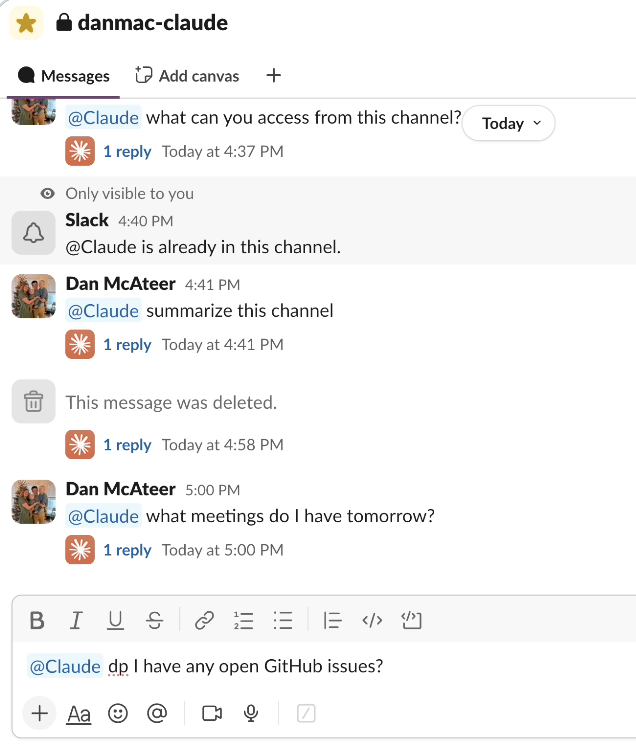
Claude tag is live in our company Slack. It's fantastic.
It does feel like a new paradigm. I've heard Anthropic employees say that you should treat Claude like a coworker.
Claude Tag makes that easy.
Pro tip from @trq212: create a personal private channel for Claude Tag.
Claude@claudeai
Introducing Claude Tag, a new way for teams to work with Claude. In Slack, Claude joins as a team member with access to the channels and tools you choose. Tag Claude in and delegate tasks to it while you focus on other work.
English