

ARU

657 posts

ARU

ARU

@a_romanu

account inactive

Cambridge, UK Katılım Şubat 2020
483 Takip Edilen202 Takipçiler
ARU
ARU@a_romanu·
@s8mb Nothing more shitty than an opinion about other people’s house designs. It’s like talking about people’s need for orthondontics. Awful really.
English
0
0
0
208
Sam Bowman
Sam Bowman@s8mb·
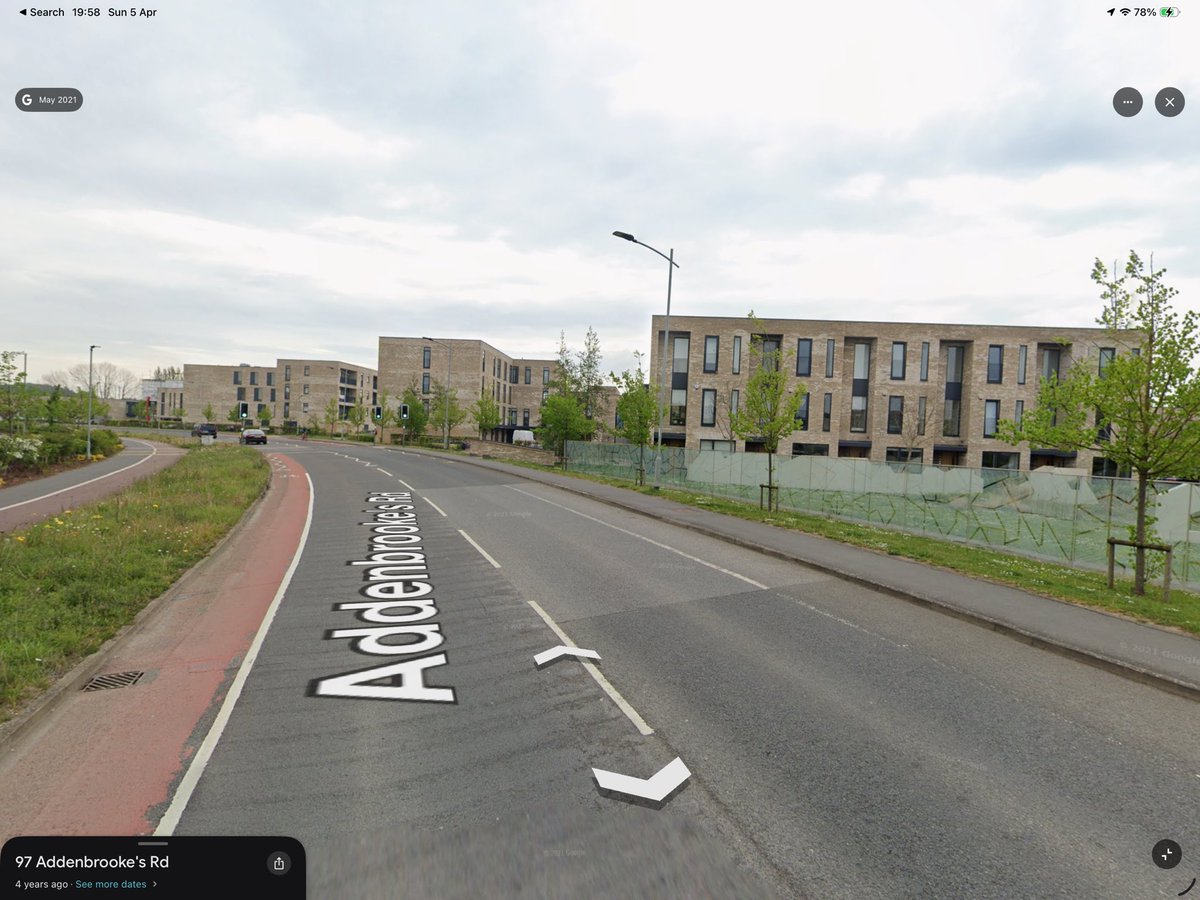
The new build estates on the outskirts of Cambridge are truly shocking. Is it any wonder that people there hate the thought of expanding the city when this is what they can expect will be built?

Sam Bowman tweet mediaSam Bowman tweet mediaSam Bowman tweet mediaSam Bowman tweet media
English
414
237
2.9K
892.1K
ARU
ARU@a_romanu·
@markrwilliamson I’m a doctor and live there. Quite like it. If you want people like me moving to Cambs maybe consider that you are asking the wrong people their opinion. Have also at least 3-4 colleagues (nurses, OT etc) who live there. Quite enjoy it.
English
0
0
0
24
Mark Williamson
Mark Williamson@markrwilliamson·
Eg: 150k new homes planned in and around Cambridge Local population up 18% in past decade (6% national average). A new hospital doubling the number of beds at Addenbooke’s to 2,000 said to b ‘unaffordable’ A&E built for 35k visits pa - now getting above 135k. 2
Mark Williamson@markrwilliamson

Cambridge University Hospitals Trust, which runs Addenbrooke’s Hospital says a new care model is needed due to “accelerated population growth” in order to meet the Government’s economic ambitions. open.substack.com/pub/mwilliamso…

English
4
16
30
2.4K
Mark Williamson
Mark Williamson@markrwilliamson·
Local people saying basically this have been dismissed as NIMBYS - not to mention the water issues, unsustainable hospital services, at capacity sewage system and a crumbling road network - people don’t see public benefits from the growth.
Sam Bowman@s8mb

The new build estates on the outskirts of Cambridge are truly shocking. Is it any wonder that people there hate the thought of expanding the city when this is what they can expect will be built?

English
21
21
75
7K
ARU
ARU@a_romanu·
@nntaleb Mozarab uses it earlier too "Padre nuestro que yes in el chiel, santificat siad lo teu nuemne. Venya a nos el teu regno, fayadse al tua voluntate in la terra, como in el chiel. Danos oy nuestro pan de cada dia. Perdona nuestros pecados, como nos perdonamos a los que nos ofenden.
Español
0
0
0
43
Nassim Nicholas Taleb
Nassim Nicholas Taleb@nntaleb·
Spanish and French translations came after that by the Church of England. They use "offense" not "debt". Another reason to ONLY read in the text.
Nassim Nicholas Taleb tweet media
English
22
7
92
28.7K
Keith Humphreys
Keith Humphreys@KeithNHumphreys·
If you work hard and play by the rules, you should get ahead in life. This was a bizarre idea in 17th century Europe except among the Dutch, and the Dutch exported it to what became the United States.
Keith Humphreys tweet media
English
3
3
16
1.2K
Pablo Eguiguren Reyes 🇨🇱
Pablo Eguiguren Reyes 🇨🇱@paeguiguren·
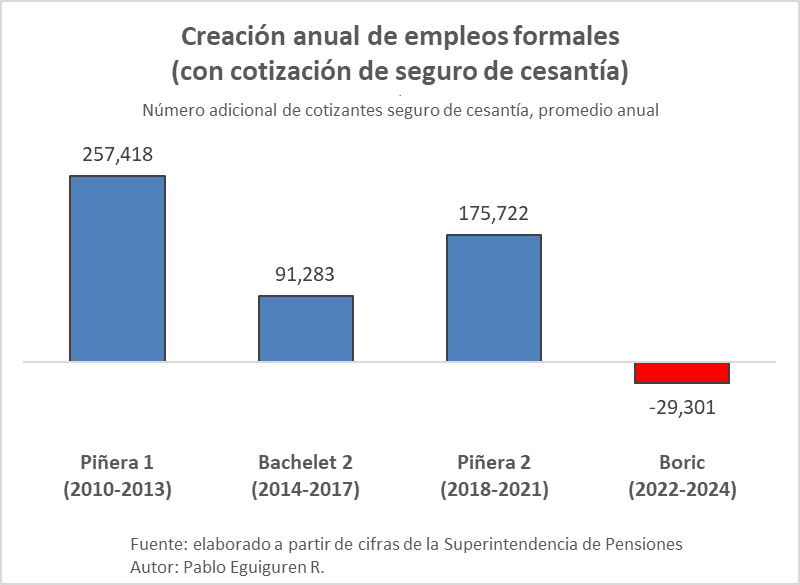
El Ministro @nico_grau señaló que se han creado 600 mil empleos durante el gobierno de Boric. Cuando vemos empleos que cotizan seguro de cesantía (lo cual excluye a trabajadores informales y a casi todos los funcionarios públicos), vemos que se han destruido 29 mil por año.
Pablo Eguiguren Reyes 🇨🇱 tweet media
Español
52
819
1.3K
41.7K
Keith Humphreys
Keith Humphreys@KeithNHumphreys·
Served loyally and without complaint for 58 years, then thrown unceremoniously into the trash after a single mishap. Please join me in a moment of silence for my gallbladder.
Keith Humphreys tweet media
English
41
4
229
6.6K
Paz Zárate
Paz Zárate@Paz_ZarateB·
💛Hace 9 años, mi amigo #GiulioRegeni, doctorando en economía de la U. de Cambridge que hacía trabajo de campo en Egipto, fue secuestrado, brutalmente torturado y asesinado por agentes de la policía secreta de la dictadura de ese país. El crimen permanece impune. #VeritáPerGiulio
Girton College, Cambridge University@GirtonCollege

🕯️ Today, we remember our former student Giulio Regeni (1988-2016). girton.cam.ac.uk/news/girton-co…

Español
3
10
28
2.6K
ARU retweetledi
Congreso Futuro
Congreso Futuro@congresofuturo·
“La falta de responsabilidad que la tecnología ha negociado para sí misma en nuestra sociedad, ahora se impone en los entornos educativos”. La Baronesa Beeban Kidron, reflexionó en su charla sobre la integración de la tecnología en la educación formal. 📲congresofuturo.cl
Español
0
1
4
313
ARU retweetledi
Thomas Bourgeron
Thomas Bourgeron@ThomasBourgeron·
Join us at the Institut Pasteur! Experience the magic of the Pasteur Quadrant—where groundbreaking basic research meets real-world applications. Don't miss this opportunity! Check out the call below 👇 research.pasteur.fr/fr/call/call-f…
English
0
5
6
865
ARU retweetledi
CLAS Cambridge
CLAS Cambridge@CLAS_Cam·
📣 Next CLAS OPEN SEMINAR "A Peruvian History of the Old World: José Carlos Mariátegui and Europe" @paulodrinot (University College London) 📆 Monday 11 November | 5:15pm 📍 Room SG1 Ground Floor, Alison Richard Building More info: latin-american.cam.ac.uk/files/further_… Come join us! 🤩
CLAS Cambridge tweet media
English
0
3
15
1.6K
ARU retweetledi
Michael Ostacher, MD, MPH
Michael Ostacher, MD, MPH@RecoveryDoctor·
We did a small open-label pilot trial of single-dose psilocybin for U.S. military Veterans with severe treatment-resistant depression. I do think our presentation of the data is quite reasonable. Hard to manage expectancy, but we did not find miracles. sciencedirect.com/science/articl…
English
11
11
48
5.8K
ARU retweetledi
César A. Hidalgo
César A. Hidalgo@cesifoti·
Eleven years ago, I quit an abusive academic relationship with my former co-author Ricardo Hausmann, presently a Professor of Practice at the Harvard Kennedy School. This abuse has now returned in a new act of plagiarism. Today, I am pushing back. A few months ago, I learned about two new working papers that Hausmann and his team posted at the World Intellectual Property Organization (WIPO) [1,2]. The first one claims to introduce a “multidimensional approach” to economic complexity by combining data on trade, patents, and publications, and concludes that these metrics are complementary when explaining economic growth. Yet, this is exactly what my co-authors and I did in a 2023 peer-reviewed journal paper [3] that Hausmann and his co-authors were perfectly aware of (as I document below). Instead of giving proper acknowledgement to our work, however, Hausmann and his team hide it in a footnote on page 18 clouded in a factually incorrect statement. The footnote says that “other studies have developed similar complexity metrics under different names.” That is not true. Our 2023 paper uses the same name as Hausmann et al.’s 2024 “new” working paper, namely, the “Economic Complexity Index (ECI).” Now, it is reasonable to wonder if this is a misunderstanding or oversight. People sometimes forget to cite others for innocent reasons. But there is clear evidence to the contrary in two other working papers published almost simultaneously with the first one. One of them, is another WIPO working paper by his coauthors but without Hausmann [4]. This paper does properly acknowledge the existence of our work in multidimensional economic complexity in the main text: “Following […] Stojkoski et al. (2023).” So, the team clearly knew about the work. The third working paper [2], also at WIPO, includes Hausmann as a first author making a call for the use of multidimensional economic complexity methods in innovation policy. Here, the only example of multidimensional work cited by Hausmann et al. is his own 2024 working paper [1], this time completely ignoring the 2023 peer-reviewed paper he knew about (“In Hausmann et al. (2024), we measure this for each country in different dimensions (e.g., trade and patents).”). Unsurprisingly, I had made a similar call for multidimensional expansion of the field in a paper that was also published after peer-review in 2023 (Hidalgo CA, Research Policy, 2023 [5]) and that had been available as a pre-print for two years. In that paper, I cite our original multidimensional economic complexity contribution and also two other papers that had introduced multidimensional approaches to relatedness, another key concept in the field, which Hausmann does not cite either. In my view, these three documents provide clear evidence of an attempt by Hausmann to misappropriate an idea published by a former co-author while knowing of that work. This, violates Harvard’s honor code [6] which requires the “accurate attribution of sources” and considers “plagiarizing or misrepresenting the ideas or language of someone else as one’s own” as a violation of its community standards. In the first working paper [1], he copies the idea while hiding the attribution in a factually incorrect footnote. Simultaneously, he releases a second working paper citing this unpublished work as the only example of prior art [2]. The third paper [4], the one by his co-authors but not him, shows that the team knows about the work and behaves differently when the senior member of the team (Hausmann) is not an author. My co-authors and I were dismayed by Hausmann’s attempt to misappropriate our ideas. Why bother doing original work and getting it past peer-review (which for both of our papers was a lengthy process), if authors with a platform such as Harvard University take your ideas and pass them as their own? But this is not the first time. In 2019, Hausmann and his team announced a “first-of-its-kind” and “unique” feature in their trade data visualization website (“Atlas Online”): the “country profiles.” Yet, my group had supported country profiles in the Observatory of Economic Complexity (OEC) since 2012, several months before Hausmann and I parted ways in 2013 (see full story document for details [7]). The reason that the profiles disappeared in Hausmann’s copy of the Observatory in 2013 was that they were deleted by his team, probably because they did not understand that we had conceived these pages for search engine optimization. In short, the original OEC that I designed with my group and placed in the public domain had country profiles in 2012 and was redesigned in 2015 to make the country and product profiles the main part of the site. Today, OEC.world [8] serves over 100,000 profiles, a design concept we use prominently when constructing other data distribution platforms (e.g. Data USA, Data Mexico, etc). In fact, in 2016 I published a “how to” guide in Scientific American for this kind of work in 2016 [9]. But when Hausmann and his team at Harvard finally built country profiles in 2019, seven years after we did, they claimed a “revolutionary first-of-its-kind” and “unique” feature, in their lab’s own website [10] and in the Harvard Gazette [11] So why share this now? I have three reasons. First, I broke off my relationship with Hausmann in 2013 after several unpleasant experiences, which included having to fight for the authorship rights of junior authors (which Hausmann wanted to exclude from our joint book: The Atlas of Economic Complexity) and being exploited when we were equal partners in a company that I had registered for us to do joint consulting work (see full story document [7]). From there on, I just wanted to forget about him. The tacit deal was that, if he stopped the abuse, I could put this in the past. But Hausmann has repeatedly broken this tacit deal. His 2024 working paper research agenda seems to involve putting forward, without proper acknowledgement, ideas my team and I published after peer-review in 2023 and made available online in 2022. It has been more than a decade. This has to stop. The second reason is that because Hausmann has done this before, I am concerned that if I don’t push back, he will do it again. Right now, my research group and I have a great thing going on. Should we worry that in 2026 Hausmann will try to pass off our 2024 and 2025 papers as his own? The third reason is that this egregious behavior is supported by a power asymmetry that is highly profitable for Hausmann thanks to the Harvard platform. Soon after we split ways in 2013, Hausmann sold this [12] embarrassingly bad economic data visualization website to the Mexican Government as part of a project rumored to be about USD 5,000,000 (paid using an undisclosed and untraceable escrow account (“fideicomiso”)). The online platform was so sloppy that some government officials started to call it “El Mamarracho” (a derogatory term in Spanish for extremely shoddy work). I learned about this in 2019, after a new team entered Mexico’s economic ministry and invited us to build Data Mexico [13], a properly built open data portal integrating dozens of datasets in thousands of profiles for a fraction of the cost of the “Mamarracho.” Hausmann has engaged in commercial endeavors with many governments (e.g. Albania, Azerbaijan, Colombia, Mexico, etc.). So, in my opinion, the target audience for these misappropriated working papers are not other scholars, but the officials who purchase economic development contracts from him and take the word of the Harvard Professor of Practice at face value. This is what makes misappropriating the multidimensional economic complexity idea important. A strong motivation for any consulting work in this space is the fact that trade-based measures of economic complexity explain future economic growth. This was established in a paper Hausmann and I published together in 2009 [14], based on work we did together while I was a PhD student at the University of Notre Dame. But the 2023 multidimensional economic complexity paper made that idea obsolete. On the one hand, it simultaneously considers multiple expressions of complexity (trade, patents, and research), and on the other hand, it looks at multiple outcomes (growth, inequality, and emissions). Giving advice based on the latest developments in the field requires using a multidimensional framework. Finally, I want to say that I have nothing against Hausmann’s co-authors, some of whom I know personally and some of whom I don’t. I understand that they are in a situation in which they may depend financially and professionally on Hausmann. His first attempt to spin my publicizing these facts may be to argue that someone of his caliber does not have the time to look at petty things like footnotes and references (pinning the responsibility on them). I don’t think that’s fair. I also want to say that I do not consider Ricardo’s behavior necessarily representative of Harvard University or of the World Intellectual Property Organization. I have met many people at those organizations and continue to collaborate with some of them. They are outstanding scholars I have decided to go public with this statement after consulting with several senior colleagues and lawyers specialized in disputes in higher education. I am absolutely distraught by having to deal with this situation eleven-years after I quit that abusive relationship. But he needs to cut it out.
English
51
370
2K
442.7K
ARU retweetledi
Nuffield Trust
Nuffield Trust@NuffieldTrust·
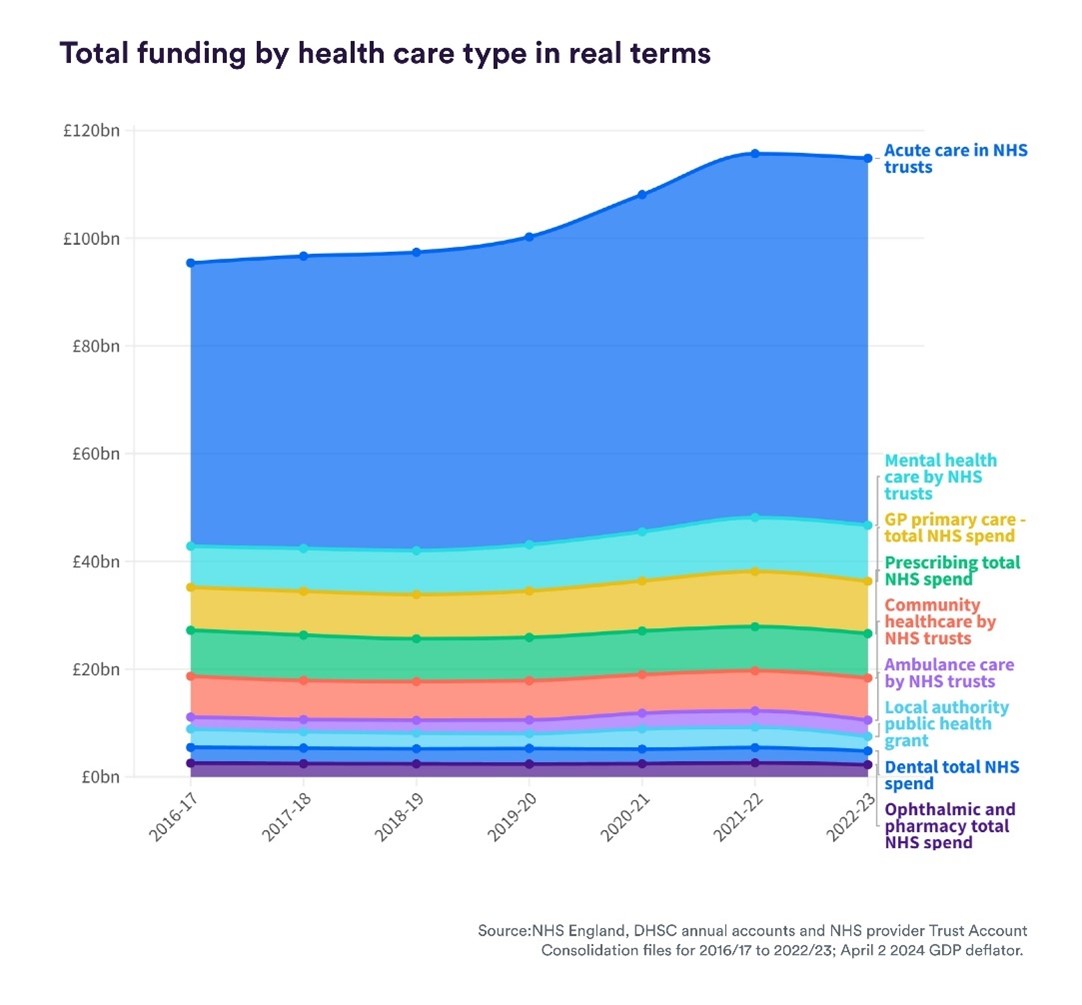
Where does the #NHS money go? We looked at how funding has been shared across different NHS services since 2016. 🏥 Community care funding has grown much more slowly than for acute care. 📉 Dentistry/ public health/ prescribing have seen real-terms cuts. nuffieldtrust.org.uk/resource/where…
Nuffield Trust tweet media
English
2
45
51
20.4K
ARU retweetledi
JAMA Surgery
JAMA Surgery@JAMASurgery·
Among US surgical residents, pregnancy/parenthood-based mistreatment, obstetric complications, and postpartum depression were associated with female gender, likely driving gendered attrition. ja.ma/3zM9iKG
JAMA Surgery tweet media
English
0
49
95
27.5K