Abhinav Pathak

1.4K posts

Abhinav Pathak

Abhinav Pathak

@abhinavpathak27

Building Escape Plan | Forbes 30 under 30 India & Asia | Ex-Founder & CEO, Perpule (Acquired by Amazon!)

Bengaluru, India Katılım Haziran 2013
946 Takip Edilen696 Takipçiler
Abhinav Pathak retweetledi

Gajender Yadav
Gajender Yadav@imYadav31·
Wife tried sliding the RARE trolley once and said, “kya makhan chalti hai.” 😂 Now she’s enjoying sliding it at the airport and not even giving it back to me 🤣 That’s the real premium trolley test. Smooth wheels, clean design, 10-year warranty, and made for the modern traveller. Use code GAJENDER for a monster discount

Gajender Yadav tweet mediaGajender Yadav tweet media
Gajender Yadav@imYadav31

One of the most premium trolleys you can buy at this price. Presenting RARE by @my_escplan for the modern traveller. Premium finish, solid build, clean design, and a 10-year warranty that makes it even better. As always your boi gets you monster savings with code GAJENDER. bit.ly/RareRabbitTrol…

English

6
2
95
61.1K
Abhinav Pathak retweetledi
Gajender Yadav
Gajender Yadav@imYadav31·
One of the most premium trolleys you can buy at this price. Presenting RARE by @my_escplan for the modern traveller. Premium finish, solid build, clean design, and a 10-year warranty that makes it even better. As always your boi gets you monster savings with code GAJENDER. bit.ly/RareRabbitTrol…
Gajender Yadav tweet mediaGajender Yadav tweet mediaGajender Yadav tweet mediaGajender Yadav tweet media
English
8
12
106
111.5K
Abhinav Pathak retweetledi
CNBC-TV18
CNBC-TV18@CNBCTV18News·
What happens when venture capitalists swap boardrooms for a cricket pitch? 🏏 At @jungleventures AGM in Mumbai, founders, global investors and VCs came together for an unconventional day—playing cricket, but also rethinking how startups are built. From “test match” patience to the idea of VCs as coaches rather than just cheque-writers, the conversations went far beyond the game. The format may be new, but it raises a bigger question about what venture capital is really becoming. @Aish_19_Anand reports. #VentureCapital #Startups #JungleVentures #IndianStartups #VC #Innovation #Entrepreneurship #StartupEcosystem #BusinessNews #CNBCTV18Digital #NewEconomy #Leadership #Founders #Investing
English
0
5
10
3.1K
Abhinav Pathak retweetledi
Ashish Agrawal
Ashish Agrawal@dvbydt·
Today, India celebrates National Startup Day and 10 yrs of the Startup India initiative with $150B+ of public market cap and $300B+ of private value created by tech startups. The founders and teams are getting more ambitious and skilled. The markets are getting deeper and frictionless. And venture capital is willing to embrace far greater risk. The foundations are set for the startup ecosystem to create an order of magnitude more value in the coming decade. We @peakxvpartners are thrilled to partner with the next generation of ambitious entrepreneurs and help them build legendary companies. @PMOIndia @PiyushGoyal
English
12
7
81
7.8K
Abhinav Pathak retweetledi
Indian Tech & Infra
Indian Tech & Infra@IndianTechGuide·
🚨 Disney has leased 174,000 sq. ft. of office space at the Ecoworld 20 campus on ORR Bellandur, Bengaluru.
Indian Tech & Infra tweet media
English
69
251
4.6K
78.7K
Abhinav Pathak retweetledi
Mahesh.BR
Mahesh.BR@Maheshbr4U·
#Karnataka DCM @DKShivakumar made an imp. announcement of, 5.5 KM Buffer road b/n Koramangala (Ejipura) to Iblur Junction ( Sarjapura main road) , completion by Mar 26 ■Cutsdown dist. by whopping 10 Km ■Made possible with the help of Defence land ■Double Bonanza for this area along with ongoing Ejipura flyover works. ■ Route Map ( marked in pink)👇
Mahesh.BR tweet media
𝑷𝒓𝒊𝒚𝒂𝒏𝒌𝒂 𝑫@priyaJasTweet4u

🚧 #Bengaluru buffer #road push. DCM @DKShivakumar says the 5.5 km Koramangala–Sarjapur buffer road will be ready by March next year, cutting travel by ~10 km. 🔹 300 km of buffer roads identified along rajakaluves (Phase 1) 🔹 Only cars & two-wheelers allowed 📸: @timesofindia

English
26
20
198
43.7K
Abhinav Pathak retweetledi
Jagriti Chandra
Jagriti Chandra@jagritichandra·
IndiGo limping back to normalcy: 🔵1800 flights operated compared to some 700 on Friday and 1650 yesterday . Total flights nearly 2300 🔵90% On time performance, ie flight punctuality 🔵Rs 827 crore released in reimbursements 🔵 Over 4500 bags have been delivered to respective customers, and we are on track to deliver the rest in the next 36 hours
English
30
5
96
11K
Abhinav Pathak retweetledi
Citizen MattersX
Citizen MattersX@CitizenMattersX·
🚨 #BREAKING ORR Upgrade 2026: Tough Quality Controls, Long-Term Maintenance, Global Standards”. Bengaluru’s ORR Set for World-Class Makeover! The Outer Ring Road (Silk Board – K.R. Puram) is set for a major Makeover with tough new quality controls by B-SMILE under the Greater Bengaluru Authority (GBA). Here’s what’s changing: 🔷️10-year maintenance liability: Contractors will now be responsible for developing and maintaining the 17-km stretch for a decade, up from the earlier 2-year Defect Liability Period (DLP). 🔷️Full Depth Reclamation (FDR): Roads will be rebuilt from scratch to avoid excuses of poor sub-base-no more quick patchwork. 🔷️High-quality materials: Mandatory use of Stone Matrix Asphalt (SMA) and VG30 bitumen to ensure durability. 🔷️Traceability: Contractors must provide documents showing the source of asphalt components, preventing use of substandard materials. 🔷️Selective reconstruction: Main carriageway (4 of 10.5 m) to be fully rebuilt, service lanes fully reconstructed, minor patchwork elsewhere. 🔷️Global-standard features: Walkways, cycle lanes, cable ducts, and state-of-the-art bus shelters under direct B-SMILE supervision. 🔷️Estimated cost & timeline: ₹450 crore; work to start Feb 2026, completion expected by end of 2026. This stretch isn’t just any road- it’s a key IT corridor and major arterial route, and with these measures, Bengaluru is aiming for a world-class, durable, and commuter-friendly road experience. If successful, this model could set a new standard for road projects across the city. 🌟 Long-awaited move that promises smoother, safer, and globally benchmarked roads for Bengaluru commuters! #BengaluruRoads #OuterRingRoad #BSMILE #GBA #ORRUpgrade #SmartCity #RoadSafety #Infrastructure #GlobalStandards #NammaBengaluru @DKShivakumar @GBAChiefComm @0RRCA @ChristinMP_ @TVMohandasPai @kiranshaw @bengalurupost1 @namma_BTM @NandanNilekani @PrasadBidapa @ashwinmahesh @BelawadiBlr @BrindaAdige @srikanthn1975 @Infosys_nmurthy @lkatheeq @ELCITA_IN @ELCIA_IN @WFRising @kdevforum @BellandurJothge @Dkhallirising @Carmelaramunite @SaveKadugodi @Dnekundi_rising
Citizen MattersX tweet media
English
41
52
533
46K
Abhinav Pathak retweetledi
Bangalore real estate
Bangalore real estate@Bangalorereal1·
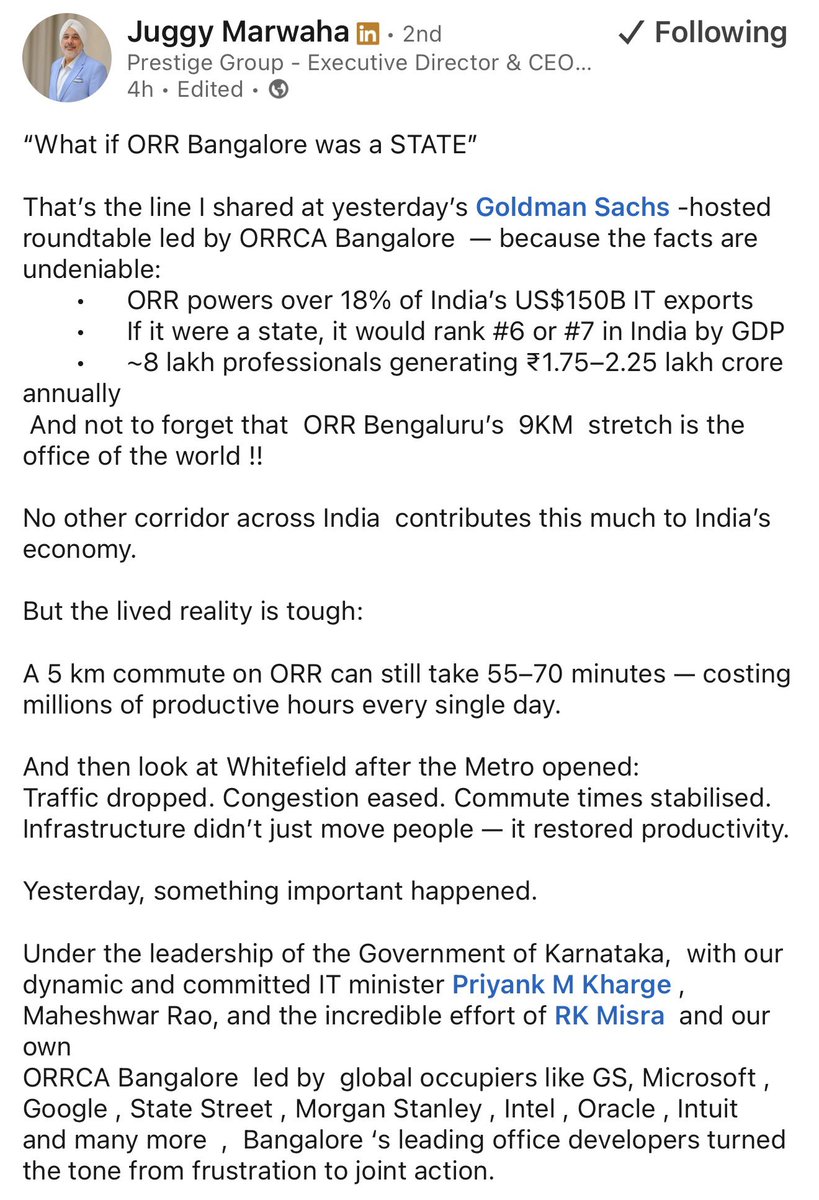
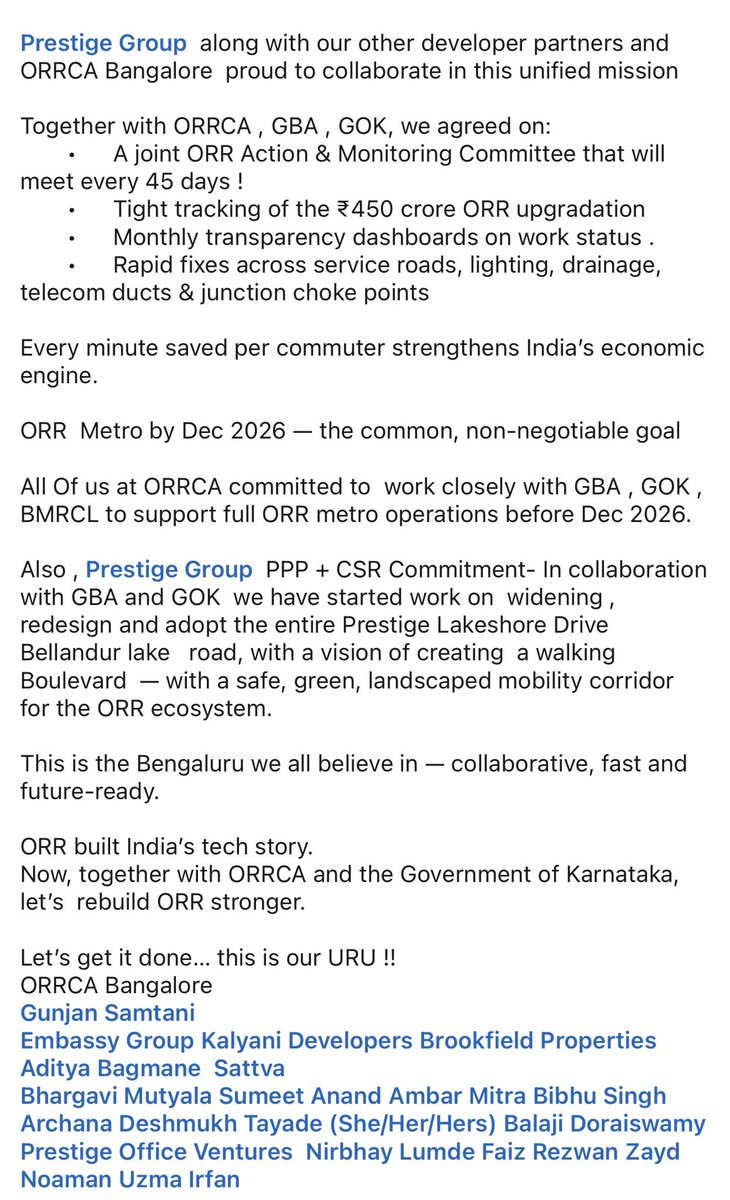
CEO of @prestigegroup Mr.@juggymarwaha’s message after the recent meeting with industry leaders, ORR Companies and GOK. The last line: “ORR built India’s tech story. Now, together with ORRCA and the Government of Karnataka, let’s rebuild ORR stronger. Let’s get it done… this is our URU !!”
Bangalore real estate tweet mediaBangalore real estate tweet media
English
39
64
635
94.1K
Abhinav Pathak retweetledi
Kiran Kumar S
Kiran Kumar S@KiranKS·
In 1995, Bangalore handled around 250 flights per month. Bombay handled over 1100. A huge difference. 4-5 times less than Bombay. In October 2025, Bengaluru handled 20,819 domestic flights. Mumbai handled 20,540 flights. BLR actually overtook India's Financial capital! Wow..
English
73
309
3.5K
127.7K
Abhinav Pathak retweetledi
Ash Arora
Ash Arora@asharoraa·
My intern was born in 2007 I have unread emails older than that
English
1.2K
16.3K
345.2K
12.1M
Abhinav Pathak retweetledi
Arindam Paul
Arindam Paul@arindam___paul·
Friday night, 11.30 PM But its the festive sale weekend and here we are sitting and looking at campaign wise hour wise metrics Grateful to be working on things for last 10 years which feels like play. And you gotta get better at the craft :)
Arindam Paul tweet media
English
5
4
87
7.3K
Abhinav Pathak retweetledi
Arindam Paul
Arindam Paul@arindam___paul·
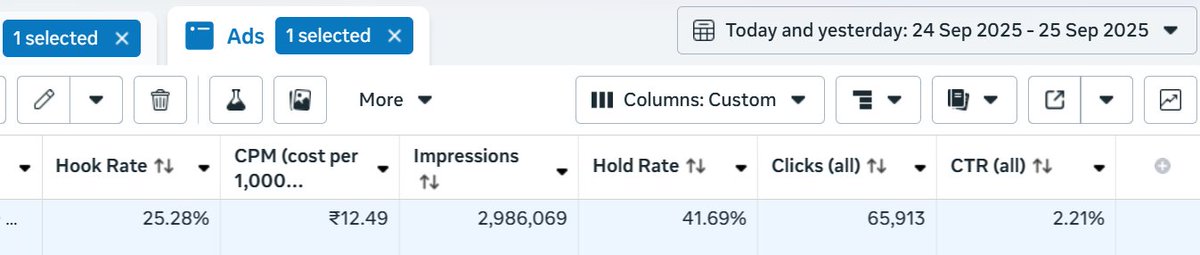
Have told multiple times that CPMs on Meta is an output metric If you have creatives that are native to the platform, relevant for the audience and can hold attention, you can achieve CPMs which are barely believable
Arindam Paul tweet media
English
14
10
184
19.6K
Abhinav Pathak retweetledi
ET Now Swadesh
ET Now Swadesh@ETNowSwadesh·
स्टार्टअप से इकोनॉमी को रफ्तार स्टार्टअप इको सिस्टम 'फुल चार्ज बिजनेस वर्ल्ड में स्टार्टअप की संभावनाएं अपार कॉस्ट हो कम, कैसे बेस्ट बनें हम? स्टार्टअप मंत्र में स्टार्टअप का संसार 'स्टार्टअप मंत्र' में देखिए खास चर्चा आज शाम 7:00 बजे #StartupMantra #Startup @tweet2prashant @NewzzPandey
ET Now Swadesh tweet media
हिन्दी
1
1
3
360
Abhinav Pathak retweetledi
Indian Tech & Infra
Indian Tech & Infra@IndianTechGuide·
🚨 Navi Mumbai is set to host Maharashtra's first Formula night street race this December.
Indian Tech & Infra tweet media
English
127
367
9K
270.8K
Jogy Abraham
Jogy Abraham@jogyabraham·
@abhinavpathak27 @my_escplan Thank you so much, @abhinavpathak27! I reached out to you as a last resort since I couldn't find any other way to get help on the website. I tried all available options, but unfortunately, they didn't yield any response. Looking forward
English
1
0
0
22
Jogy Abraham
Jogy Abraham@jogyabraham·
@abhinavpathak27, need your help! Placed orders #1086 & #1087 on Sept 12, but haven't received any delivery updates. Multiple emails sent with no response. Can you please look into this? It's been 9 days and I'm getting worried!
English
1
0
0
35
Abhinav Pathak retweetledi
Arindam Paul
Arindam Paul@arindam___paul·
Marketing teams are often accused of spending too much and measuring too little by the CEO, CFO, board members, and investors. But the answer isn’t to stop spending. It’s to start measuring the right things. This post is about how to track brand health and evaluate success/failure of brand campaigns in a way that’s meaningful, repeatable, and useful for decision-making, not just to impress the board or justify ATL spends Measuring Success of a Brand Campaign Performance campaigns are easy to measure. You get almost immediate feedback through sales numbers, click-through rates (CTRs), and other conversion metrics at each step of the buying process. Brand campaigns are more complex. While their ultimate goal is to generate sales, they typically don't drive immediate results. This makes measuring their success or failure trickier. So how do you do it? The answer isn't in the "buzz" generated, awards won, or other vanity metrics. The metrics I use to evaluate a brand campaign’s impact fall into two categories: brand metrics and business metrics. Brand metrics aim to measure the awareness of your brand among consumers and understand if they have formed the intended associations with it. Business metrics aim to measure the tangible business impact the campaigns have created. To measure a campaign's impact, you need to commission a brand track—an ongoing measurement of brand building efforts that tracks key metrics like brand awareness and perception Research agencies typically conduct these by interviewing a statistically significant sample of your target group (TG) through face-to-face or online questionnaires. Brand metrics 1. Correct Brand Recall to Reach Ratio Every media plan has a target to achieve certain reach and frequency numbers for their TG. For example, 75% reach at 1+ frequency means 75% of your TG will see the ad at least once. However, seeing an ad, noticing it, and correctly remembering the brand are three distinct things. The campaign must ensure that all three happen, and to check if these are indeed happening, interviews are conducted in the field. Usually, during brand track interviews, the brand name is masked in the ad shown to consumers. They're asked two questions: Do you remember seeing this ad? (indicates Ad Recall) If yes, which brand was advertised? (indicates Brand Recall) Correct Brand Recall = Ad Recall × Brand Recall. If 50% remember seeing your ad, and half of them correctly identify the brand, you have a 25% Correct Brand Recall. With a 75% Reach at 1+ Frequency, your Correct Brand Recall/Reach ratio would then be (25/75) or 0.33. Ideally, Correct Brand Recall should equal Reach. The higher this number, the more successful the campaign. Strong, clutter-breaking campaigns achieve ratios of 0.6-0.8. New brands find it harder to achieve high Correct Brand Recall. Viewers might remember the ad but not the brand name. Since the brand is new, it needs something different and unique to make an impression. This metric tests how well your communication breaks through the noise. Without success here, subsequent metrics become meaningless, and this is also where most campaigns falter. 2. Improvement in Spontaneous Awareness Spontaneous Awareness is also an indicator of how well your brand is known and how it’s faring with respect to the competition in terms of occupying mind share. For example, if you sell fans and ask respondents, "Which fan brands are you aware of?", the percentage who name your brand without any cue or prompt represents your Spontaneous Awareness. This indicates how many people know your brand exists and its purpose. When your campaign effectively links your brand to its category, Spontaneous Awareness should spike. The difference in Spontaneous Awareness levels before and after the campaign measures its success. 3. Improvement in Brand Associations Beyond creating the association with the right category of product, brands aim to build specific associations. These can be tangible, like features (for new brands), or intangible, like emotions (for mature brands). Fogg, for instance, did both successfully at different stages of its journey. “Bina gas wala deo” established that their deodorant didn’t have gas inside. Later, “Fogg chal raha hai” appealed to the senses or emotions of consumers rather than any product features. Each marketing campaign should strengthen these desired associations. The change in associations before and after the campaign indicates its effectiveness. Business metrics 1) Increase in brand searches Across Google, Amazon, Flipkart, and other e-commerce or quick commerce channels, the number of searches for your brand should increase after a brand campaign. Most platforms allow you to measure the number of searches happening. Compare the figures for before and after the brand campaigns were activated. The higher the increase, the better the campaign’s performance. 2) Improvement in performance marketing CTR and conversion rates A successful brand campaign builds awareness and trust, making conversions easier. Tracking them at every step of the performance marketing funnel is straightforward. If conversions have improved and sales have increased, it’s an indication that the brand campaigns are effective. 3) Comparison between geographies where a campaign has run and not run Measuring sales numbers and conversion rates for two different geographies—where you've chosen to run a campaign in one but not in another—will give you a sense of the campaign's effectiveness. For example, if TN and Karnataka showed similar numbers initially, did Karnataka's numbers improve after running an ad there? If not, the ad hasn't been effective. 4) Increase in Rate of Distribution Expansion Effective marketing campaigns create brand pull, encouraging consumers to seek out the brand in stores. This naturally creates a ripple effect and retail stores are more keen to stock your brand. This makes it easier for the sales team to establish new retail locations. The change in distribution expansion rate before and after the campaign measures its impact. While there are other leading indicators (like brand searches, organic visits) and lagging metrics (revenue, reduced dependence on performance marketing), these four metrics best isolate campaign impact and identify areas for improvement. Hopefully, future campaign awards and recognition will be based on these meaningful metrics rather than vanity metrics. Measuring Brand Health and Brand Strength While campaigns happen from time to time, brand building a continuous process. And if the brand keeps getting stronger, invariably the business benefits The strength of a brand can be measured in different ways. A marketing manager would look at it from a more current, operational point of view, whereas a CEO would be more interested in a long-term, strategic view. For newer brands, it’s possible that the CEO doubles up as the CMO or the marketing head, so it’s imperative for them to look at both types of metrics. I have segregated these metrics into Operational Metrics and Strategic Metrics. Operational Metrics help the marketing manager with decision-making in a relatively short-term timeframe. They ensure tactical efficiency and allow for quick course correction if needed. Strategic Metrics help you evaluate the brand from a business perspective, and aid you for the larger, more critical decisions pertaining to the future of the brand Operational Metrics Operational Metrics broadly comprise the following five metrics: Awareness Consideration Trials Preference Performance You’ll notice that they move progressively from understanding how well a brand is known to how much the brand’s products are actually being purchased. Awareness Brand awareness can be evaluated through quantitative surveys. For example, for fans, simply ask consumers, "Which fan brands do you know of?" Their responses reveal how well your target audience recognizes your brand and allow you to further categorize the audience by their awareness levels. When respondents list brands, the first one they mention indicates "Top of Mind Awareness." If we’re doing a survey for Atomberg and 30% of respondents say "Atomberg" first before any other brand, that's 30% Top of Mind Awareness for Atomberg. Naturally, the higher the Top of Mind Awareness, the stronger the awareness. At the second level, brands mentioned without any aid or prompts represent "spontaneous" or "unaided awareness." For instance, if 40 out of 100 people mention Atomberg at any point in their list of brands they’re aware of, that's 40% Spontaneous Awareness. "Aided awareness" is measured by directly asking, "Have you heard of Atomberg?" This is done when Atomberg isn’t listed by the consumer on their own. A positive response here counts toward Aided Awareness. Total Awareness then is the sum of Spontaneous and Aided Awareness. (Note that Top of Mind Awareness is included under Spontaneous Awareness for this calculation.) Companies regularly track this metric through Brand Tracks. Another key awareness indicator comes from search volumes on platforms like Google, Amazon, and other relevant e-commerce sites. Rising search numbers with time indicate growing awareness. You can monitor exact search volumes weekly on most such platforms. Consideration While awareness metrics show how well people recognize your brand, consideration metrics reveal how many would actually consider purchasing it. To measure consideration, we ask potential category buyers: "Which two brands would you consider buying the most?" This question focuses on brands they're already aware of. For instance, if someone knows four brands, we want to know which two they'd seriously consider purchasing. The brands mentioned first and second comprise the "Top 2 Consideration" metric, while the top three mentions make up the "Top 3 Consideration" metric. Strong consideration from your target audience indicates effective brand communication. However, some brands achieve high awareness but struggle with low purchase intent. This disconnect often signals a need to reassess both communication strategy and product offering. While high awareness suggests large scale media investment, low consideration indicates that despite knowing the brand, consumers aren't sufficiently motivated to buy. Trials While consideration metrics are more relevant for high-intent purchase items, like consumer durables, low-intent and low-ticket-size items must be evaluated through Trials. Here, the question for potential buyers in a category is, “Which brands have you tried?” Similar to consideration metrics, if brand awareness is high but not enough people are trying the product, it's a clear indication that the brand communication isn't persuasive enough. Every brand must aim for a high Trial-to-Awareness ratio. For new consumer brands, a low Trail-to-Awareness ratio could also indicate a product problem or a smaller than expected market size for the category. Brand Preference For people who have tried multiple brands, brand preference can be measured by asking which brands they like the most. This metric shows how strong your brand and product are compared to competitors, and indicates what they’re likely to purchase next. Some brands face an interesting challenge: they may have high awareness and trial rates but low preference. Take Pepsodent, for example—it has high awareness and trials, but low preference. This could signal issues with the product itself, brand associations, or persuasion effectiveness. Another strong indicator of brand preference is when consumers search for specific product variants on Google or other platforms—for example, "Cadbury Silk Mousse" rather than just "Cadbury." High search volumes for specific variants indicate that consumers have developed a strong affinity for those particular products, demonstrating both strong consideration and brand preference. Performance Brand strength is reflected in the effectiveness of performance marketing campaigns. A strong brand should see conversion rates significantly higher than the category average at each funnel stage. Moreover, as brand strength grows, spending on performance marketing should gradually decrease. Simply put, brands with high consideration result in high click-through rates (CTRs), and a stronger brand preference results in higher conversion rates. Strategic Metrics When scaling consumer brands, here are 5 key strategic metrics that a CEO must monitor periodically. These metrics indicate brand strength from a long-term business perspective and help guide the brand's future direction. 1. Price Elasticity of Demand This measures how demand changes relative to price changes. Price Elasticity = Percentage Change in Demand/Percentage Change in Price A strong brand typically has lower price elasticity. The ability to increase prices without losing demand to competitors is one of the strongest indicators of brand strength. Ideally, as brand strength grows, price elasticity should continue decreasing. 2. Contribution of Discounted Sales Every brand has a standard market operating price (MOP, which could be MRP in some categories). Brands also generate sales through consumer discounts beyond the MOP. Discounted Sales Contribution = Sales Volume with Discounts/Total Sales Volume A strong brand will have a lower contribution from discounted sales. The ability to maintain sales at the market operating price indicates brand strength. As brand strength grows, the contribution of discounted sales should decrease. 3. Performance Ads Driven Sales Brands generate both organic sales (through brand searches, repeat purchases, marketplace SEO, etc.) and paid sales (through Amazon ads, Google/Meta ads, etc.). Performance Ads Driven Sales Percentage = Sales due to ads/Total Sales A strong brand has a lower contribution from ads-driven sales. Strong brands naturally generate higher repeat purchases, more brand searches, and rank organically at the top for generic marketplace searches. As brand strength grows, the percentage of ads-driven sales should decrease. 4. Performance Ads Driven Visitors Both D2C websites and marketplace listings receive organic visitors (through brand searches and SEO) and paid visitors (through Amazon Ads, Google/Meta ads). While overall ads-driven sales attribution can be complex (as customers may click ads to visit a D2C website but purchase organically from marketplaces), visitor attribution is more straightforward. Percentage of Performance Ads Driven Visitors = (Ads-driven visitors on Marketplaces + Ads-driven visitors on D2C)/(Total Visitors on Marketplaces + Total Visitors on D2C) As brand strength grows, the percentage of ads-driven visitors should decrease. 5. Share of Spends/Market Share Share of Spends (SOS) represents the brand's marketing expenditure as a percentage of total category marketing spend done by all the brands in a year. When a brand's market share exceeds its Share of Spends in the category, it indicates: Higher conversion rates and a more efficient marketing engine High baseline sales New brands typically have a higher share of spends than market share (as baseline is 0). However, this ratio should decrease as brand strength grows. While reaching zero might harm long-term brand health as it indicates no brand investment, strong brands should maintain a ratio between 0.5-1. This means that if they have a market share of 20% in the category, their Share of Spends in the category should be in the 10% to 20% range. 6. Share of Spontaneous Awareness / Market Share: If your share of spontaneous awareness is higher than market share, it means your proposition and conversion levers need to work harder. If it’s the other way around, it indicates there’s plenty of scope for gaining market share by improving spontaneous awareness. 7. Share of Consideration / Market Share: If your share of consideration is higher than market share, it means availability and conversion levers need to work harder. If it’s the other way around, then improving consideration can improve market share, and focus should be to create a stronger proposition to improve consideration. 8. Share of Spontaneous Awareness / Share of Consideration: Very similar to the awareness/consideration ratio, this ratio shows if you have a stronger proposition relative to your competition. A higher share of spontaneous awareness than consideration shows a weaker relative proposition and vice versa. These metrics help isolate where your brand is strong and where it’s leaking. And it highlights issues with proposition, distribution, conversion levers, creatives, etc. Strong brands naturally lead to strong businesses. When done right, brand-building investments always pay off financially. Strong brands rely less on performance marketing and discounts, and can increase prices without losing volume. These metrics presented here will help you gauge your progress in building a strong brand P.S. This post is from one of the chapters of my book Zero to Scale and is fairly representative of the writing in the book- language, depth, style etc. If you like it, there is a good chance you will find value in the other 24 chapters. If not, it saves you the time/effort of going through the book :)
English
11
64
283
39.4K